Wholesale Shorts From Bangladesh: Prices, MOQ and Reliable Suppliers
Compare wholesale shorts from Bangladesh on one specification: price drivers, MOQ per colour and size, supplier signals, and the checks to finish before you confirm an order.
Short answer
To buy wholesale shorts from Bangladesh, fix one specification covering style, fabric, wash, trims, labels and quantities per colour and size, then send it unchanged to every supplier. Compare replies side by side on unit price, inclusions, minimum per colour, sample terms, inspection and delivery term, and confirm the winner in writing. A lower unit price alone means little when its minimum, wash or packing differ from the others.
On this page
Key takeaways
Compare wholesale shorts only on one unchanged specification, because fabric, wash, trims and packing differences make headline prices incomparable.
Test every quotation against your actual split: a programme total can clear every minimum while one colour falls below its per-colour lot.
Score price beside inclusions, minimum per colour, sample terms, inspection and delivery term, never on unit price alone.
Agree fibre labelling, inspection level and AQL values before production, and approve samples in writing in actual fabric, colour, trims and wash finish.
Exportain verification is a document and photo review, not a factory inspection, and a badge is not a guarantee.
A wholesale shorts order is won or lost before the first carton ships, in the way quotations are compared. Send three suppliers the same chino, cargo or denim short and you will receive three prices that look comparable but often are not: one may assume a heavier fabric, another may exclude the wash, and a third may carry a minimum per colour that your order cannot meet. This guide is for buyers in the USA, the UK, the EU and the UAE who buy shorts wholesale from Bangladesh, and it shows how to compare suppliers on one specification.
The method is strict to apply. Fix one specification, send it unchanged to every candidate, ask every candidate for the same reply format, and score the replies side by side on price, minimum per colour and size, inclusions, samples and delivery term. Anything quoted on a different specification or term is a different offer, not a cheaper one.
Why this matters for buyers and sellers
For a wholesale buyer, the unit price is only one part of the margin. The landed result also depends on whether the order size fits each supplier minimum, whether the wash, trims and packing are inside the price, whether samples match the bulk, and whether duty is calculated on the right classification. A short that arrives in the wrong shade, with a waistband that measures short after washing, ties up stock long after the saving on the quotation has disappeared.
For a seller, a wholesale order has to fit line planning. Fabric is bought and dyed in lots, a sewing line is set up per style, and trims are ordered per colour. A supplier therefore prices and sets minimums for your exact split of styles, colours and sizes, not for shorts in general.
Shorts also resist a single blended comparison. A programme may combine a plain twill chino short, a multi-pocket cargo short and a washed denim short, each with its own fabric, construction and minimum. Compare each style separately, even when one supplier quotes for the whole programme.
Step-by-step: how it works
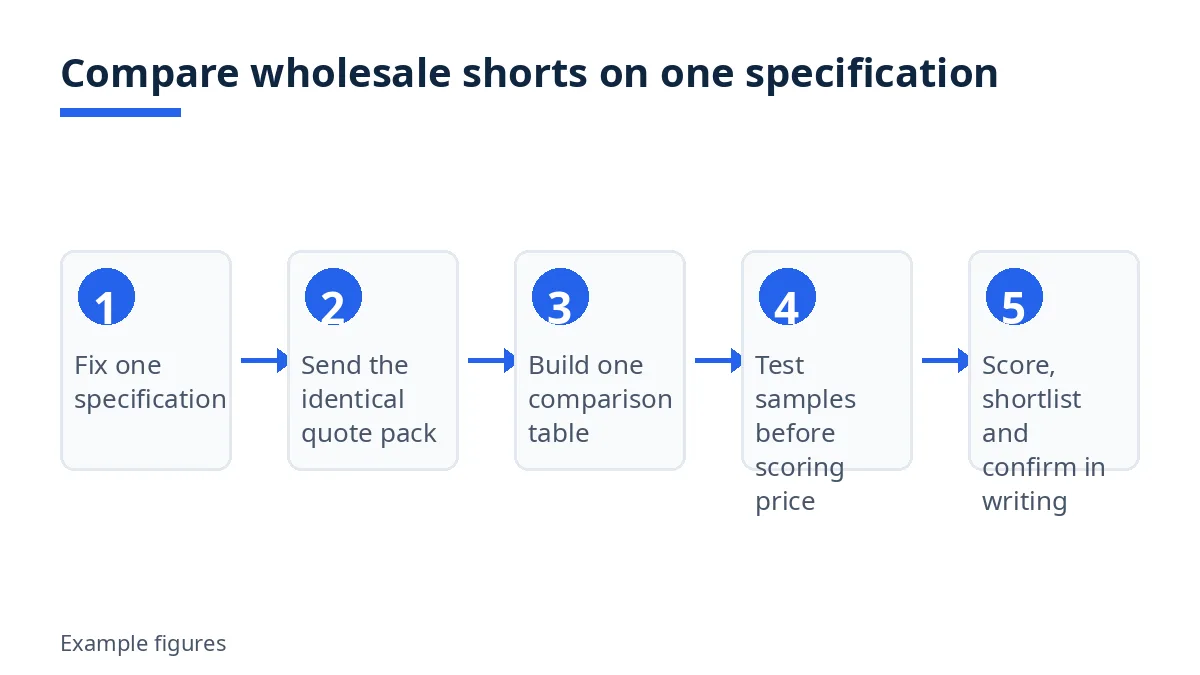
Fix one programme specification. Write down each style, fabric composition and weight, woven or knitted construction, waistband type, pocket count and position, inseam and rise, closures, labels and packing, plus the size range and the quantity per colour and per size. A specification that leaves fabric weight or wash open invites three different prices for three different garments.
Shortlist on shorts-relevant work. Look for suppliers whose current range already includes shorts or matching woven bottoms, where waistband setting, fly construction, pocket bartacking and, for denim, washing are part of everyday work. A catalogue photograph does not show whether those operations run in-house.
Send the identical quote pack to every candidate. Ask for the same reply format from each: unit price with inclusions stated, minimum per style and per colour, size ratio assumed, sample type and cost, inspection arrangement, validity period, and one delivery term with a named place. The Incoterms 2020 rules set out 11 rules with a clear allocation of cost, risk and obligations.1
Build one comparison table. Put every reply into the same columns: style, fabric assumed, unit price, inclusions, minimum per colour, sample terms, inspection, delivery term and validity. Gaps in the table are questions to put back to the supplier, not details to assume in their favour.
Test samples before you score price. Order a development sample to check construction, then a pre-production sample in the actual fabric, colour, trims and wash finish, and measure and wash it against your chart. A supplier whose sample fails on waist or shade should leave the comparison however sharp its price looks.
Score, shortlist and confirm in writing. Rank the surviving replies on the full set of columns, not on unit price alone, then confirm the winner's price, minimum, inclusions, sample approval, inspection plan and delivery term on the purchase order.
Costs, timelines and documents
Price drivers to compare, not a price list
No guide can state a wholesale price for shorts as a fact, because each supplier prices your fabric, construction, wash, trims, labels and order split. What a buyer can compare is which drivers move each quotation, and whether every supplier priced the same ones.
Driver | How it moves a quotation | What to state in the request |
|---|---|---|
Fabric | Composition, weight and whether the colour is stocked or dyed to order | Composition, construction, weight, stocked or dyed to order |
Construction detail | Extra pockets, flaps, bartacks and fly work add operations | Pocket count and position, closure type, bartack points |
Wash or garment dye | A wash finish adds processing and changes measurements | Wash type, or no wash, with measurements after washing |
Trims and labels | Zips, buttons, drawcords, woven labels and cartons run in their own lots | Trim, label, tag and carton specification |
Order split | Small quantities per colour cost more per piece to set up | Quantity per style, per colour and per size |
Delivery term | The term decides which costs sit with seller and which with buyer | One Incoterm and named place for every quotation1 |
Example figures: the table below compares three example replies to the same twill chino short, on the same delivery term, for an order of 2,400 pieces split across three colours at 800 pieces per colour. The figures are illustrative only, not market rates.
Example supplier | Example unit price | Minimum per colour | Wash and packing |
|---|---|---|---|
Supplier A | 4.80 | 500 pieces | Wash included, standard packing |
Supplier B | 4.40 | 1,000 pieces | Wash excluded, standard packing |
Supplier C | 5.10 | 300 pieces | Wash included, retail packing |
Example figures: Supplier B looks cheapest, but its minimum of 1,000 pieces per colour rules out an 800-piece colour run, and its price excludes the wash the other two include. Supplier A and Supplier C both clear the split, so the real choice is between a lower unit price with standard packing and a higher unit price with retail packing. The example shows why a comparison must score the minimum and the inclusions beside the price, never the price alone.
Timelines
Ask for dates as separate lines, not a single delivery week: fabric ready, sample approval, bulk production, inspection, and shipment. Sampling time depends on fabric availability and correction rounds, bulk time on dyeing, washing, trim delivery and line capacity, and shipping time on routing and season.
Documents
The order documents are the specification, the itemized quotation and the purchase order, with the price, minimum, inclusions, inspection plan and delivery term on both. On the export side, goods may not be loaded unless an export declaration, the Bill of Export or Shipping Bill, is submitted to Customs and approved.2 Enclosed documents include the export contract or purchase order where there is no export letter of credit, the commercial invoice, the packing list, the EXP form certified by an authorized dealer, and a certificate of origin issued by the Export Promotion Bureau or a Chamber of Commerce and Industry.2 Confirm the full export set with the supplier and your forwarder before production, not at the port.
Bangladesh-specific rules and tips
Check association claims at the source. The Bangladesh Garment Manufacturers and Exporters Association (BGMEA) is the apex trade body representing the apparel sector.3 If a supplier claims BGMEA membership, confirm it with the association itself. Membership signals participation in the organised apparel sector, not capacity for your style, your wash, or your delivery date, so treat it as a starting check rather than a verdict.
Price the destination duty position separately for each market. For the EU, Bangladesh benefits as a least developed country from the Everything But Arms arrangement, which grants duty-free, quota-free access for all exports except arms and ammunition.4 The same European Commission page notes that 91 percent of Bangladesh exports to the EU enter duty- and quota-free.4 That position still depends on origin rules and on the classification of each style, so confirm the duty position for your exact short with a customs broker before comparing landed costs across markets.
Fix fibre labelling at sampling stage. Under Regulation (EU) No 1007/2011, a textile product shall be labelled or marked with the name and percentage by weight of all constituent fibres in descending order.5 Agree the wording when the sample is approved and check that the percentages match the fabric actually bought. See the HS code for shorts guide for how shorts sit with trousers in classification.
Agree inspection before production, not after it. ISO 2859-1:2026 defines a system of acceptance sampling plans for inspection by attributes, indexed by acceptance quality limit (AQL) for lot-by-lot inspection.6 AQL is the maximum average percentage of defective items considered acceptable during random sampling, and it determines sample sizes and acceptance or rejection thresholds.6 Write the inspection level and AQL values into the purchase order, and draw the sample randomly across sizes, colours and cartons rather than accepting pieces the factory selects. The shorts quality control checklist sets out the waist, pocket and shade checks to pair with that plan.
Keep one legal name across every paper. The export declaration names the exporter and the foreign buyer,2 so the name on the trade licence, quotation, proforma invoice and payment account should match. A mismatch discovered at clearance costs more time than a check made at shortlisting.
Mistakes and red flags
Comparing prices on different specifications. A lower price on a lighter fabric, an unwashed short, stock labels or a different delivery term is a different offer. Compare only replies to the same specification on the same Incoterm.1
Reading the total order instead of the split. A programme total can clear every minimum while one colour falls below its per-colour lot. Ask for the minimum per style and per colour, and test your actual split against it, as the example table above does.
Treating a badge or a profile as a capability check. A profile is a starting point for enquiries. It does not test whether a supplier can make your short, and a badge is not a guarantee of capacity, quality or delivery.
Accepting a short validity or a vague inclusion. A quotation that expires before samples are approved, or that leaves wash, labels or packing unstated, will be repriced at the point where you have the least room to walk away. Ask for validity that covers sampling and confirmation, and for every inclusion in writing.
Paying on changed bank details without a separate check. Keep payments to the company account named in the documents, and verify any change of bank details through a separate channel before paying.
Skipping sample approval to save a week. An unapproved sample becomes the bulk standard by default, and a bulk standard nobody measured is how waist, shade and pocket faults reach the buyer. Approve in writing and keep one sealed counter-sample of each style.
Checklist
Before you confirm a wholesale shorts supplier, every line should be answered in writing.
One specification sent unchanged to every candidate, with fabric, construction, wash, trims, labels, sizes and packing.
Quantity stated per style, per colour and per size, with one size ratio per colour.
Unit price compared only on the same specification and the same delivery term.1
Minimum confirmed per style and per colour, and tested against your actual split.
Inclusions confirmed: fabric, wash, trims, labels, tags, cartons and packing.
Sample approved in writing in actual fabric, colour, trims and wash finish.
Inspection level and AQL values in the purchase order.6
Fibre labelling wording agreed for the destination market.5
Export set confirmed: invoice, packing list, EXP form, certificate of origin, Bill of Export.2
Duty position confirmed per market and per style, with origin rules checked for EU orders.4
How Exportain helps
On Exportain, browse suppliers and post your specification, split per colour and delivery term on the RFQ board, so suppliers quote against the same document and you can score the replies in one table. Ask each reply for its per-style and per-colour minimum and for its inclusions in writing.
Read the badges for what they record. Exportain Verified means Exportain has checked identity, phone, email and business registration, and Export Verified means it has checked the Export Registration Certificate (ERC).7 Factory Verified means it has reviewed photos of the manufacturer factory, while Trading Company Verified means it has reviewed photos of the trading company office or warehouse.7 Verification is a document and photo review by staff, free, and never granted by membership plans.7 It is not a factory inspection,7 8 so sample approval and inspection stay with you. When you accept a quotation, Exportain creates one order and issues one proforma invoice from the accepted terms.7 See how supplier verification works on Exportain.
FAQs
What should I know first about shorts?
Know your specification before you ask for a price. A wholesale short is defined by its style, fabric composition and weight, construction, wash, trims, labels and size split, and each of those moves the price and the minimum. A request without fabric weight, wash or per-colour quantities cannot produce comparable replies.
What are the typical costs and timelines?
There are no typical costs or timelines a guide can state as fact, because each supplier prices your fabric, construction, wash, trims and order split on the delivery term you choose.1 Fabric, construction detail and the quantity per colour drive the unit price, while sampling, dyeing, washing, trim delivery and line capacity drive the timeline.
Which documents are needed?
The order documents are the specification, the itemized quotation and the purchase order, with the price, minimum per style and per colour, inclusions, inspection plan and delivery term on both. The export set is the Bill of Export, commercial invoice, packing list, EXP form certified by an authorized dealer, and a certificate of origin issued by the Export Promotion Bureau or a Chamber of Commerce and Industry.2
What are the most common mistakes?
The most common mistakes are comparing prices on different specifications or delivery terms,1 reading the programme total instead of the per-colour split, accepting a short validity or unstated inclusions, and reading a badge as a guarantee of capacity or delivery. A badge records a document and photo review, not a factory inspection.7 8
Next steps on Exportain
Browse suppliers, then post your specification and split per colour on the RFQ board so replies arrive in a form you can score side by side. Before you confirm, read how to import shorts from Bangladesh for the order sequence and the shorts quality control checklist for the inspection points to write into your order.
Sources
- Incoterms® 2020. International Chamber of Commerce (ICC) (accessed )
- Customs Clearance Procedures for Export. Bangladesh Customs, National Board of Revenue (accessed )
- BGMEA President emphasizes on shifting towards high-end apparels. BGMEA (accessed )
- EU trade relations with Bangladesh. European Commission, (accessed )
- Regulation (EU) No 1007/2011 on textile fibre names and related labelling and marking of the fibre composition of textile products. European Union, (accessed )
- ISO 2859-1:2026 - Sampling procedures for inspection by attributes — Part 1: Sampling schemes indexed by acceptance quality limit (AQL) for lot-by-lot inspection. ISO (accessed )
- Trust & Safety Center. Exportain (accessed )
- Supplier verification: Earn trust badges buyers can see. Exportain (accessed )
About the author
Sourcing from Bangladesh?
Post a request for quotation and suppliers on Exportain can send you their quotes directly.
Post an RFQ