

Wholesale School Uniforms From Bangladesh: Prices, MOQ and Reliable Suppliers
No single price or MOQ covers wholesale school uniforms from Bangladesh: what sets the cost per set, how the school size run and crest change the minimum, and how to order for term start.
Short answer
Wholesale school uniforms from Bangladesh are ordered per school set, not per generic style. Price and minimum depend on the pieces in the set, the fabric and shade, the crest method, and the size run built from the school roll. Ask for the minimum per size and the crest set-up as a separate line, approve a washed size-set sample, and agree replenishment terms before confirming.
On this page
Key takeaways
School uniform buying is set buying: pieces, size run from the school roll, and a crest that must work on the smallest garment.
There is no typical price or MOQ; fabric, crest method, size run, and delivery term set the cost and the per-size minimum.
Approve a washed size-set sample including the smallest crest size, and agree shade hold and replenishment terms in writing.
Pack by school, garment, and size, and compare quotations only on the same set, size run, crest method, and delivery term.
Exportain verification is a document and photo review, not a factory inspection, and a badge is not a guarantee.
A school uniform order is not a fashion order with a school logo added at the end. The buyer is usually ordering for a named school, a fixed start-of-term date, and a roll of pupils whose sizes change every year. A shirt that fits in September and a trouser that matches it in January are part of the same promise, and a crest that looks right on a screen but puckers on a small chest size is a failed delivery even when the fabric is correct.
Bangladesh suits this kind of order because much of its woven capacity is built around repeatable, specification-driven garments rather than one-off styles. The Bangladesh Garment Manufacturers and Exporters Association (BGMEA) presents an industry with more than 4,000 factories serving buyers in more than 150 countries.1 Ready-made garment exports totalled US$38.70 billion in fiscal year 2025-26, with woven garments proving comparatively steady, down only 0.61 percent year on year.2 That scale does not remove the school-specific work. The buyer still has to define the set, the size run, the crest, and the replenishment plan before any factory can quote usefully.
Why this matters for buyers and sellers
For a school, a distributor, or a retailer serving schools, the uniform is a multi-year identity item. Parents buy the same set again when a child grows, new pupils join each intake, and leavers free no stock for the next cohort. A supplier that holds the approved fabric shade, the crest file, and the size chart can serve those repeat purchases without re-approving the whole programme. A supplier that treats each order as a new style cannot.
For the seller, the value of a school account sits in that repeatability, but so does the risk. Crest embroidery is specific to one school and cannot be sold to another buyer. A size run spread thinly across many small sizes costs more in cutting and packing than the same total in a few middle sizes. And a missed term-start date is not a late fashion delivery that can be sold next season. It is a set of pupils starting school without the required uniform.
The practical consequence is that school uniform buying rewards early, exact specification. Decide the set, the fabric, the crest method, the size run, and the packing rule first, then ask for prices. A quote obtained before those decisions is a quote for a different order.
Step-by-step: how it works
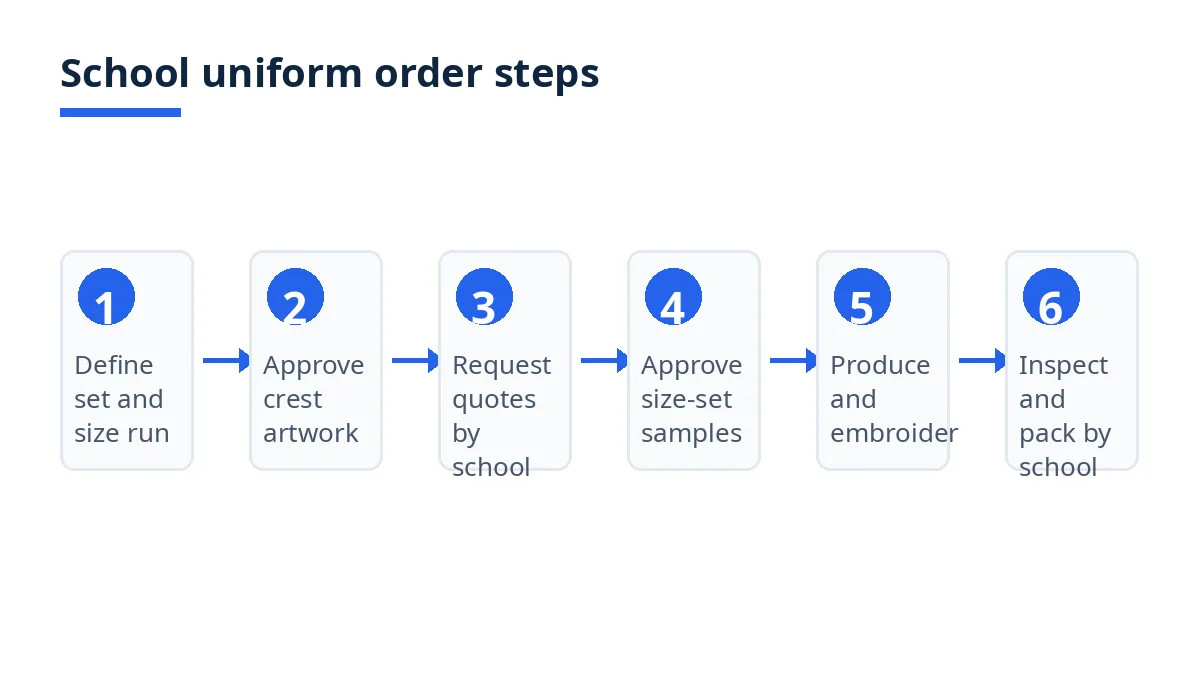
Define the set and the size run. List every piece in the set, for example a shirt, a trouser or skirt, and any blazer or jumper, with the fabric, colour, and shade reference for each. Then build the size run from the school roll, not from a generic chart. State how many pupils sit in each size, including the smallest and largest sizes, because those extremes often decide whether an order is workable.
Fix the crest and its method. Supply the crest artwork as a vector file where possible, state its finished size and placement on each garment, and choose embroidery or print before sampling. Embroidery needs a digitised file for the design, and that file is made for one crest size and one placement. A crest approved at one size does not automatically transfer to a smaller chest.
Ask for quotes on the same split. Send every candidate the same set, fabric, crest method, size run, and packing rule, and ask for the price per set and per piece, the minimum per size, and the crest set-up cost as a separate line. Ask also whether the crest set-up is charged once and reused on repeats.
Approve a size-set sample, not a single sample. Ask for samples across the size range, including the smallest size with the crest, the largest size, and one middle size, in the actual fabric and shade. Check the crest on the smallest garment, check trouser and skirt lengths at the extremes, and wash one sample to check shade and shrinkage before approving in writing.
Agree the bulk and replenishment plan in the same order. State the bulk quantity, the delivery date tied to term start, and how replenishment will work: whether small top-up orders are possible, what minimum applies to a top-up, and whether the crest file and fabric shade are held for the next intake.
Inspect and pack by school and size. Agree the inspection plan before production, then require cartons sorted by school, garment, and size, with the size and quantity marked on each carton. Mixed cartons are the most common cause of a correct order arriving as an unusable delivery at a school store.
Costs, timelines and documents
What are the typical costs and timelines?
There is no published typical price for a wholesale school uniform set from Bangladesh, because the set, fabric, crest method, size run, and delivery term differ on every order. Price drivers a buyer can control are worth naming plainly. A cotton-rich woven fabric, a larger crest, embroidery rather than print, and a wide size run with many small sizes all add cost or set-up, while a single fabric shade shared across the shirt and the trouser, one crest placement, and a consolidated size run reduce it.
Example figures: a buyer orders 2,400 sets split across eight sizes, with 300 sets in each middle size and 60 sets in each extreme size. The total looks comfortable, but the extreme sizes may still fall below a per-size cutting or embroidery minimum, so the factory may surcharge those sizes or ask the buyer to consolidate them. The same 2,400 sets across four sizes would present a different cost and minimum picture. The example shows structure only, not a typical price, MOQ, or lead time.
Timelines follow the same logic. Sampling depends on fabric availability and crest digitising, bulk production on dyeing or shade matching, embroidery capacity, and line time, and delivery on the agreed term. The Incoterms 2020 rules provide 11 rules with a clear allocation of cost, risk, and obligations,3 so compare quotations only on the same rule and named place. Ask for sampling, fabric ready, bulk production, inspection, and shipment dates as separate lines, and work backwards from the term-start date with a buffer for one correction round.
Which documents are needed?
The order documents are the tech pack, the size run, the crest artwork and its written approval, the itemized quotation, and the purchase order naming the set, sizes, crest method, inspection plan, and delivery term. For export clearance, the supplier files the Bill of Export set described by Bangladesh Customs.4
Bangladesh-specific rules and tips
Classify by garment, not by the word uniform. A school set has no single HS heading. Woven pieces fall under Chapter 62 of the Bangladesh Customs Tariff, which covers articles of apparel not knitted or crocheted.5 Heading 6203 covers boys suits, ensembles, jackets, blazers, trousers and shorts, heading 6204 covers the corresponding girls garments including dresses and skirts, heading 6205 covers boys shirts, and heading 6206 covers girls blouses and shirt-blouses.5 Confirm the heading per piece with the supplier and your customs broker, because duty and labelling treatment follow the piece, not the set name.
Treat the label as part of the uniform, not an afterthought. For sales into the European Union, Regulation (EU) No 1007/2011 requires textile products to be labelled with the name and percentage by weight of all constituent fibres in descending order.6 School labels also carry size, care, and school identification, so approve the label artwork with the crest artwork and check it on the smallest sample, where space is tightest.
Hold the shade, not just the fabric name. Two fabrics both described as navy school twill can differ visibly. Keep a sealed shade swatch from the approved sample, name the fabric construction and weight in the tech pack, and require the bulk shade to be checked against that swatch before cutting. Replenishment orders fail most often on shade drift, not on a changed fabric name.
Check the crest at the smallest size first. Embroidery that reads well on a large blazer chest can crowd a small shirt chest and distort on a curved seam. Digitise for the smallest garment that will carry the crest, approve that sample in writing, and only then approve the larger sizes. A crest charge that covers digitising once is worth confirming in writing, so a repeat order does not pay for the same file again.
Plan replenishment before the first bulk order ships. Ask in writing whether the factory will hold the approved fabric shade, the crest file, and the size chart for top-ups, what minimum applies to a top-up per size, and how long that hold lasts. A school programme without a replenishment answer becomes a new sourcing project every term.
Settle inspection before production, not at shipment. ISO 2859-1 gives sampling plans for inspection by attributes, indexed by AQL for lot-by-lot inspection: AQL is the highest average defective percentage treated as acceptable in random sampling, and it sets sample sizes plus accept/reject thresholds.7 Write the inspection level and AQL values into the purchase order, and inspect by school and size so a fault in one size does not hide inside a passed lot.
Mistakes and red flags
What are the most common mistakes?
Ordering from a generic size chart. Adult or general child size ratios do not match a specific school roll. The result is stock in sizes no pupil wears and shortages in the sizes the roll actually needs. Build the run from enrolment data, including new intake and leavers.
Approving the crest on screen only. A digital proof hides puckering, thread density, and placement on a small chest. Approve a stitched crest on the smallest actual garment, in the actual fabric, before bulk embroidery starts.
Sampling one middle size only. A middle size can pass while the smallest size distorts the crest and the largest size pulls at the seam. Sample the extremes and one middle size as a minimum.
Ignoring the per-size minimum. A comfortable total can still fail at the extremes. Ask for the minimum per size and per crest run in writing, and consolidate or surcharge the extreme sizes deliberately rather than discovering the problem at quotation stage.
Mixing schools in one carton. Cartons sorted only by garment, with several schools mixed inside, turn receipt at a school store into a sorting exercise and invite misdelivery. Require cartons by school, garment, and size, marked on the outside.
Treating a profile as proof of school capacity. A listing that shows uniform styles does not show that a factory holds your shade, digitises your crest, or packs by school. Ask for the shade hold, crest file handling, and packing rule in writing, and test them on the sample order.
Skipping the wash test. School garments are washed weekly. A sample that looks correct unwashed can shrink, fade, or pucker after washing. Wash one approved sample and record the result before bulk approval.
Checklist
Before you confirm, every line should be answered in writing.
Set defined piece by piece, with fabric, shade reference, and construction for each garment.
Size run built from the school roll, with quantities per size including the extremes.
Crest artwork supplied, method chosen, digitising cost stated, and smallest-size crest sample approved.
Quotations compared on the same set, size run, crest method, and delivery term.3
Minimum confirmed per size and per crest run, with extreme sizes consolidated or surcharged deliberately.
Fabric shade held against a sealed swatch, with replenishment terms and hold period agreed.
Sample set approved across the size range, washed, measured, and approved in writing.
Inspection level and AQL values in the purchase order.7
Cartons sorted and marked by school, garment, and size.
Export set confirmed with the supplier, and shipment date tied to term start with a correction buffer.
How Exportain helps
On Exportain, browse suppliers and post the set, size run, and crest method on the RFQ board so suppliers quote against the same school specification. Ask each reply for its per-size minimum, crest set-up treatment, shade hold, and replenishment terms. Read the MOQ guide before comparing minimums, and read how supplier verification works on Exportain for what a badge records. Verification is a document and photo review, not a factory inspection, and a badge is not a guarantee of capacity, quality, or delivery.8 9
FAQs
What should I know first about school uniforms?
Start with the set, the school roll, and the crest, in that order. A school uniform order is defined by its pieces, its size run from actual enrolment, and a crest that must work on the smallest garment. Woven pieces are classified by garment under Chapter 62, with boys and girls headings kept separate.5 Price, minimum, and timeline all follow those three decisions, so settle them before requesting quotations.
What are the typical costs and timelines?
There are no typical figures a buyer can rely on, because each factory prices the set, fabric, crest method, size run, and delivery term for that school.3 Example figures in this guide show structure only. Sampling, shade matching, crest digitising, embroidery, and line capacity set the timeline, so ask for each stage as a separate date and work backwards from term start.
Which documents are needed?
The order documents are the tech pack, the size run, the crest artwork and its written approval, the itemized quotation, and the purchase order. For export clearance, the supplier files the Bill of Export set described by Bangladesh Customs.4
What are the most common mistakes?
The most common mistakes are ordering from a generic size chart, approving the crest on screen only, sampling one middle size, ignoring the per-size minimum, and mixing schools in one carton. Each mistake is avoidable by approving a washed size-set sample and requiring cartons sorted by school, garment, and size.
Next steps on Exportain
Put the set, size run, and crest method into an RFQ on the RFQ board after browsing suppliers, asking each reply to state its per-size minimum and crest terms. Read how supplier verification works on Exportain and the MOQ guide before you confirm.
Sources
- BGMEA | Home. Bangladesh Garment Manufacturers and Exporters Association (BGMEA) (accessed )
- EU share erodes as Bangladesh RMG exports slip 1.64% to $38.70 billion in FY26. United News of Bangladesh (accessed )
- Incoterms® 2020. International Chamber of Commerce (ICC) (accessed )
- Customs Clearance Procedures for Export. Bangladesh Customs, National Board of Revenue (accessed )
- Bangladesh Customs Tariff, Chapter 62. Bangladesh Trade Portal (accessed )
- Regulation (EU) No 1007/2011 on textile fibre names and related labelling and marking of the fibre composition of textile products. European Union, (accessed )
- ISO 2859-1:2026 - Sampling procedures for inspection by attributes — Part 1: Sampling schemes indexed by acceptance quality limit (AQL) for lot-by-lot inspection. ISO (accessed )
- Trust & Safety Center. Exportain (accessed )
- Supplier verification: Earn trust badges buyers can see. Exportain (accessed )
About the author
Sourcing from Bangladesh?
Post a request for quotation and suppliers on Exportain can send you their quotes directly.
Post an RFQ


