Wholesale Sandals and Slippers From Bangladesh: Prices, MOQ and Reliable Suppliers
Buying sandals and slippers wholesale from Bangladesh is a channel decision before it is a price decision. This guide covers stock and production lines, size curves, quotation lines, labeling, classification, and reorder terms.
Short answer
Wholesale sandals and slippers from Bangladesh are bought as an assortment of styles, colors, and sizes for a named sales channel, counted on the supplier's stated basis. Settle the channel and the size curve first, choose stock or production lines, compare quotations on the same delivery term and pack, approve a sample pair of each color, and agree the smallest reorder and price validity in writing before the first shipment. All figures here are example figures, and duty is broker-confirmed.
On this page
Key takeaways
Buy for the channel first: the pack, size curve, label, and repeat rhythm follow the channel, and price follows those choices.
Example figures: four style-color lines of 480 pairs give 1,920 pairs and 80 cartons at 24 pairs per carton.
Ask the counting basis in writing, per order, per style, per color, or per combination, before comparing any two replies.
No duty rate is stated: the broker confirms the code and duty line for the exact pair and market, and labeling is agreed before production.
Agree the smallest reorder, price validity date, and repeat time in writing before the first shipment, and review sell-through before reordering.
A wholesale order for sandals and slippers from Bangladesh is decided by the channel it will sell through. A hotel chain, a market trader, and an online seller do not buy the same pair in the same way, even when the sole and the strap look alike. The channel sets the pack, the size spread, the labeling, and the speed of the repeat order, and price follows those choices. This guide works through the wholesale channel for open footwear: the buyers in it, the stock and production lines they draw on, the size curve that decides whether the order sells through, and the paperwork that must travel with the cartons. It is written for buyers in the USA, UK, EU, and UAE who buy sandals and slippers in volume.
Open footwear rewards a channel-first view because so little of the pair is hidden. A sandal carries the foot on a sole, a footbed, and straps that are all on show, and an indoor slipper is judged the same way on its sole covering and heel grip. Fix the channel first, then the assortment, size curve, and pack that channel needs.
Who buys wholesale sandals and slippers, and what each channel orders
Retail chains buy a narrow style list in a deep size curve. They need the same pair, in the same pack, delivered on a schedule, with barcode and carton discipline that a warehouse can scan without opening every carton. Label artwork is fixed early because a chain cannot re-label thousands of pairs at goods-in. Independent shops buy the opposite shape: more styles, fewer pairs of each, and faster turnover, so a mixed carton that spreads sizes across a style can suit them better than a full carton of one size.
Hospitality and leisure buyers, such as hotels, spas, and resorts, buy plain indoor slippers and sandals for guest use. Their orders repeat on a schedule rather than a season, the pairs are usually packed in bulk without retail boxes, and a consistent fit matters more than fashion detail. Market traders and discount sellers buy on price, in high pair counts, with simple packs and short reorder cycles, and they feel a wrong size curve first because unsold end sizes cannot be moved at a premium. Online sellers feel the size curve differently again: a wrong curve returns as returns, so the pair must arrive in an individual pack with the right label and barcode on every pair, and the size marking must match the listing.
The supplier landscape behind these channels is organized through its trade body. The Leathergoods and Footwear Manufacturers and Exporters Association of Bangladesh says on its president's page that it speaks for makers and exporters of leather products, footwear, and synthetic and allied factories in the country, aiming for a healthy business environment between them.1 A membership claim still proves only membership. Test the maker on the order itself: the pair, the pack, and the carton.
Channel | Order shape | What decides the repeat |
|---|---|---|
Retail chain | Few styles, deep size curve, scanned cartons | On-time delivery, identical pack, steady fit |
Independent shop | More styles, fewer pairs, mixed cartons | Fast style turnover, sizes that clear |
Hospitality and leisure | Plain pairs, bulk pack, scheduled repeats | Consistent fit, washability, schedule kept |
Market trader | High pair counts, simple pack, price-led | Clearance speed, end sizes that still move |
Online seller | Individual packs, label and barcode per pair | Size accuracy, low returns, listing match |
Ready stock, production orders, and mixed wholesale programmes
A ready-stock line is a sandal or slipper the supplier already holds as finished pairs in named colors and sizes. The order moves to packing and checking without a production run, so the gain is time. The limits are choice and freshness: the colors and sizes on hand are the colors and sizes available, and the sole unit, strap, and pack are already fixed. Ask for a dated stock list that breaks the pairs down by style, color, and size, and treat any stock figure without that breakdown as a headline, not a promise.
A production line is made for the order, to the colors, strap, sole unit, and pack the buyer chooses. The gain is control. The buyer commits to the quantity on the counting basis the supplier states, and any change after the cut-off date needs a new quotation. Record the cut-off date, and record what is already held for the order, such as sole units or strap material, so a late change can be priced against something real rather than argued about.
Most wholesale programmes mix the two. A core of plain styles ships from stock while fashion styles go into production, and the two halves must still arrive as one assortment with one labeling and packing standard. Ask, line by line, which styles ship from stock and which enter production, and put the answer in the same document as the price.
Build the assortment on the size curve
An assortment is a list of styles, colors, and sizes with a pair count for each size. For open footwear, the size curve deserves the first pass, not the last, because the ends of the range are where fit trouble and unsold stock both collect. A last is the foot-shaped form the pair is built on, fixing its length, width, and outline. SATRA describes a lasts and fitting service that assesses the dimensions and suitability of lasts for their intended market, runs fitting trials on new ranges, and advises on sizing systems and conversions.2 Ask for the last measurements per size, the size system in use, the width fitting, and the insole length for each size, in writing, before sampling. Run a wear check on the smallest, a middle, and the largest size, and record length, width, heel grip, and strap pressure for each.
The table below shows one style-color line of 480 pairs spread across ten sizes. The curve is an example, not a market rule: shape it from the buyer's own sales, not from another market's curve.
Size (EU) | 36 | 37 | 38 | 39 | 40 | 41 | 42 | 43 | 44 | 45 | Total |
|---|---|---|---|---|---|---|---|---|---|---|---|
Pairs | 24 | 36 | 48 | 60 | 60 | 60 | 48 | 48 | 48 | 48 | 480 |
24 + 36 + 48 + 60 + 60 + 60 + 48 + 48 + 48 + 48 = 480 pairs. Four style-color lines on the same curve give 1,920 pairs (4 x 480). At 24 pairs per carton, the order fills 80 cartons (1,920 / 24). Agree the pairs per carton and the carton marks before production: style, color, size breakdown, and quantity on every carton, matching the packing list. A carton that mixes sizes without a printed breakdown slows every count at goods-in and hides a short size until the shelf is empty.
Colors multiply the order in the same way sizes do. Each color needs its own shade agreement across the pairs in the line, and a color approved on a sample pair does not approve the shade of the next color. Keep the color count tied to sales evidence, and approve one pair of each color, in the pack it will ship in, carrying the labeling it will carry.
The wholesale cycle, from first enquiry to the second reorder
Six stages carry a wholesale order from enquiry to reorder, and each stage should leave paper the next one can use. The diagram shows the six in order.
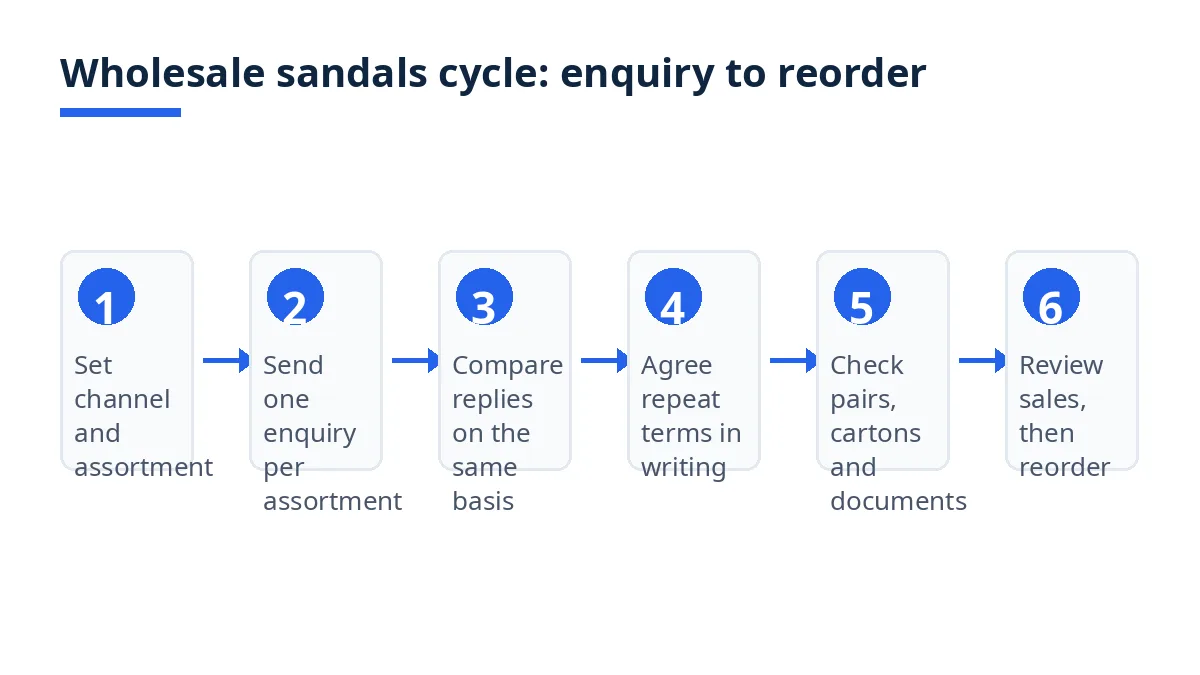
Fix the channel, the assortment, and the size curve, and write the pair specification: sole unit, strap material and fixing, footbed, labeling, and pack.
Send one enquiry for each assortment, giving the counting-basis question, delivery term, destination, and reorder question, so all replies answer one brief.
Compare the replies side by side on counting basis, delivery term, and pack, check the sample pair and pack against the written specification, and only then rank on price.
Agree the repeat terms in writing, covering the smallest reorder, the price validity date, and the repeat production time, before the first shipment leaves.
Check the finished pairs against the approved pair, confirm the carton marks against the packing list, and ship on a matching set of documents.
Review sales by style, color, and size, then reorder the lines that sold and cut the ones that did not.
A sample pair approved in one color does not approve every color, and a sample pair approved in a middle size does not approve the ends of the curve. Keep one approved pair of each color as the checking reference, and record every change that follows the sample, with the date and the person who agreed it.
What moves the wholesale price, channel by channel
Pair price follows the pair itself first. The sole unit and its thickness, the strap material and its fixing, the footbed, and the assembly method each move the price, and a cheaper reply that changes any of them prices a different pair. The size curve moves the price next: a wide curve with thin counts at the ends costs more per pair to run than a tight curve, because the line still changes over for sizes that yield few pairs. The pack moves it again: an individual polybag or pair box, a printed carton, and a barcode label each add cost that a bulk hospitality pack does not carry. Labeling work belongs in the same line, since artwork and carton printing are settled before production, not after it.
The delivery term moves the landed price after the pair price. FAS, FOB, CFR, and CIF are the four rules confined to sea and inland waterway transport.3 CPT, DPU, and DDP work with any transport mode, with DPU putting unloading on the seller at the named place and DDP putting import clearance and duty on the seller.3 Under FAS and FOB, the seller handles export formalities, while the buyer books the carrier, pays the port-to-port carriage, and deals with import formalities.3 For container loads, the Academy's discussion points buyers toward FCA: a box can wait at the terminal for days before it is loaded, so a rule that hands over at the terminal fits the movement better than one tied to the ship's side.3 Write the rule, its version year, and the named place or port into the contract, and confirm the duty line with a broker for the exact pair and market. No duty rate is stated in this guide.
Minimum quantity acts as a price driver inside the channel, not as a verdict on the supplier. A minimum can be set per color, per order value, or per pallet of one stock-keeping unit, and the same supplier can use different bases for different lines.4 Ask whether the figure runs per color, per size, or per total order, and restate the answer in writing with the total it produces.4 A headline figure with no basis hides very different totals: one figure per style-color across four style-colors is four times the pairs of a figure counted once for the whole order.
The example below builds a cost before duty, using example figures only. Duty stays with the broker to confirm, and this guide states no production or transit time as fact.
Cost line — example figures only | Amount |
|---|---|
Pairs: 1,920 at 2.85 US dollars each | 5,472.00 US dollars |
Carriage and cover to the destination port (example figure) | 980.00 US dollars |
Entry charges plus broker fees (example figure) | 260.00 US dollars |
Duty | Use the broker's confirmed figure on the customs value |
Total, duty excluded | 6,712.00 US dollars |
Per pair, duty excluded | 3.50 US dollars |
The sums check as follows: 1,920 multiplied by 2.85 gives 5,472.00; adding 980.00 and 260.00 gives 6,712.00; dividing by 1,920 gives 3.50 per pair after rounding. Substitute the confirmed pair price, the carrier's carriage figure, and the broker's duty figure before using the result against a home-market purchase or a retail price.
Read a wholesale quotation the way a channel buyer reads it
Use the table as a completeness test: a reply earns a ranking only once each line below is filled in on the same terms. A reply with a gap is not cheaper; it is unfinished, and the gap gets priced later, when there is less room to move.
Quotation line | What to check |
|---|---|
Delivery term and named place | Rule, version year, named place or port, who clears import |
Counting basis, total pairs, and cartons | Per order, per style, per color, or per combination, with carton count |
Pair price, currency, and validity date | Price per pair, currency, date the price stops holding |
Size curve and carton breakdown | Pairs per size adding to the line total, printed on the carton |
Sample and approval steps | Sample pairs per color, approval steps, cut-off date for changes |
Label artwork and pack | Artwork agreed, pack type, carton print |
Checking and faulty pairs | Who checks, against which approved pair, what happens to failures |
Payment schedule | Deposit, balance, documents tied to each payment |
Repeat and distributor terms | Smallest reorder, repeat time, territory, faulty-pair handling |
Documents | Invoice, packing list, transport document, origin proof, checking evidence |
Do not trade away the checking line or the sample line to cut the pair price. A quotation that prices the pair without pricing the check leaves the buyer paying for the check anyway, in returns and rework.
Labeling, classification, and documents the channel must carry
Labeling is fixed by the destination market, not by the factory, and it must be settled while the assortment is still open to change. In the European Union, the label covers the outer sole, the upper, and the lining and sock.5 The label names a material once it reaches the four-fifths line: 80 percent of the upper's surface, 80 percent of the lining-and-sock surface, or 80 percent of the outer sole's volume. Below that line, the two main materials are named instead.5 The label may be written or shown as pictograms, must stay visible, firmly fixed, and easy to reach, and must sit on at least one item of every pair.5 For imported pairs, whoever first puts the footwear on the EU market carries the duty for the label and its accuracy, while retailers must still check that what they sell carries the right labeling.5 Agree the label artwork before production, and recheck the wording whenever a material change moves a component across the 80 percent line.
Classification follows the materials of the pair. The table below gives the lines a wholesale buyer meets most often on the United Kingdom tariff, on the trade date shown on the schedule pages.6 7 Treat every line as indicative only, confirm the code with a broker, and take no duty rate from a schedule page without the broker's confirmation for the market and date of trade.
Pair in front of you | Indicative line |
|---|---|
Sole and upper of rubber or plastics, upper straps or thongs fixed to the sole by plugs | 6402 20 |
Sole and upper of rubber or plastics, strap vamp, rubber uppers | 6402 99 10 |
Sole and upper of rubber or plastics, strap vamp, plastics uppers | 6402 99 31 or 6402 99 39 |
Sole and upper of rubber or plastics, slippers and other indoor footwear | 6402 99 50 |
Textile uppers, rubber or plastics soles, slippers and other indoor footwear | 6404 19 10 |
Textile uppers, rubber or plastics soles, other sandals | 6404 19 90 |
Textile uppers, leather or composition leather soles, slippers and other indoor footwear | 6404 20 10 |
Textile uppers, leather or composition leather soles, other sandals | 6404 20 90 |
The chapter notes judge the upper by the material covering the greatest external surface area, leaving accessories and reinforcements such as buckles, tabs, and edging out of the count, and judge the outer sole by the material with the greatest surface area in contact with the ground.6 The same schedule splits some lines by insole length against a 24 centimetre line, which is one more reason the size curve and pair details must be settled before the code is confirmed.6 Keep the broker's written confirmation beside the classification note in the order file.
The document set must match the pairs in the cartons. The commercial invoice sets out the description, value, and terms of sale, underpins customs valuation, and — for Bangladesh shipments — has to show the export registration number and the HS code, matching the rest of the export papers.8 The bill of lading is used for sea transport and serves as a document of title, while the air waybill is used for air transport and is not a document of title.8 In Bangladesh, an exporter registers with the government through an Export Registration Certificate issued by the Export Promotion Bureau, and the certificate of origin — obtained from the local chamber of commerce or another authorised body — states the country of origin and underpins duty and preference claims.8 The export packing list covers each package type, quantity, and weight, and an inspection certificate may be needed for some destinations, to confirm quality, quantity, and specifications.8 Before the cartons leave, check that description, value, quantity, code, and origin agree across every document in the set.
Settle the repeat order before the first order ships
Agree the repeat terms in the same document as the first order, while the supplier still wants the business. Settle the smallest reorder on the same counting basis as the first order, and settle separately whether short sizes may be restocked on their own or only inside a full assortment, since that answer decides whether a fast seller can be restocked without carrying slow sizes again. Settle the price validity period as a date, and the repeat production time counted from the reorder date, so the second order has a price and a window the buyer can plan around.
Distributor terms go further and should be settled with the same care. For distributor terms, put the territory down by country or region, say plainly if the arrangement is exclusive, how long any exclusivity runs, and which sales volume preserves it. Also settle the stock position if the arrangement ends. For faulty pairs, agree who takes returns back, who bears the return carriage cost, and whether replacements sit inside the next order's count. Fix a date for reviewing sell-through when the first order is placed, tally sales by style, color, and size at that date, and let the reorder follow the tally rather than the opening enthusiasm for a style.
Wholesale mistakes that leave unsold stock behind
Wholesale mistakes show up as stock, not as paperwork, and most of them are made before the first carton is booked. Copying a size curve from another market leaves the wrong sizes behind, because foot sizes and size systems differ by market and the ends of the curve move first. Buying the full color range of every style without sales evidence spreads the order thin and leaves slow colors in the warehouse while fast colors sell out. Approving a sample pair in one color and assuming the rest match misses shade differences and strap-fixing differences that customers see at once. Ranking replies on pair price alone, without the counting basis, the pack, the checking line, and the delivery term, ranks an incomplete reply above a complete one. Leaving repeat terms and the price validity date to conversation leaves the second order without a price the buyer budgeted for, and leaves the supplier free to reprice the lines that sold quickest.
A wholesale readiness check before the first carton is booked
Work down the table and fill every row before the first carton is booked. An empty row means the figure or answer tied to it is still open, however firm the total sounds.
Check | Written answer needed |
|---|---|
Channel and assortment | Channel, styles, colors, sales evidence behind each line |
Size curve and carton math | Pairs per size, pairs per carton, carton count, carton marks |
Stock or production split | Which lines ship from stock, which enter production, change cut-off date |
Sample pair, pack, and label | One approved pair of each color, in its pack, with its labeling |
Counting basis and quotation lines | Basis, total pairs, delivery term, payment schedule, repeat terms |
Labeling and classification | Label artwork agreed, broker-confirmed code and duty position |
Documents | Invoice, packing list, transport document, origin proof, checking evidence, all matching |
Repeat and distributor terms | Smallest reorder, price validity date, repeat time, territory, faulty-pair handling, in writing |
Checking plan | Who checks, against which approved pair, what happens to failures |
What should I know first about buying sandals and slippers wholesale from Bangladesh?
Start with the channel, the assortment, and the size curve, in that order. Name the channel the pairs will sell through, plan the styles, colors, and size spread it needs, and ask how the supplier counts the minimum: per order, per style, per color, or per combination. Then settle the sample pair, the pack, and the label artwork before ranking replies on price, and keep the repeat terms in the same document as the first order.
How do wholesale costs and timelines differ between stock lines and production orders?
Stock lines move faster because the pairs already exist in named colors and sizes, and the choice is limited to what is held. Production lines take longer because the pairs are made for the order, and the buyer gains the choice of color, strap, sole unit, and pack, with a cut-off date after which changes need a new quotation. In both cases the bill runs from the pair itself, the pack, the delivery term, and the duty line for the destination market, each confirmed for the exact consignment. No production time or transit time is stated as a fact in this guide, since both depend on the line, the carrier, and the destination.
Which documents must a wholesale sandals shipment carry?
The commercial invoice, the packing list, the transport document, and the origin proof form the core set, with an inspection certificate where the destination needs one.8 The invoice must carry the Export Registration Certificate number and the Harmonized System code in Bangladesh, and must agree with the other documents on description, value, quantity, code, and origin.8 The certificate of origin comes from the local chamber of commerce or another authorised body, and the packing list must cover each package type, quantity, and weight.8 Match the whole set before shipment, and keep the broker's classification confirmation with it.
What mistakes most often leave wholesale sandals stock unsold?
Stock gets stranded by assortment decisions, taken early and discovered late: a size curve copied from another market; a full color range bought without sales evidence; a sample approved in one color and assumed to cover the rest; a reply ranked on pair price without the counting basis, pack, checking line, and delivery term; and repeat terms left to conversation so the second order has no budgeted price. Fix a sell-through review date when the first order is placed, and let the reorder follow the tally by style, color, and size.
Next steps on Exportain
Start from the supplier listings on Exportain with the assortment plan and the size curve from this guide in hand, read Exportain's supplier-verification page before shortlisting, and use Exportain's guide to how a minimum order is counted to frame the counting-basis question in the enquiry.
Sources
- President's Message - LFMEAB. Leathergoods and Footwear Manufacturers and Exporters Association of Bangladesh (LFMEAB) (accessed )
- Footwear fit and comfort. SATRA (accessed )
- FOB & FAS Incoterms® 2020 explained: Key differences. ICC Academy (accessed )
- Discover MOQ Minimum Order Quantity: Meaning, Types & Negotiation. DocShipper, (accessed )
- Footwear labelling. European Commission, EUR-Lex (accessed )
- Other footwear with outer soles and uppers of rubber or plastics - UK Integrated Online Tariff. GOV.UK (accessed )
- Footwear with outer soles of rubber, plastics, leather or composition leather and uppers of textile materials. GOV.UK (accessed )
- Essential export documents for shipping from Bangladesh. DHL (accessed )
About the author
Sourcing from Bangladesh?
Post a request for quotation and suppliers on Exportain can send you their quotes directly.
Post an RFQ