

Wholesale Mobile Phones From Bangladesh: Prices, MOQ and Reliable Suppliers
Wholesale mobile phones from Bangladesh, bought as an assortment: per-model minimums, carton quantities, battery freight, warranty terms and how to compare quotes on equal terms.
Short answer
Wholesale mobile phone buying is assortment buying. The price that matters is the price of a defined mix of models, memory sizes and colors on one delivery term, in the cartons the supplier actually ships. Ask for the minimum per model and per color, the carton quantity, one Incoterm on every quotation, a sealed sample of each model, inspection terms, battery freight treatment and warranty terms in writing before you confirm.
On this page
Key takeaways
Wholesale phone buying is assortment buying: compare the price of a defined mix of models, memory sizes and colors on one delivery term, not a single headline unit price.
The binding minimum is usually per model and per color, and the carton quantity decides whether an assortment ships cleanly or leaves part cartons.
Battery freight, destination classification and warranty terms change the real cost of a wholesale order, so settle them before you confirm.
Exportain verification is a document and photo review, not a factory inspection, and a badge is not a guarantee.
Wholesale mobile phone buying is assortment buying. A distributor or retailer rarely buys one model in bulk. The order is a mix of models, memory sizes and colors that must sell together, and the price that matters is the price of that whole mix on one delivery term, in the cartons the supplier actually ships.
That mix is where wholesale quotes diverge. Two suppliers can quote the same headline unit price for the same phone and still deliver different deals, because one price covers a single model in full cartons on one term while the other spreads across several models, mixed cartons and a different freight arrangement. This guide follows the wholesale channel: how the assortment is built, what sets the per-model minimum, where battery freight and destination rules change the cost, and how to compare replies on equal terms.
Why this matters for buyers and sellers
For the buyer, the assortment is the risk. A model that sells slowly ties up the cash that a fast model needs, and a warranty return becomes a stock problem when the replacement comes from a different batch with a different charger or packaging. The wholesale question is therefore never only the unit price. It is which models move together, in what quantities, with what warranty cover, and how returns are handled at wholesale distance.
For the seller, the assortment is the constraint. Each model carries its own packing, labeling and carton quantity, and a mixed carton still has to be picked, checked and sealed model by model. The minimum a supplier sets per model is how it pays for that handling work.
Ask each candidate which channel role it plays, because the role decides what it can promise. An assembler or manufacturer controls the build and the packing line. A trading company assembles an assortment from more than one source and can widen the model range, but it does not control production dates in the same way. A distributor or wholesaler sells from stock it already holds, which can shorten the wait but limits the mix to what is on its shelves.
Step-by-step: how it works
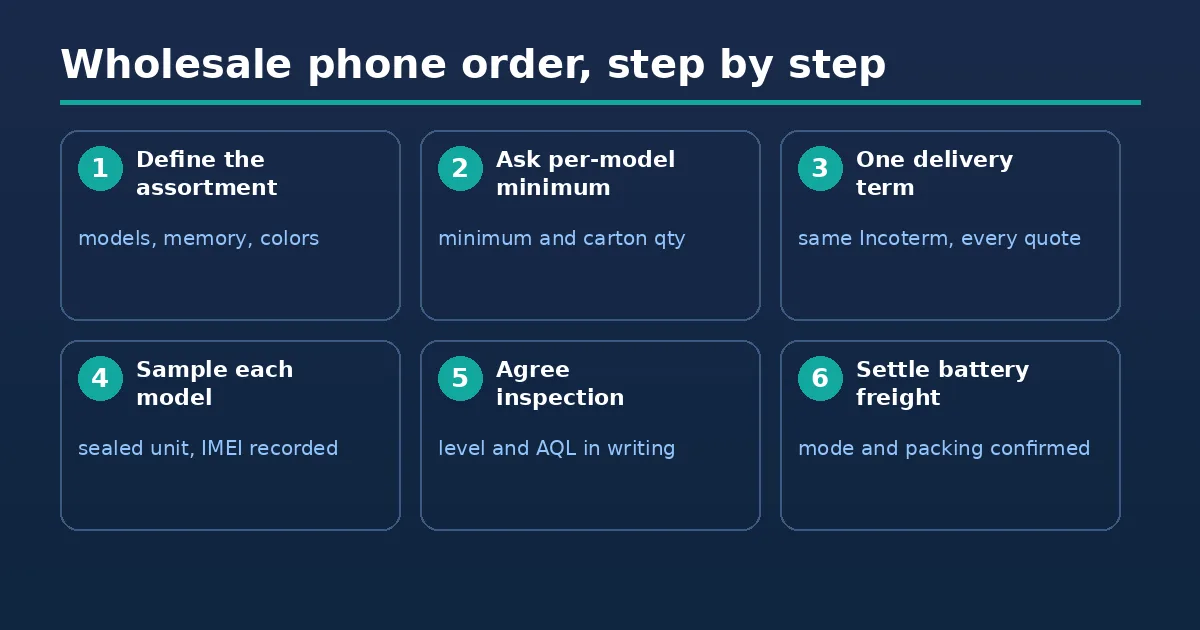
Define the assortment before you ask for a price. List each model with its memory size, color, charger and plug type, language and packaging. A price for "mobile phones" cannot be compared with anything, while a price for a named model in a named configuration can.
Ask for the minimum per model, not only per order. Ask for the minimum quantity per model and per color, and the quantity per carton. An order total that looks large can still fail if one model inside it falls below its own minimum or fills only part of a carton.
Ask for one delivery term on every quotation. The Incoterms 2020 rules set out 11 rules with a clear allocation of cost, risk and obligations.1 Compare quotations only on the same rule and named place, and ask which costs sit inside the quoted price and which sit outside it.
Sample each model, not only the lead model. Ask for a sealed retail unit of each model, with its charger and packaging, and check the plug type, language, labeling and accessories against your market before you confirm. Record the serial and IMEI numbers of the samples you approve.
Agree inspection before you confirm. ISO 2859-1 defines a system of acceptance sampling plans for inspection by attributes, indexed by acceptance quality limit (AQL) for lot-by-lot inspection.2 AQL is the maximum average percentage of defective items considered acceptable during random sampling.2 Write the inspection level, the AQL values and the checks per model into the purchase order.
Settle battery freight before you choose air or sea. Phones contain lithium batteries, and lithium batteries are classified as dangerous goods with prescribed packing, marking and labeling requirements.3 Ask your forwarder which mode and packing apply to your carton quantities, and keep spare batteries and power banks out of a handset consignment unless the forwarder confirms the correct treatment.3
Agree warranty and returns in writing. State the warranty period per model, who holds replacement stock, how a faulty unit is returned, and what happens to a model that is discontinued during the warranty period.
Confirm destination rules with your broker. Ask your customs broker to confirm the full national classification code, the destination labeling and charger requirements, and the documents your market requires, before the goods ship.
Costs, timelines and documents
What are the typical costs and timelines?
There are no typical wholesale costs or timelines a guide can state as fact, because each supplier prices your assortment, not a generic phone. The unit price moves with the model mix, the memory size, the quantity per model, the carton quantity, the delivery term, the freight mode, the battery packing it requires, and the warranty cover in the price. A quotation that looks cheaper on the unit price can cost more once freight, inspection and returns are added, so compare the landed cost of the whole assortment on one term.1
For timelines, sampling depends on whether each model is in stock or packed to order, and bulk supply depends on packing, battery documentation and inspection. Ask for sampling, packing-ready, inspection and shipment dates as separate lines, not a single delivery week.
Example figures: a buyer builds an assortment of three models split across two colors each, packed in full cartons only. The total clears the supplier minimum while one model in one color fills only part of a carton, so that line carries a part-carton charge or is dropped. The same total split across fewer colors fills every carton, and the charge falls away. The example shows structure only, not a typical price, MOQ or lead time.
Which documents are needed?
For export clearance in Bangladesh, goods may not be loaded unless an export declaration, the Bill of Export or Shipping Bill, is submitted to Customs and approved.4 Enclosed documents include the export contract or purchase order where there is no export letter of credit, the commercial invoice, the packing list, the EXP form certified by an authorized dealer, and a certificate of origin issued by the EPB or a Chamber of Commerce and Industry.4
On top of that export set, a wholesale phone order needs its own papers. Keep the assortment table with the model, memory size, color and quantity per model on the quotation and the purchase order. Keep a serial and IMEI list per carton, so a faulty unit can be traced to its carton and batch. Keep the battery documentation your forwarder requires for the chosen mode, and the warranty and returns terms in writing.
Bangladesh-specific rules and tips
Classify the phone, not the category. In the Harmonized System, heading 8517 covers telephone sets, including smartphones and other telephones for cellular networks or for other wireless networks.5 Within that heading, smartphones sit at 8517.13 and other telephones for cellular networks or for other wireless networks at 8517.14.5 The Harmonized System is a six-digit nomenclature used by more than 200 countries and economies as a basis for their customs tariffs.6 Only the first six digits are harmonized, so ask your broker to confirm the full national code for your destination. See the HS code for mobile phones guide.
Keep one legal name across every paper. The export declaration names the exporter and the foreign buyer,4 so the name on the trade licence, quotation, proforma invoice and payment account should match. A mismatch between the invoice name and the payment account name is a common reason a bank or broker queries a shipment.
Treat battery freight as a cost line, not an afterthought. Lithium battery shipments are subject to international packing and shipping safety regulations, and the shipper bears the responsibility to pack, label, mark and declare the shipment as required.3 The lithium battery mark and label must be durable, legible and easily identifiable on the package.3 Ask the forwarder for the battery cost and packing requirement at the quotation stage, while you can still choose the freight mode.
Confirm current handset-identity requirements at order time. Handset identity rules for the Bangladesh market change from time to time, and a buyer ordering for resale needs the position that applies on the order date, not the position from an old guide. Ask the supplier and your broker to confirm the current requirements in writing, and record the answer with the purchase order.
Mistakes and red flags
What are the most common mistakes?
Comparing prices on different assortments. A lower unit price on a single fast-selling model is not comparable with a price spread across a full assortment that includes slow models. Compare only replies to the same assortment table on the same Incoterm.1
Asking for a total MOQ only. The binding minimum is usually per model and per color. An order can clear the total and still fall below the minimum for one model, which then carries a surcharge, a substitution or removal from the assortment.
Ignoring the carton quantity. A quantity that is not a multiple of the carton quantity leaves a part carton, and part cartons are where picking errors and damage concentrate. Ask for the carton quantity per model and build the assortment in full cartons where you can.
Treating a profile or a badge as verification. A profile is a starting point for enquiries. It does not test whether a supplier can supply your assortment, and a badge is not a guarantee of capacity, quality or delivery.7
Skipping the serial and IMEI record. Without a per-carton serial and IMEI list, a faulty unit cannot be traced and a warranty claim cannot be matched to its batch.
Accepting warranty terms verbally. Record the warranty period per model, the replacement route and the handling of discontinued models on the purchase order.
Mixing power banks into a handset order. Power banks are treated as lithium batteries in their own right, not as phone accessories.3 Adding them to a handset consignment without forwarder confirmation can change the packing, marking and mode that apply to the whole shipment.
Red flags that should pause an order. A supplier that will not name the per-model minimum, will not send a sealed sample of each model, prices only on a vague delivery term, or cannot explain how returns are handled is asking you to carry its risks.
Checklist
Before you confirm, every line should be answered in writing.
Assortment table agreed: model, memory size, color, charger, language, packaging.
Minimum confirmed per model and per color; binding line named.
Carton quantity per model confirmed; full cartons where possible.
Quotations compared on the same assortment and Incoterm.1
Sealed sample of each model approved, serial and IMEI numbers recorded.
Inspection level and AQL values in the purchase order.2
Battery mode, packing, marking and labeling confirmed with the forwarder.3
Warranty period, replacement route and discontinued-model handling in writing.
Destination classification, labeling and charger rules confirmed with your broker.5 6
Export set agreed: invoice, packing list, EXP form, certificate of origin, Bill of Export.4
One legal name across licence, quotation, invoice and payment account.
How Exportain helps
On Exportain, browse suppliers and post a request for quotation (RFQ) on the RFQ board with your assortment table, per-model quantities and delivery term, so suppliers quote against the same mix. Ask each reply for its per-model minimum and carton quantity, and for the battery freight treatment on your chosen mode. When you accept a quotation, Exportain creates one order and issues one proforma invoice from the accepted terms.7 See how supplier verification works on Exportain.
Read the badges for what they record. Exportain Verified means Exportain has checked identity, phone, email and business registration, and Export Verified means it has checked the Export Registration Certificate (ERC).7 Factory Verified means it has reviewed photos of the manufacturer factory, while Trading Company Verified means it has reviewed photos of the trading company office or warehouse.7 Verification is a document review by staff, free, and never granted by membership plans.8 It is not a factory inspection,7 8 so sample approval and inspection stay with you.
FAQs
What should I know first about mobile phones?
Wholesale buying is assortment buying. The price that matters is the price of a defined mix of models, memory sizes and colors on one delivery term, in the cartons the supplier actually ships. Heading 8517 covers telephone sets including smartphones,5 and the six-digit code is harmonized while the full national code is set by your destination.6
What are the typical costs and timelines?
There are no typical figures a buyer can rely on, because each supplier prices your assortment. Model mix, quantity per model, carton quantity, delivery term, freight mode, battery packing and warranty cover drive the price,1 3 and stock availability, packing, battery documentation and inspection drive the timeline. Ask for costs and dates as separate lines per model.
Which documents are needed?
The order documents are the assortment table, itemized quotation and purchase order, with the per-model minimum and carton quantity on both. The export set is the Bill of Export, commercial invoice, packing list, EXP form certified by an authorized dealer, and a certificate of origin issued by the EPB or a Chamber of Commerce and Industry.4 Add a per-carton serial and IMEI list and the battery documentation your forwarder requires.3
What are the most common mistakes?
Comparing prices on different assortments or terms,1 asking only for a total MOQ, ignoring the carton quantity, and reading a badge as a guarantee. A badge is not a guarantee of capacity, quality or delivery.7 Skipping the serial and IMEI record and accepting warranty terms verbally cost the most after delivery.
Next steps on Exportain
Browse suppliers, then post your assortment table, per-model quantities and delivery term on the RFQ board so suppliers state their minimum per model and carton quantity. Before you confirm, read how to import mobile phones from Bangladesh.
Sources
- Incoterms® 2020. International Chamber of Commerce (ICC) (accessed )
- ISO 2859-1:2026 - Sampling procedures for inspection by attributes — Part 1: Sampling schemes indexed by acceptance quality limit (AQL) for lot-by-lot inspection. ISO (accessed )
- Frequently Asked Questions About Shipping Lithium Batteries by Air. International Air Transport Association (accessed )
- Customs Clearance Procedures for Export. Bangladesh Customs, National Board of Revenue (accessed )
- Heading 8517: Telephone sets including smartphones. GOV.UK, HM Revenue and Customs (accessed )
- What is the Harmonized System (HS)?. World Customs Organization (accessed )
- Trust & Safety Center. Exportain (accessed )
- Supplier verification: Earn trust badges buyers can see. Exportain (accessed )
About the author
Sourcing from Bangladesh?
Post a request for quotation and suppliers on Exportain can send you their quotes directly.
Post an RFQ


