

Wholesale Knitted Beanies From Bangladesh: Prices, MOQ and Reliable Suppliers
Wholesale knitted beanies from Bangladesh are bought as a range of styles, colours, and sizes. This guide covers range structure, wholesale price and MOQ lines, supplier checks, documents, and repeat supply for resale buyers.
Short answer
Wholesale knitted beanies from Bangladesh are bought as a range of styles, colours, and sizes, not as a single beanie. State the full range split in one sheet, compare versioned quotations on the same delivery term, approve a washed sample in the production yarn and colour, and confirm the per-style and per-colour minimums in writing. Check knitwear capability, documents, and inspection terms before ordering, and agree repeat supply terms for the next season.
On this page
Key takeaways
A wholesale order is a range of styles, colours, and sizes. The minimum and price usually follow the smallest unit in the split, so state the full split before any quotation can compare.
Example figures show structure only: 900 beanies at 100 units cost 90,000 units, while 1,000 beanies at 92 units cost 92,000 units, so ordering up for a tier can cost more in total.
Judge reliability on current beanie knitting, a washed sample in the production yarn and colour, documents checked at the source, and a dated capacity and repeat-supply statement. A badge is a document and photo review, not a factory inspection.
Use one delivery term for every quotation, approve label proofs word for word for each market, and record every change in a new quotation version before ordering.
A wholesale buyer does not buy one knitted beanie. A wholesale buyer buys a range: several styles, in several colours, across head sizes, packed for resale before a selling season that will not wait. A beanie in the right colour split is stock that can sell; the same beanie in the wrong split, or arriving after the cold weather, stays on the shelf.
Wholesale knitted beanies from Bangladesh are knitted goods. The order is decided by yarn, gauge, style, colour, and size split before any price can be compared. Knitwear exports grew by 6.88 percent to US$5.963 billion in the first quarter of fiscal 2026-27, within ready-made garment exports of US$10.578 billion, according to Export Promotion Bureau (EPB) data reported by The Financial Express.1 This guide is for a buyer ordering wholesale for resale in the United States, the United Kingdom, the European Union, or the United Arab Emirates, and every illustrative number in it is labelled Example figures.
Why the assortment, not the beanie, is the order
A wholesale range has four dimensions
A wholesale beanie range has four dimensions: styles, colours within each style, sizes within each colour, and depth of each size. The minimum and price usually follow the smallest unit in the split, not the total, because yarn, dye lots, and trim runs are set per colour and per style.
Yarn choice runs through all four dimensions. Wool is a natural, protein-based fibre made from keratin, valued for softness, breathability, elasticity, moisture management, odour resistance, and temperature regulation.2 Acrylic and wool blends change care, hand feel, and cost alongside warmth, so a yarn change in one style is a different product. Gauge runs through the range too: in circular knitting machines, gauge is the number of needles within a set linear distance, commonly needles per inch, and a higher gauge gives smaller loops and finer fabric while a lower gauge gives larger loops and bulkier fabric.3
For the seller, one set of materials is bought for the whole range: yarn in lots, dye per colour, pom-poms, labels, and cartons in runs. Changing one colour after the price is agreed changes the dye lot, trim set, and label run. The MOQ can be counted per order, per style, or per colour, with a supplier able to combine a quantity minimum with a minimum order value.4
Stock risk sits with the wholesale buyer
When an order lands, it becomes the buyer's stock. Beanies are seasonal, so sizes and colours that sell out early cannot be remade quickly if the yarn lot is gone, and slow colours tie up cash until the next season. Check the size split against last season's sales.
Repeat supply is part of reliability
A reliable wholesale supplier can repeat the same style, colour, and size split later, with the same yarn and packing, and states in writing when a lot has changed. Test this before the first order: ask whether the yarn will be available for a repeat and what repeat price and minimum apply.
Step by step: from range plan to repeat order
Wholesale buying follows a fixed sequence. Skipping a step moves the cost of that step into the finished stock.
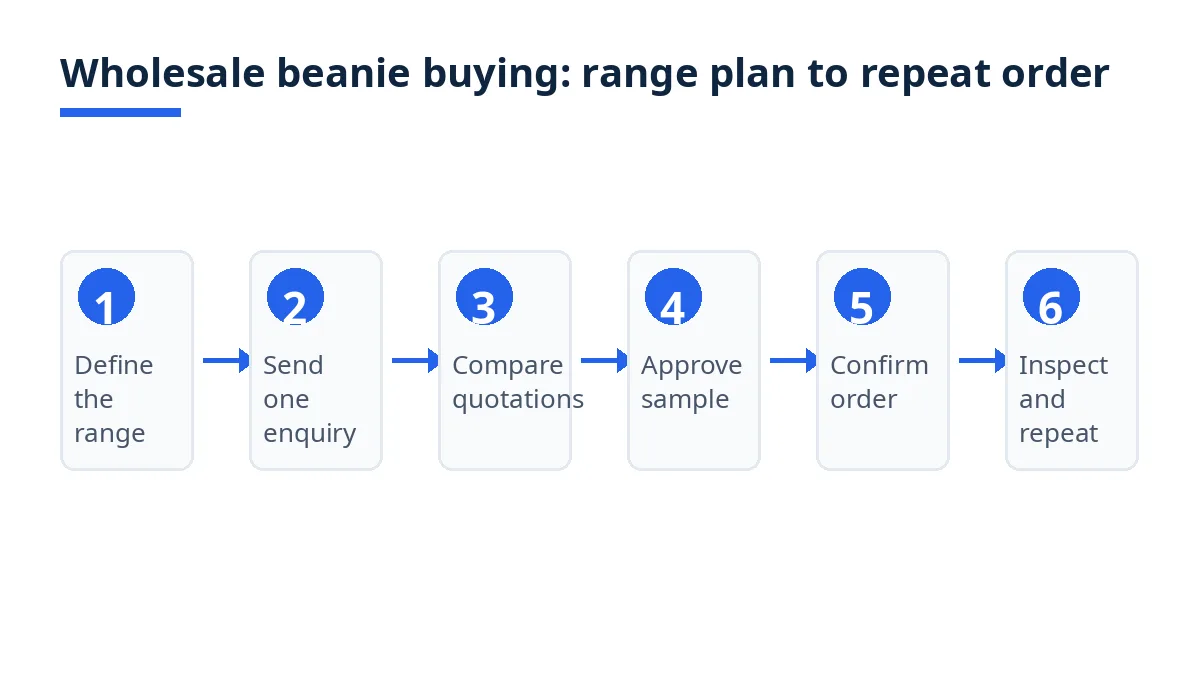
Define the range first. List each style, colours, size range, quantity per size, packing per carton, and resale markets. State yarn and fibre composition, gauge, cuff depth, crown closing, pom-pom and lining details, labels, and packing per style.
Send one wholesale enquiry to every candidate. Send the same range sheet, quantity split, delivery term, and named place to each supplier. Ask for unit price per style, MOQ and counting basis, lead time by stage, payment terms, and validity. On Exportain, post the range sheet as a request for quotation (RFQ).5
Compare wholesale quotations on the same basis. Compare only quotations answering the same sheet on the same term and packing. A lower price on fewer colours, a different yarn, or a different term is a different offer.
Approve the sample and the pack. Order a sample in the production yarn and colour, with production trims and labels, and check it against the measurement chart after washing. Approve the carton pack at the same time.
Confirm the wholesale order in one document. Put the split, quantities, unit prices, delivery term and named place, payment terms, inspection standard, and validity into one purchase order, with the start date and inspection date. Any later change needs a new version.
Inspect, receive, and plan the repeat. Agree the inspection standard before production, inspect against the approved sample and measurement chart, and record the result by style, colour, and size. ISO 2859-1:2026 provides sampling schemes indexed by acceptance quality limit (AQL) for lot-by-lot inspection, and AQL is the maximum percentage of defective items considered acceptable in a lot.6
Costs, timelines and documents
Wholesale price structure
A wholesale price is a resale calculation, not a single number. The supplier's unit price covers the beanie and work up to the delivery term agreed. The resale margin must cover everything after that point, plus unsold stock. Read the quotation as lines.
Wholesale cost area | What it covers | What to ask |
|---|---|---|
Beanie cost lines | Yarn, knitting, pom-pom, lining, labels, packing | Lines per style |
Quantity lines | Per-style and per-colour minimums, price tiers, set-up lines | Counting basis, tier starts |
Delivery lines | Inland transport, port handling, export documents | Delivery term, named place |
Buyer lines after delivery | Freight, insurance, import clearance, duty and tax, onward delivery | Budget each line apart from unit price |
The Incoterms 2020 rules give a clear allocation of cost, risk, and obligations across 11 rules.7 Use one delivery term for every quotation.
Example figures: one style in one colour costs 100 units at the first tier and 92 units from the next tier. Example figures: 900 beanies at 100 units cost 90,000 units, while 1,000 beanies at 92 units cost 92,000 units. The larger order costs more in total. Example figures show structure only, not market prices.
Example figures: 1,200 beanies across four colours at 300 per colour can pass the order total while each colour sits below a per-colour minimum. The same 1,200 beanies in two colours at 600 per colour can pass both lines. Ask for the minimum per style, per colour, and per size in writing, and which line binds. For the general meaning of MOQ, see the guide to MOQ meaning.4
Timelines by gate
Ask for dates by gate: range approval, sample, yarn and dye ready, knitting, inspection, and loading. A delay past the selling window changes the stock's value, even when the beanies are correct. Yarn and dye readiness is the gate most often missed, because a colour cannot be knitted until its lot is ready.
Documents in three sets
Three sets are needed: the order set (range sheet, quotation version, purchase order, sample approval), the product set (measurement chart, label proofs, certificate evidence), and the shipment set (commercial invoice, packing list, EXP form, certificate of origin, Bill of Export).8 Keep all three in one record, under one legal name for each party.
Bangladesh-specific rules and tips
Check knitwear capability, not general garment capability
Knitted beanies are knitwear, knitted as a tube on circular or flat-bed machines. A factory that sews woven garments well may never have controlled gauge, yarn lots, and crown closing as one knitted piece. Ask which beanies are in knitting now, ask for a physical sample of a comparable beanie, and get in writing which stages run in the named facility. The Bangladesh Knitwear Manufacturers and Exporters Association (BKMEA) represents the knitwear sector and approximately 2,540 knitwear member factories.9 That record does not establish beanie capability.
Confirm membership claims with the association
If a supplier claims association membership, confirm the record with the association. The Bangladesh Garment Manufacturers and Exporters Association (BGMEA) runs an online Membership Management System through which member factories can generate an e-certificate of membership.10 Ask for the e-certificate, and check that its legal name and address match the quotation, invoice, and payment account. On Exportain, trust badges record document and photo checks reviewed by staff, not a factory inspection.11 See how supplier verification works on Exportain.
Classification is indicative until confirmed for the destination
The Harmonized System comprises more than 5,000 commodity groups, each identified by a six-digit code, used by more than 200 countries and economies as a basis for customs tariffs and trade statistics.12 Heading 6505 covers hats and other headgear, knitted or crocheted, or made up from lace, felt or other textile fabric, in the piece, whether or not lined or trimmed, and hair-nets of any material.13 Treat any heading as indicative, and confirm the full code against the destination tariff before filing.
Price the label and certificate work for each resale market
Label rules differ by market. In the European Union, a textile product shall be labelled or marked with the name and percentage by weight of all constituent fibres in descending order, under Regulation (EU) No 1007/2011.14 Confirm fibre, care, and origin rules for each resale market before the label run, approve each proof word for word, and price re-labelling after a yarn change separately.
Certificate scope needs the same care. A certificate for yarn alone does not cover the finished beanie. The OEKO-TEX STANDARD 100 system tests a product and each of its components, and a finished good must have its own certification even if all the individual components have already been certified.15 A STANDARD 100 certificate is valid for 12 months and is renewed annually.15
Allow for export clearance in the order plan
Goods shall not be loaded for export unless an export declaration, the Bill of Export or Shipping Bill, is submitted to Customs and approved, with enclosed documents including the export contract or purchase order where there is no export letter of credit, the commercial invoice, the packing list, the EXP form certified by an authorized dealer, and a certificate of origin issued by the EPB or a Chamber of Commerce and Industry.8 The supplier's handling lines should state which documents sit inside the quoted price.
Mistakes and red flags
Ordering a total without a split. The binding minimum and tier are usually per style, colour, or size. An order clearing the total can still fail on one colour. State the split first and confirm the binding line.4
Comparing wholesale with retail prices. The wholesale price ends at the agreed delivery term; the retail price must also cover freight, import costs, storage, markdowns, and margin. Compare wholesale quotations only with each other, on the same range and term.7
Accepting a yarn or colour change verbally. A message agreeing to change a yarn or swap a colour has not changed the order until the quotation and purchase order change with it. Record every change in a new version.
Judging reliability from a listing alone. A listing, photograph, and badge are starting points. They do not test whether a supplier can knit the range, repeat it, or ship the size split ordered. Evidence is the sample, documents, and written split answers. Verification on Exportain is a document and photo review, not a factory inspection.11
Cutting sampling or inspection to protect the season. A washed, measured sample and an inspection against an agreed standard catch a changed lot or a wrong size split before the goods become stock.6
Checklist
Before confirming, every line should be answered in writing.
Range sheet sent: styles, colours, sizes and quantity per size, packing, markets.
Specification per style: yarn, gauge, cuff depth, crown closing, pom-pom and lining, labels, packing.
MOQ confirmed per style, per colour, and per size, with the binding line named.4
Quotations compared on the same range, delivery term, named place, and packing.7
Price tiers and validity stated. Example figures only.
Sample approved in writing in the production yarn and colour, washed and measured.
Capacity and repeat supply stated with dates.
Membership and badge claims checked at the source, one legal name across all documents.11 10
Classification confirmed as indicative, destination code checked before filing.12 13
Label proofs approved word for word for each resale market.14
Certificate scope checked with the issuer, in date.15
Export set agreed: invoice, packing list, EXP form, certificate of origin, Bill of Export.8
Inspection agreed: sampling standard, AQL values, defect classifications, inspector.6
Changes in a new quotation version, with a new sample where the specification changed.
How Exportain helps
On Exportain, browse the supplier catalogue, filter by badge, sample availability, and OEM or ODM capability, and sort by MOQ or lead time.5 Post the range sheet on the RFQ board so suppliers state per-style and per-colour minimums against the same specification. Read each profile's trust and verification checklist before shortlisting; a badge records document and photo checks reviewed by staff, not a factory inspection.11
What should I know first about knitted beanies?
A knitted beanie is one knitted piece, and a wholesale order is a range of styles, colours, and sizes. The supplier must show beanies in current knitting, with a sample in the production yarn and colour, and the buyer must state the full split, gauge, and yarn before any quotation can compare.2 3
What are the typical costs and timelines?
There is no typical wholesale cost or timeline, because yarn, gauge, colours, size range, quantity basis, delivery term, and destination move the figure, and yarn lots and line capacity move the dates. Example figures show structure only: a unit price of 100 units at one tier and 92 units at the next tier makes 900 beanies cost 90,000 units and 1,000 beanies cost 92,000 units. Ask for itemized lines, a lead time by gate, and a validity date.7
Which documents are needed?
Three sets are needed: the order set, the product set (measurement chart, label proofs, certificate evidence),15 and the shipment set (commercial invoice, packing list, EXP form, certificate of origin, Bill of Export).8 Keep all three in one record, under one legal name for each party.
What are the most common mistakes?
The most common mistakes are ordering a total quantity without a split, comparing wholesale prices on different ranges or delivery terms,7 and accepting a yarn or colour change verbally instead of in a new quotation version. Next, judging reliability from a listing or badge alone.11 Last, cutting sampling or inspection.6
Next steps on Exportain
Browse Bangladeshi suppliers and shortlist knitwear suppliers with the badges the range needs. Then post the range sheet on the RFQ board so suppliers state per-style and per-colour minimums against the same specification. Before confirming, read how supplier verification works on Exportain and the guide to MOQ meaning.
Post a free RFQ on Exportain and get quotes from Bangladeshi suppliers → https://exportain.com/rfqs
Sources
- Merchandise exports rise 6.34pc to $13.09b in Q1 FY27: EPB. The Financial Express, (accessed )
- What is the Wool Fibre?. Woolmark (accessed )
- Circular Knitting Machine Gauge Selection in Modern Textile Manufacturing. Yuanda, (accessed )
- MOQ Meaning (Minimum Order Quantity). Exportain (accessed )
- How to source and buy from Bangladesh. Exportain (accessed )
- ISO 2859-1:2026 — Sampling for Inspection by AQL. American National Standards Institute (ANSI) (accessed )
- Incoterms® 2020. International Chamber of Commerce (ICC) (accessed )
- Customs Clearance Procedures for Export. Bangladesh Customs, National Board of Revenue (accessed )
- BKMEA at a Glance. BKMEA (accessed )
- BGMEA launches Membership Management System to provide faster and simpler services. BGMEA (accessed )
- How Supplier Verification Works on Exportain. Exportain, (accessed )
- What is the Harmonized System (HS)?. World Customs Organization (accessed )
- HS, 2012 - Code 6505. United Nations Statistics Division (accessed )
- Regulation (EU) No 1007/2011 on textile fibre names and related labelling and marking of the fibre composition of textile products. European Union, (accessed )
- OEKO-TEX STANDARD 100 FAQ. Hohenstein (accessed )
About the author
Sourcing from Bangladesh?
Post a request for quotation and suppliers on Exportain can send you their quotes directly.
Post an RFQ


