Wholesale Knit Dresses From Bangladesh: Prices, MOQ and Reliable Suppliers
No single wholesale knit dress price or MOQ in Bangladesh: silhouette, length, drape fabric, print and embellishment minimums, and the size-curve assortment set each quote. This guide shows how to specify and compare them.
Short answer
There is no single wholesale knit dress price or MOQ in Bangladesh. Each factory sets its price and minimum for your silhouette, length, drape fabric, print or embellishment, colourway, and size-curve assortment. Fix those specifications in the tech pack, ask for every minimum as a separate line, and compare quotations only on the same specification and delivery term.
On this page
Key takeaways
No single wholesale knit dress price or MOQ exists in Bangladesh: each factory sets its minimum per style, colourway, print run, or size for your specification.
Silhouette and length ranges drive fabric use, grading, and price, so fix both together in the tech pack, for every size.
Drape fabric must be judged washed: stretch recovery, drape, and colour after washing decide whether a dress holds its shape.
Print and embellishment minimums sit apart from the garment MOQ, per method, artwork colour, and placement.
Build the order as a size-curve assortment, not a total, and name the binding minimum before you confirm.
A knit dress range is ordered as a grid, not as a quantity. One style becomes several different cutting, printing, and packing jobs once it is offered in more than one length, more than one colorway, and a full run of sizes. A single total, such as 1,000 dresses, does not describe the order, because the factory prices and sets minimums cell by cell.
Length is what turns a dress order into a range problem. Changing only the length changes the panel, the amount of fabric, the number of print repeats down the skirt, the hem treatment, and the way the fabric falls at the smallest and largest sizes. A midi and a maxi from the same jersey are not the same job with extra fabric added; the longer dress carries a different repeat layout, a heavier hem, and a different risk of pull or bagging after washing. This guide therefore works from the assortment grid outward: lengths, sizes, and colorways first, then fabric behavior, then print and trim lots, and only then price comparison.
Drape is the second property that separates dress buying from simpler knit buying. A jersey can measure correctly flat on a table and still fail as a dress, because the wearer judges it by how it hangs, moves, and recovers after washing. Stretch recovery matters most where the dress is fitted, drape matters most where it is fluid, and print placement matters most where the skirt flares or tiers, since a motif that sits well on a straight skirt can sit unevenly across a flare. Fix each property as a measurement or a washed check, not as a style adjective.
Why this matters for buyers and sellers
Start with the length ladder, because it drives nearly every later decision. A range that offers a mini, a midi, and a maxi in the same silhouette is really three length specifications sharing a bodice, and each length needs its own finished length per size, its own hem sweep, and its own print repeat position. Agree it late, after fabric booking or screen cutting, and every correction is remade three times.
Length in the ladder | What changes against the shorter length | Check before bulk cutting |
|---|---|---|
Mini | Shortest panel, smallest repeat count, lightest hem | Hem finish and movement at the smallest size |
Knee | Mid panel, repeat shifts with the knee line | Motif position relative to the knee |
Midi | Longer panel, more repeats, heavier fall | Drape and hem weight after washing |
Maxi | Longest panel, most repeats, fullest hem sweep | Drag, pooling, and flare behavior at the largest size |
For the buyer, one bad length can mark the whole drop: a dragging maxi, a midi that bags after washing, or a print that breaks across a tier. For the seller, the exposure is stock made to one buyer: dyed fabric, cut screens, and printed cartons that cannot be redirected if the range is cancelled. Both sides therefore need the same grid, with identical lengths, sizes, and colorways, on the tech pack, the quotation, and the purchase order.
The field to search in is wide. BKMEA, established in 1996, represents about 2,540 knitwear member factories.1 EPB data put knitwear shipments at $5.963 billion in July to September 2026, up 6.88 percent on the year, within ready-made garment exports of $10.578 billion.2 More factories mean more quotations, and more variation between them, since each prices the same grid against its own fabric stock, print capacity, and line availability.
Step-by-step: how it works
The grid comes first below, so print lots, fabric checks, and grading all answer to one agreed structure.
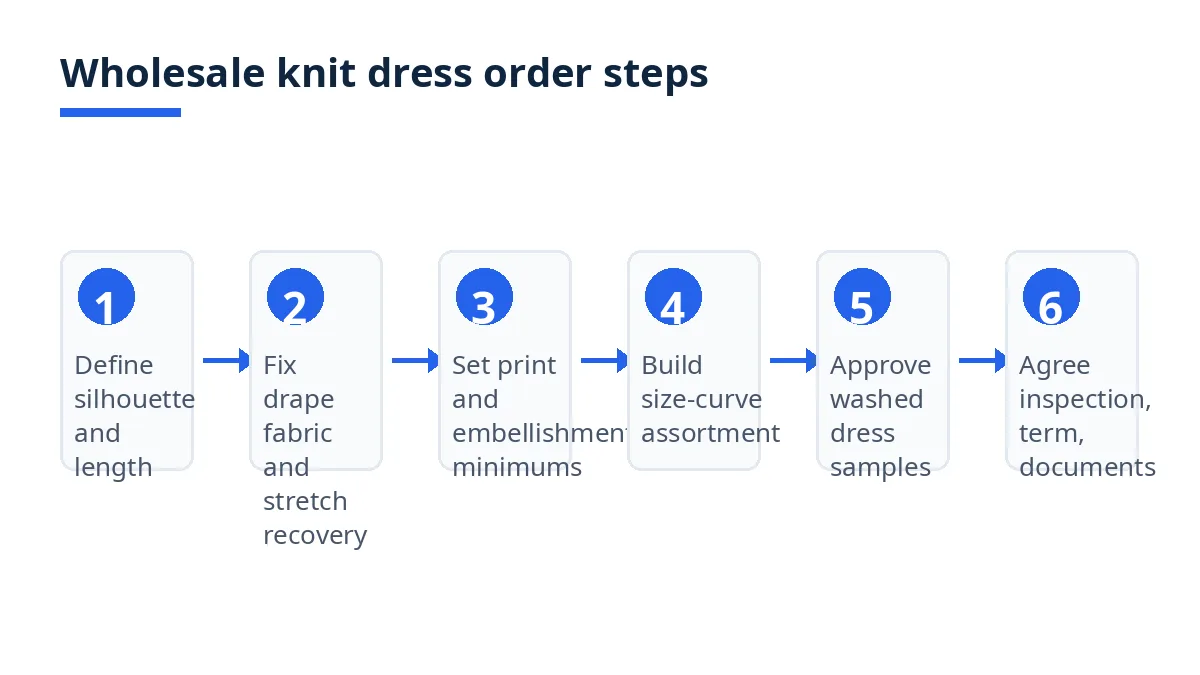
Lock the assortment grid before asking for a price. Write every style as rows of silhouette and length, crossed with colorways and sizes, with the number of dresses in each cell and in each assortment pack. State whether a carton holds a single size, a single colorway, or a fixed pack, and ask the factory to name the cell that sets the binding minimum.
Price print and trim lots apart from the dress quantity. Ask for a separate minimum for each print method, each artwork color, each placement, and each trim type, including lace, sequin, and bead work. A placement motif and an all-over print do not share a setup, and a trim lot does not move with the garment total.
Choose the drape fabric from washed swatches, not from a handle description. Request swatches in the actual fabric and finish for every colorway, wash them by the method the end wearer will use, and record composition, weight, stretch percentage, recovery after washing, and color retention. Book bulk fabric only after those washed results are written into the tech pack.
Grade the ladder at both size ends. Send finished length, hem sweep, and key measurements for all sizes, and require sample checks at the smallest and largest sizes plus the middle. A silhouette that holds in a medium can still pull at the smallest size or drag at the largest.
Approve washed samples in the extreme lengths. Order a proto sample to settle silhouette and length, then a pre-production sample in bulk fabric, colorway, print or trim, labels, and bulk packing, in the shortest and longest lengths. Measure it flat and on a form, wash it, re-measure it, and record approval or corrections in writing against the grid.
Fix inspection, the delivery term, and the paper set in the purchase order. Put the inspection level, acceptance values, and a dress-specific defect list into the order, following ISO 2859-1,3 and put one delivery term with a named place on every quotation, under the Incoterms 2020 rules.4 Confirm which party prepares each export paper, and hold shipment until the export filing is approved.
Costs, timelines and documents
Price follows the grid, fabric behavior, and separate print and trim lots, not any published rate. Two quotations can differ widely without either factory being unreasonable: one may rest on a shorter ladder, a lighter jersey, one placement, or an earlier-ending term.
What are the typical costs and timelines?
No published figure can stand in for a quotation on your grid, so the table below lists questions to put to each factory, not a price list.
Decision | Price or minimum effect | Enquiry note |
|---|---|---|
Assortment grid | Pack build, carton count, and the binding cell | Sizes per colorway, pack size, carton mix |
Length ladder | Panel length, repeat count, hem work | Finished length per size, hem sweep per length |
Fabric behavior | Blend, weight, dye lot | Blend, weight, stretch, post-wash recovery |
Print placement | Setup per method, color, and position | Method, artwork colors, placement, repeat |
Trim lots | Lot size per trim type and placement | Trim type, placement, lot quantity |
Handover term | Who carries cost and risk, and from where | One term, one place4 |
Example figures: a buyer plans 1,350 dresses across 3 colorways, 450 per colorway, in sizes XS to XL at a ratio of 1-2-3-2-1, which gives 50, 100, 150, 100, and 50 dresses per colorway. If the factory requires a trim lot of 500 dresses per colorway, each colorway is 50 short, so the range must rise to 1,500 dresses in total, calculated as 3 multiplied by 500, unless a colorway is dropped or the trim is changed. Example figures show structure only, not a typical MOQ, price, or lead time.
On timing, ask for separate dates for sampling, fabric readiness, print approval, trim arrival, production, and inspection, not one delivery week. Print approval and trim arrival slip most often, and a single week hides which step moved.
Which documents are needed?
The commercial order rests on three papers: the tech pack with the grid, drape results, and print and trim lots; the itemized quotation with every minimum shown separately; and the purchase order repeating those figures. Production papers are the written sample approvals and the inspection report. Shipment needs an approved export declaration with its enclosed set, with agreeing names, quantities, and values.5
Bangladesh-specific rules and tips
Check a membership claim with the association, and read it narrowly. A supplier may describe itself as a BKMEA member, and that claim can be checked with BKMEA itself.1 A confirmed membership shows an active knitwear business. It says nothing about whether that factory holds drape across a maxi length, places a print cleanly on a flare, or grades a fitted dress to the largest size.
Match the payment account first, then the rest of the paper. Money should go only to an account whose holder matches the licence behind the quotation. When an invoice or a filing shows a different holder, pause and ask for the link in writing before paying, because a mismatch ignored at order stage reappears at clearance.5
Write drape and recovery as test results, not as adjectives. Words such as fluid or soft do not survive a dispute, because two people can read them differently. Put fabric weight, wash method, stretch percentage, and post-wash recovery into the tech pack, and repeat the checks on the pre-production sample in every length.
Keep fiber wording identical from tech pack to label. For the European Union, textile labeling must give the name and percentage by weight of all constituent fibers in descending order.6 If the tech pack percentages and the label percentages differ, the shipment carries a labeling problem even when the dresses themselves are correct, so have the factory confirm the label wording before bulk cutting.
Mistakes and red flags
What are the most common mistakes?
Letting one total hide a short colorway. A range can pass its headline quantity while one colorway sits below its print minimum or one trim lot sits below its lot quantity. The short cell then attracts a surcharge or is dropped. Test the grid cell by cell, not by the total.
Lining up quotes built on different length ladders. A cheaper quotation may rest on a shorter ladder, a lighter jersey, stock labels, or a delivery term that ends earlier.4 None of those is a saving on the same dress. Compare replies only when they answer the same grid, the same fabric results, and the same term.
Passing a sample before washing. A dress approved flat and unwashed has not been tested in the condition the wearer will meet. Wash the pre-production sample, measure it again, and check drape, recovery, and print match across lengths before signing.
Fit agreed in one size is not fit agreed across the range. Samples measured only in the middle tell you nothing about hem pull at the small end or drag at the large end. Insist on the two end sizes, in both extreme lengths, before bulk is cut.
Leaving a concession off the purchase order. A lower minimum, a shared dye lot, or a waived setup agreed in conversation has no standing at inspection unless it is written on the quotation and the purchase order, with the colorway and placement it covers. If it is not written, it cannot be inspected against.
Reading a listing as a capacity test. A supplier profile is a place to start enquiries. It does not show whether a factory can hold a print placement on a flare or keep recovery across bulk, and a badge records only what its own verification page describes.7 8
Checklist
Use this list as the last pass over the grid before money moves.
Assortment grid agreed: silhouette and length rows crossed with colorways and sizes, with pack size and carton mix.
Binding minimum named: the per-style, per-colorway, per-print, per-trim, or per-size line that sets the order size.
Print and trim lots confirmed apart from the dress quantity, per method, color, and placement.
Dye position by colorway: fabric on hand, or dyeing still to run, after sample wash approval.
End-size grading for the ladder, with length and sweep per size.
Extreme-length pre-production samples: form-checked, washed, re-measured, signed off.
Inspection terms in the purchase order: level, acceptance values, dress defect list.3
Quote comparison on an identical grid, fabric results, and handover term.4
Export declaration and enclosed papers agreed, with matching names, quantities, and values.5
How Exportain helps
On Exportain, browse suppliers and put the assortment grid, the length ladder, the drape fabric results, and the print and trim lots into one request on the RFQ board, so each reply quotes against the same structure. Ask every reply to name its binding minimum cell. For what each badge records, see the trust and verification pages.7 8 Sample approval and inspection remain with the buyer; read the how supplier verification works on Exportain guide and the MOQ definition guide before confirming.
FAQs
What should I know first about knit dresses?
Know the assortment grid first: the silhouettes, the length ladder, the drape fabric and its washed recovery, the print and trim lots, and the size curve per colorway. Women's or girls' knitted dresses sit under HS heading 6104,9 with dress subheadings split by fiber, including 610442 for cotton and 610443 for synthetic fibers.9 Confirm the full national code for your exact fiber mix before calculating duty, and keep the tech pack percentages identical to the label, which in the European Union must list fiber names and percentages by weight in descending order.6
What are the typical costs and timelines?
There are no figures a buyer can rely on as typical, because each factory prices its own grid, fabric, print and trim lots, and delivery term.4 The assortment grid, the length ladder, the drape fabric and its dye lots, print and trim setups, and the delivery term move the price, while sampling, print approval, trim arrival, and inspection move the timeline.
Which documents are needed?
The commercial papers are the tech pack, the itemized quotation, and the purchase order, all carrying the same grid and the same separate minimums. The shipment papers center on the approved export declaration with its enclosed set, including the commercial invoice, packing list, EXP form certified by an authorized dealer, and certificate of origin.5
What are the most common mistakes?
The recurring errors are counting only the order total, lining up quotes from different length ladders or terms,4 passing an unwashed sample, checking fit only in the middle size, leaving a concession off the purchase order, and reading a listing or a badge as a capacity test.7 8
Next steps on Exportain
Read how to import knit dresses from Bangladesh, then browse suppliers and post the full assortment grid, length ladder, and drape fabric results on the RFQ board, asking each reply to name its binding minimum cell.
Sources
- BKMEA at a Glance. BKMEA (accessed )
- RMG exports rise 6.10pc to US$10.58b in July-Sept of FY27. The Financial Express, (accessed )
- ISO 2859-1:2026 - Sampling procedures for inspection by attributes — Part 1: Sampling schemes indexed by acceptance quality limit (AQL) for lot-by-lot inspection. ISO (accessed )
- Incoterms® 2020. International Chamber of Commerce (ICC) (accessed )
- Customs Clearance Procedures for Export. Bangladesh Customs, National Board of Revenue (accessed )
- Regulation (EU) No 1007/2011 on textile fibre names and related labelling and marking of the fibre composition of textile products. European Union, (accessed )
- Trust & Safety Center. Exportain (accessed )
- Supplier verification: Earn trust badges buyers can see. Exportain (accessed )
- Classification Detail — HS Code 6104. United Nations Statistics Division (accessed )
About the author
Sourcing from Bangladesh?
Post a request for quotation and suppliers on Exportain can send you their quotes directly.
Post an RFQ