Wholesale Jute Rugs and Carpets From Bangladesh: A Buyer Guide
Wholesale jute rugs and carpets from Bangladesh: how a bulk price is built from GSM and construction, how to grade a wholesale lot, and what a 2,400-rug order to Hamburg costs landed.
Short answer
Wholesale jute rugs and carpets from Bangladesh are bought by the lot, not by the piece: prices are quoted per rug or per square foot by GSM and construction, with 50 to 100 units as a typical minimum and 2 to 6 weeks lead time. Grade the lot, sample it under ISO 2859-1, agree packing and labelling in writing, and compare landed cost per rug before you order.
On this page
Key takeaways
Wholesale rug prices are quoted per piece or per square foot by GSM and construction; flat woven rugs commonly run 180 to 250 GSM and hand-woven rugs often exceed 300 GSM.
One Bangladeshi exporter sets the rug minimum at 50 to 100 units with 2 to 6 week lead times, but freight and inspection only spread sensibly at container scale.
A lot of 2,400 rugs is sampled under ISO 2859-1 at Level II as 125 rugs, passing with 7 or fewer major defects at AQL 2.5.
Example figures price 2,400 braided jute rugs to Hamburg at $61,892 landed, or $25.79 per rug, in one 40-foot container.
A home-goods importer in Hamburg is planning a spring range and needs 2,400 braided jute rugs in one size, one shade and one construction. It is a wholesale lot, and the questions change with the scale: what the price per rug is made of, how many rugs fill a container without damage, how quality is graded across thousands of pieces, and which supplier can repeat the same rug month after month. Bangladesh exported jute and jute goods worth 820.16 million dollars in the year to June 2025, per Export Promotion Bureau data.1
How a wholesale rug price is built
A wholesale rug price is usually quoted per piece or per square foot. A per-piece price suits a single size ordered in volume. A per-square-foot price suits a mixed lot of sizes, because it keeps the comparison honest when a 200 by 290 cm rug sits beside a 120 by 180 cm rug in the same order. Ask every supplier which basis the quotation uses, and ask for the price at two or three quantities so the volume steps are visible.
Weight per square metre, known as GSM, is the first price driver. Flat woven rugs commonly run at 180 to 250 GSM, while hand-woven rugs often exceed 300 GSM.2 A heavier rug uses more yarn and costs more to ship, so a quotation that leaves GSM out is not comparable with one that states it. Sizes run from 2 by 3 feet to 12 by 14 feet with one Bangladeshi exporter, and dyeing can be matched to a Pantone reference or left natural.2
The second driver is construction: braided and flat woven rugs have no latex backing, while tufted rugs carry a glued second backing that adds material, labour and a chemical test. The third is the finish: a natural shade is cheaper than a dyed lot, and a Pantone-matched dye costs more because the dye lot has to be mixed and approved first.
One exporter states that its price quotes include packaging, documentation and clearance fees, and that volume-based discounts apply.2 Others quote the rug alone and add packing, export clearance and documents as separate lines. Get the inclusions in writing, and compare landed cost per rug rather than the headline figure.
How many rugs make a wholesale lot
For rugs, one Bangladeshi exporter puts the minimum order at 50 to 100 units, with lead times of 2 to 6 weeks depending on order size, and standard stock products dispatchable in 7 to 10 days.2 That floor suits a first range, but a wholesale lot earns its margin at container scale, where freight is spread across hundreds of rugs instead of dozens.
A standard 40-foot dry container holds about 68 cubic metres with a maximum payload of 28,750 kg, while a 40-foot high cube holds about 76 cubic metres.3 Rugs are light for their volume, so the cube fills before the weight limit is reached. Work out the packed volume per rug first: a vacuum-sealed roll takes far less space than a folded rug in a carton, and the difference decides whether the lot fits in one container or needs a second.
Quality grades for a wholesale lot
Wholesale buyers grade a lot before they price it, because the grade fixes the defect list, the sampling plan and the price band in one move.
Grade | Construction and GSM | Typical buyer | What to check |
|---|---|---|---|
Economy | Flat woven, 180 to 220 GSM | Price-led retail | Even weave, clean selvedges |
Standard | Braided, 220 to 300 GSM | Home-goods chains | Braid evenness, stitch gaps, shade |
Premium | Hand-woven or braided, above 300 GSM | Boutique hotels | Braid consistency, Pantone shade |
A grade is only useful if it is written into the order with tolerances: the allowed shade variation between dye lots, the allowed size variation, and the number of stitch gaps or loose ends allowed per rug. Agree the shade range with a sealed reference rug.
Sampling follows the lot size. Under ISO 2859-1 at General Inspection Level II, a lot of 1,201 to 3,200 rugs takes code letter K and a sample of 125 rugs, and at AQL 2.5 the lot passes with 7 or fewer major defects and fails at 8.4 Put those numbers in the purchase order before production starts.
Vetting a supplier for volume orders
The checks that matter at volume are capacity, repeatability and paperwork, in that order.
Capacity is a number, not a claim. One Bangladeshi exporter reports a daily capacity of more than 500 rugs, with looms and semi-automatic finishing units behind it.2 Ask your supplier for the same kind of figure: rugs per day at your construction and size.
Repeatability is the second check. A wholesale range lives or dies on the second and third orders looking like the first. Ask for production records from the last three runs of your construction, and which buyers in your market received them. Ask also what happens when yarn runs short mid-lot, and who approves the shade change.
Paperwork is the third check: the export registration in the firm's own name, a trade licence, a bank account in the company name, and shipping papers for a recent rug order to your market with prices and buyer names blanked out. Exportain checks suppliers by reviewing documents and photographs; it does not inspect factories. Our jute rugs and carpets quality control checklist turns these checks into an inspection plan for the packed lot.
Packing, rolling and container loading
Rugs travel rolled, not folded. Vacuum-sealed rolls are offered for efficient logistics, and they cut the volume a lot occupies in the container.2 Each roll should be labelled with design, size, shade lot and rug count.
Moisture is the main risk in transit and storage: jute absorbs water easily, and a damp roll grows mildew in a closed container. Rugs should be stored in a dry, ventilated space on pallets, and silica gel packets or a dehumidifier help preserve quality in long storage.2
Plan the load against the box. A 40-foot dry container measures 12,031 mm long, 2,348 mm wide and 2,390 mm high inside, with a door opening 2,336 mm wide and 2,280 mm high.3 Rolls run along the length of the box. A high cube adds about 30 cm of internal height and about 8 cubic metres of volume, which suits light, bulky rug loads.3 Ask for the loading plan before the container is booked.
Compliance a wholesale lot must already meet
For the European Union, Regulation (EU) No 1007/2011 sets the fibre names and labelling rules for textile products placed on the Union market.5 Only the fibre names listed in its Annex I may be used on labels, and a product may be called 100 per cent, pure or all of one fibre only when it is made exclusively of that fibre.5 Where the backing and the use-surface are made of different fibres, the label may give the composition of the use-surface only, and must name the use-surface.5 Get the label wording approved in writing before the labels are printed.
OEKO-TEX Standard 100 tests every component of a textile article, from fibre to finished product, against a limit-value list of harmful substances.6 Rugs fall under Class IV, the decoration class for articles with no direct skin contact in normal use, and the formaldehyde limit there is looser than for baby articles while heavy metal, amine and PFAS limits stay the same.6 Certificates are valid for 12 months and must be renewed each year by re-submitting samples.6 Ask for the certificate number and class, and check that it covers your construction, backing and dye.
For the United States, the Consumer Product Safety Commission splits rugs by size. A rug counts as large when one dimension runs past 6 feet and its surface area tops 24 square feet, and as small when no dimension passes 6 feet and the area stays at or below 24 square feet.7 A large rug that fails the flammability test cannot be sold. For a small rug, a failed test does not end the sale: the rug may still be sold when it carries the permanent warning label the rule prescribes, which opens with the words FLAMMABLE (FAILS U.S. DEPARTMENT OF COMMERCE STANDARD FF 2-70).7 Rugs given a flame-retardant treatment must carry the letter T as a mark.7
Worked example: 2,400 braided jute rugs for a Hamburg home-goods importer
Example figures. A home-goods importer in Hamburg orders 2,400 braided jute rugs, 160 by 230 cm, standard grade at 260 GSM, natural shade, from a supplier in Bangladesh. The lot ships in one 40-foot dry container from Chattogram to Hamburg, FOB Chattogram; the importer books freight and insurance.
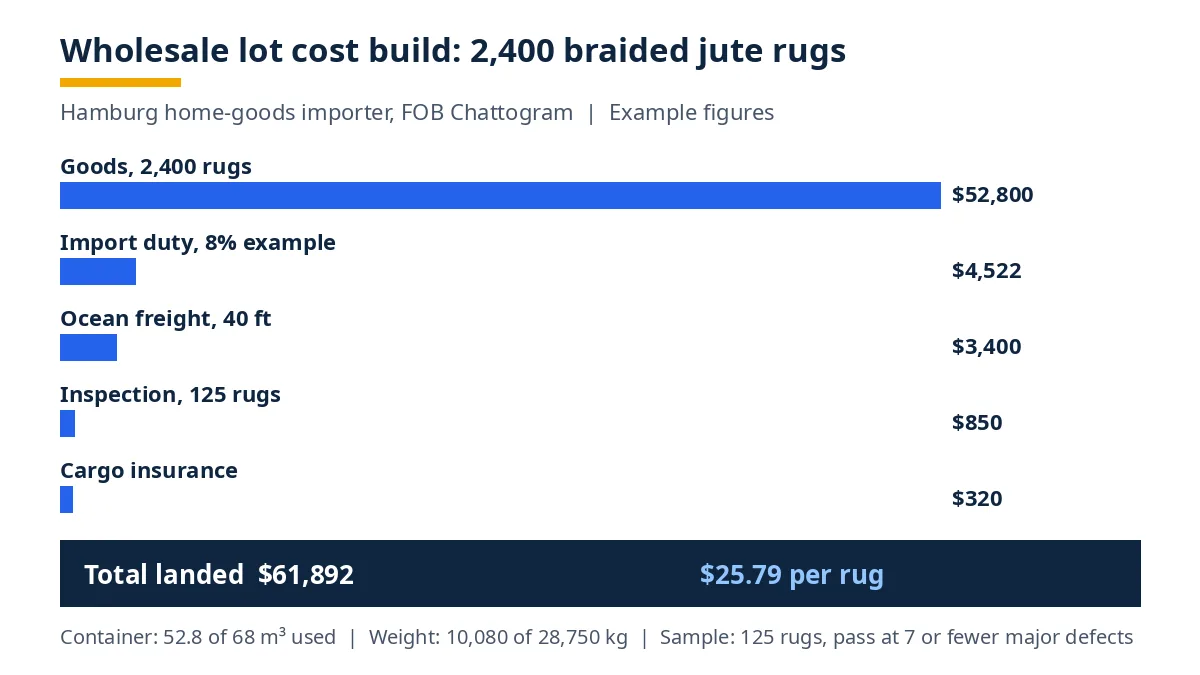
Cost line | Example figure | Notes |
|---|---|---|
Goods, 2,400 rugs at 22.00 dollars FOB | 52,800 dollars | Braided, 260 GSM, standard grade |
Pre-shipment inspection, AQL 2.5 Level II | 850 dollars | 125 rugs sampled |
Ocean freight, Chattogram to Hamburg | 3,400 dollars | One 40-foot container |
Cargo insurance | 320 dollars | Arranged by the importer |
Import duty, example 8 per cent of 56,520 dollars | 4,522 dollars | Example rate on goods, freight, insurance |
Total landed cost | 61,892 dollars | 25.79 dollars per rug |
52,800 plus 850 plus 3,400 plus 320 plus 4,522 gives 61,892 dollars, and 61,892 divided by 2,400 gives 25.79 dollars a rug. The goods are 85 per cent of the landed total, so a 1 dollar move in the per-rug price moves the lot by 2,400 dollars.
Each vacuum-sealed roll takes about 0.022 cubic metres, so 2,400 rolls take about 52.8 cubic metres against the 68 cubic metres a 40-foot dry container holds.3 Each rug weighs about 4.2 kg, so the lot weighs about 10,080 kg against the 28,750 kg payload limit.3
At 2,400 rugs the ISO 2859-1 plan is code letter K, a sample of 125 rugs, with 7 or fewer major defects to pass and 8 to fail at AQL 2.5.4 The importer unrolls the sample rugs, checks braid evenness and shade against the sealed reference, and measures size on a flat floor.
Common mistakes in wholesale rug orders
Comparing a per-piece price with a per-square-foot price, so the cheaper number is the larger rug.
Approving a sample in one shade lot and accepting production in another, with no sealed reference rug held back.
Ordering 2,400 rugs from a supplier whose weekly capacity was never stated, then learning the lot ships in three parts.
Writing no sampling plan into the order, so the inspection samples five rugs from the top carton.
Printing EU labels from the supplier's standard wording without checking the fibre percentages and the use-surface rule.
Treating an OEKO-TEX certificate for one rug as cover for the whole range, when it names a different construction or an expired year.
Questions buyers ask about wholesale jute rugs
What is a normal minimum order for wholesale jute rugs?
One Bangladeshi exporter sets the rug minimum at 50 to 100 units, with lead times of 2 to 6 weeks for custom orders.2 Treat that as a starting floor: freight and inspection costs only spread sensibly once the order fills a container.
How do I compare two wholesale rug quotations?
Ask for GSM, construction, size, shade, packing, documents and the price basis on one sheet, then compare landed cost per rug.
Does every rug in the lot need OEKO-TEX certification?
No. OEKO-TEX Standard 100 certifies the finished article, and the certificate names the article it covers.6 Check that it covers your construction, backing and dye.
Next steps on Exportain
Work out the landed cost per rug for your lot size, then check our classification guide and our jute rugs and carpets quality control checklist. When the specification is set, search Bangladeshi suppliers and raise an RFQ stating the grade, GSM, size, shade lot, quantity and container plan. Our wholesale jute bags guide shows the same wholesale math for a different jute product.
Sources
- Exports of jute and jute goods keep falling. The Financial Express, (accessed )
- Wholesale Woven Jute Bags & Rugs From Bangladesh. Imperial Jute (accessed )
- Container Dimensions. Transarya, (accessed )
- AQL Table & Sample Size Chart [2026]. CloudSpects, (accessed )
- Regulation (EU) No 1007/2011 on textile fibre names and related labelling and marking of the fibre composition of textile products. European Union, (accessed )
- OEKO-TEX Standard 100: Complete Guide. TextileTuts (accessed )
- Rug Flammability: 16 CFR 1630 vs 1631 for Importers. CargoTrans, (accessed )
About the author
Sourcing from Bangladesh?
Post a request for quotation and suppliers on Exportain can send you their quotes directly.
Post an RFQ