

Wholesale Hotel Linen From Bangladesh: Prices, MOQ and Reliable Suppliers
Wholesale hotel linen from Bangladesh means buying a core range in bulk tiers for resale or multi-property supply. This guide explains tier tables, stock commitments, distributor terms and replenishment cycles.
Short answer
Buying wholesale hotel linen from Bangladesh means agreeing a narrow core range of sheets, pillowcases and towels, buying it in bulk tiers, and topping it up on a cycle for resale or supply across properties. The tier table, the stock commitment behind it, and the replenishment rules matter as much as the unit price, because they decide whether the same item is available again next quarter.
On this page
Key takeaways
Wholesale hotel linen buying is a range business: a narrow core range bought in bulk tiers and topped up on a cycle, for resale or for supply across properties.
A tier table is only complete with its band basis, its price validity for top-ups, and the stock term behind each tier, all stated in writing.
Distributor and stockist terms differ on territory, exclusivity, stockholding and continuity of specification, and each must be agreed before the first bulk shipment.
A badge is a document and photo review, not a factory inspection and not a guarantee of capacity, quality or delivery.
Buying hotel linen at wholesale from Bangladesh means buying a stocked range in bulk tiers for resale or for supply across several properties, rather than placing a single order for one hotel opening. A wholesale buyer is usually a distributor, a stockist, a hotel-group central buyer, or a laundry and rental operator who will draw on the same sheets, pillowcases and towels again and again. The relationship turns on three things: the tier table at each volume, the stock commitment behind each tier, and the replenishment routine between bulk shipments.
This guide covers that channel only, not how a single hotel specifies an opening programme, how to inspect a shipment, or how hotel linen is classified for duty. Those questions are covered in the companion guides linked at the end.
Why this matters for buyers and sellers
For a distributor, the wholesale channel changes what a good order looks like. A retail-style order chases breadth: many colours, many sizes, small quantities of each. A wholesale order chases depth: a small number of core items, held in quantity, so a hotel customer can reorder the same white flat sheet or bath towel next quarter and receive the same item. Hotels replace linen continuously as items wear, stain or go missing, so depth is what makes a distributor useful.
For a hotel-group buyer, wholesale terms change the planning horizon: one range, one tier table and one replenishment cycle, drawn on property by property. For a laundry or rental operator, the question is replacement rate: the supplier must repeat the same item on the same specification over many cycles.
For the seller, a bulk tier order lets a mill or exporter plan sheeting and terry runs in larger lots and hold finished stock against a named range. In return, the seller takes on the stock risk: finished goods sitting in a warehouse for a buyer who may reorder slowly. That trade is why tier prices, stock commitments and reorder terms belong in the same written agreement.
Bangladesh sits in this channel as a home-textile exporting country: the Export Promotion Bureau has proposed a home-textiles export target of $1.065 billion for fiscal year 2026-27, within a total proposed export target of $66 billion.1 That figure is a proposed target, not a measure of any one supplier.
Step-by-step: how wholesale ordering works
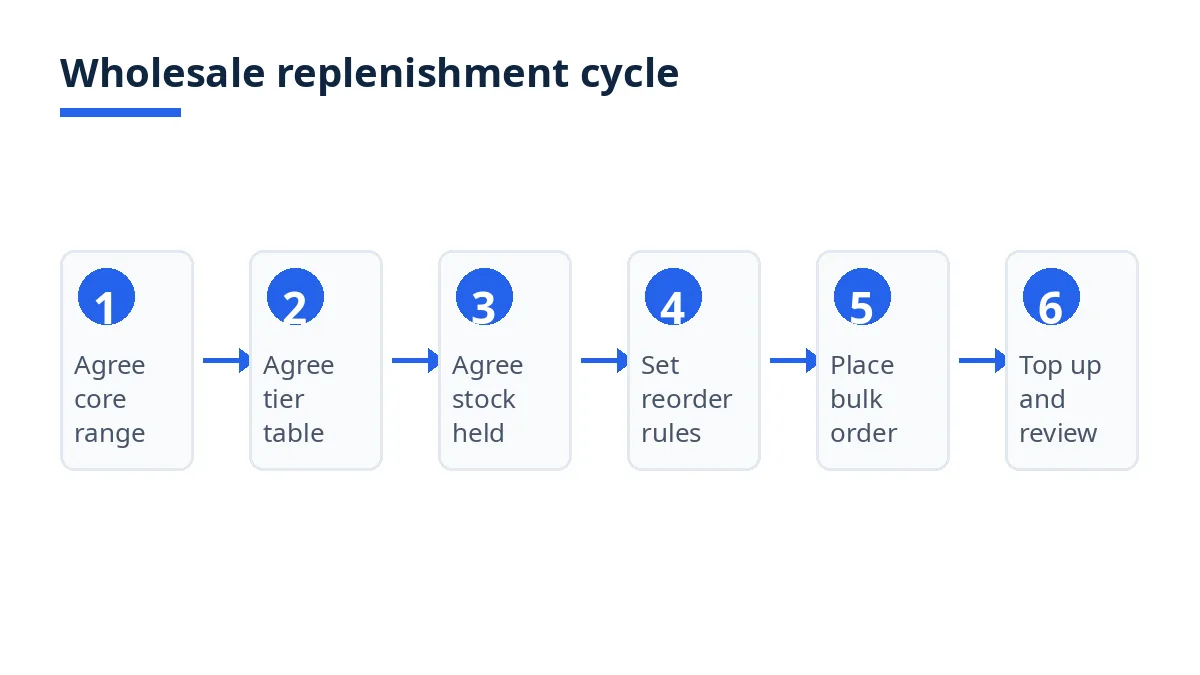
Wholesale ordering runs as a cycle, not as a single purchase:
Fix the core wholesale range. List the items you will stock, by item and size only, and cut everything else. A workable core range might be two sheet sizes, one pillowcase size, one bath towel and one hand towel, all in white.
Agree the tier table in writing. Record the volume bands, the unit price at each band, and whether the band counts per item, per shipment or per contract period.
Agree what the supplier holds. State the stock commitment behind each tier: pieces of each core item held as finished stock, how often stock levels are confirmed, and what happens when a core item runs out.
Set the replenishment rules. Agree a reorder point for each core item, a standard top-up quantity, and a fixed ordering day or cycle.
Place the first bulk order against the tier table. Confirm the tier each item reaches, the delivery term, the packing, and the labelling for resale.
Run the top-up cycle and review the tiers. After two or three top-ups, compare actual draw against the tier bands, and renegotiate the band structure if one item consistently misses its band.
Bulk tiers, distributor terms and stockist terms
A tier table prices the same item differently at different volumes: the buyer commits to a larger quantity, and the supplier passes on part of the saving from a larger, simpler run. Three terms deserve separate attention. First, the band basis: whether the quantity counts per item, per shipment, per contract period, or across items. A band that counts across items can leave the slowest item at the highest price. Second, the price validity: how long the tier price holds, and whether it holds for top-ups as well as for the first bulk order. Third, the stock term: whether the supplier holds finished stock, makes to order, or holds undyed stock to finish on order. Finished stock gives the fastest top-up; made-to-order gives the slowest repeat.
Example figures: the table below shows how a tier table can be structured. Every figure is an example figure only, not a quote or a typical price.
Tier | Quantity per item per order | Example figures: unit price index | Stock term in the example |
|---|---|---|---|
Tier 1, single-case buying | 100 pieces | 100 | Made to order |
Tier 2, stockist band | 500 pieces | 94 | Finished stock held for core items |
Tier 3, distributor band | 2,000 pieces | 88 | Finished stock held, monthly stock report |
Your own table will differ in every number, but not in structure: band basis, price validity and stock term stated for each tier, in writing, before the first order.
A distributor agreement and a stockist arrangement are not the same thing, and the written terms should say which one you hold. A distributor buys in bulk tiers, holds stock, and resells to hotels or smaller trade buyers in a defined territory or customer group. A stockist holds a narrower range for immediate supply, often on shorter cycles, and may buy from a distributor rather than from the mill directly. Agree before the first bulk shipment: territory, exclusivity, minimum stockholding, stock report, reorder point, price validity, freight on top-ups, and the procedure when a core item is discontinued.
For hospitality-contract supply, add continuity of specification: record the specification reference per item, and agree that any change to fibre, weight, size or finish is notified in writing before shipment.
Costs, timelines and documents
What are the typical costs and timelines?
There are no typical wholesale costs or timelines that hold across suppliers, because each tier table, stock term and delivery term changes both. The cost elements, however, are stable, and a buyer should see each one as a separate line: the unit tier price; freight per shipment, where a bulk shipment spreads freight across many pieces while a small top-up carries a higher cost per piece; warehousing, including working capital tied up in distributor stock; and replacement for linen lost or worn out in use, which sets the true repeat quantity.
For timelines, separate the first bulk order from the top-up cycle. The first bulk order follows a production timeline: confirmation, production or finishing, packing and shipment. A top-up from finished stock is shorter: order, pick, pack and ship. Ask for both timelines, in writing, per item.
Which documents are needed?
The wholesale document set has two layers. The commercial layer is the tier agreement itself: the core range list, the tier table with its band basis and validity, the stock commitment, the replenishment rules, the delivery term, and the specification reference per item. Amend it in writing when a tier or an item changes.
The export layer is the set required for goods to leave Bangladesh. Goods may not be loaded unless an export declaration, the Bill of Export or Shipping Bill, is submitted to Customs and approved.2 The documents enclosed include the export contract or purchase order where there is no export letter of credit, the commercial invoice, the packing list, the EXP form certified by an authorized dealer, and a certificate of origin issued by the Export Promotion Bureau or a Chamber of Commerce and Industry.2 Confirm the export paperwork names the same items, quantities and values as the tier order.
For resale labelling, check the rules of your own market before the first bulk shipment. In the European Union, Regulation (EU) No 1007/2011 covers textile fibre names and fibre-composition labelling, and a textile product is to be labelled or marked with the name and percentage by weight of all constituent fibres in descending order.3 Agree that labelling at the tier stage, not after the goods arrive.
Bangladesh-specific rules and tips
Use one delivery term across the whole cycle. The Incoterms 2020 rules comprise 11 rules with a clear allocation of cost, risk and obligations.4 A cycle that mixes terms makes tier prices hard to compare. Pick one rule and one named place, and state it on the tier agreement and on each order.
Confirm the stock claim before you rely on it. Ask for the current stock figure per core item, the date of the last stock count, and the lead time for a standard top-up. Then test it with a small top-up before committing to the highest tier.
Plan replenishment around the hotel calendar, and treat the tier agreement as a living document. Hotels replace linen heaviest before peak seasons, so share that pattern when you agree reorder points, and amend the range list and tier table together when a size or weight changes.
Mistakes and red flags
What are the most common mistakes?
Buying a retail assortment at wholesale quantities. A wide range with thin depth in each item gives the distributor nothing to sell twice. Wholesale value comes from depth in a few items.
Accepting a tier table without a stock commitment. A low price at a high tier means little if the supplier makes to order and the top-up takes a full production cycle. The stock term is part of the price.
Counting the tier across mixed items. If the band counts sheets, towels and table linen together, the headline tier may be reached while no single item earns its own tier price.
Setting no reorder point. Without a reorder point per item, top-ups happen when stock runs out, the most expensive moment to order. Set the point from actual draw over two or three cycles.
Agreeing a tier price that covers only the first shipment. If the tier price expires after the bulk order, every top-up is renegotiated at spot prices. Confirm price validity for top-ups.
Reading a badge as a guarantee. Supplier profiles on Exportain carry document and photo review badges, and a badge is not a guarantee of production capacity, product quality or delivery.5 Verification is a document and photo review, not a factory inspection.6 For a wholesale commitment, the stock evidence and the tier agreement matter more than any badge.
Red flags include a tier table with no band basis stated, a stock claim with no stock figures or dates, a price valid only until the first shipment, or a refusal to put the tier table in writing. Any one of these is a reason to pause before ordering.
Checklist
Before you sign a wholesale tier agreement, every line below should be answered in writing.
Core range fixed: items and sizes only, everything outside the range cut.
Tier table agreed: bands, unit price per band, band basis per item.
Price validity confirmed for top-ups, not only the first bulk order.
Stock commitment per core item: quantity held, stock report frequency, out-of-stock procedure.
Reorder point and standard top-up quantity set per item.
Delivery term agreed for the whole cycle, on one Incoterms 2020 rule and named place.4
Packing confirmed: pieces per carton, cartons per pallet, labelling for resale.3
Specification reference recorded per item, with written notice required for any change.
Export set confirmed: contract or purchase order, invoice, packing list, EXP form, certificate of origin.2
Territory, exclusivity and stockholding terms stated, if a distributorship.
Continuity clause agreed: repeat items match the original specification.
How Exportain helps
On Exportain, browse suppliers and post a wholesale request on the RFQ board stating the core range, the tier structure you want quoted, the stock term you require, and the delivery term for the cycle. Ask each reply for its tier table with band basis, price validity and stock commitment stated separately. When you accept a quotation, Exportain creates one order and issues one proforma invoice from the accepted terms, including quantity, unit price, currency and Incoterm as quoted.5
Read the badges for what they record. Exportain Verified means Exportain has checked identity, phone, email and business registration, and Export Verified means it has checked the Export Registration Certificate (ERC).5 Factory Verified means it has reviewed photos of the manufacturer factory, while Trading Company Verified means it has reviewed photos of the trading company office or warehouse.5 Verification is a document review by staff, free, and never granted by membership plans, and it is not a factory inspection.5 6 See how supplier verification works on Exportain and finding suppliers in Bangladesh before you shortlist.
FAQs
What should I know first about hotel linen?
Wholesale hotel linen buying is a range business, not a single-order business. The buyer agrees a narrow core range, buys it in bulk tiers, and tops it up on a cycle for resale or for supply across properties. The tier table, the stock commitment and the replenishment rules matter as much as the unit price, because they decide whether the same item is available again next quarter.
What are the typical costs and timelines?
There are no typical wholesale costs or timelines, because each supplier sets its own tier table, stock term and delivery term. The cost lines are the unit tier price, freight per shipment, warehousing and working capital, and replacement for linen lost or worn out in use. Timelines split in two: the first bulk order follows a production timeline, while a top-up from finished stock is shorter.
Which documents are needed?
The commercial set is the tier agreement: core range list, tier table with band basis and validity, stock commitment, replenishment rules, delivery term and specification reference per item. The export set enclosed with the Bill of Export includes the export contract or purchase order where there is no export letter of credit, the commercial invoice, the packing list, the EXP form certified by an authorized dealer, and a certificate of origin.2
What are the most common mistakes?
The most common mistakes are buying a wide retail assortment instead of a deep core range, accepting a tier table with no stock commitment, counting a tier across mixed items, setting no reorder point, and letting a tier price expire after the first shipment. A further mistake is reading a badge as a guarantee: it is a document and photo review, not a factory inspection and not a guarantee of capacity, quality or delivery.5 6
Next steps on Exportain
Browse suppliers, then post your core range, tier structure and stock term on the RFQ board so suppliers quote the same wholesale terms. Before you shortlist, read how to import hotel linen from Bangladesh for the single-programme view, and the hotel linen quality control checklist for the item checks to agree before your first bulk order.
Sources
- EPB charts $66b export roadmap for FY27. The Financial Express (accessed )
- Customs Clearance Procedures for Export. Bangladesh Customs, National Board of Revenue (accessed )
- Regulation (EU) No 1007/2011 on textile fibre names and related labelling and marking of the fibre composition of textile products. European Union, (accessed )
- Incoterms® 2020. International Chamber of Commerce (ICC) (accessed )
- Trust & Safety Center. Exportain (accessed )
- Supplier verification: Earn trust badges buyers can see. Exportain (accessed )
About the author
Sourcing from Bangladesh?
Post a request for quotation and suppliers on Exportain can send you their quotes directly.
Post an RFQ


