

Wholesale Frozen Fish From Bangladesh: Prices, MOQ and Reliable Suppliers
Wholesale frozen fish from Bangladesh, built as a channel: line-by-line assortments, per-line minimums, replenishment rhythms, cold-chain terms, and the fishery and destination documents to settle before shipment.
Short answer
Wholesale frozen fish from Bangladesh means buying an assortment of lines — one species, in one cut, in one pack size, at one grade — for resale through distributors, foodservice, or retail. Build the line list first, set a per-line minimum and replenishment rhythm for each line, agree cold-chain and temperature-record terms in writing, and compare quotations line by line on one delivery term. Confirm the fishery health certificates and your destination's food-safety rules before shipment.
On this page
Key takeaways
A wholesale assortment is built line by line: one species, in one cut, in one pack size, at one grade, each with a named customer group, a per-line minimum, and a replenishment rhythm.
Prices are structured in tiers per line, and timelines run per line group: a mixed assortment ships when its slowest line is ready unless split shipments are agreed.
Quick frozen finfish must reach -18°C or colder at the thermal centre and stay deep frozen through transportation, storage, and distribution, so cold-chain terms belong in the written specification.
Fishery health certificates come through the Department of Fisheries e-certification route, while destination rules add their own layer: EU establishment and marking requirements, or US importer verification under the seafood HACCP rules.
A badge is a document and photo review, not a factory inspection: line specification, cold-chain terms, inspection, and payment terms are the buyer's real protection.
Wholesale frozen fish from Bangladesh is a channel decision before it is a product decision. A wholesaler does not buy one fish; it buys an assortment that has to keep moving through cold storage, distribution trucks, and customer freezers without a break in temperature, a gap in a popular line, or a slow line tying up working capital. The fish itself — whole, gutted, filleted, or cut into steaks — is only one part of the order. The rest is the structure around it: how many lines, how much of each, how often it replenishes, and on what terms each line is bought.
A wholesale assortment is built line by line. A line is one sellable unit: one species, in one cut, in one pack size, at one grade. A whole round fish and a fillet of the same species are two lines, not one, because they go to different customers, move at different speeds, and need different handling. Treat every line separately from the start, and the rest of the channel logic follows.
Why this matters for buyers and sellers
For a buyer, the wholesale channel changes what a good deal looks like. A low unit price on one line means little if that line sells slowly, needs a large minimum per shipment, or arrives in a pack size the buyer's customers will not take. A wholesaler's profit sits in turnover: lines that sell through, in pack sizes customers can use, on a replenishment rhythm that keeps stock fresh. A line that sits in a freezer for months costs money even when its purchase price looked attractive.
For a seller, the wholesale channel changes what a good order looks like. A processor or exporter serving wholesale buyers needs predictable, repeatable lines: the same species, cut, grade, glaze, and pack, shipment after shipment. Buyers who reorder the same lines let a supplier plan raw material, freezing, and packing; buyers who change the assortment every order push cost and risk back onto the supplier, and that cost returns in price, minimums, or lead time.
Step-by-step: how it works
Build the wholesale assortment in this order. Each step fixes a decision the next step depends on, and skipping a step usually means redoing a later one.
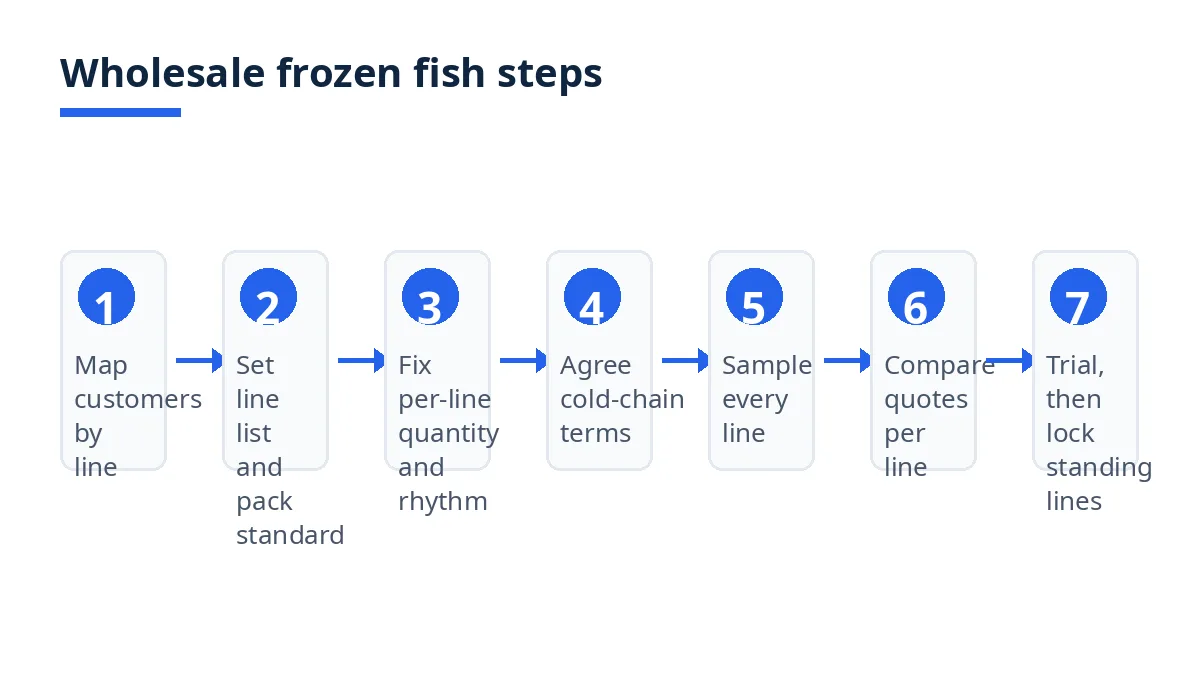
Map the customer base by line, not by species. List who buys from you — retailers, restaurants, caterers, institutions — and what each group takes: whole fish, fillets, steaks, or portion cuts, and in what pack size. A line with no named customer group is a guess, not an assortment.
Set the line list and the pack standard. For each line, write species and scientific name, cut, grade, glaze percentage, pack weight, inner and master carton, and labelling. Quick frozen finfish, uneviscerated and eviscerated, are covered by Codex STAN 36-1981, which requires the quick freezing process to bring the product to -18°C or colder at the thermal centre and to keep it deep frozen through transportation, storage, and distribution.1
Fix the per-line quantity and the replenishment rhythm. Decide the minimum per line per shipment, the order multiple (cartons per line), and how often each line reorders: weekly, fortnightly, or monthly. Fast lines replenish often in smaller lots; slow lines replenish rarely, and only in quantities the buyer can sell before quality or cash flow suffers.
Agree the cold-chain terms in writing. State the holding temperature, the reefer set point, the temperature record for the shipment, and who is responsible for temperature at each handover: factory cold store, port, vessel, destination cold store, and distribution. A temperature gap at any handover is a quality event even when the fish still looks frozen on arrival.
Sample each line, not just each species. Approve a sample of every cut and pack size you will sell, checked against the written line specification: cut, grade, glaze, pack weight, and labelling. A whole-fish sample approves nothing about a fillet line.
Compare quotations line by line on one delivery term. The Incoterms 2020 rules set out 11 rules with a clear allocation of cost, risk, and obligations.2 Compare suppliers only on the same term, the same line list, and the same pack standard, or the comparison is meaningless.
Run a trial assortment, then lock the standing lines. Ship the trial, sell it through, and record sell-through speed, damage, and customer complaints per line. Lines that sell through become standing lines with a fixed replenishment rhythm; lines that do not are dropped or repriced, not carried on hope.
Costs, timelines and documents
How wholesale pricing is structured
Wholesale prices are built in tiers, not as a single number. A tier is a quantity band for one line: the unit price changes when the ordered quantity crosses a band boundary. Tiers also differ by line, because a fillet line carries more processing cost than a whole-fish line, and a small retail pack carries more packing cost than a bulk catering pack. Compare tiers only within the same line and the same pack.
Example figures (structure only, not market rates): a buyer building an assortment of 6 lines might order 2 fast lines at a higher tier, 3 medium lines at a middle tier, and 1 slow line at the lowest tier that still meets the supplier's per-line minimum. The example shows the shape of a tiered assortment, not a typical line count, tier size, or price. Every figure in this section is an example figure; real prices come only from a supplier quotation against your written line list.
Timelines run per line, not per order
A wholesale order has several clocks, and they do not all run at the same speed. Raw material availability differs by species and season, and freezing and packing time differs by cut. A mixed assortment ships only when its slowest line is ready, unless the buyer agrees to split shipments. Ask for a date per line group, not one delivery week for the whole order.
Which documents sit in the order file
The wholesale order file holds the line list, the pack and labelling standard, the cold-chain terms, the itemised quotation, and the purchase order, with the delivery term stated once and used everywhere. The export set is separate: the exporter's bank certifies the EXP form for the shipment, and the Bill of Export or Shipping Bill is the customs document that evidences the shipment, carrying the package and goods description, gross and net weight, and HS code.3 The fishery set sits alongside it: health certificates and product test certificates for fish and seafood trade are issued through the Department of Fisheries system, including additional health certificates as per the importing country's requirements.4
Bangladesh-specific rules and tips
Use the Department of Fisheries e-certification route for the fishery documents. Bangladesh's e-certification and laboratory information management service, run by the Department of Fisheries, covers licences, health certificates, additional health certificates as per the importing country's requirements, sample collection, inspection, test reports, and certificate issuance, and is connected to customs.4 The system's user manual describes it as the national online portal for trade-related certifications, covering exporter licence applications and health certificate issuance, with real-time tracking of application status.5 Ask a supplier which certificates it will obtain for your destination, and confirm the certificate names against your destination's import rules before shipment.
Settle the destination food-safety rules line by line. In the EU, Regulation (EC) No 853/2004 lays down specific hygiene rules for food of animal origin, including fishery products, and importation from third countries is permitted only when the third country and the dispatching establishment appear on the applicable lists and the product satisfies the regulation's requirements, including health and identification marking.6 In the USA, every importer of fish or fishery products must either source from a country with an active memorandum of understanding covering the product, or have and implement written verification procedures, including product specifications and affirmative steps such as obtaining the foreign processor's HACCP and sanitation monitoring records for the specific lot.7
Write the cold chain as a specification, not a slogan. "Keep frozen" is not a term. State the product temperature at loading, the reefer set point, the temperature recorder type and placement, the acceptable range on arrival, and what happens when the record shows an excursion: rejection, inspection, or a price adjustment. The Codex standard's -18°C or colder thermal-centre requirement gives the buyer a reference point to write into the specification.1
Treat mixed containers as an assortment decision. A container holding several lines is efficient only when every line in it sells at a compatible speed. A fast line that sells out while a slow line fills the freezer means the next container must be ordered for one line alone, losing the mixed-container economy. Balance the container by sell-through speed, not by making every line the same quantity.
Mistakes and red flags
Which mistakes repeat most often
Buying species instead of lines. An order for "frozen fish" with no cut, grade, glaze, or pack standard per line cannot be inspected on arrival, because there is nothing to inspect against. Every dispute about a wholesale fish delivery traces back to an unspecified line.
Setting one minimum for the whole assortment. A single order minimum hides the real constraint, which is the per-line minimum. A buyer who meets a total minimum with ten thin lines has ten lines to sell through, each too small to justify its own replenishment. Check the per-line minimum before the order minimum.
Ignoring the slow line. The slowest line in an assortment decides how much freezer space and cash the assortment ties up. A slow line kept for range completeness needs a deliberate decision: a smaller pack, a lower minimum, or a decision to drop it. Carrying it by default is the most expensive way to keep it.
Accepting a temperature record nobody reads. A reefer log filed unread is not a cold-chain control. Name who reads the record, when, and what action follows an excursion, before the first shipment sails.
Reading a badge as a channel guarantee. A profile or badge is a starting point for enquiries. Exportain verification is a document and photo review, not a factory inspection, and a badge is not a guarantee of capacity, quality, or delivery.8 Your protection is the line specification, the cold-chain terms, the inspection plan, and the payment terms.
Checklist
Before you confirm a wholesale frozen fish assortment, every line should be answered in writing.
Customer group named for every line: retailer, foodservice, caterer, or institution.
Line list written: species and scientific name, cut, grade, glaze, pack weight, inner and master carton, labelling.1
Per-line minimum and order multiple stated, separate from any order total.
Replenishment rhythm set per line: weekly, fortnightly, or monthly, by sell-through speed.
Cold-chain terms written: holding temperature, reefer set point, temperature record, handover responsibilities, excursion action.1
Samples approved per line, not per species, against the written specification.
Quotations compared line by line on one delivery term.2
Destination food-safety obligations assigned in writing: EU establishment and marking rules or US importer verification, as applicable.6 7
Fishery documents confirmed: health certificates and any additional certificates for the destination, via the Department of Fisheries route.4 5
Export set agreed: EXP form, Bill of Export, commercial invoice, packing list.3
Trial assortment sold through and reviewed per line before standing lines are locked.
Inspection plan agreed: who inspects, against what specification, and what a failed line means for the rest of the container.
How Exportain helps
On Exportain, browse suppliers for frozen fish sellers and post a request for quotation (RFQ) on the RFQ board with your line list, pack standard, per-line quantities, replenishment rhythm, cold-chain terms, and delivery term, so suppliers quote against the same assortment and the same terms. Ask each reply for its per-line minimum, its glaze and pack standard, its temperature terms, and its fishery certificate route for your destination.
Read the badges for what they record. Exportain Verified means Exportain has checked identity, phone, email, and business registration, and Export Verified means it has checked the Export Registration Certificate (ERC).8 Factory Verified means it has reviewed photos of the manufacturer's factory, while Trading Company Verified means it has reviewed photos of the trading company's office or warehouse.8 Verification is a document review by staff, free, and never granted by membership plans.8 It is not a factory inspection,8 so line specification, cold-chain, and inspection decisions stay with you.
FAQs
What should I know first about frozen fish?
Start with lines, not species. A wholesale assortment is a set of lines — one species, in one cut, in one pack size, at one grade — each with a named customer group, a per-line minimum, and a replenishment rhythm. The quick freezing standard requires the product to reach -18°C or colder at the thermal centre and to stay deep frozen through transportation, storage, and distribution.1 Get the line list, pack standard, and cold-chain terms in writing before you discuss price.
What are the typical costs and timelines?
There are no typical wholesale figures a buyer can rely on, because each supplier prices your line list, pack standard, quantities, and delivery term for your order. Prices are structured in tiers per line, and timelines run per line group: a mixed assortment ships when its slowest line is ready unless split shipments are agreed. Costs beyond the unit price — freezing, packing, documentation, freight, insurance, clearance, and distribution — should appear as separate lines.2
Which documents are needed?
The order file holds the line list, pack and labelling standard, cold-chain terms, itemised quotation, and purchase order. The export set includes the EXP form certified by the exporter's bank and the Bill of Export or Shipping Bill.3 The fishery set includes health certificates and any additional certificates required by the importing country, issued through the Department of Fisheries system.4 5 Destination rules add their own layer: EU establishment and marking requirements,6 or US importer verification procedures under the seafood HACCP rules.7
What are the most common mistakes?
The most common mistakes are buying species instead of specified lines, setting one minimum for the whole assortment instead of per-line minimums, carrying a slow line by default, filing a temperature record nobody reads, and reading a badge as a channel guarantee. A further mistake is comparing quotations across different delivery terms or different pack standards: the Incoterms 2020 rules allocate cost, risk, and obligations differently under each rule, so only a same-term, same-line comparison is meaningful.2
Next steps on Exportain
Browse suppliers, then post your line list, pack standard, and replenishment rhythm on the RFQ board so suppliers quote per line on one delivery term. Before you confirm, read how supplier verification works on Exportain and the MOQ guide for the badge meanings and the per-line minimum mechanics that sit alongside this wholesale assortment work.
Sources
- Standard for Quick Frozen Finfish, Uneviscerated and Eviscerated (CXS 36-1981). Codex Alimentarius Commission (accessed )
- Incoterms® 2020. International Chamber of Commerce (ICC) (accessed )
- Guide to Export from Bangladesh as a Foreign Investor. tahmidurrahman.com (accessed )
- Bangladesh rolls out online certification system to simplify fish and seafood trade. International Collective in Support of Fishworkers (ICSF) (accessed )
- E-Certification System User Manual. Department of Fisheries, Bangladesh (accessed )
- Regulation (EC) No 853/2004 laying down specific hygiene rules for food of animal origin. European Union (accessed )
- 21 CFR 123.12 — Special requirements for imported products. GovRegs (accessed )
- How Supplier Verification Works on Exportain. Exportain, (accessed )
About the author
Sourcing from Bangladesh?
Post a request for quotation and suppliers on Exportain can send you their quotes directly.
Post an RFQ


