Wholesale Formal Suits From Bangladesh: Prices, MOQ and Reliable Suppliers
Formal suits from Bangladesh are priced as a matched jacket and trouser pair. This guide covers suiting cloth, construction, size runs, MOQ, pressing and supplier checks for wholesale buyers.
Short answer
A wholesale formal suit order from Bangladesh is priced per matched jacket and trouser pair, not per garment. Cloth, canvas construction and the size and length run set the price, while fit approval at the middle and end sizes, pair-matched inspection and form pressing set whether the suits sell. Ask each supplier to quote the same cloth, construction and pressing method on one delivery term.
On this page
Key takeaways
A formal suit is priced and inspected as a matched jacket and trouser pair: same cloth, same shade, same construction standard, and a size and length run that fits both ends of the range.
Suiting cloth is the largest cost line, and construction is the next: a fused jacket is cheapest, a half-canvassed jacket carries sewn canvas through chest and lapels, and a full-canvassed jacket carries canvas through the full front.
Approve fit at the middle size and at both ends of the range, and approve a pre-production pair in bulk materials as the sealed inspection reference.
State the quantity per jacket size, per length, and per trouser waist and length: a total quantity without that split cannot be cut as matched pairs.
Exportain verification is a document and photo review, not a factory inspection, so fit approval, pair matching and pressing checks stay with the buyer.
A formal suit fails as a pair, not as a single garment. A jacket that fits well beside trousers cut from a different cloth lot, a lapel that rolls cleanly on the sample but sits flat in bulk, or a trouser leg that loses its crease after one press can each turn an otherwise sound order into stock a shop cannot sell with confidence. Buying wholesale formal suits from Bangladesh therefore starts with the matched pair: the same cloth, the same shade, the same construction standard, and a size run that fits real bodies at both ends of the range.
That matched-pair test shapes every price conversation. Woven garments, the construction most formal suits use, earned $4.614 billion in July to September of fiscal year 2026-27, up 5.11 percent year on year, within ready-made garment exports of $10.578 billion, according to data released by the Export Promotion Bureau (EPB).1 One quotation may rest on a fused jacket in a stocked polyester-wool blend, another on a half-canvassed jacket in an imported wool suiting. The unit price only becomes comparable once cloth, construction, fit and finishing are fixed in the same terms for every supplier.
In the Harmonized System, heading 6203 covers suits, ensembles, jackets, blazers, trousers, bib and brace overalls, breeches and shorts for men or boys, not knitted or crocheted.2 A two-piece suit normally travels as jacket and trouser under that heading family, so confirm how the pair is classified for your destination before you fix the price, since classification drives duty and origin paperwork.
Why this matters for buyers and sellers
For a buyer, a suit order ties up more cash per unit than most woven garments, and the risk sits in fit rather than in fabric alone. A suit that is a size out at the shoulder or a length out at the trouser hem cannot be salvaged by a price cut, because the customer tries it on. For a seller, suiting cloth is cut in matched jacket-and-trouser sets, and a size run changed late wastes cloth already laid for the pair. Both sides gain from fixing the pair, the construction and the size run before bulk cutting.
What should I know first about formal suits?
Know the three decisions that move the price most: cloth, construction and fit. Cloth sets the material cost and the hand of the finished suit. Construction sets how the jacket holds its shape. Fit sets how many sizes and lengths you must carry, and how much cloth each size consumes. Until those three are written into the tech pack, a quotation is a guess, and two quotations for "formal suits" cannot be ranked.
Step-by-step: how it works
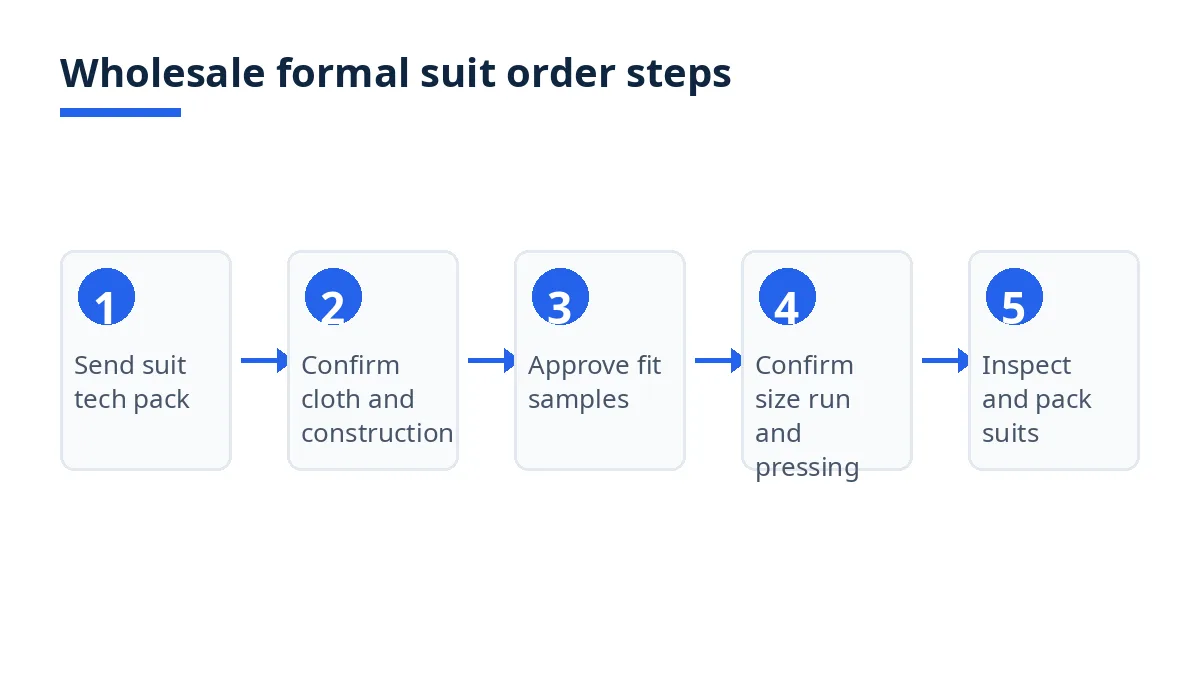
Write a suit tech pack, not a style name. State the jacket model (single or double breasted, button count, lapel type, vent count), the trouser model (flat front or pleated, waistband, hem finish), cloth composition, weight and shade standard, lining, canvas method, trim details, the full size and length run, and the packing method.
Fix cloth and construction in one reply. Ask each supplier to confirm the exact suiting cloth by composition, weight and mill or stock reference, and to state fused, half-canvassed or full-canvassed construction in writing. A half-canvassed jacket carries a sewn canvas through the chest and lapels with fused material below, while a fused jacket uses heat-pressed adhesive instead of sewn canvas and is the most affordable option, though less breathable and more prone to bubbling over time.3
Approve a fit sample on a body, not on a hanger. Order a proto sample, then a fit sample in the bulk cloth at a middle size and one size at each end of the range. Check shoulder slope, lapel roll, jacket length, trouser waist, seat, rise and hem break, and record every correction in writing.
Confirm the size run and the cloth booking together. State the quantity per jacket size, per length (short, regular, long where offered) and per trouser waist and length, so the factory can book cloth for matched pairs rather than for a total piece count. A total that mixes jackets and trousers cannot be cut.
Approve a pre-production suit in bulk materials. Check the pair together: shade match between jacket and trouser, lapel roll, button stance, trouser crease, lining finish, and pressing quality. Keep one sealed pair as the inspection reference.
Agree inspection and delivery term before confirming. Write the inspection level and acceptance quality limit (AQL) values into the purchase order. ISO 2859-1 defines sampling schemes indexed by AQL for lot-by-lot inspection, and AQL is the maximum average percentage of defective items considered acceptable during random sampling.4 State one Incoterm and named place for every quotation.5
Costs, timelines and documents
Suiting cloth is usually the largest single cost line, and its price moves with fiber content, fineness and weight. A wool suiting costs more than a polyester-wool blend of the same weight, and a finer wool yarn costs more than a coarser one, so a quotation naming only "wool blend" hides the main price driver. Ask for composition, weight in grams per square metre, and whether the cloth is stocked or must be ordered in, because an ordered-in cloth adds both a minimum and a waiting period before cutting.
Construction is the second cost line, and it is where two similar-looking jackets diverge. A fused jacket is cheapest to produce, a half-canvassed jacket sits above it because canvas is sewn through the chest and lapels, and a full-canvassed jacket sits above both because the canvas runs the full front of the jacket.3 Pressing and finishing form the third cost line buyers often miss: a suit needs form pressing to set the lapel roll and the trouser crease, and the method (hanger with suit bag versus folded flat pack) changes finishing time and the carton plan. Ask for pressing, suit bag or cover, hanger and carton costs as separate lines, so a cheaper flat-packed price is not compared with a hanger-packed price as if they were the same offer.
Cost line | What moves it | State in your enquiry |
|---|---|---|
Suiting cloth | Fiber, fineness, weight, stocked or ordered in | Composition, weight, shade standard, stock status |
Construction | Fused, half-canvassed or full-canvassed | Canvas method in writing |
Fit and grading | Size range, lengths, trouser waist and length matrix | Full size and length run |
Trim and lining | Buttons, lining, canvas, shoulder pads | Trim and lining specification |
Pressing and packing | Form pressing, suit bag, hanger, carton | Pressing and packing method |
Delivery term | Freight, insurance, risk transfer point | One Incoterm and named place5 |
Example figures: a buyer orders 600 suits in one shade, split across five jacket sizes and three lengths, with trousers matched by waist and length. The factory prices cloth per matched pair, the canvas method per jacket, and form pressing per suit, with pressing shown apart from the unit price. The example shows structure only, not a typical price, MOQ or lead time.
What are the typical costs and timelines?
There are no typical suit costs or timelines a guide can state as fact, because each factory prices your cloth, canvas method, size run, pressing method and delivery term separately.5 Timelines depend on cloth availability first: a stocked cloth can move to sampling at once, while an ordered-in suiting cloth sets the earliest cutting date. After cloth, the timeline follows fit corrections, grading, bulk pressing capacity, and inspection against the sealed pair. Ask for cloth ready, sample approval, production, pressing and inspection dates as separate lines, not a single delivery week.
Which documents are needed?
The order papers are the suit tech pack, the itemized quotation showing cloth, construction, pressing and packing as separate lines, the purchase order carrying the size and length run and the inspection plan,4 and the written fit approvals for the middle and end sizes. Confirm in the quotation who handles shipment papers and which delivery term applies, so that handling cost is not discovered after the price is agreed.5
Before loading, have the supplier or your agent confirm the current export declaration requirements with Bangladesh Customs — the rule set behind the shipment paperwork, not the paperwork itself.6
Bangladesh-specific rules and tips
Keep the pair together through every paper. The jacket and the trouser share one shade standard and one cloth booking, so the name, shade reference and cloth reference on the tech pack, quotation, proforma invoice and packing list should match exactly. A shade code that differs by one letter between the jacket paper and the trouser paper is how a pair arrives in two shades.
Confirm who holds the suiting cloth. Much suiting cloth for formal suits is ordered in rather than stocked, so ask whether the supplier holds the cloth, has it on order with a confirmed date, or will order it only after your deposit. A supplier that cannot name the cloth position cannot give a firm cutting date, and a late cloth delivery moves pressing and shipment with it.
Check fit skill, not only sewing capacity. A factory can sew a straight seam well and still fail a suit, because the shoulder, lapel roll and trouser drape depend on pattern and pressing skill. Ask for a sample in your cloth at your middle and largest sizes, and judge the shoulder line and trouser break before you judge the price.
Plan pressing capacity into the schedule. Form pressing is a separate station from sewing, so ask how many suits the pressing section completes per day and whether hanging or folded packing changes that rate, then set the inspection date after pressing, not after sewing.
Label for the destination market. For the European Union, Regulation (EU) No 1007/2011 governs fibre labelling: every constituent fibre must appear by name with its share by weight, heaviest first.7 Match the fiber content and care wording on the label to the bulk cloth before printing begins.
Mistakes and red flags
What are the most common mistakes?
Ordering suits by total quantity only. A total of 600 suits means nothing until it is split by jacket size, length, trouser waist and trouser length. An order can clear a factory total and still fail because one length or one waist size falls below its cutting minimum.
Comparing a fused price with a half-canvassed price. The two jackets look alike on a hanger and differ in canvas, drape and pressing behavior. Compare only replies that state the same canvas method, the same cloth and the same pressing and packing method.3
Approving fit on one size. A suit graded from a single middle size can drift at the smallest and largest sizes, where the shoulder and the trouser seat change most. Approve fit at the middle size and at both ends of the range before bulk cutting.
Skipping the pair check at inspection. Inspecting jackets and trousers as separate lots misses the failure that matters most for suits: shade or cloth mismatch within the pair. Inspect sealed pairs, and write pair matching into the defect classes of the inspection plan.4
Accepting a verbal construction promise. A supplier that says "half canvas" in a call and writes only "suit" on the quotation has promised nothing enforceable. Record the canvas method, cloth reference and pressing method on the quotation and purchase order.
Treating a profile as proof of suit skill. A profile shows a business exists and trades; it does not prove pattern, canvas or pressing skill. Judge the fit samples and the sealed pair.
Checklist
Before you confirm, every line should be answered in writing.
Suit tech pack sent: jacket model, trouser model, cloth, lining, canvas method, buttons, sizes and lengths, packing.
Cloth confirmed: composition, weight, shade standard, stocked or ordered in, and cloth position with a date.
Construction stated in writing: fused, half-canvassed or full-canvassed.3
Fit approved at the middle size and at both ends of the range, with corrections recorded.
Quantity split per jacket size, per length, per trouser waist and per trouser length, with matched pairs.
Pressing method, suit bag or cover, hanger and carton agreed, with pressing priced apart from the unit price.
Pre-production pair approved in bulk materials and sealed as the inspection reference.
Inspection level, AQL values and pair-matching defect classes in the purchase order.4
Quotations compared on the same cloth, construction, pressing method and Incoterm.5
Label fiber content and care wording checked against the bulk cloth.7
How Exportain helps
On Exportain, browse suppliers and post your suit tech pack summary, size and length run and delivery term on the RFQ board, so suppliers quote against the same cloth, construction and pressing specification. Read what each badge records on how supplier verification works on Exportain before you rely on it, and keep fit approval and inspection with you.8 9
FAQs
What should I know first about formal suits?
Know the three decisions that move the price most: cloth, construction and fit. A half-canvassed jacket carries sewn canvas through the chest and lapels with fused material below, while a fused jacket uses heat-pressed adhesive and is the most affordable option.3
What are the typical costs and timelines?
There are no typical figures a buyer can rely on, because each factory sets its price and lead time for your cloth, canvas method, size run, pressing method and delivery term.5 Cloth availability sets the earliest cutting date, fit corrections set sampling time, and pressing capacity sets finishing time, so ask for each stage as a separate date.
Which documents are needed?
The order papers are the suit tech pack, the itemized quotation, the purchase order carrying the size and length run and inspection plan,4 and the written fit approvals. Confirm who handles shipment papers and which delivery term applies in the quotation, so that handling cost is agreed before the price is fixed.5
What are the most common mistakes?
The most common mistakes are ordering by total quantity without a size and length split, comparing a fused price with a half-canvassed price,3 approving fit on one size only, and inspecting jackets and trousers as separate lots instead of as matched pairs. Record the canvas method, cloth reference and pressing method on the purchase order, and inspect pairs against the sealed pair.4
Next steps on Exportain
Raise your suit tech pack summary, size and length run and delivery term as an RFQ after browsing suppliers, and ask every reply to price per matched pair. Study how to import formal suits from Bangladesh, the MOQ definition guide and the HS code for formal suits guide before confirming.
Sources
- RMG exports rise 6.10% to $10.58b in July-Sept of FY27. tob.news, (accessed )
- Classification Detail — HS Code 6203. United Nations Statistics Division (accessed )
- Full Canvas vs Half Canvas vs Fused Suit. SUITABLEE (accessed )
- ISO 2859-1:2026 - Sampling procedures for inspection by attributes — Part 1: Sampling schemes indexed by acceptance quality limit (AQL) for lot-by-lot inspection. ISO (accessed )
- Incoterms® 2020. International Chamber of Commerce (ICC) (accessed )
- Customs Clearance Procedures for Export. Bangladesh Customs, National Board of Revenue (accessed )
- Regulation (EU) No 1007/2011 on textile fibre names and related labelling and marking of the fibre composition of textile products. European Union, (accessed )
- Trust & Safety Center. Exportain (accessed )
- Supplier verification: Earn trust badges buyers can see. Exportain (accessed )
About the author
Sourcing from Bangladesh?
Post a request for quotation and suppliers on Exportain can send you their quotes directly.
Post an RFQ