

Wholesale Duvet Covers From Bangladesh: Prices, MOQ and Reliable Suppliers
Wholesale duvet covers from Bangladesh, compared on one specification: price drivers, MOQ per design and colour, and a supplier scorecard for fabric, closure, corner ties, size after washing and finishing.
Short answer
Wholesale duvet covers from Bangladesh have no single price or MOQ. Each supplier prices your fabric, closure, corner ties, size after washing, finishing and set composition, and sets its minimum per design and colour. Compare suppliers only on one identical specification sheet and delivery term, score fabric, closure, ties, washed size and finishing side by side, and confirm the binding MOQ line and inspection plan in writing before ordering.
On this page
Key takeaways
Wholesale duvet covers from Bangladesh have no single price or MOQ: each supplier prices and sets its minimum for your specification, per design and per colour.
Compare suppliers only on one identical specification sheet covering fabric, closure, corner ties, size after washing and finishing, on the same delivery term.
Fabric, dyeing or printing, closure, corner ties, size after washing, finishing, set composition and packing are the price and MOQ drivers to itemise in every quotation.
Ask for the MOQ per design, per colour and per size, and name the binding line in writing, because a total that clears the order minimum can still fail per colour.
Exportain verification is a document and photo review, not a factory inspection, and a badge is not a guarantee.
Wholesale duvet covers from Bangladesh are bought in bulk by retailers, brands, hotel suppliers and distributors in the United States, the United Kingdom, the European Union and the United Arab Emirates. The buying decision is rarely about finding the lowest headline price. It is about comparing suppliers on the same cover, with the same fabric, closure, corner ties, size after washing and finishing.
Why this matters for buyers and sellers
For a wholesale buyer, duvet covers tie up more working capital than a small apparel order, because each cover uses two large panels of sheeting fabric and is often sold in sets with pillowcases. For a seller, a wholesale order is planned production: fabric woven, dyed or printed in batches, cut to a size range and sewn with a set closure. Work orders for home textiles are booked for one or two seasons in bulk quantities, so an enquiry that arrives with a finished specification can be planned and priced, while a vague enquiry cannot.1
What should I know first about duvet covers?
A duvet cover is bed linen: a sewn envelope that holds a duvet insert, closed at one end and usually sold on its own or in a set. In the Harmonized System, heading 6302 covers bed linen, table linen, toilet linen and kitchen linen, with bed linen split by construction and fibre, including 6302.21 for printed cotton bed linen and 6302.31 for other cotton bed linen, neither knitted nor crocheted.2 The split matters for wholesale buying because each design in an order can sit on a different classification line, and the classification line is part of what a quotation should state.
Five specification points decide whether two wholesale quotes can be compared at all: fabric (fibre composition, weave, finished weight), closure (envelope flap, buttons, snaps or zip, and its position), corner ties or loops inside the cover, size after washing measured on a washed cover fitted over the insert it will be sold for, and finishing (dyeing or printing route, shade standard and packing, including set composition and cartons). Hold those five fixed across every supplier, and the quotes become comparable.
Step-by-step: how it works
Wholesale comparison works when every candidate answers the same questions, in the same format, on the same delivery term.
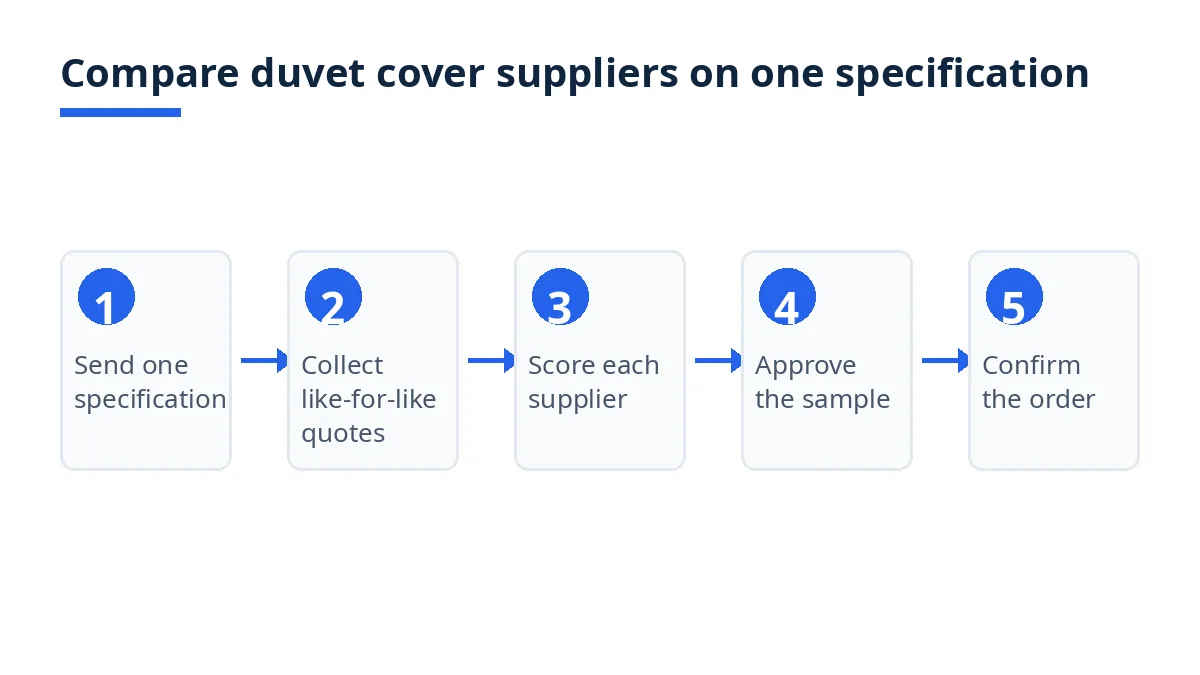
Write one specification sheet. State fibre composition, weave, finished weight, size chart with sizes after washing, closure type and position, corner ties or loops, print or colour standard, set composition, label wording and packing. Add the insert size each cover is made to fit.
Send the identical sheet to every candidate. Add the split, not only the total: quantity per design, per colour and per size, with the size ratio per colour.
Ask for the same reply format. Require fabric assumed, closure fitted, corner ties, pieces per set, price inclusions and exclusions, validity, MOQ per design and per colour, and one delivery term with a named place.
Score the replies on one sheet. Mark any reply that changes the fabric, closure, ties, size basis or finishing as a different offer, and ask for a requote on the stated specification before ranking it.
Approve samples in writing. Order a pre-production sample in the actual fabric, colour, closure and finishing. Wash it, measure it after washing, fit it over the named insert, work the closure and pull the corner ties, then approve or list corrections in writing.
Confirm inspection and documents before production. Write the inspection plan and defect limits into the purchase order, and confirm the export document set below. The Incoterms 2020 rules give a clear allocation of cost, risk and obligations for each rule, so compare quotations only on the same rule.3
Costs, timelines and documents
What are the typical costs and timelines?
There is no typical wholesale price or timeline for duvet covers that a guide can state as a market rate, because each supplier prices your fabric, construction, closure, print or dye work, finishing, packing and delivery term. What can be compared is the structure of the price: which lines are included, which are excluded, and which specification choice moves each line.
Price and MOQ driver | What to ask each supplier to state | Why it moves the quote |
|---|---|---|
Fabric | Fibre, weave, finished weight, width | Two large panels per cover, so fabric weight and width set much of the material cost |
Dyeing or printing | Route, colour standard, lots per colour | Batch work sets the minimum per colour |
Closure | Type, position, flap depth where fitted | A zip, buttons or snaps each add material and sewing operations |
Corner ties or loops | Included or not, position, length, stitching | Small parts, but missing ties change how the cover performs in use |
Size after washing | Chart measured after washing, insert size fitted | Cutting and shrinkage allowances change fabric use |
Finishing | Pressing, shade standard, inspection level | Finishing and inspection time may sit inside or outside the price |
Set composition | Cover only, or cover plus pillowcases | Pillowcases add fabric, sewing and shade matching across the set |
Packing | Fold, polybag, carton count, markings | Carton and marking choices change packing cost |
Example figures: a buyer asks three suppliers for the same cover, and the quotes differ. Supplier A quotes a printed cotton cover with a concealed zip and corner ties. Supplier B quotes the same size in a solid-colour blend with an envelope flap and no ties. Supplier C quotes the stated specification but excludes packing and inspection from the unit price. None of the three prices can be ranked until B is requoted on the stated specification and C states packing and inspection as priced lines. The example shows structure only, not a market price, MOQ or lead time.
Example figures for MOQ work the same way. A buyer splits an order across four colours, and each colour sits below the dye-lot minimum even though the total clears the order minimum. The same total in two colours can clear both lines. Ask for the MOQ per design, per colour and per size, and name the binding line in writing.
Timelines also split into separate lines: sampling, fabric ready, production and inspection dates, not a single delivery week. Plan around the seasonal booking pattern for home textiles, where work orders are booked for one or two seasons in bulk quantities.1
Which documents are needed?
The buyer documents are the specification sheet, the itemised quotation, the purchase order with the split and the delivery term, the written sample approval and the inspection plan. The export document set sits with the seller and the clearing agent. Goods may not be loaded unless an export declaration, the Bill of Export or Shipping Bill, is submitted to Customs and approved.4 Documents enclosed with the Bill of Export for all export consignments include the export letter of credit, or where there is no letter of credit the export contract, purchase order or export guarantee approved by the negotiating bank, the commercial invoice, the packing list, the EXP form certified by an authorized dealer, the certificate of origin issued by the Export Promotion Bureau (EPB) or a Chamber of Commerce and Industry, the VAT registration certificate and the Taxpayer Identification Number.4
Bangladesh-specific rules and tips
Confirm the classification line per design. Heading 6302 splits bed linen by knitted or crocheted construction, by printed or other, and by fibre.2 A printed cotton cover, a plain cotton cover and a man-made fibre cover in one order can sit on different lines, so ask each supplier to state the line assumed for each design.
Agree fibre labelling at sampling stage. For sales into the European Union, Regulation (EU) No 1007/2011 states that a textile product shall be labelled or marked with the name and percentage by weight of all constituent fibres in descending order.5 Agree the wording when the sample is approved, and check that the percentages match the fabric bought. Confirm the destination labelling rules for each market in the order rather than assuming one label serves all four.
Plan around the home-textile season. Home textile exports grew by 7.85 percent year on year in the July to December period to 410.81 million dollars, according to EPB data reported for that period, with work orders booked for one or two seasons in bulk quantities.1 A buyer who samples early has more room to fix shade, closure and size issues than one who arrives after bulk capacity is committed.
Keep one legal name across every paper. The export declaration specifies the description of goods, value, name of exporters, name of foreign buyers or importers and name of transport operators.4 The name on the quotation, proforma invoice, payment account and export documents should match.
Check association claims at the source. If a supplier claims membership of the Bangladesh Textile Mills Association (BTMA), confirm it with the association itself.1 Membership signals an active textile business, not the price, MOQ or capacity for your cover.
Agree the inspection method before production. ISO 2859-1:2026 defines a system of acceptance sampling plans for inspection by attributes, indexed by acceptance quality limit (AQL), and AQL is the maximum average percentage of defective items considered acceptable during random sampling, used to determine sample sizes and acceptance or rejection thresholds.6 Write the inspection level and AQL values into the purchase order.
Mistakes and red flags
What are the most common mistakes?
Comparing quotes on different specifications. A lower price on a lighter fabric, an envelope flap instead of a zip, no corner ties, or size measured before washing is a different cover. Compare only replies to the same specification sheet on the same delivery term.3
Asking for a total MOQ only. The binding minimum is usually per design or per colour, set by dye or print lots and cutting plans. An order can clear the total and still fall below the per-colour minimum for one colour, which then carries a surcharge, a colour removal or a shade compromise.
Approving size before washing. A cover that measures correctly flat can fit badly after washing. Measure the washed sample, fit it over the named insert, and write the after-washing chart into the purchase order.
Splitting sets across shade lots. A cover and its pillowcases must match in shade. If pillowcases are cut from a different dye lot, the set can pass piece by piece and still fail as a set. Ask how sets are kept together through dyeing, cutting and packing.
Treating a profile or a badge as a guarantee. Exportain verification is a document and photo review, not a factory inspection, and a badge is not a guarantee of production capacity, product quality or delivery.7 Sample approval and inspection stay with the buyer.
Accepting a verbal sample approval or a verbal MOQ exception. Record the approved sample, the MOQ per design and colour, the binding line, the inspection plan and the delivery term on the quotation and purchase order. A verbal exception cannot be checked at inspection or at the port.
Red flags include a quotation that will not state the fabric assumed, a closure described only as standard, corner ties missing from the reply, a size chart with no after-washing column, and packing excluded without a priced line.
Checklist
Before you confirm a wholesale duvet cover order, every line below should be answered in writing.
Specification sheet sent: fibre, weave, finished weight, size chart after washing, insert size fitted, closure type and position, corner ties or loops, print or colour standard, set composition, labels, packing.
Split stated per design, per colour and per size, with one size ratio per colour.
MOQ confirmed per design and per colour, with the binding line named.
Quotations compared on the same specification and the same delivery term, with exclusions priced as lines.3
Price drivers itemised: fabric, dyeing or printing, closure, ties, finishing, packing.
Pre-production sample washed, measured after washing, fitted over the named insert, closure worked and ties pulled, approved in writing.
Inspection level and AQL values in the purchase order.6
Fibre label wording agreed for each destination market.5
Classification line stated per design.2
Export set agreed: Bill of Export, commercial invoice, packing list, EXP form, certificate of origin.4
Packing checked: set contents and shade matching across cartons, carton markings against the order.
How Exportain helps
On Exportain, browse suppliers and post a request for quotation (RFQ) on the RFQ board with your specification sheet, split per design and colour, and delivery term, so suppliers quote against the same cover. Ask each reply for its fabric assumed, closure fitted, corner ties, size after washing, finishing and MOQ per design and colour.
Read the badges for what they record. Exportain Verified means Exportain has checked identity, phone, email and business registration, and Export Verified means it has checked the Export Registration Certificate (ERC).7 Factory Verified means it has reviewed photos of the manufacturer factory, while Trading Company Verified means it has reviewed photos of the trading company office or warehouse.7 Verification is a document review by staff, free, and never granted by membership plans.7 It is not a factory inspection,7 8 so sample approval and inspection stay with you.
FAQs
What should I know first about duvet covers?
A duvet cover is bed linen under heading 6302, a sewn envelope that holds a duvet insert.2 Before comparing prices, fix five points: fabric, closure, corner ties or loops, size after washing fitted over the named insert, and finishing.
What are the typical costs and timelines?
There are no typical wholesale figures a buyer can rely on, because each supplier prices your fabric, construction, closure, dye or print work, finishing, packing and delivery term.3 Timelines split into sampling, fabric ready, production and inspection dates.1
Which documents are needed?
The buyer documents are the specification sheet, itemised quotation, purchase order, written sample approval and inspection plan. The export set enclosed with the Bill of Export includes the export letter of credit or contract or purchase order, commercial invoice, packing list, EXP form certified by an authorized dealer, certificate of origin, VAT registration certificate and Taxpayer Identification Number.4
What are the most common mistakes?
The most common mistakes are comparing quotes on different specifications or delivery terms,3 asking only for a total MOQ, approving size before washing, splitting sets across shade lots, and reading a badge as a guarantee.7
Next steps on Exportain
Browse suppliers, then post your specification sheet, split per design and colour and delivery term on the RFQ board so suppliers state their fabric, closure, corner ties, size after washing and MOQ on the same basis. Before you confirm, read the how to import duvet covers from Bangladesh guide and the duvet covers quality control checklist.
Sources
- Bangladesh's home textile exports bounce back. Asia News Network (accessed )
- HS 2017 - Code 6302: Bed linen, table linen, toilet linen and kitchen linen. United Nations Statistics Division (accessed )
- Incoterms® 2020. International Chamber of Commerce (ICC) (accessed )
- Customs Clearance Procedures for Export. Bangladesh Customs, National Board of Revenue (accessed )
- Regulation (EU) No 1007/2011 on textile fibre names and related labelling and marking of the fibre composition of textile products. European Union, (accessed )
- ISO 2859-1:2026 - Sampling procedures for inspection by attributes — Part 1: Sampling schemes indexed by acceptance quality limit (AQL) for lot-by-lot inspection. ISO (accessed )
- Trust & Safety Center. Exportain (accessed )
- Supplier verification: Earn trust badges buyers can see. Exportain (accessed )
About the author
Sourcing from Bangladesh?
Post a request for quotation and suppliers on Exportain can send you their quotes directly.
Post an RFQ


