

Wholesale Denim Jackets From Bangladesh: Prices, MOQ and Reliable Suppliers
No single wholesale denim jacket price or MOQ in Bangladesh: how cloth weight, wash loads, hardware lots, collar and lining work, and size runs set the minimum, and how to compare quotes on one term.
Short answer
There is no single wholesale price or MOQ for denim jackets from Bangladesh. Each factory quotes your specification, with minimums that can bind per wash load, per hardware lot, and per size. Before you ask for a price, fix the denim cloth weight, the wash reference, the collar and lining, the full hardware set, and the size run, then compare itemized quotations on the same specification and delivery term.
On this page
Key takeaways
There is no single wholesale price or MOQ for denim jackets from Bangladesh: each factory sets minimums per wash load, per hardware lot, and per size for your specification.
Denim cloth weight, wash stages, hardware finishes, collar and lining work, and the size run are the drivers that set the price and the floor.
Approve shade, collar shape, and hardware finish on a washed sample in your actual cloth and hardware, with a shade band agreed in writing before bulk.
Compare itemized quotations only on the same cloth, wash, hardware, lining, size run, and Incoterm, and write the inspection level and AQL values into the purchase order.
Exportain verification is a document and photo review, not a factory inspection, and a badge is not a guarantee.
A denim jacket carries much of its cost in parts a buyer cannot judge from a photograph. The collar stand, the lining, the button or zip front, the rivets at pocket corners, and the way a heavy woven cloth is cut and sewn into a shaped body all sit between the cloth price and the finished jacket. Two quotations that both say denim jacket can therefore describe different garments, and the cheaper one is often the one that left a lining, a hardware finish, or a wash stage out of the specification.
There is no single wholesale price or minimum order quantity for denim jackets from Bangladesh. Each factory prices the cloth weight, the wash, the hardware set, the lining and collar work, and the size run you ask for, and sets minimums around the loads and lots those choices create. Before you ask for a price, fix those five points in writing, then compare quotations that answer the same specification on the same delivery term.
Denim jackets belong to the woven-garment trade, and Bangladesh is a major base for that trade. The Bangladesh Garment Manufacturers and Exporters Association (BGMEA) represents the readymade garment industry across woven garments, knitwear and sweaters, and its member factories account for 100 percent of woven garment exports from the country.1 Ready-made garment exports reached $10.578 billion in July to September 2026, with woven garment exports at $4.614 billion, up 5.11 percent year on year, according to data reported in the same period.2
Why this matters for buyers and sellers
For a buyer, a denim jacket order ties up more cash per piece than a light woven shirt, and a mistake is harder to correct after bulk cutting. Cloth is bought by weight and width, hardware is bought per jacket, and a wash mistake shows on every piece in the load. A jacket that arrives with the wrong collar shape, a button that does not match the wash shade, or a size run that misses the middle sizes becomes stock that a shop cannot sell at full price, even if the unit price looked low.
For a seller, the jacket minimum protects work that cannot be reused. A wash recipe set for your shade, a button die struck with your finish, a lining cut for your body shape, and a pattern graded across your size run are all specific to your order. A short run still uses the pattern work, the wash set-up, and the hardware order, so the cost per jacket rises as the quantity per wash and per size falls. That is why a factory may accept a small total and still refuse a small quantity in one wash or one size.
The jacket also has a second cost centre that light garments do not: the trim and hardware set. Buttons, rivets, zips, buckles, and collar and cuff fastenings each carry their own finish, size, and supplier lot. A change of button finish after approval can restart that lot, and a hardware item that fails on a washed sample can hold up an otherwise finished order. Fix the hardware set as early as the cloth, and treat it as part of the price, not as an afterthought.
Step-by-step: how it works
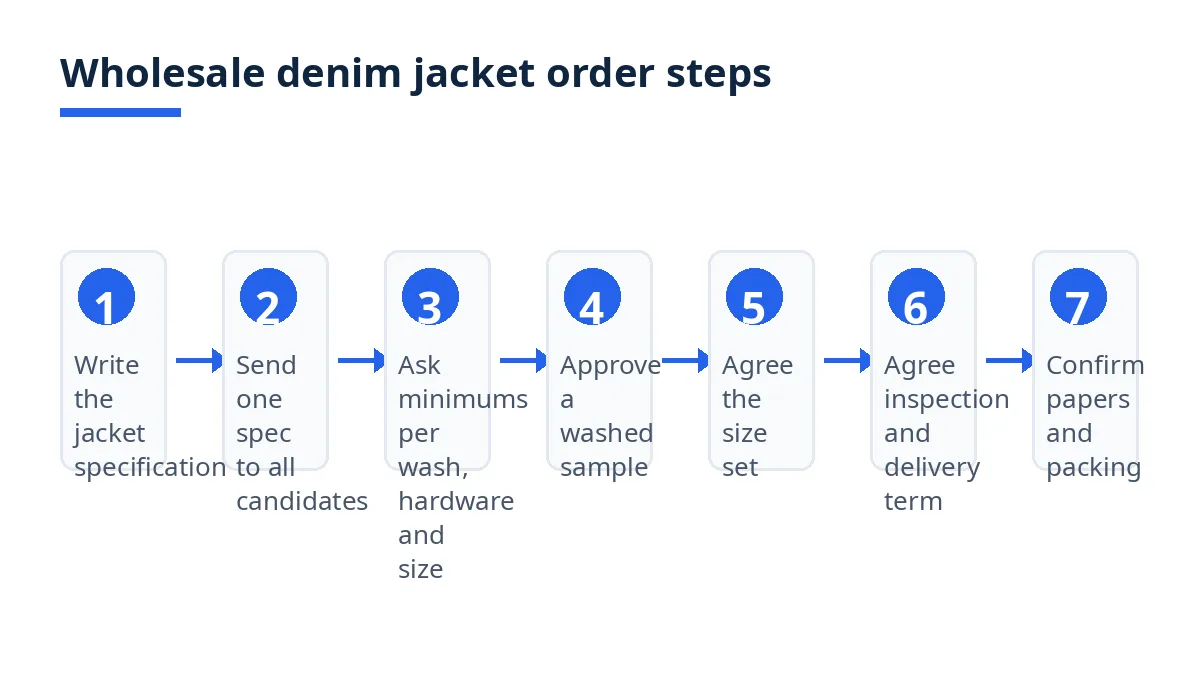
Write the jacket specification before you ask for a price. State the denim cloth weight and composition, the body and sleeve construction, the collar shape and lining, the front closure, the pocket layout, the hardware set with finishes, the wash reference, the size run with a ratio per size, and the packing method.
Send the same specification to every candidate. One tech pack, one wash reference, one hardware list, and one size run for all replies, so the quotations can be compared line by line rather than by headline price.
Ask for minimums per wash, per hardware lot, and per size. Ask which of those three lines binds for your order, and what changes if you drop a wash, change a button finish, or narrow the size run.
Approve a washed sample in your actual cloth and hardware. Check the collar shape, the lining fit, the button and rivet finish after washing, the pocket placement, and the measurements after washing. List corrections in writing and approve the corrected sample before bulk.
Agree the size set before cutting. Ask for measurements across the full size run, not only the sample size, and confirm the ratio per size so the middle sizes are not short and the end sizes are not overproduced.
Agree inspection and the delivery term before you confirm. Write the inspection level and AQL values into the purchase order, following ISO 2859-1, which defines a system of acceptance sampling plans for inspection by attributes, indexed by acceptance quality limit (AQL) for lot-by-lot inspection.3 State one Incoterm and named place for every quotation. The Incoterms 2020 rules set out 11 rules with a clear allocation of cost, risk, and obligations.4
Confirm the shipment papers and the packing plan with the order. Confirm carton quantities per size and wash, carton markings, and who supplies each export paper, so the finished jackets are not held up after inspection.
Costs, timelines and documents
What are the typical costs and timelines?
There are no typical costs or timelines a guide can state as fact, because each factory prices your cloth, wash, hardware, lining, and size run, and schedules its wash and sewing lines around its own order book. A heavier denim cloth uses more material per jacket and sews more slowly than a lighter cloth. A multi-stage wash adds laundry time and handling that a rinse wash does not. A lined collar and a button front add sewing and hardware steps that an unlined, zip-front jacket does not carry. Compare quotations only when they share the same cloth, wash, hardware, lining, and size run, and on the same Incoterm.4
Cost driver | What moves the price | State in your enquiry |
|---|---|---|
Denim cloth | Weight, composition, and width | Weight, fibre mix, and cloth width |
Wash | Number of stages and shade depth | Wash reference and shade band |
Hardware | Buttons, rivets, zips, and finishes per jacket | Full hardware list with finishes |
Collar and lining | Shape, lining cloth, and sewing steps | Collar shape and lining specification |
Size run | Pattern grading and ratio per size | Full size run with a ratio per size |
Packing | Carton plan per size and wash | Cartons per size, markings, and method |
Example figures: a buyer orders 900 jackets in two washes at 450 per wash, with one button finish across both washes. The same 900 jackets split into three washes at 300 per wash, with a different button finish for the third wash, create three wash loads and two hardware lots instead of two loads and one lot. The example shows structure only, not a typical price, minimum, or lead time.
For timelines, ask for separate dates for cloth readiness, sample approval, hardware delivery, wash completion, sewing, inspection, and shipment, rather than a single delivery week. Hardware delivery and wash capacity are the two stages most likely to move a jacket schedule, because both sit outside the sewing line and both depend on lots set for your order.
Which documents are needed?
The order papers are the tech pack, the itemized quotation, the purchase order with the wash, hardware, size run, inspection level, and delivery term written in, and the written sample approval. For export clearance, follow the Bangladesh Customs export procedure and confirm the current document set with your supplier and forwarder.5
Bangladesh-specific rules and tips
Check association claims at the source. If a supplier claims BGMEA membership, confirm it with the association itself. BGMEA member factories account for 100 percent of woven garment exports,1 which tells you the supplier sits inside the woven trade, not what its jacket price, wash capacity, or hardware minimum will be for your order.
Separate the wash question from the sewing question. A factory that sews jackets well may send washing to a separate laundry, and the laundry sets its own loads and shade limits. Ask who washes the jackets, what load size each wash needs, and whether the wash shade is approved on a sample from that laundry, not from a photograph of another order.
Classify the jacket by wearer and cloth. In the Harmonized System, code 620332 covers jackets and blazers, men's or boys', of cotton, not knitted or crocheted.6 The Bangladesh Customs Tariff lists 6204.32.00 for women's or girls' jackets and blazers of cotton.7 Confirm the code for your exact jacket with your customs broker, since the code follows the wearer and the cloth, not the style name alone.
Set the fibre label early for the EU market. Under Regulation (EU) No 1007/2011, a textile product must carry the name and percentage by weight of every constituent fibre, listed heaviest first.8 Agree the blend, the label wording, and who prints the labels before bulk, so a cotton-elastane jacket is never shipped as pure cotton.
Ask which hardware is imported for your order. Buttons, rivets, and zips in a specific finish may be bought in for your specification, and an imported hardware lot can set both the minimum and the earliest production date. If a finish is imported, ask for the hardware delivery date in writing before you confirm the bulk schedule.
Mistakes and red flags
What are the most common mistakes?
Approving a wash shade from a photograph. A screen image hides shade depth, uneven fading, and hardware colour change after washing. Approve the shade on a washed sample in your actual cloth and hardware, and keep that sample as the bulk reference.
Leaving hardware out of the price comparison. A quotation with a cheaper button finish, a plastic button where you expected metal, or rivets omitted at pocket corners is a different jacket. Compare the full hardware list, finish by finish, before you compare prices.
Comparing jackets with different linings or collars. A lined collar, a quilted lining, and a shaped collar stand add cloth and sewing time. A lower price on an unlined collar is not a saving if your shop sells a lined jacket.
Ordering a size run the shop cannot sell. A run weighted to the end sizes leaves the middle sizes short, and a run with no ratio per size lets the factory fill the total with the sizes that cut most easily. State the ratio per size in the order and check it at inspection.
Reading a profile or a badge as proof of capacity. A company page opens the enquiry; it cannot show whether a factory washes your shade, sources your hardware finish, or grades your size run. A badge likewise says nothing on its own about capacity, quality, or delivery.9
Dropping the washed sample to save time. ISO 2859-1 sampling measures a lot against an agreed AQL,3 and the washed sample is where a collar, hardware or shade mistake is still cheap to fix — once bulk is cut, the same mistake is your inventory.
Checklist
Before you confirm, every line should be answered in writing.
Tech pack sent: cloth weight and composition, body and sleeve construction, collar and lining, closure, pockets, hardware, wash, sizes, packing.
Wash reference and shade band agreed on a washed sample in actual cloth and hardware.
Hardware list confirmed finish by finish, with the lot minimum and delivery date.
Minimums confirmed per wash, per hardware lot, and per size; binding line named.
Size run and ratio per size stated, with measurements across the full run.
Lining and collar specification confirmed, not assumed from a photograph.
Inspection level and AQL values in the purchase order.3
Quotations compared on the same cloth, wash, hardware, lining, size run, and Incoterm.4
Export papers and carton plan per size and wash confirmed with the order.5
Sample approval in writing before bulk cutting.
How Exportain helps
On Exportain, browse suppliers and post your jacket specification, wash reference, hardware list, and size run on the RFQ board, so suppliers quote against the same jacket rather than the same style name. Read the verification note on how supplier verification works on Exportain: verification is a document and photo review, not a factory inspection,9 so washed-sample approval and inspection stay with you. For the minimum itself, read the MOQ definition guide before you compare replies.
FAQs
What should I know first about denim jackets?
Know the jacket as a structured garment, not as a cloth weight alone. The cloth, the wash, the collar and lining, the hardware set, and the size run each move the price and the minimum, and a quotation that leaves one of them open cannot be compared with one that fixes it. Men's or boys' cotton jackets sit under HS code 620332,6 and women's or girls' cotton jackets sit under 6204.32.00 in the Bangladesh Customs Tariff.7
What are the typical costs and timelines?
There are no typical figures a buyer can rely on, because each factory sets its price, minimum, and lead time for your cloth, wash, hardware, lining, and size run. Heavier cloth, a multi-stage wash, a lined collar, and a full hardware set each add cost and time, and hardware delivery and wash capacity can move the schedule. Compare itemized quotations on the same specification and Incoterm.4
Which documents are needed?
The order documents are the tech pack, the itemized quotation, the purchase order with wash, hardware, size run, inspection, and delivery term written in, and the written washed-sample approval. For export clearance, follow the Bangladesh Customs export procedure and confirm the current document set with your supplier and forwarder.5
What are the most common mistakes?
The most common mistakes are approving a wash shade from a photograph, leaving hardware out of the price comparison, comparing jackets with different linings or collars, ordering a size run without a ratio per size, and reading a badge as a guarantee. A badge is not a guarantee of capacity, quality, or delivery.9
Next steps on Exportain
Before you confirm any reply, study the verification guide and the MOQ guide. Then raise the jacket specification, wash reference, hardware list and size run as an RFQ after browsing suppliers, and require each reply to split its minimums by wash, by hardware lot, and by size.
Sources
- Bangladesh Garment Manufacturers and Exporters Association (BGMEA). Devex (accessed )
- Exports up over 6% to $13.1bn in Q1 of current fiscal. United News of Bangladesh (accessed )
- ISO 2859-1:2026 - Sampling procedures for inspection by attributes — Part 1: Sampling schemes indexed by acceptance quality limit (AQL) for lot-by-lot inspection. ISO (accessed )
- Incoterms® 2020. International Chamber of Commerce (ICC) (accessed )
- Customs Clearance Procedures for Export. Bangladesh Customs, National Board of Revenue (accessed )
- Classification Detail — HS Code 620332. United Nations Statistics Division (accessed )
- Bangladesh Customs Tariff, Chapter 62. Bangladesh Trade Portal (accessed )
- Regulation (EU) No 1007/2011 on textile fibre names and related labelling and marking of the fibre composition of textile products. European Union, (accessed )
- Supplier verification: Earn trust badges buyers can see. Exportain (accessed )
About the author
Sourcing from Bangladesh?
Post a request for quotation and suppliers on Exportain can send you their quotes directly.
Post an RFQ


