

Wholesale Chino Trousers From Bangladesh: Prices, MOQ and Reliable Suppliers
No single wholesale chino price or MOQ in Bangladesh: what twill weight, dye method and the waist and inseam matrix do to a quote, and how to compare suppliers on the same specification.
Short answer
There is no single wholesale price or MOQ for chino trousers from Bangladesh. Each factory sets its price and minimum per colour and per size cell for your specification, driven by twill weight and blend, piece-dye or garment-dye method, waistband and pocket construction, trim and label runs, and the waist and inseam matrix. Ask for minimums per colour and dye lot in writing, approve a washed sample, and compare quotes only on the same tech pack and delivery term.
On this page
Key takeaways
There is no single wholesale chino trousers price or MOQ in Bangladesh: each factory sets its price and minimum per colour and per size cell for your specification.
Twill weight and blend, piece-dye or garment-dye method, waistband and pocket construction, and trim and label runs are the drivers that set the price floor.
A chino order is a waist and inseam matrix, not a total: one style in four waist sizes and three inseam lengths is twelve size cells before colour is counted.
Ask for the MOQ per colour and per dye lot in writing, approve a washed pre-production sample, and compare quotes only on the same tech pack and delivery term.
Exportain verification is a document and photo review, not a factory inspection, and a badge is not a guarantee of capacity, quality or delivery.
A chino earns its place in a range at the hem, not on the hang tag. The leg has to break cleanly over the shoe, the front crease has to survive a wash, and the waist has to sit where the size chart says it sits after wear and laundering. When any of those three fails, the buyer holds stock that fits the chart on paper and disappoints in the fitting room. Chino cloth is a cotton twill, and the diagonal rib on the face of that cloth gives the leg its smooth fall and crease line.1
Quotations for the same style name diverge sharply because the style name settles almost nothing that costs money. A lightweight summer twill, a midweight year-round twill and a heavy work chino differ in yarn use, sewing speed and wash behavior, and a garment-dyed shade differs from a piece-dyed shade in depth, hand and shrinkage. Add a stretch share, a waistband build and a waist-by-inseam grid, and two factories can quote two different trousers while both calling the garment a chino. The supply base is deep: woven shipments were $4,614.80 million in July to September 2026, within ready-made garment exports of $10,578.56 million, on Export Promotion Bureau data.2
Why this matters for buyers and sellers
For a buyer, a chino program is a leg-length business before it is a price negotiation. Waist and inseam are sold together, so a style offered in six waist sizes and two inseam lengths is twelve separate cells, and a shop that runs out of one cell cannot move a neighboring cell in its place. The cloth choice sharpens that risk: a light twill bags at the knee, a heavy twill feels rigid in warm weather, and a stretch blend that loses recovery leaves knee and seat baggy. Shade adds a third risk, because a garment-dyed lot can drift between runs, showing first where cloth is doubled, at the waistband and pocket flaps.
For a seller, a chino order commits cloth, dye capacity and sewing time to one buyer's pattern. Cloth, pocketing and labels cut or printed for one buyer cannot be redirected if the order changes. A short run still absorbs the dye lot, the cutting marker and the line change, so the cost per pair climbs as the quantity in each color and each waist-by-inseam cell falls. That is why a factory answers a chino enquiry with floors per color and per cell rather than one floor for the whole order.
What should I know first about chino trousers?
Four choices set the quotation before any factory names a figure: cloth class, dye route, leg shape and grid. Cloth class means twill weight in grams per square metre or ounces per square yard, fiber blend and any stretch share, stated beside the weave direction. Dye route means piece-dyed cloth cut after dyeing, or a finished trouser dyed as a garment, since the two routes give different shade depth, different hand and different shrinkage. Leg shape means rise, taper from thigh to hem, leg opening and break, and whether the front carries a crease or a flat finish. Grid means every waist and inseam combination on order, with the quantity in each cell. Put those four in writing, with the waistband build and pocket construction beside them.
Step-by-step: how it works
Move through the sequence below with the order papers updated at each stage, so no decision rests only on a message thread.
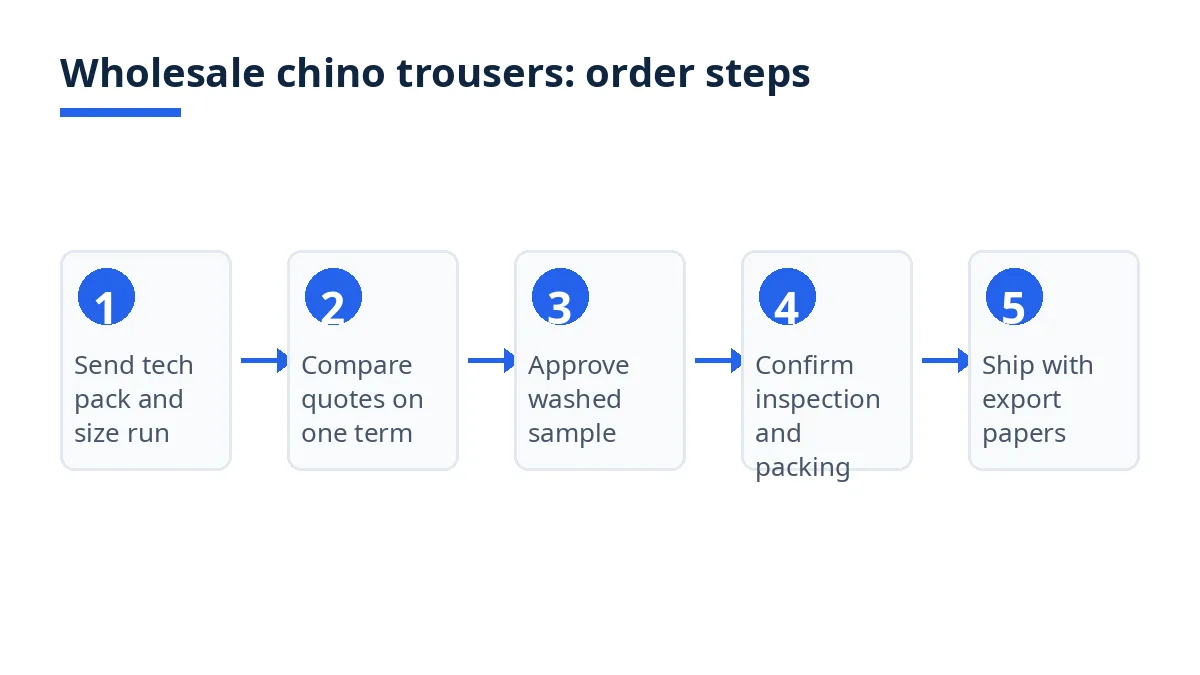
Fix the cloth class and the stretch share first. State twill weight, fiber blend, elastane percentage where the style stretches, cloth width and whether each color is stocked, piece-dyed to order or garment-dyed. Ask for a washed swatch in the actual twill and shade, and check knee bagging, crease retention and stretch recovery on it before the cloth is booked.
Give every candidate the same tech pack. Include the cloth class and dye route, the fit block with rise, thigh, knee and leg opening, the waistband, fly and pocket construction, button and zip specification, the waist and inseam chart, label artwork and the carton plan. A pack that leaves the waistband or the pocket shape open invites quotations for different trousers.
Ask for floors cell by cell. Request the floor per style, per color, per dye lot and per waist-by-inseam cell, and ask which floor binds for the grid on offer. Record whether each color is stocked twill, dyed cloth or a garment-dye run, because each route carries a different floor.
Approve a washed pre-production sample. Order a proto for fit, then a pre-production sample in the actual twill, shade, dye route and waistband build. Measure it, wash it by the end wearer's care method, check the crease, pocket bags, inseam twist and waistband grip, then approve it in writing or list corrections in writing and keep the approved sample as the bulk reference.
Put checking and the handover term on the purchase order. Write the sampling level and acceptance numbers into the order, referencing ISO 2859-1,3 and state one Incoterms 2020 rule with a named place on every quotation, so replies are compared on the same allocation of cost and risk.4
Lock the carton build before production ends. Agree the carton breakdown by waist, inseam and color and the carton markings, so a short cell is not hidden inside a mixed carton.
When the pre-production sample is measured, work through the chino trousers quality control checklist point by point, recording crease retention after washing, pocket-bag twist, inseam behavior and waistband grip separately.
Costs, timelines and documents
A chino quotation is built from cloth, dye, cut, construction and finish lines, each answering a question in the tech pack. Change the twill weight and the cloth use per pair changes; change the dye route and the lot size changes; change the waistband from a plain band to a gripper-lined curtain waistband and the sewing time changes. The delivery term then decides which freight and risk costs sit inside the quoted figure.4
What are the typical costs and timelines?
A rate card cannot price a chino grid: the rows below interact, and a change to one row moves the others. Read them as enquiry questions, not as a price list.
Driver | What shifts the quotation | Put in the enquiry |
|---|---|---|
Twill class | Weight, blend, width, stocked or dyed to order | Weight, blend, width, cloth source |
Stretch share | Elastane percentage, recovery after washing | Stretch percentage, recovery check |
Dye route | Piece-dyed cloth or garment-dyed trouser | Route, shade reference, wash standard |
Waist and inseam grid | Cell count, marker efficiency, thin cells | Every waist and inseam cell, with quantities |
Waistband and pockets | Curtain, gripper, fly, pocket bags, bartacks | Construction drawings, stitch and bartack points |
Trims, labels, cartons | Buttons, zips, labels, tags, carton runs | Trim specification, label artwork, carton plan |
Finish and pressing | Wash recipe, crease setting, pressing | Finish recipe, crease and hand standard |
Handover term | Where cost and risk pass to the buyer | One Incoterms 2020 rule and named place4 |
Example figures: a buyer orders 1,800 pairs in six waist sizes and two inseam lengths, which is 12 cells at 150 pairs each. Split across three colors, the order becomes 36 cells at 50 pairs each, and a factory floor of 60 pairs per color cell leaves every cell short even though the 1,800-pair total looks large. The example shows grid arithmetic only, not a typical price, floor or lead time.
Timelines follow the same lines as price. Get a calendar with a separate date for cloth readiness, dye approval, sewing, washing, final checking and shipment, rather than one promised week, so a delay shows which stage moved. Dye approval and trim delivery slip most often: a shade that drifts after washing sends the order back to the dye unit, and a late button or zip lot holds finished trousers at pressing.
Which documents are needed?
The order papers are the tech pack, the itemized quotation and the purchase order, with the floor per color, per dye lot and per cell on both, beside the grid itself.
Ask your supplier or freight partner to confirm the export filing route for your shipment, including the Bill of Export, before loading.5
Bangladesh-specific rules and tips
Check a BGMEA claim directly. A supplier that claims membership of the Bangladesh Garment Manufacturers and Exporters Association can be checked with the association itself.6 A confirmed membership describes an active garment business; it says nothing about twill stock, dye-lot size or waistband sewing for a particular chino.
Ask where the twill comes from and how it is dyed. Some twill is stocked locally, some is dyed to order, and some is imported for a particular shade, and each route sets a different earliest sewing date. A garment-dyed chino needs one dye lot for the shade: a split lot can drift, showing first where cloth is doubled at the waistband and pocket flaps.
Settle the label wording for the destination market early. For sales into the European Union, give the factory the exact fiber composition for the label under Regulation (EU) No 1007/2011 before labels are printed.7
Agree the checking plan before cutting. Write the sampling level and acceptance numbers into the purchase order, referencing ISO 2859-1,3 and check waist, inseam, crease, shade and stretch recovery on the washed sample, not on an unwashed proto. Keep the washed sample as the bulk reference.
Mistakes and red flags
What are the most common mistakes?
Counting pairs instead of cells. The floor that bites is usually per color, per dye lot or per waist-by-inseam cell. An order can clear its total and still fall below the floor for one inseam length or one shade, and that cell then carries a surcharge or drops out of the order.
Lining up quotations for different trousers. A lower figure on a lighter twill, a piece-dyed shade instead of a garment-dyed one, a plain waistband instead of a lined curtain waistband, or stock labels instead of a buyer's own labels is a different offer. Compare only replies that answer the same tech pack, the same grid and the same handover term.4
Signing off a sample before washing. Twill shrinks, twists and fades in washing, and a chino approved unwashed can arrive a size smaller, with a softer crease and a looser waistband than the sample showed. Approve the washed pre-production sample.
An exception that never reaches the order papers. A supplier may agree to a lower cell floor, a shared dye lot or a waived set-up, but the inspector works from the quotation and the purchase order, not from a chat history. If the concession is absent from both papers, the cell is judged against the written floor, so write the color and the waist-by-inseam cells it covers into both documents.
Reading a badge as proof of chino capacity. A badge records document and photo checks, not a factory inspection, and it says nothing about whether a factory holds the twill, runs the dye lot or sews the waistband a particular chino needs.8 9 Judge capacity from the factory's answers on cloth, dye route and grid. Keep the sampling plan in the purchase order as the last control before the trousers become stock.3
Checklist
Go through the items below against the order papers before any payment is released; an item agreed only in conversation is still open.
Cloth class fixed per color: twill weight, fiber blend, stretch share, cloth source.
Dye route fixed per color: stocked twill, piece-dyed cloth or garment-dyed trouser, with shade reference.
Leg shape fixed: rise, taper, leg opening, break, crease or flat finish, waistband and pocket build.
Grid stated per color as waist-by-inseam cells, with the quantity in each cell.
Written floors for each color, each dye lot and each cell, with the binding floor identified.
Button, zip, label, tag and carton floors confirmed apart from the garment floor.
Washed pre-production sample measured, checked for crease, pockets, inseam twist and waistband grip, and approved in writing.
Sampling level and acceptance numbers in the purchase order.3
Replies compared on the same tech pack, grid and handover term.4
Carton build agreed by waist, inseam and color, with markings.
Export filing route confirmed with the supplier or freight partner.5
How Exportain helps
Put the same chino summary in front of suppliers: browse suppliers, then post the twill class, stretch share, dye route, waist-by-inseam grid and handover term on the RFQ board so replies state their floor per color, per dye lot and per cell. Read badges for what they record, as document and photo checks rather than a factory inspection,8 9 and read the MOQ definition guide and how supplier verification works on Exportain before confirming.
FAQs
What should I know first about chino trousers?
Know the cloth class, the dye route, the leg shape and the grid before asking for a price. Chinos are cotton twill trousers, and the diagonal rib on the cloth face shapes the leg and the crease.1 For men's or boys' styles, heading 6203 covers woven trousers among other woven garments, while women's styles fall under heading 6204; confirm the full code with a customs broker.10
What are the typical costs and timelines?
No figure can be relied on as typical, because each factory prices the twill class, stretch share, dye route, waistband and pocket build, trim and label runs, finish and handover term for the grid in front of it.4 Cloth readiness, dye approval, sewing capacity, washing, trim delivery and final checking set the timeline, so ask for a date for each stage.
Which documents are needed?
The order papers are the tech pack, the itemized quotation and the purchase order, carrying the floor per color and per cell and the full waist-by-inseam grid. Ask your supplier or freight partner to confirm the export filing route for your shipment, including the Bill of Export, before loading.5
What are the most common mistakes?
The recurring mistakes are counting pairs instead of cells, comparing quotations for different cloths, dye routes or handover terms,4 approving a sample before washing, leaving an exception verbal, and reading a badge as proof of capacity.
Next steps on Exportain
Browse suppliers, then post the twill class, dye route and waist-by-inseam grid on the RFQ board so suppliers state their floor per color, per dye lot and per cell. Use the chino trousers quality control checklist and the MOQ definition guide as a final read before confirming.
Sources
- Cotton Twill vs. Ripstop: What is the Best Material for Work Pants?. Alsco, (accessed )
- RMG exports rise 6.10pc to US$10.58b in July-Sept of FY27. The Financial Express, (accessed )
- ISO 2859-1:2026 - Sampling procedures for inspection by attributes — Part 1: Sampling schemes indexed by acceptance quality limit (AQL) for lot-by-lot inspection. ISO (accessed )
- Incoterms® 2020. International Chamber of Commerce (ICC) (accessed )
- Customs Clearance Procedures for Export. Bangladesh Customs, National Board of Revenue (accessed )
- BGMEA at a Glance. BGMEA (accessed )
- Regulation (EU) No 1007/2011 on textile fibre names and related labelling and marking of the fibre composition of textile products. European Union, (accessed )
- Trust & Safety Center. Exportain (accessed )
- Supplier verification: Earn trust badges buyers can see. Exportain (accessed )
- Classification Detail — HS Code 6203. United Nations Statistics Division (accessed )
About the author
Sourcing from Bangladesh?
Post a request for quotation and suppliers on Exportain can send you their quotes directly.
Post an RFQ


