

Wholesale Cargo Pants From Bangladesh: Prices, MOQ and Reliable Suppliers
No single cargo pants price or MOQ in Bangladesh: the pocket build, cloth, knee layer, wash load and waist-by-inseam matrix set each factory's figures. This guide shows how to specify, compare and check them.
Short answer
There is no single wholesale price or MOQ for cargo pants from Bangladesh. Each factory sets its figures for your specification: the bellowed pocket build, ripstop or twill cloth, reinforced knees, wash load per shade, hardware, and the waist-by-inseam size matrix. Send one tech pack with pocket drawings and the full size matrix to every candidate, ask for minimums per style, colour, and wash shade in writing, and compare quotes only on the same specification and delivery term.
On this page
Key takeaways
No single cargo pants price or MOQ exists in Bangladesh: each factory sets its figures for your pocket build, cloth, knee layer, wash load, and size matrix.
The bellowed pocket drives the cost: panel count, bellow depth, pleats, flaps, closures, and bartacks set sewing time and cloth use, and the reinforced knee adds a second layer.
Ripstop and twill cut, sew, and wash differently, and a wash load minimum per shade can make a large multi-colour order too small per shade.
Cargo trousers are sold on a waist-by-inseam grid: state the quantity per waist, inseam, and colour, or the order cannot be cut or priced.
Exportain verification is a document and photo review, not a factory inspection, and a badge is not a guarantee of capacity, quality, or delivery.
A cargo trouser earns its price in the thigh pocket. Fill both thigh pockets with the items the wearer actually carries, then sit, walk, and crouch. A well-built pocket keeps its shape, keeps the flap closed, and leaves the leg hanging straight. A weak one drags the side seam forward and lets the flap lift after a single wash. When you compare wholesale quotations for cargo pants, start with that loaded-pocket test, because the pocket, the knee, and the wash explain most of the difference between two quotes that both say "cargo pants."
Two factories can use the same style name for different work. One may cut a flat patch pocket, stitch a single row around it, and leave the knee as one layer of shell cloth. The other may cut a bellowed pocket with a center pleat, a shaped flap, a snap or button closure, bartacks at the stress points, and a second cloth layer over the knee. The second pair needs more panels, more stitching operations, and more cloth per pair, so it costs more before cloth grade is even discussed. Price follows the construction drawing, not the style name, and a quotation without that drawing cannot be compared with one that has it.
Bangladesh offers a wide base of woven garment factories for this trouser. The Bangladesh Garment Manufacturers and Exporters Association (BGMEA) presents apparel from Bangladesh as reaching more than 150 countries, with thousands of factories serving global brands.1 That breadth means several factories can quote on a cargo program, but it creates no shared price, minimum, or lead time. Each factory prices your pocket drawing, cloth, knee panel, wash, and size grid on its own.
Why this matters for buyers and sellers
A buyer who gets the pocket wrong pays for it twice: once in the unit price, and again in returns and markdowns when loaded pockets distort. Waist and inseam can measure correctly while the garment still fails, because a customer judges a cargo pant by how its pockets behave when worn and washed, not by how they look flat on a table. A seller who prices the pocket loosely faces the opposite problem: sewing minutes, cloth use, and wash handling all concentrate in the pocket and knee, so a quote that treats the pocket as a minor trim will lose money once bulk sewing starts.
Two decisions protect both sides before bulk begins. First, agree a sampling plan for final inspection under ISO 2859-1, so pocket stitching, flap position, and knee placement are each judged as pass or fail on a defined sample.2 Second, put one Incoterms 2020 rule and named place on every quotation, so freight, insurance, and the point where risk passes are identical across replies.3 With those two controls in writing, a cheaper quote can be traced to a real saving instead of a missing pocket panel or a different delivery term.
Step-by-step: how it works
Work in this order, and keep each agreement in writing. The pocket drawing comes first, because every later decision, from cloth consumption to wash handling, depends on it.
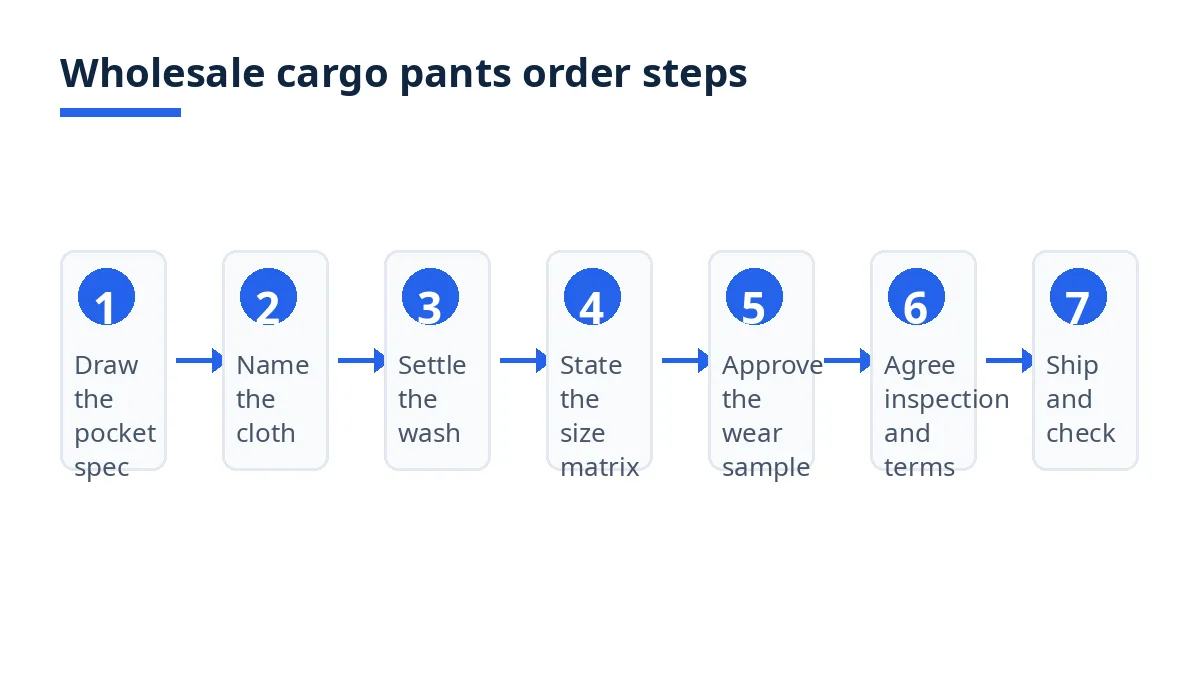
Draw every pocket in full. Show position, finished width and depth, bellow depth, pleat type, flap shape, closure type and position, bartack points, and stitch rows. Add the knee panel with its size and placement, the waistband and fly, the hem, and all hardware. Attach a waist-by-inseam size chart.
Name the shell cloth by weave and mix. State whether the shell is cotton twill or ripstop, the fiber mix, the cloth weight, and whether the cloth is held in stock or woven and dyed for the order. Twill shows a diagonal rib; ripstop carries a heavier grid yarn at intervals through the weave. The two cloths cut, sew, and wash differently, so "cargo fabric" alone is not a specification.
Fix the knee as its own item. State the knee panel size, whether it is sewn flat or shaped with articulation, how it is bartacked, and whether it uses the shell cloth or a heavier cloth. A knee panel that shifts slightly on each pair will read as sloppy across a carton, even when waist measurements pass.
Settle the wash by shade, not by color name. State the wash recipe, the shade range, and the minimum pieces per wash load. A flap cut from a different cloth lot can shade differently from the leg after washing, and a bellowed pocket can shrink at a different rate from a flat leg panel, so the wash check must happen on a finished, washed pair.
State quantities as a grid, not a total. Give pieces per waist, per inseam, and per color. Cargo trousers are cut from a waist-by-inseam grid, and a total without that grid cannot be cut, priced, or checked.
Ask for minimums on each line separately. Ask for the minimum per style, per color, per wash shade, and per waist-by-inseam run, plus any separate minimum for hardware, labels, and cartons. Record which line binds for your grid, because the binding line, not the order total, decides whether the order can run.
Approve a loaded, washed sample in writing. Order a proto sample for shape, then a pre-production sample in the actual cloth, pocket build, knee panel, wash, and hardware. Load the pockets, wear the sample, wash it, and measure pocket position and knee placement again. Approve it in writing, or list corrections in writing.
Costs, timelines and documents
A factory builds a cargo quotation from the construction drawing outward. The table below names the lines to ask for separately, so a lower total can be traced to the line where the saving was made.
Line in the quote | What changes it | Put this in the enquiry |
|---|---|---|
Bellowed pocket | Panel count, bellow depth, pleat, flap, closure, bartacks | Full pocket drawing with sizes and closures |
Shell cloth | Twill or ripstop weave, fiber mix, weight, stock or dyed to order | Weave, mix, weight, stock status |
Knee panel | Second layer, shaping, panel size, bartack count | Knee drawing, placement, cloth |
Wash | Recipe, shade count, load minimum per shade | Recipe, shade range, load minimum |
Hardware and trims | Snaps, buttons, buckles, drawcords, zips, labels | Hardware spec per pocket and waist |
Waist-by-inseam grid | Cutting marker waste, thin sizes, extreme sizes | Pieces per waist, inseam, and color |
Delivery term | Who pays freight and insurance, where risk passes | One Incoterms rule and named place3 |
What are the typical costs and timelines?
No guide can hand you a usable cargo price list, because the pocket drawing, cloth, knee panel, wash load, and grid differ on every order. Timelines work the same way: sampling time depends on cloth availability and correction rounds, while bulk time depends on dyeing, pocket sewing capacity, wash loads, and hardware delivery. Ask for sampling, cloth ready, production, wash, and inspection dates as separate lines, rather than accepting a single promised week.
Example figures: a buyer orders 3,000 pairs across five colors, which is 600 pairs per color. If the wash load minimum is 900 pairs per shade, every color falls 300 pairs short of a load, and the five colors together would need 4,500 pairs to fill one load each. The same 3,000 pairs in fewer colors, or with colors sharing a wash load by agreement, change the arithmetic completely. The example shows structure only, not a typical price, minimum, or lead time.
Example figures: a reinforced knee adds one panel per leg, so 1,800 pairs need 3,600 knee panels. A small color of 240 pairs still needs 480 knee panels cut and placed to match the rest of the order, which is why a small color can carry a surcharge even when the order total looks large. The example shows structure only, not a typical price, minimum, or lead time.
Which documents are needed?
The order papers are the tech pack with pocket and knee drawings, the itemized quotation, the purchase order carrying the size grid and inspection plan, and the written pre-production sample approval. For the export set, see the Bangladesh Customs export clearance page, which states the declaration rule and the enclosed documents.4
Bangladesh-specific rules and tips
Check a membership claim with the body itself. If a supplier claims BGMEA membership, confirm it through the association rather than through the quotation. BGMEA presents itself as the trade body for garment manufacturers and exporters, and its site lists member search tools alongside its industry material.1 A confirmed membership points to an active garment business; it says nothing about bellowed-pocket sewing capacity, wash handling, or the smallest grid a factory will run.
Match the registered name everywhere. Before cutting starts, line up the exporter and buyer names on the trade licence, quotation, proforma invoice, and payment account with the export declaration, since a mismatch found at shipping stage stalls the file.4
Ask which inputs are bought in for your specification. Snaps, buckles, drawcords, and some ripstop cloth may be ordered in for your order, and a bought-in closure or cloth lot can set both the minimum and the earliest production date. Ask whether each input is stocked, ordered, or imported, and on what lead time.
Measure the pocket after washing, not only before. A bellowed pocket and a flat leg panel can shrink at different rates, and a flap that sat centered before washing can sit off-center after it. Put a post-wash pocket measurement and a post-wash knee placement check into the inspection plan, and judge the pair on those points as well as on waist and inseam.
Mistakes and red flags
What are the most common mistakes?
Quoting a style name instead of a construction drawing. Two cargos under one name can differ by two pocket panels, a knee layer, and a wash recipe. A quotation without pocket drawings answers a different question from a quotation with them, and the two totals cannot be compared.
Comparing quotations on different grids or terms. A lower unit price on middle sizes only, or on a different delivery term, is a different offer from a price covering the full waist-by-inseam grid on your term. Compare only replies to the same tech pack, grid, and Incoterms rule.3
Splitting colors below the wash load. A large total spread across many shades can still fall short per shade, which then brings a surcharge or a forced shade change. Settle the shade count before finalizing the color count.
Approving a sample that was never loaded or washed. A cargo sample measured flat can pass every dimension and still fail in wear, because loaded bellows pull the side seam and the waist, and washing moves pocket position. Load the pockets and wash the sample before signing.
Putting a deal point only in conversation. A supplier's yes to a smaller minimum, a combined wash load, or a dropped set-up charge means little at inspection unless that yes sits in the quotation and purchase order tied to a named grid split.
Judging pocket skill from a profile page. Profile pages and badges describe checks that were recorded, not the sewing line that will run your order, so they cannot show whether bellowed pockets will hold shape at bulk volume.5
Skipping the last inspection to gain a few days. Once the cartons leave, pocket distortion and knee drift become your inventory problem, not a correctable factory error, so hold the ISO 2859-1 check even when the schedule tightens.2
Checklist
Use the list that follows as your sign-off sheet: nothing moves to confirmation until each line carries a written answer.
Pocket drawings sent: bellow depth, pleats, flaps, closures, bartacks, stitch rows.
Shell cloth stated: twill or ripstop, fiber mix, weight, stocked or dyed to order.
Knee panel drawn: size, shaping, placement, cloth, bartack points.
Wash settled: recipe, shade range, minimum per wash load, post-wash checks.
Size grid stated per waist, inseam, and color, with one ratio per color.
Minimum confirmed per style, color, wash shade, and size run; binding line named.
Hardware, label, tag, and carton minimums confirmed apart from the garment minimum.
Pre-production sample loaded, worn, washed, measured, and approved in writing.
Inspection level and AQL values in the purchase order.2
Quotations compared on the same pocket build, grid, and Incoterms rule.3
Export set confirmed against the customs clearance page.4
How Exportain helps
On Exportain, browse suppliers and post a request for quotation (RFQ) on the RFQ board with your pocket drawings, cloth, knee panel, wash, size grid, and delivery term, so replies quote against the same construction. For what badges record, see the trust and seller-verification pages before relying on one.5 6
FAQs
What should I know first about cargo pants?
A cargo pant is a woven trouser defined by its utility pockets, and the pocket build drives sewing time, cloth use, and wash behavior. For men's or boys' woven trousers, start from heading 6203, with the synthetic-fiber line at subheading 620343.7 Women's or girls' woven trousers fall under heading 6204, with cotton at subheading 620462.8 Confirm the full code for your fiber mix and gender with your customs broker, since duty follows the code rather than the style name. For EU sales, state shell, pocketing, and lining fiber mixes separately, since Regulation (EU) No 1007/2011 sets out how fiber composition is stated on textile labelling.9
What are the typical costs and timelines?
No typical cargo figures can be relied on, because each factory sets its price, minimum, and lead time for your pocket build, cloth, knee panel, wash load, and size grid. Pocket panels, ripstop or twill cloth, knee layers, wash loads, and hardware drive the price, while cloth availability, wash capacity, and hardware delivery drive the timeline. Compare quotations only on the same construction and delivery term.3
Which documents are needed?
The order papers are the tech pack with pocket and knee drawings, the itemized quotation, the purchase order carrying the size grid and inspection plan, and the written sample approval. For the export set, see the Bangladesh Customs export clearance page, which states the declaration rule and the enclosed documents.4
What are the most common mistakes?
The most common mistakes are quoting a style name instead of a pocket drawing, comparing quotations on different grids or terms,3 splitting colors below the wash load, approving a sample that was never loaded or washed, and reading a badge as a guarantee. A badge is not a guarantee of capacity, quality, or delivery.5
Next steps on Exportain
Start on suppliers, then put your pocket drawings, cloth, knee panel, wash, and size grid on the RFQ board and ask each reply for its minimum per style, color, and wash shade. Before confirming, read how to import cargo pants from Bangladesh and the MOQ definition guide.
Sources
- BGMEA | Home. BGMEA (accessed )
- ISO 2859-1:2026 - Sampling procedures for inspection by attributes — Part 1: Sampling schemes indexed by acceptance quality limit (AQL) for lot-by-lot inspection. ISO (accessed )
- Incoterms® 2020. International Chamber of Commerce (ICC) (accessed )
- Customs Clearance Procedures for Export. Bangladesh Customs, National Board of Revenue (accessed )
- Trust & Safety Center. Exportain (accessed )
- Supplier verification: Earn trust badges buyers can see. Exportain (accessed )
- Classification Detail — HS Code 620343. United Nations Statistics Division (accessed )
- UNSD Classification Detail: HS Code 620462. United Nations Statistics Division (accessed )
- Regulation (EU) No 1007/2011 on textile fibre names and related labelling and marking of the fibre composition of textile products. European Union, (accessed )
About the author
Sourcing from Bangladesh?
Post a request for quotation and suppliers on Exportain can send you their quotes directly.
Post an RFQ


