

Wholesale Black Tiger Shrimp From Bangladesh: Prices, MOQ and Reliable Suppliers
Wholesale black tiger shrimp from Bangladesh, grade by grade: count ladders, per-grade minimums, glaze and net-weight rules, cold-chain handover, replenishment calendars, and market checks for the USA, UK, EU and UAE.
Short answer
Wholesale black tiger shrimp from Bangladesh is bought grade by grade, not as a single mixed quantity: one count size, form, and pack per line, repeated on a replenishment calendar. For each grade, fix the count basis, glaze and net-weight basis, per-grade minimum, cold-chain handover points, and delivery term in writing, check the plant status for your destination, and approve a sample per grade before bulk. All price and quantity figures in this guide are examples showing structure only.

On this page
Key takeaways
Wholesale black tiger shrimp is bought grade by grade: one count size, form, and pack per line, repeated on a replenishment calendar, rather than as a single mixed quantity.
Fix the count basis, count tolerance, glaze and net-weight basis, per-grade minimum, cold-chain handover points, and delivery term in writing for each grade before sampling, because each changes the usable product and the landed cost.
Market status is plant-specific and grade-specific: the EU uses an authorised-establishment list and a permitted third-country list, while the United States relies on processor HACCP plans and importer verification.
Frozen shrimps and prawns other than cold-water varieties fall under subheading 030617, and the exact line for cooked or prepared forms must be confirmed with a customs broker.
Approve a sample per grade and per form after thawing, run the first shipment as a test of the whole replenishment system, and record any grade change so later shipments do not drift.
A wholesale black tiger shrimp program is not a single mixed order, and it is not a general shrimp program with a different name on the carton. It is a set of grade lines that repeat: one grade for retail packs, another for food service, and a smaller grade for processing, each with its own form, pack, count tolerance, and replenishment rhythm. When a buyer treats all black tiger shrimp as one line, the first problem is rarely price. It is a large grade arriving where a small grade was expected, a glaze level that changes usable weight, or a repeat shipment that does not match the first one.
The wholesale question is how to build a grade ladder and hold it. Start with the end uses, not with a total tonnage. Decide which grades your customers actually buy, which forms they buy them in, and how often each grade must arrive. A distributor that needs a steady large grade every month has a different program from a processor that buys a smaller peeled grade in less frequent lots.
Frozen shrimps and prawns other than cold-water varieties fall under subheading 030617.1 That classification is a starting point only: a cooked or prepared product may fall elsewhere, so confirm the exact line for each form with your customs broker before you price a grade.
Why this matters for buyers and sellers
For a buyer, the grade ladder protects the customer relationship. A retailer selling a large head-on grade by count cannot substitute a smaller grade without changing the pack and price point. A food-service buyer portioning by count cannot absorb a count drift without changing portion cost. Holding grade, form, and net-weight basis steady is the core of the wholesale service.
For a seller, a grade ladder makes production plannable. A plant that knows which grades will repeat, in which forms, and in which months can plan intake, freezing, and packing around those grades. That is why sellers ask about the annual shape of demand early.
The two sides carry different grade risks. The buyer risks a grade being unavailable, or a substitute grade shipped without agreement. The seller risks a grade packed in a specific form and pack and then never reordered, leaving specialised stock in cold storage. Wholesale terms should share those risks openly: a per-grade minimum, a notice period for a grade change, and a rule for grade discontinuation or replacement.
Step-by-step: how it works
Work grade by grade. A term agreed for a large retail grade does not automatically suit a small processing grade, and a sample approved for one form does not approve another.
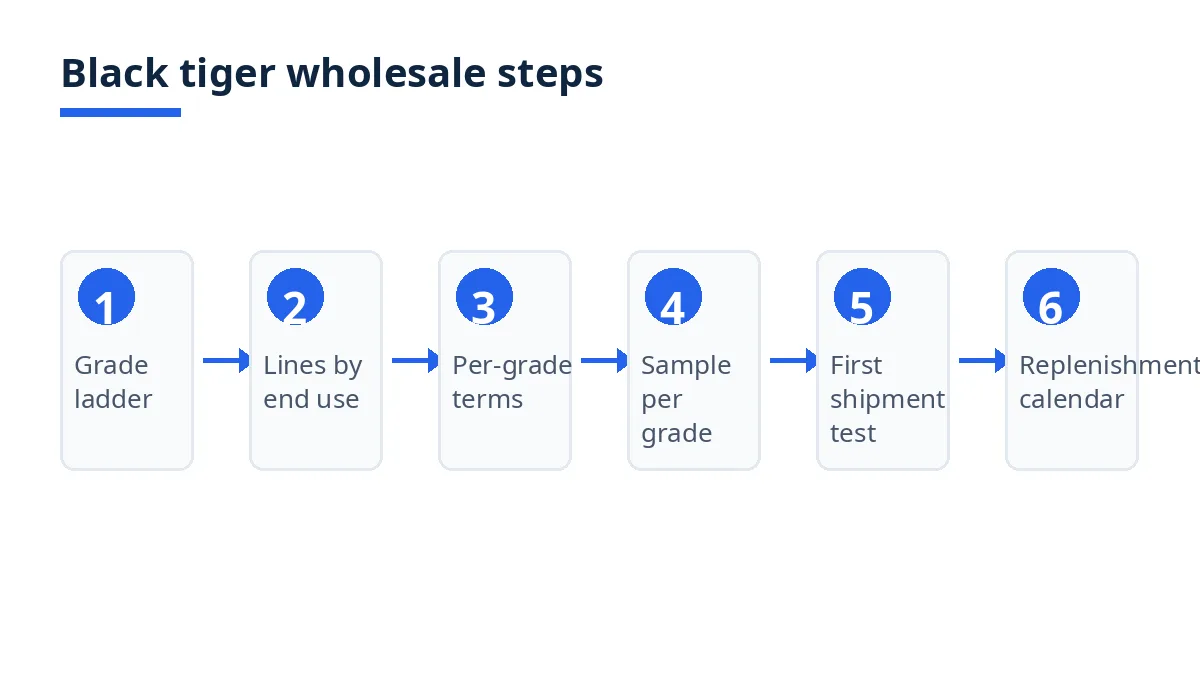
Build the grade ladder. List every grade by count size and end use. Write the count basis in full, pieces per kilogram or pieces per pound, and state whether the count is a range or a fixed count.
Split lines by end use and form. For each grade, fix the form, head-on shell-on, headless shell-on, peeled and deveined tail-on, or peeled tail-off, and the freezing method, block or individually quick frozen. A grade sold in two forms is two lines, even when the count is the same.
Agree per-grade terms before sampling. Set the per-grade minimum, the count tolerance, the glaze and net-weight basis, the pack and carton size, the cold-chain handover points, and the delivery term for each line. Sampling before these terms are agreed wastes samples on lines that cannot work.
Approve a sample per grade and per form. Check the sample after thawing: count, form, glaze, net weight on the agreed basis, and appearance. Record the approved sample as the reference for that grade line.
Run the first shipment as a system test. Check the cold chain, the carton marking by grade, the documents by line, and the arrival condition. Confirm that a second order for the same grade can be placed on the same terms before you commit to a standing program.
Set a replenishment calendar by grade. Give each grade its own order point and review date.
Review allocation and grade changes in writing. When a grade is short, agree in advance how allocation is shared, whether a neighbouring grade may be offered as a substitute, and how much notice a grade change or discontinuation requires.
Costs, timelines and documents
All figures in this section are Example figures. They show structure only and are not market rates, and no figure here should be quoted as a Bangladesh price or a typical order size.
Wholesale cost for a black tiger grade line is built from the product price for that grade and form, packing, cold storage, inland movement to the port, refrigerated ocean freight, insurance, destination handling, and any inspection or testing. Which side pays each element depends on the delivery term. The Incoterms 2020 rules set out the delivery terms and the allocation of cost, risk, and obligations under each rule.2 Name the rule and the named place in the contract for each grade line, and compare quotations only on the same rule and place.
A grade-tier table shows structure, not a market ladder:
Example tier | Example figures for one grade line | What it usually changes |
|---|---|---|
Trial grade | Example figures: one pallet of one grade in one form | Tests the grade, the pack, and the documents only |
Regular grade | Example figures: one full refrigerated container of one grade in one form | Full grade pricing and a replenishment calendar for that grade |
Standing grade | Example figures: repeat containers of the same grade on a fixed calendar | Allocation priority for that grade and a notice period for grade changes |
Timelines run in stages, not as a single delivery date. Ask for separate dates for grade and form approval, sample approval per grade, bulk production, packed-goods checking by grade, and shipment, and ask how a delay in one grade affects the others. A program can be on time for two grades and late for a third, and the contract should say which grade ships and which waits.
The document set follows the grade lines. Each grade needs its own specification, its own approved sample record, and its own line on the commercial invoice and packing list, so a carton can be traced to a grade without opening it. The export set is separate: goods may not be loaded for export unless an export declaration, the Bill of Export or Shipping Bill, is submitted to Customs and approved, and the enclosed documents include the export contract or purchase order where there is no export letter of credit, the commercial invoice, the packing list, the EXP form certified by an authorized dealer, and a certificate of origin issued by the EPB or a Chamber of Commerce and Industry.3 For the destination market, EU rules require that imports of products of animal origin from third countries take place only if the third country of dispatch appears on the permitted list, the establishment of dispatch appears on the authorised-establishment list where applicable, and the certificate and document requirements are satisfied.4 In the United States, processors of fish and fishery products must conduct a hazard analysis and, where hazards reasonably likely to occur are found, have and implement a written HACCP plan specific to each location and each kind of fish and fishery product.5 The FDA hazards and controls guidance is the reference most seafood HACCP teams use when building that analysis.6
Bangladesh-specific rules and tips
Check the plant by grade and by market, not by company name alone. EU import rules turn on the establishment of dispatch appearing on the authorised list, as well as on the third country appearing on the permitted list.4 A plant authorised for one product or market is not automatically the right plant for your grade line in another market, so check the establishment status for your exact product and destination before you agree a standing grade.
Confirm the Bangladesh licence position for the exporter and the plant. Under the Fisheries and Fish Products (Inspection and Quality Control) Act, 2020, the central competent authority determines the standards for the import, export, production, transportation, storage, marketing, and processing of fish and fish products, and no person may export fish and fish products, or establish and operate a factory or establishment, without obtaining a licence.7 Ask which licences the exporter and the plant hold, and keep those details with the grade line file.
Write the count basis the way your market counts. A grade written without its basis is not a grade. State the basis, the range, and the tolerance on the specification for each grade, and check the sample on that basis after thawing. A count checked before freezing and a count checked after thawing can differ, so the specification should say when the count is judged.
Mistakes and red flags
Ordering a total quantity instead of a grade ladder. A buyer that orders a total weight and leaves the grade split to the seller will receive the grades the seller has available, not the grades its customers buy. The grade split belongs on the order, grade by grade.
Approving one sample for several grades. A large head-on sample does not approve a small peeled grade, and a peeled tail-on sample does not approve a peeled tail-off grade. Each grade and form needs its own sample record.
Leaving glaze and net weight undefined. Glaze is frozen water added for protection, and it changes the usable shrimp weight if the net-weight basis is not written down. State whether the quoted weight is shrimp alone or shrimp plus glaze, and check the sample on that basis.
Treating a grade change as a minor variation. Changing the count range, the form, or the freezing method changes the product the end customer receives. A grade change needs the same approval as a new grade: a sample, a specification change, and a start date.
Accepting a substitute grade without a price and pack change. A neighbouring grade may be a fair substitute in a shortage, but only if the pack, the price per usable kilogram, and the customer communication change with it. A substitute shipped on the original grade terms is a grade error, not a favour.
Red flags in a supplier reply. A reply that will not state the count basis, the glaze and net-weight basis, the per-grade minimum, the allocation rule for short grades, or the notice period for a grade change is a reply to pause on. A reply that quotes one price for all grades, without separating grade and form, has not yet priced your program.
Checklist
Before you confirm a wholesale black tiger shrimp program, every line should be answered in writing, grade by grade.
Grade ladder written: every grade by count size, count basis, and end use.
Form fixed per grade, with the freezing method stated.
Count tolerance, glaze, and net-weight basis written on each grade specification.
Per-grade minimum agreed, with a rule for short or split lots.
Pack and carton size fixed per grade, with carton marking by grade.
Cold-chain handover points named, with a check and a failed-check rule per grade line.
Delivery term named as an Incoterms 2020 rule with a named place, the same on every quotation.2
Sample approved per grade and per form, checked after thawing, and recorded as the grade reference.
Replenishment calendar set per grade, with an order point and a review date for each grade.
Allocation rule agreed for short grades, with a substitute-grade rule and a notice period for grade changes.
Market status checked: EU establishment and third-country lists for EU destinations,4 and processor HACCP position for United States destinations.5 6
Bangladesh licence position recorded for the exporter and the plant.7
Export document set agreed: Bill of Export, commercial invoice, packing list, EXP form, and certificate of origin.3
Classification confirmed per form with a customs broker, starting from subheading 030617 for frozen shrimp other than cold-water varieties.1
How Exportain helps
On Exportain, browse suppliers and post a request for quotation on the RFQ board with your grade ladder, one specification per grade, the count basis, the form, the per-grade minimum, and the delivery term, so suppliers quote grade by grade on the same basis. Ask each reply for its count tolerance, its glaze and net-weight basis, its allocation rule for short grades, and its notice period for grade changes.
Read the badges for what they record. Exportain describes its seller verification and trust badges on its verification page.8 Verification is a document review, not a factory inspection, so grade specification, sample record, and cold-chain checks stay with you.
FAQs
What should I know first about black tiger shrimp?
Know the grade ladder before you know the total quantity. Black tiger shrimp is bought wholesale grade by grade, by count size, form, and end use, and each grade needs its own specification, sample, and replenishment calendar. Frozen shrimps and prawns other than cold-water varieties fall under subheading 030617, but a cooked or prepared form must be confirmed with a customs broker.1
What are the typical costs and timelines?
There are no typical figures a buyer can rely on, because each grade is priced by its count size, form, pack, and delivery term.2 All figures in the costs section are Example figures showing structure only. Timelines should be given in stages, grade by grade, from approval through production, checking, and shipment.
Which documents are needed?
The grade documents are the grade specification, the approved sample record per grade and form, the itemised quotation, and the purchase order, with each grade on its own line. The export set is the Bill of Export, the commercial invoice, the packing list, the EXP form certified by an authorized dealer, and a certificate of origin issued by the EPB or a Chamber of Commerce and Industry.3 Destination-market documents follow the EU establishment and third-country lists for EU shipments,4 and the processor HACCP position for United States shipments.5
What are the most common mistakes?
The most common mistakes are ordering a total quantity instead of a grade ladder, approving one sample for several grades, leaving glaze and net weight undefined, treating a grade change as a minor variation, and accepting a substitute grade without changing the pack and the price per usable kilogram. A further mistake is reading a badge as a grade guarantee: verification is a document review, not a factory inspection.8
Next steps on Exportain
Browse suppliers, then post your grade ladder, one specification per grade, on the RFQ board so suppliers quote grade by grade on the same count basis and delivery term. Before you confirm, read the MOQ guide for the minimum-order mechanics alongside the per-grade minimums in this program.
Sources
- Classification Detail — HS Code 030617. United Nations Statistics Division (accessed )
- Incoterms® 2020. International Chamber of Commerce (ICC) (accessed )
- Customs Clearance Procedures for Export. Bangladesh Customs, National Board of Revenue (accessed )
- Regulation (EC) No 853/2004 laying down specific hygiene rules for food of animal origin. European Union (accessed )
- 21 CFR 123.6 — Hazard analysis and HACCP plan. Cornell Legal Information Institute (accessed )
- Fish and Fishery Products Hazards and Controls. U.S. Food and Drug Administration (accessed )
- The Fisheries and Fish Products (Inspection and Quality Control) Act, 2020. InforMEA (accessed )
- Supplier verification: Earn trust badges buyers can see. Exportain (accessed )
About the author
Sourcing from Bangladesh?
Post a request for quotation and suppliers on Exportain can send you their quotes directly.
Post an RFQ


