Wholesale Bed Sheets From Bangladesh: Prices, MOQ and Reliable Suppliers
Wholesale bed sheets from Bangladesh compared on one specification: price drivers, MOQ per design and colour, size after washing, and how to score supplier replies line by line.
Short answer
Wholesale bed sheets from Bangladesh are best compared on one written specification sent to every supplier: pieces per set, fibre by weight, weave, thread count target, finished weight, size after washing and finishing. Prices and MOQs differ by design, colour and size, so ask for the MOQ split and price inclusions in writing, wash-test the sample, and compare quotes only on the same delivery term.
On this page
Key takeaways
Wholesale bed sheets are compared on one written specification sent to every supplier, not on headline prices alone.
Fibre by weight, weave, thread count target, finished weight, size after washing and finishing are the lines that make two quotes comparable.
The binding MOQ is usually per design, per colour or per size, so ask for the split in writing rather than a single total.
Size after washing, measured under ISO 5077:2007, decides whether a sheet still fits after its first wash.
Exportain verification is a document and photo review, not a factory inspection, and a badge is not a guarantee.
Wholesale bed sheets are bought on specification, not on a photograph. A wholesaler, retailer or hotel buyer who sends the same specification to every supplier in Bangladesh and scores the replies line by line will see real differences in price, minimum order quantity (MOQ) and reliability. A buyer who compares headline prices alone will not, because two sheets with the same size and colour can differ in fibre, weave, thread count target, finished weight, size after washing and finishing.
This guide is for buyers in the United States, the United Kingdom, the European Union and the United Arab Emirates who buy bed sheets in bulk for resale or for hotel use. It shows how to fix one specification, how to read wholesale prices and MOQs against it, and how to compare suppliers on the same terms.
Why this matters for buyers and sellers
For a wholesale buyer, the specification is the product. A flat sheet, a fitted sheet and a pillowcase sold as one set must match in shade, size and finish, and every repeat order must match the first. When the specification is vague, each supplier fills the gaps differently. The result is a set that looks right in a sample photograph and fits badly after washing, or a shade that changes between cartons.
Step-by-step: how it works
Fix the specification before you ask for a price. Then keep it unchanged across every supplier you approach.
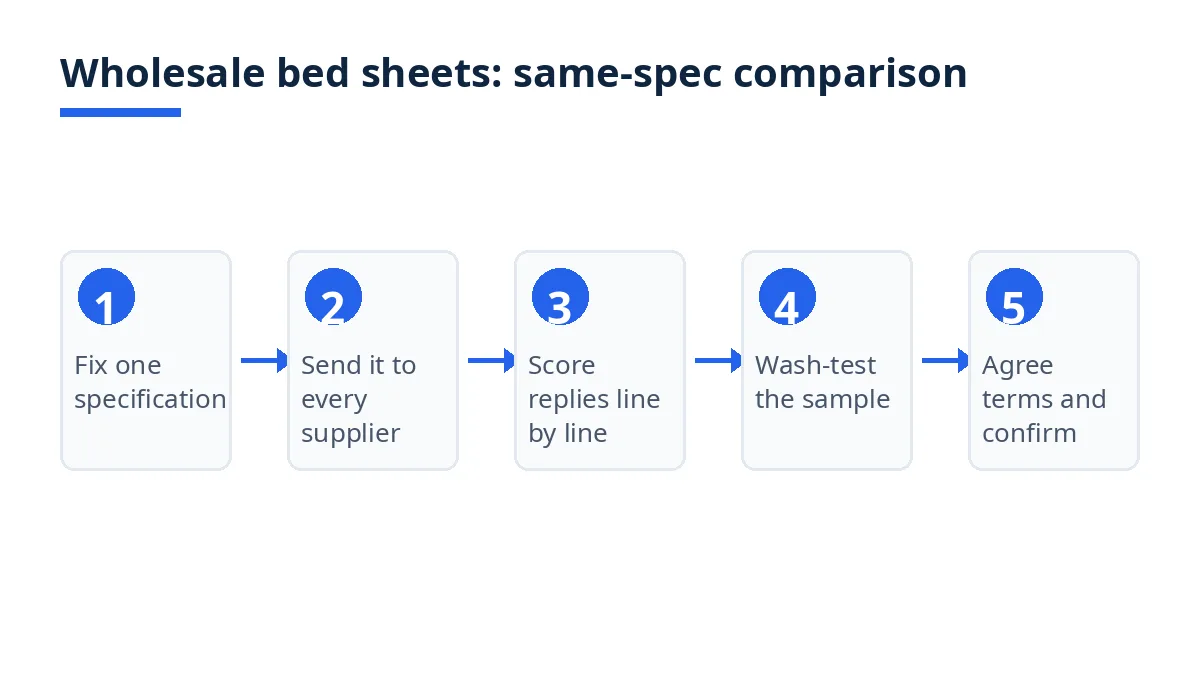
Write one specification sheet. State the pieces in the set, the fibre composition by weight, the weave, the thread count target, the finished weight, flat and fitted dimensions, fitted pocket depth, hem width, elastic type, closure type for duvet covers, colour or print, labelling and packing. Add the size after washing, not only the cut size, and the tolerance you will accept on each dimension.
Send the identical sheet to every candidate. Ask for the same reply format: fabric assumed, pieces per set, unit price per set, price inclusions and exclusions, validity period, MOQ per design, per colour and per size, sample terms, and one delivery term with a named place.
Score the replies on a scorecard, not on price alone. Give each reply a mark for specification match, MOQ fit, sample quality, document readiness and delivery term. A supplier that answers every line of the specification is easier to compare than one that quotes a single price.
Test the sample as your customer will use it. Wash the sample following the care label, then measure it against the size chart and check the fitted sheet on a mattress of the depth in the chart. ISO 5077:2007 specifies a method for determining the dimensional change of fabrics, garments or other textile articles when subjected to an appropriate combination of specified washing and drying procedures.1
Agree inspection and terms before you confirm. Write the inspection method, the acceptance numbers and the delivery term into the purchase order. ISO 2859-1:2026 defines a system of acceptance sampling plans for inspection by attributes, indexed by acceptance quality limit (AQL), for lot-by-lot inspection.2 AQL is the maximum average percentage of defective items considered acceptable during random sampling, and it sets sample sizes and acceptance or rejection thresholds.2
Scorecard line | What to record | Why it changes the comparison |
|---|---|---|
Fibre and weave | Composition by weight, weave, thread count target | A different fibre or weave is a different sheet |
Finished weight | Weight per set or per square metre, as quoted | Weight affects feel, cost and freight |
Size after washing | Dimensions after washing, with tolerance | A sheet past tolerance does not fit |
Finishing | Dyeing, printing or finishing route named | Each route carries its own batch minimum |
MOQ split | Minimum per design, per colour and per size | A total MOQ can hide a failing colour |
Price inclusions | Testing, packing, delivery term stated | Excluded items raise the landed cost |
Sample terms | Sample type, cost, approval in writing | Approval in writing is the reference for bulk |
Costs, timelines and documents
What are the typical costs and timelines?
There is no typical wholesale price or timeline that a guide can state as fact, because each supplier prices your fibre, weave, thread count target, finished weight, set composition, finishing route, packing and delivery term. The Incoterms® 2020 rules give 11 rules with a clear allocation of cost, risk and obligations,3 so compare prices only on the same rule and named place. A price that includes freight and insurance is not comparable with a price that stops at the port of loading.
The drivers below explain why two quotes for sheets of the same size can sit far apart. Use them to ask what each price is based on, rather than to judge a quote as high or low.
Price driver | What moves it | Ask the supplier to state |
|---|---|---|
Fibre and yarn | Fibre type, blend ratio, yarn count | Composition by weight for each piece |
Weave and thread count target | Weave construction, threads per unit area as specified | Weave and thread count target in writing |
Finished weight | Fabric weight after finishing | Weight basis used in the quote |
Dyeing or printing | Batch size per colour or print, number of print colours | Batch minimum per colour or print |
Construction | Fitted corners, elastic, hems, closures | Each construction detail and its cost treatment |
Finishing | Finishing route applied to the fabric | Finishing steps included in the price |
Packing | Retail set packing, inserts, carton spec | Pieces per carton, carton size and weight |
Delivery term | Where cost and risk pass | One Incoterms® 2020 rule and named place3 |
Example figures: two suppliers quote the same specification, a cotton percale set with two pillowcases, for 2,000 sets. Supplier A quotes a lower price per set that excludes special retail packing and testing, while Supplier B quotes a higher price per set that includes both. Once packing and testing are added to Supplier A, the two prices sit close together, and the choice turns on MOQ fit and sample quality. The example shows structure only, not a market price, a typical MOQ or a typical lead time.
For timelines, ask for sampling, fabric ready, production, inspection and shipment dates as separate lines. Sampling depends on fabric availability and correction rounds, and bulk production depends on dyeing or printing batches, finishing and line capacity.
Which documents are needed?
For export clearance in Bangladesh, goods may not be loaded unless an export declaration, the Bill of Export or Shipping Bill, is submitted to Customs and approved.4 Enclosed documents include the export contract or purchase order where there is no export letter of credit, the commercial invoice, the packing list, the EXP form certified by an authorized dealer, and a certificate of origin issued by the Export Promotion Bureau (EPB) or a Chamber of Commerce and Industry.4 Keep the buyer documents beside them: the specification sheet, the itemized quotation, the purchase order with the MOQ split and inspection terms, the approved sample record, and the label artwork.
Bangladesh-specific rules and tips
Classify each piece before you price it. In the Harmonized System, heading 6302 covers bed linen, table linen, toilet linen and kitchen linen, and bed linen splits by construction, print status and fibre: 6302.10 for bed linen that is knitted or crocheted, 6302.21 to 6302.29 for printed bed linen, and 6302.31 to 6302.39 for other bed linen.5 A printed cotton set and a plain cotton set therefore sit on different lines, and a set can span more than one line. Confirm the full national code for each piece before you fix a selling price. See the HS code for bed sheets guide.
Write the label from the specification. For the European Union, Regulation (EU) No 1007/2011 states that a textile product shall be labelled or marked with the name and percentage by weight of all constituent fibres in descending order.6 Agree the fibre wording at sampling stage and check that the percentages match the fabric bought.
State size after washing in the specification, not in a footnote. A flat sheet measured before washing and a flat sheet measured after washing are two different measurements. ISO 5077:2007 gives the method for measuring dimensional change after washing and drying,1 so name the wash and dry procedure and the tolerance per dimension. Cut the sample, wash it, measure it, and only then approve the size chart.
Keep one legal name across every paper. The export declaration names the exporter and the foreign buyer,4 so the name on the trade licence, quotation, proforma invoice, payment account and certificate of origin should match. A mismatch delays clearance, because the papers no longer describe the same transaction.
Mistakes and red flags
What are the most common mistakes?
Comparing prices on different specifications. A lower price on a lighter fabric, a lower thread count target, a different weave, a simpler finishing route or a different delivery term is a different offer. Compare only replies to the same specification sheet on the same Incoterms® 2020 rule.3
Reading a thread count number without the rest of the specification. Thread count alone does not describe a sheet. Without fibre, weave, yarn type and finished weight beside it, the number cannot be compared across suppliers, and a higher number on a weaker construction is not a better sheet.
Accepting a size chart measured before washing. A sheet that fits on the cutting table and falls short after its first wash will draw returns, not reorders. Approve sizes after washing, against the tolerance in the specification, using the method in ISO 5077:2007.1
Asking for a total MOQ only. The binding minimum is usually per design, per colour or per size. An order can clear the total and still fall below the minimum for one colour, which then carries a surcharge, a merged shade batch or a dropped colour.
Treating a profile or a badge as a capacity check. A profile is a starting point for enquiries. It does not test whether a supplier can make your sheet at your volume, and a badge is not a guarantee of capacity, quality or delivery.7
Red flags in a reply. A supplier that will not state the fibre composition by weight, the weave or the finished weight; a quote with no MOQ split and no validity period; a sample offered only in a substitute fabric; or a request for payment to a personal account rather than the company account named in the documents. Each of these is a reason to pause.
Checklist
Before you confirm a wholesale order, every line should be answered in writing.
Specification sheet sent: pieces per set, fibre by weight, weave, thread count target, finished weight.
Sizes stated after washing, with tolerance per dimension and mattress depth for fitted sheets.
MOQ confirmed per design, per colour and per size, with the binding line named.
Fabric status per colour recorded: stocked, dyed to order or printed to order.
Price inclusions and exclusions itemized: testing, packing, delivery term and named place.3
Sample washed, measured and approved in writing against the size chart.1
Inspection method and AQL values in the purchase order.2
Label wording agreed, with fibre percentages in descending order for the European Union.6
Classification confirmed per piece under heading 6302.5
Export set agreed: invoice, packing list, EXP form, certificate of origin, Bill of Export.4
One legal name across quotation, invoice, payment account and origin documents.4
How Exportain helps
On Exportain, browse suppliers and post your specification sheet, MOQ split and delivery term on the RFQ board, so suppliers quote against the same specification and you compare replies line by line. When you accept a quotation, Exportain creates one order and issues one proforma invoice from the accepted terms.7
Read the badges for what they record. Exportain Verified means Exportain has checked identity, phone, email and business registration, and Export Verified means it has checked the Export Registration Certificate (ERC).7 Factory Verified means it has reviewed photos of the manufacturer factory, while Trading Company Verified means it has reviewed photos of the trading company office or warehouse.7 Verification is a document and photo review by staff, free, and never granted by membership plans.8 It is not a factory inspection,7 8 so sample approval and inspection stay with you. Exportain is not a party to the goods contract and does not inspect goods, book freight or clear customs.
FAQs
What should I know first about bed sheets?
Wholesale bed sheets are bought on a written specification: pieces per set, fibre by weight, weave, thread count target, finished weight, size after washing and finishing. Bed sheets are bed linen in heading 6302, split by construction, print status and fibre.5 Fix that specification before you ask for a price, and compare every supplier against it.
What are the typical costs and timelines?
There are no typical figures a buyer can rely on, because each supplier prices your fibre, weave, thread count target, finished weight, set composition, finishing route, packing and delivery term. The Incoterms® 2020 rules allocate cost, risk and obligations for each rule,3 so compare quotes only on the same rule and named place. Sampling, dyeing or printing batches, finishing and line capacity drive the timeline, so ask for each stage as a separate date.
Which documents are needed?
The order documents are the specification sheet, the itemized quotation and the purchase order, with the MOQ split and inspection terms on both. The export set is the Bill of Export, commercial invoice, packing list, EXP form certified by an authorized dealer, and a certificate of origin issued by the EPB or a Chamber of Commerce and Industry.4
What are the most common mistakes?
The most common mistakes are comparing prices on different specifications or delivery terms,3 reading a thread count number without fibre, weave and finished weight beside it, approving sizes measured before washing,1 asking only for a total MOQ, and reading a badge as a guarantee. A badge is not a guarantee of capacity, quality or delivery.7
Next steps on Exportain
Browse suppliers, then post your specification sheet, MOQ split and delivery term on the RFQ board so suppliers state their price and MOQ per design and per colour on the same terms. Before you confirm, read how to import bed sheets from Bangladesh and the bed sheets quality control checklist.
Sources
- ISO 5077:2007 - Textiles — Determination of dimensional change in washing and drying. International Organization for Standardization (accessed )
- ISO 2859-1:2026 - Sampling procedures for inspection by attributes — Part 1: Sampling schemes indexed by acceptance quality limit (AQL) for lot-by-lot inspection. ISO (accessed )
- Incoterms® 2020. International Chamber of Commerce (ICC) (accessed )
- Customs Clearance Procedures for Export. Bangladesh Customs, National Board of Revenue (accessed )
- HS 2017 - Code 6302: Bed linen, table linen, toilet linen and kitchen linen. United Nations Statistics Division (accessed )
- Regulation (EU) No 1007/2011 on textile fibre names and related labelling and marking of the fibre composition of textile products. European Union, (accessed )
- Trust & Safety Center. Exportain (accessed )
- Supplier verification: Earn trust badges buyers can see. Exportain (accessed )
About the author
Sourcing from Bangladesh?
Post a request for quotation and suppliers on Exportain can send you their quotes directly.
Post an RFQ