Using Telegraphic Transfer (TT) When Buying From Bangladesh: Bank Rules and Tips
TT payment to Bangladesh, run from the buyer bank: instruction fields, charge codes, cut-off and tracing, documents, and Bangladesh Bank rules to check before sending.
Short answer
Using a TT payment to buy from Bangladesh means instructing your bank with the seller exact bank details, an agreed OUR, SHA, or BEN charge code, and an invoice reference, then confirming the beneficiary bank credit rather than the send. Costs, cut-off times, and intermediary deductions shape the amount credited, while the seller bank matches the credit to the EXP export file and Bangladesh Bank repatriation rules.
On this page
Key takeaways
A TT is complete only when the beneficiary bank credits the seller account, not when your bank sends the instruction.
Agree the OUR, SHA, or BEN charge code and the invoice reference in the contract before you instruct your bank.
Cut-off times, correspondent banks, holidays, and compliance screening decide how long a TT takes and how much is credited.
On the Bangladesh side, the seller bank matches the credit to the EXP export file and the exporter undertaking to repatriate proceeds within four months.
Send every leg to the company account in the contract name, verify any changed bank details through a known channel, and never send a balance leg before its trigger document is checked.
Your bank instruction decides whether a telegraphic transfer (TT) to Bangladesh arrives cleanly, arrives short, or stalls in a compliance queue. This guide is for the buyer who must operate that instruction: what to put on it, which charge code to choose, how to trace it, and which Bangladesh-side bank rules affect the seller who receives it. It covers the bank work behind the payment terms on your proforma invoice.
A TT moves on a payment instruction, not on a promise in an email thread. Your bank creates a SWIFT message, most commonly an MT103, carrying the payment details to the recipient bank. SWIFT itself does not hold or move the funds; it carries the instruction, and banks move funds through their own account relationships.1
Why this matters for buyers and sellers
For the buyer, a TT instruction leaves narrow room for correction once sent. A wrong account number, a beneficiary name that does not match the account, or a missing reference can push the payment into a repair queue, return it, or leave it unmatched. For the seller in Bangladesh, the same payment must fit the export file at the seller bank, so a credit without a usable reference can be hard to match to an order, an invoice, or a shipment.
Step-by-step: how it works
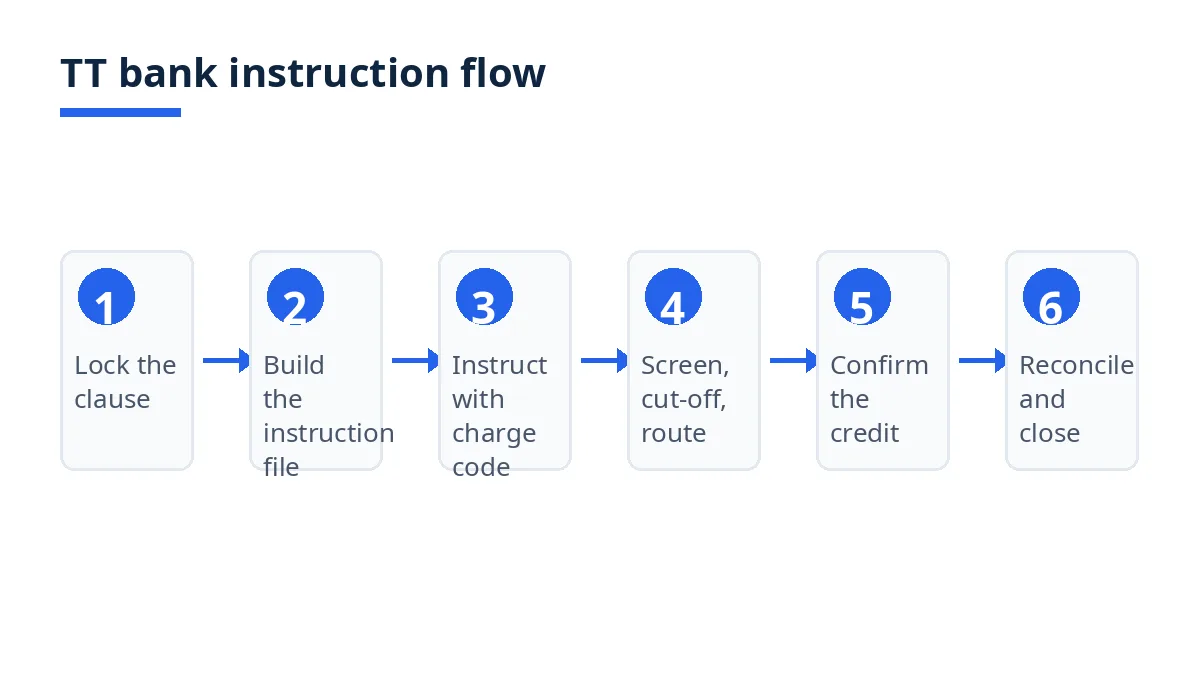
Lock the payment clause before you instruct. Write the currency, the total value, each TT leg, the trigger for each leg, the charge code, and the reference the seller bank should see. State whether the balance is due against a copy of the transport document, an inspection report, or another named document, rather than leaving it as "balance on shipment".
Build the instruction file from the seller current written details. Collect the beneficiary legal name exactly as registered on the account, the account number, the beneficiary bank name and branch, the SWIFT/BIC code, the amount and currency, the purpose of payment, and the charge code. Your bank verifies both sides, screens against anti-money laundering and sanctions lists, and may ask for invoices or contracts.1
Instruct with the charge code and reference on the instruction itself. Put the invoice or order number in the remittance information field, in the form the seller asked for, and check it character by character. An unmatchable reference is a common reason a credit sits unmatched even after the money has arrived.
Let screening, cut-off, and routing run. Transfers submitted after a bank daily cut-off are processed on the next business day, and currencies and destinations have varying cut-off times.1 Where the two banks have no direct relationship, the payment routes through one or more correspondent banks, each with its own processing timeline and fees.1
Confirm the credit, not the send. Ask the seller for beneficiary bank confirmation that the amount was credited, and compare amount, currency, and reference with the instruction. Confirmations with reference numbers serve as proof of payment, and finance teams should reconcile them with the instruction, accounting for deductions and exchange differences.1
Reconcile the leg and close the file. Record the amount sent, the amount credited, every deduction, the exchange rate, and the credit date. If the credited amount is short, agree in writing whether it is a bank deduction under the agreed charge code or an amount still owed.
Costs, timelines and documents
What are the typical costs and timelines?
There is no single TT price: a transfer can carry four kinds of cost, and only the first is always visible to the sender. One published guide reports a sending bank fee, intermediary bank fees, an exchange-rate markup, and a receiving bank fee, with intermediary fees of USD 10 to 35 per bank and receiving fees often of USD 5 to 25, both deducted from the transfer amount.2 The markup is most often missed, because it is built into the quoted rate rather than shown as a separate fee, and the same guide reports it at 1 percent to 5 percent above the mid-market rate.2 Ask your bank for all four figures before you send.
The charge code decides who bears the middle costs. Under OUR, you pay all fees, including intermediary charges, so the recipient should receive the full amount. Under SHA, you pay your sending bank fee and the recipient pays intermediary and receiving fees, so the recipient receives slightly less. Under BEN, the recipient pays all fees, deducted from the amount received.2 Your bank will ask you to make that choice before you confirm.3 For a fixed invoice value, OUR protects the total; SHA is the common default, and the code most likely to produce a short credit.
One guide reports international TTs typically taking 1 to 5 business days, depending on destination, currencies, intermediary banks, and cut-off times.2 Holidays in either country, incorrect details, and large time zone differences push a transfer toward the longer end.2 Another guide describes the standard case as 1 to 3 business days.3 Do not promise a credit date until you have allowed for cut-off, weekends, holidays in both countries, and a possible compliance hold.
Example figures: a buyer in Germany orders cotton canvas bags for EUR 18,400, paid as a 40 percent advance of EUR 7,360 and a 60 percent balance of EUR 11,040 against a copy bill of lading and an inspection report. Example figures: if the balance leg is sent under SHA with EUR 65 in deductions, the seller bank credits EUR 10,975, leaving a EUR 65 shortfall to reconcile before document release. The amounts are illustrative only.
Which documents are needed?
A TT instruction needs only the bank fields, but the order needs a paper trail both sides can follow. Keep the contract or proforma invoice with the TT schedule, the seller written bank details, your bank instruction and confirmation, the seller bank credit confirmation, and the trigger document for each leg. For a balance leg, that trigger document is the control: do not send the balance until you have checked it.
Bangladesh-specific rules and tips
The prescribed period for repatriating export proceeds is four months, and if the full proceeds are not received within that period without authorization from Bangladesh Bank, the exporter is subject to action under the Foreign Exchange Regulation Act, 1947.4 Payment may be received through an authorized dealer (AD) bank in freely convertible foreign currency, including Chinese Yuan.4 Before executing an export transaction, the AD bank must satisfy itself that arrangements exist for realization within the period, for receipt of title documents, and that the buyer abroad is bona fide where needed.4
Advance payments carry their own conditions. Before paying out money against a remittance whose stated purpose is an advance receipt for goods to be exported, the AD bank should obtain a declaration from the beneficiary on the Advance Receipt Voucher, with a report to the online reporting module.4 Conditions include an irrevocable letter of credit (LC) or contract, satisfactory previous performance and adequate capability, no interest, and execution within one year from receipt.4 If the export is not executed, the AD bank may allow a refund, using Exporters Retention Quota funds first.4 Agree the refund route before you send.
Transport documents add a further check. Transport documents for exports from Bangladesh must generally be drawn to the order of an AD bank, and handed to its authorized representative.4 They may be drawn to the order of the importer only if the shipment is made against full payment received in advance through an AD bank and it is a requirement of the export LC or contract, with a certificate from the designated AD to the carrier.4 If a seller offers to draw documents directly to you on a part-payment TT, ask which condition it relies on and get the answer in writing through the seller bank route.
Electronic filing changes the timing but not the discipline. The electronic EXP Form option is acceptable in the Bangladesh Bank online system before customs formalities, and AD banks accept forms submitted electronically, with the information then available in the customs system.4 Exporters submit shipping information immediately on shipment, and the AD bank completes reporting within 14 days where needed; exporters submit a signed hardcopy with the bill of export and shipping documents within the same period.4 An earlier Bangladesh Bank circular introduced that electronic option.5
First, send every leg to the company account in the company name on the contract, never to a personal or different company account, and treat any request to change the account as a stop signal until verified through a channel you already trust. Second, quote the invoice number, the order number, and any reference the seller bank asked for, in the remittance information. Third, for a first order, confirm the seller business registration and export credentials, and agree an inspection before the balance leg if the value justifies one.
Mistakes and red flags
What are the most common mistakes?
Sending a leg without its trigger. A balance sent on a promise, rather than against the agreed transport document copy or inspection report, removes the last check the buyer held.
Leaving the charge code unagreed. If no code is agreed, a SHA default can leave the seller short, and the shortfall then blocks document release. Write OUR, SHA, or BEN into the contract clause, not only into the bank form.
Copying beneficiary details from an old invoice. A misspelled name, a missing SWIFT/BIC code, or a superseded account number causes delays and extra charges. Copy details from the seller current written instruction and have a second person read them back.
Treating a sending confirmation as a credit. Your bank confirmation proves an instruction was sent. Only the beneficiary bank credit proves the seller received the money.
Acting on changed bank details sent by email alone. Payment diversion works by intercepting or imitating a message announcing new bank details. If details change, stop and verify through a contact you already trust before sending anything.
Ignoring cut-off, weekends, and holidays. A Friday instruction sent after cut-off, across a holiday in either country, does not become a Monday credit by assertion.
Paying a full advance on a first order without a contract control. A staged schedule, a balance tied to documents, and an agreed inspection reduce exposure more than any reassurance in messages.
Red flags that justify pausing include pressure to pay urgently outside the agreed schedule, a beneficiary name that does not match the supplier, refusal to provide written bank details, and any request to split a payment to an unrelated third party.
Checklist
Before you instruct any TT leg, answer every line in writing.
Contract clause states currency, total value, each leg, each trigger, the charge code, and the reference.
Beneficiary legal name matches the contracting company exactly, from the seller current written instruction.
Account number, beneficiary bank and branch, and SWIFT/BIC code checked character by character, with a second person reading back.
Any change to bank details verified through a separate, known contact channel.
Charge code agreed in the contract, with the expected credited amount stated for that leg.
Remittance information quotes the invoice or order number and any reference the seller bank asked for.
For a balance leg, the trigger document received and checked against the order before the instruction is sent.
Cut-off times, weekends, holidays in both countries, and possible compliance holds allowed for in the timetable.
Credit to be confirmed by the beneficiary bank, not assumed from your sending confirmation.
Amount sent, amount credited, deductions, exchange rate, and credit date reconciled and filed with the contract.
For an advance leg, the contract, the seller capability, and the refund route understood before the instruction is sent.
How Exportain helps
Exportain is a marketplace where buyers find Bangladeshi suppliers, post requests for quotation, and compare replies. That role is separate from the bank transfer: the TT runs between your bank and the supplier bank, and Exportain does not move it. On the buying journey, payment is settled on the accepted terms directly with the supplier, with inspection and shipment conditions agreed in writing first.6 When a buyer accepts a quotation, Exportain creates one order and issues one proforma invoice from the accepted terms, including quantity, unit price, currency, and Incoterm.7
Use the platform to get the payment clause right before you go to your bank. Browse suppliers and post the quantity, delivery term, and payment schedule on the RFQ board so replies quote against the same terms. Read the badges for what they record: Exportain Verified means Exportain has checked identity, phone, email, and business registration, and Export Verified means it has checked the Export Registration Certificate.7 Verification is a document and photo review by staff, not a factory inspection.8 It does not replace your own checks or the bank controls in this guide. For what each badge covers, see how supplier verification works on Exportain.
FAQs
What should I know first about TT payment?
Know first that a TT is a bank instruction, not a bank guarantee. Your bank sends a SWIFT instruction, most commonly an MT103, and the transfer is complete only when the beneficiary bank credits the seller account.1 The charge code, reference, and trigger decide whether that credit arrives in full and matched to your order.
What are the typical costs and timelines?
Costs combine a sending bank fee, a cable or SWIFT charge, intermediary and receiving bank fees, and an exchange-rate margin, shaped by the OUR, SHA, or BEN code.2 3 Timelines typically run from 1 to 5 business days, lengthened by cut-off times, holidays, and compliance checks.2
Which documents are needed?
To instruct the transfer, you need the seller full written bank details and your bank instruction, with the invoice or order reference in the remittance information. Around the TT, keep the contract or proforma invoice with the TT schedule, the bank confirmations, the credit confirmation, and the trigger document for each leg. On the Bangladesh side, the export is declared on the EXP Form at full invoice value, and the exporter undertakes to repatriate the full proceeds within the period specified by Bangladesh Bank.4
What are the most common mistakes?
The most common mistakes are sending a leg without its trigger document, leaving the charge code unagreed, copying beneficiary details from an old invoice, treating a sending confirmation as a credit, and acting on changed bank details sent by email alone. Each is preventable at the instruction stage.
Next steps on Exportain
Browse suppliers, then post your quantity, delivery term, and TT schedule on the RFQ board so suppliers quote against the same payment clause. Before you instruct your bank, read the LC payment meaning guide if you are weighing a bank undertaking against a direct transfer, and check the payment clause against the checklist above.
Sources
- The Complete Telegraphic Transfer Guide for Payment Operations Teams. Rapyd (accessed )
- Telegraphic Transfer (TT): What It Is & How It Works. Statrys (accessed )
- Telegraphic Transfer (TT): What It Is and How It Works. Airwallex (accessed )
- Consolidated circular on foreign exchange regulations — export trade transactions (FEPD-1 Circular No. 26, July 30, 2026). Bangladesh Bank (accessed )
- FE Circular No. 17: Introduction of electronic option of EXP Form submission for export of goods from Bangladesh. Bangladesh Bank, (accessed )
- How to source and buy from Bangladesh. Exportain (accessed )
- Trust & Safety Center. Exportain (accessed )
- Supplier verification: Earn trust badges buyers can see. Exportain (accessed )
About the author
Sourcing from Bangladesh?
Post a request for quotation and suppliers on Exportain can send you their quotes directly.
Post an RFQ