Using Transferable LC When Buying From Bangladesh: Bank Rules and Tips
Transferable LC Bangladesh: how a transferable credit moves from a first beneficiary to a second beneficiary, and what buyers must confirm with their banks.
Short answer
A transferable LC under UCP 600 Article 38 is a credit that specifically states it is transferable, allowing the first beneficiary to ask for it to be transferred in whole or in part to a second beneficiary. The transferring bank is not obliged to transfer, transfer charges are normally for the first beneficiary, and the second beneficiary cannot transfer it onward. Confirm the transferring bank, amounts, and dates before shipment.
On this page
Key takeaways
A credit is transferable under UCP 600 Article 38 only if it specifically states it is "transferable"; transfer in whole or in part to a second beneficiary is at the first beneficiary's request.
The transferring bank is under no obligation to transfer except as expressly consented to by that bank, and a transferred credit cannot be transferred again at the request of the second beneficiary.
Unless otherwise agreed at transfer, transfer charges are for the first beneficiary's account; the transferred credit may only reduce the amount, unit price, expiry date, presentation period, and latest shipment date, with the insurance cover percentage increasable.
The first beneficiary may substitute its own invoice and draft and draw the difference, but must do so on first demand; confirm the transferring bank, amounts, dates, and AD bank steps in writing before shipment.
A transferable letter of credit (LC) is a documentary credit that specifically states it is "transferable", and that wording allows the first beneficiary to ask for the credit to be made available, in whole or in part, to a second beneficiary. Under UCP 600 Article 38, the beneficiary named in the credit is called the first beneficiary, and the bank that carries out the transfer is called the transferring bank.1 A credit without that wording is not transferable under Article 38.
This matters most when the company named in your LC is not the company that makes the goods. A trading house or intermediary may hold the buyer relationship, while a producer further down the chain manufactures and ships the order. A transferable LC lets that chain work inside a single credit: the buyer opens one credit in favor of the intermediary, who asks for part or all of it to be transferred to the producer.
For buyers, the question is whether the transfer terms protect the documents, dates, and amount agreed. Transfer does not change the goods ordered, and it does not turn document checking into goods inspection.
Why this matters for buyers and sellers
For a buyer, a transferable LC is worth considering when the named seller is an intermediary and the real producer needs bank-backed payment assurance before shipping. Without transfer, the intermediary must fund the producer itself or arrange a separate instrument, either of which can slow production or add cost that reaches the buyer in the price. That structure is common where the party holding the customer relationship is not the party producing the goods.2
For the first beneficiary, the value lies in the margin mechanism. When the credit is transferred at a lower amount or unit price, the first beneficiary can substitute its own invoice and draft, if any, for those of the second beneficiary, for an amount not above the credit amount, and then draw for the difference. The supplier is paid the transferred amount, the intermediary keeps the difference, and the buyer pays the original credit amount on a complying presentation.
For the second beneficiary, the value is direct access to a bank credit rather than reliance on the intermediary's promise to pay. The transferred credit must still be checked field by field, since its own amount, dates, and document list govern the producer's presentation.
Three nearby LC features are often confused with transferability. A back-to-back LC is a separate credit, not a transfer of the first credit. A confirmed LC adds a second bank undertaking, while transferability on its own adds none. An irrevocable LC cannot be amended or cancelled without agreement, while transferability must also be expressly stated.
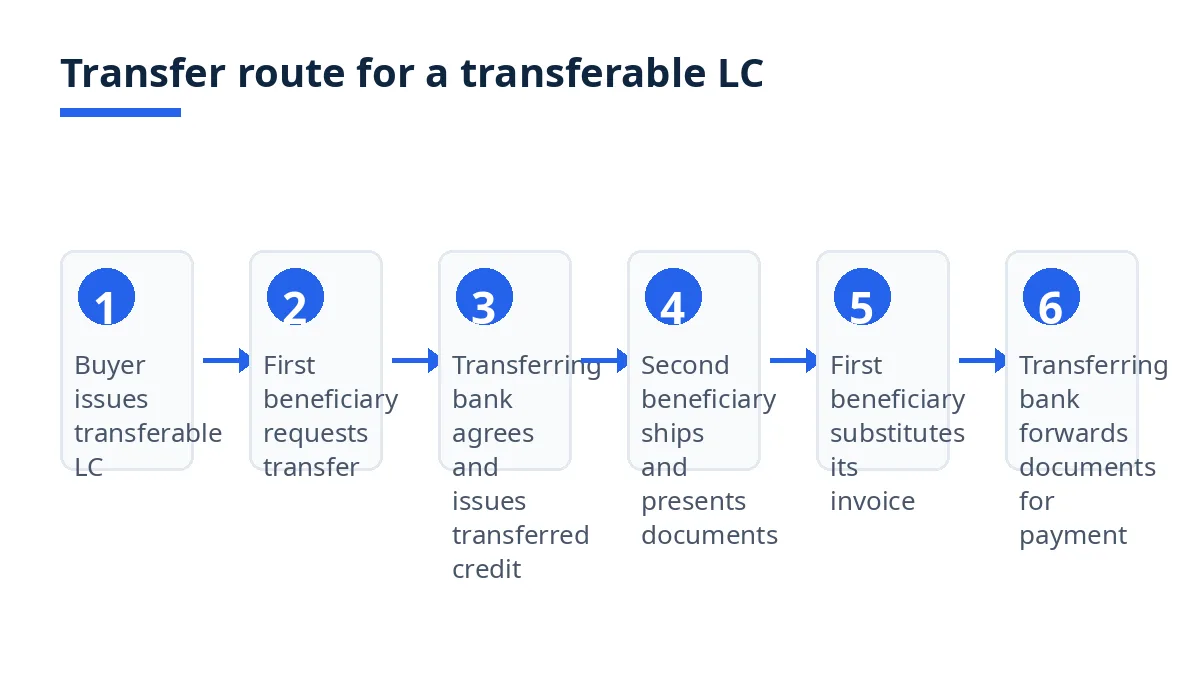
Step-by-step: how it works
Buyer and intermediary agree the deal. The sales contract states the goods, quantity, price, shipment terms, and that payment will be by transferable LC.
Buyer applies for a transferable LC. The application must ask for a credit that specifically states it is "transferable", and must state whether partial drawings or shipments are allowed.
Issuing bank issues and advises the credit. The issuing bank sends the credit to the advising bank, which advises it to the first beneficiary, who checks every field against the contract.
First beneficiary requests the transfer. The first beneficiary asks the transferring bank to transfer the credit, in whole or in part, to a named second beneficiary, stating the conditions for advising amendments to that beneficiary.
Transferring bank decides whether to transfer. A bank is under no obligation to transfer a credit except to the extent and in the manner expressly consented to by that bank.1 The transferring bank may be a nominated bank, or, where the credit is available with any bank, a bank specifically authorized by the issuing bank to transfer.
Second beneficiary ships and presents documents. The second beneficiary ships by the latest shipment date in the transferred credit and presents the required documents to the transferring bank before expiry.
First beneficiary substitutes its invoice. Where the first beneficiary is to present its own invoice and draft, it substitutes them for the second beneficiary's documents and draws for the difference, if any. If it fails to do so on first demand, or presents a discrepant invoice it fails to correct on first demand, the transferring bank may present the second beneficiary's documents as received.
Documents move onward and payment follows a complying presentation. The transferring bank forwards the documents toward the issuing bank, and payment follows the credit terms once a complying presentation is established.
A transferable credit can be transferred in part to more than one second beneficiary, provided partial drawings or shipments are allowed.3 A transferred credit cannot be transferred again at the request of a second beneficiary. The first beneficiary is not treated as a subsequent beneficiary, which is why the route back to the first beneficiary for invoice substitution is allowed.
Worked example
The figures below are an illustration only, not a bank offer or a market price. A buyer orders 8,000 woven cotton tote bags for USD 24,800 under a transferable LC in favor of a Dhaka trading house as first beneficiary. The trading house transfers USD 21,600 of the credit to a Narayanganj producer as second beneficiary. The producer ships and presents its documents. The trading house substitutes its own invoice for USD 24,800 and draws the USD 3,200 difference, subject to complying documents and to the transfer charges agreed at transfer.
What can change on transfer, and what cannot
The transferred credit must accurately reflect the terms and conditions of the original credit, including confirmation, if any, with a limited set of exceptions. Only the credit amount, any unit price, the expiry date, the presentation period, and the latest shipment date or shipment period may be reduced or curtailed. The insurance cover percentage may be increased to provide the cover stipulated in the credit. The first beneficiary's name may be substituted for the applicant's in the transferred credit, and where the applicant name is specifically required in a document other than the invoice, that requirement must be reflected.
That list is the whole of the flexibility. The goods description, quantity terms, ports, and document list do not change on transfer. A buyer who wants different goods, documents, or shipment terms for the producer needs an amendment to the original credit, not a transfer instruction.
Costs, timelines and documents
No standard transfer charge, margin, or processing time applies to every transferable LC. Charges depend on the banks involved, the amount, the number of second beneficiaries, and the work required, so every figure must be confirmed in writing with both banks before the credit is issued.
Unless otherwise agreed at the time of transfer, all charges incurred in respect of a transfer must be paid by the first beneficiary.1 The intermediary usually bears the transfer cost, and the buyer should confirm whether any part of it is reflected in the unit price. Other charges follow the allocation stated in the credit and the contract.
Timelines come from the credit itself, not from a general timetable. The expiry date, latest shipment date, and presentation period in the transferred credit are often shorter than those in the original credit, because the first beneficiary and the transferring bank need time for invoice substitution and onward presentation. Map every date in both credits on one timeline before shipment.
The document set follows the document list in the credit: the commercial invoice, the transport document, the packing list, and, where called for, a certificate of origin, insurance documents, and an inspection certificate, with data that must not conflict across documents.4 The substituted invoice must still correspond with the credit goods description and must not exceed the credit amount. Exportain's payment terms are separate from bank charges on any LC.5
Item | What to confirm before shipment |
|---|---|
Transfer charges | Which bank charges what, who pays each charge, and whether the first beneficiary default was changed |
Transferred amount | The exact reduced amount, if any, and the margin drawn on substitution |
Dates | Expiry date, latest shipment date, and presentation period, checked against the original credit |
Amendment conditions | Whether amendments may be advised to the second beneficiary, and on what conditions |
Invoice substitution | Whether the first beneficiary will substitute its invoice, and its deadline on first demand |
Document list | Every required document, its issuer, and any applicant-name rule outside the invoice |
Confirmation | Whether the transferred credit carries confirmation, since transfer alone adds none |
Bangladesh-specific rules and tips
Bangladesh adds a bank-practice layer on top of UCP 600. Export transactions through Bangladeshi banks run through authorized dealer (AD) banks, and the AD bank route, authenticated LC channel, and foreign exchange paperwork should be settled before the transfer is requested. A buyer whose intermediary or producer banks in Bangladesh should ask, at contract stage, which AD bank will handle the transfer and whether it will act as transferring bank.
Bangladesh Bank has directed AD banks to take safeguards for export trade, including satisfying themselves of the bona fides of the applicant bank and issuing bank for LCs received through authenticated channels, and, for transferred LCs, of the first beneficiary and the transferring bank in addition.6 A transferred LC touching Bangladesh can therefore face extra bona fides checks that the shipment plan must allow time for.
Three tips follow. First, name the transferring bank in the deal documents where possible, so AD bank checks can start early. Second, keep the parties and the goods description consistent across the contract, application, and transfer request, since a mismatch is a common reason for a bank to pause a transfer. Third, confirm whether any Bangladesh foreign exchange reporting step applies, and build it into the shipment timeline.
Mistakes and red flags
Assuming a credit is transferable because it is an LC. Transferability must be expressly stated, and fixing its absence needs an amendment, not a transfer request.
Assuming the transferring bank must agree. A bank is under no obligation to transfer except as expressly consented to by it.
Assuming the second beneficiary can pass the credit on. A transferred credit cannot be transferred again at the request of the second beneficiary.
Planning against the original credit dates. The transferred credit dates are often shorter, and shipping to the original latest shipment date may already be late.
Leaving amendment conditions blank. A transfer request must state if and under what conditions amendments may be advised.
Treating invoice substitution as automatic. Substitution happens on first demand, and a missed or discrepant substitution risks the transferring bank forwarding the second beneficiary's documents as received.
Assuming transfer adds confirmation. Transfer alone adds no bank undertaking, so confirmation must be requested separately.
Assuming the buyer is protected on quality. Transfer changes the payment route, not the goods check, so an inspection certificate must be named as an LC document.
Hiding the chain from the banks. Disclose the chain, the parties, and the transferring bank at application stage.
Checklist
[ ] The credit specifically states it is "transferable", and partial drawings or shipments are allowed for more than one second beneficiary.
[ ] The transferring bank is named where possible, and has expressly consented.
[ ] The transfer request names each second beneficiary, the transferred amount, and the amendment conditions.
[ ] The transferred credit dates are mapped against the original credit dates.
[ ] The charge allocation is stated in writing, including whether the first beneficiary default was changed by agreement.
[ ] The invoice substitution plan is agreed, including the deadline on first demand.
[ ] The document list is checked in the transferred credit, including any applicant-name rule outside the invoice.
[ ] Confirmation, if needed, is requested separately and reflected in the transferred credit.
[ ] The AD bank route, authenticated channel, and any Bangladesh foreign exchange paperwork are confirmed.
[ ] The inspection certificate, if required, is named as an LC document with its issuer and timing.
How Exportain helps
Exportain helps buyers and sellers agree clear payment terms before any bank step begins. A buyer can post a request for quotation stating the goods, quantity, shipment terms, and that payment will be by transferable LC, so suppliers and intermediaries respond against the same terms rather than discovering the transfer structure after prices are agreed. Keeping the goods description, quantity, ports, dates, and document list identical across the quotation, contract, and LC application prevents most amendment requests.
Exportain also records the quotation history both sides can see, so the accepted unit price, payment terms, and validity date are visible to buyer and seller alike. That record supports the margin conversation between the beneficiaries, since the transferred amount and the substituted invoice amount can be checked against accepted terms. Exportain's buyer protection page describes document review, the recorded quotation trail, and the limits of what the platform does and does not do.7
FAQs
What should I know first about transferable LC?
A transferable LC is a credit that specifically states it is "transferable", and that wording allows the first beneficiary to ask for the credit to be made available, in whole or in part, to a second beneficiary under UCP 600 Article 38.1 The transferring bank is under no obligation to transfer except as expressly consented to by it, and a transferred credit cannot be transferred again at the request of the second beneficiary.
What are the typical costs and timelines?
There are no standard costs or timelines for a transferable LC. Unless otherwise agreed at transfer, transfer charges are for the first beneficiary's account. Timelines come from the credit itself, and the transferred credit dates are often shorter than the original credit dates.
Which documents are needed?
The document list in the transferred credit governs, and it typically includes the commercial invoice, the transport document, and the packing list, plus a certificate of origin, insurance documents, or an inspection certificate where called for.4
What are the most common mistakes?
The most common mistakes are assuming a credit is transferable without the express wording, assuming the transferring bank must agree, assuming the second beneficiary can transfer the credit onward, and planning shipment against the original credit dates instead of the shorter transferred credit dates.
Next steps on Exportain
Post a free RFQ on Exportain at https://exportain.com/rfqs and state in the RFQ that payment will be by transferable LC, naming the goods, quantity, shipment terms, and document list you expect. For the LC basics behind this guide, read the LC meaning guide, check Exportain payment terms, and read Exportain buyer protection before you agree payment terms.
Sources
- Uniform Customs and Practice for Documentary Credits (UCP 600). LegalGuide (accessed )
- Transferable Letter of Credit Guide. Financely Group, (accessed )
- Transfer Options In Transferable Letters Of Credit And Non-transferable Letters Of Credit. Mondaq, (accessed )
- LC Meaning (Letter of Credit). Exportain (accessed )
- Payment and Membership Terms. Exportain (accessed )
- BB directs ADs to safeguard export trade. Bangladesh Post (accessed )
- Buyer protection: What Exportain does to protect buyers. Exportain (accessed )
About the author
Sourcing from Bangladesh?
Post a request for quotation and suppliers on Exportain can send you their quotes directly.
Post an RFQ