Terry Bathrobes Price in Bangladesh: FOB Cost Breakdown for Buyers
Terry bathrobe FOB price in Bangladesh, read as a garment price: cloth, collar, sleeves, belt, pockets and hood, priced across the size curve, with a per-robe worked example, inspection and export documents, and quote-reading checks that catch a missing line.
Short answer
A terry bathrobe FOB price from Bangladesh is the seller's price for a finished robe delivered loaded on board the vessel at the named port, covering cloth, dyeing, garment assembly, trims, packing, inspection, documents, and port delivery. Read it by its garment parts, collar, sleeves, belt, pockets, and hood, and by the size curve, not as a flat towel price. Ocean freight, insurance, and import costs after loading sit outside the FOB price.
On this page
Key takeaways
A terry bathrobe FOB price ends when the robe is loaded on board the vessel at the named port in Bangladesh; ocean freight, insurance, and import costs after loading sit outside it.
Read a bathrobe quote as a garment price, not a towel price: collar style, sleeves, length, belt, pockets, and hood each carry their own cloth and assembly cost.
Price cloth on the size curve, not on one size: the average cloth use depends on the ratio across sizes, and the smallest-quantity size carries the highest cost per piece. Example figures in the guide show structure only.
Approve the sample worn and after washing, agree the inspection level and garment inspection points in writing, and agree the export document list at quotation stage, not in loading week.
A terry bathrobe quoted on Free on Board (FOB) terms is priced less like a flat towel and more like a garment. The cloth matters, but so do the sleeves, the collar, the belt, the pockets, and the way the robe is cut across sizes. A buyer who reads a bathrobe quote as if it were a towel quote will miss the lines where the money moves. This guide reads the quote by the robe's parts, by the size curve, and by the named port. Every figure in this guide is an example figure showing structure only, not a market price.
Under the Incoterms 2020 FOB rule, the seller delivers the goods loaded on board the vessel nominated by the buyer at the port of shipment, and risk transfers to the buyer at that point.1 The seller carries the goods to the port, loads them on board, and completes export formalities, while the buyer contracts the carrier and pays freight from that point onward.1 The FOB price therefore ends at loading; ocean freight, insurance, destination charges, and import costs after loading sit outside it.
Why this matters for buyers and sellers
For the buyer, the garment parts are the reason two robes at the same cloth weight can carry very different FOB prices. A shawl collar needs more cloth and sewing than a simple kimono-style front. A belt is a separate cut piece with its own loops and finishing. Patch pockets add cutting, placement, and topstitching, and a hood adds a whole extra component. None of these show up in a towel-style quote that prices only cloth, dyeing, and hemming, so a buyer who asks only for a total cannot tell which garment they are buying.
For the seller, the same parts are the reason a single unit price can mislead. A robe order is rarely one size. It is a size curve, and the average cloth use across that curve depends on the ratio of small to large sizes. A quote built on a medium robe will understate the cloth in an order weighted toward large sizes. Pricing by the robe's parts and by the size curve protects both sides.
Step-by-step: how it works
Read a quote in this order.
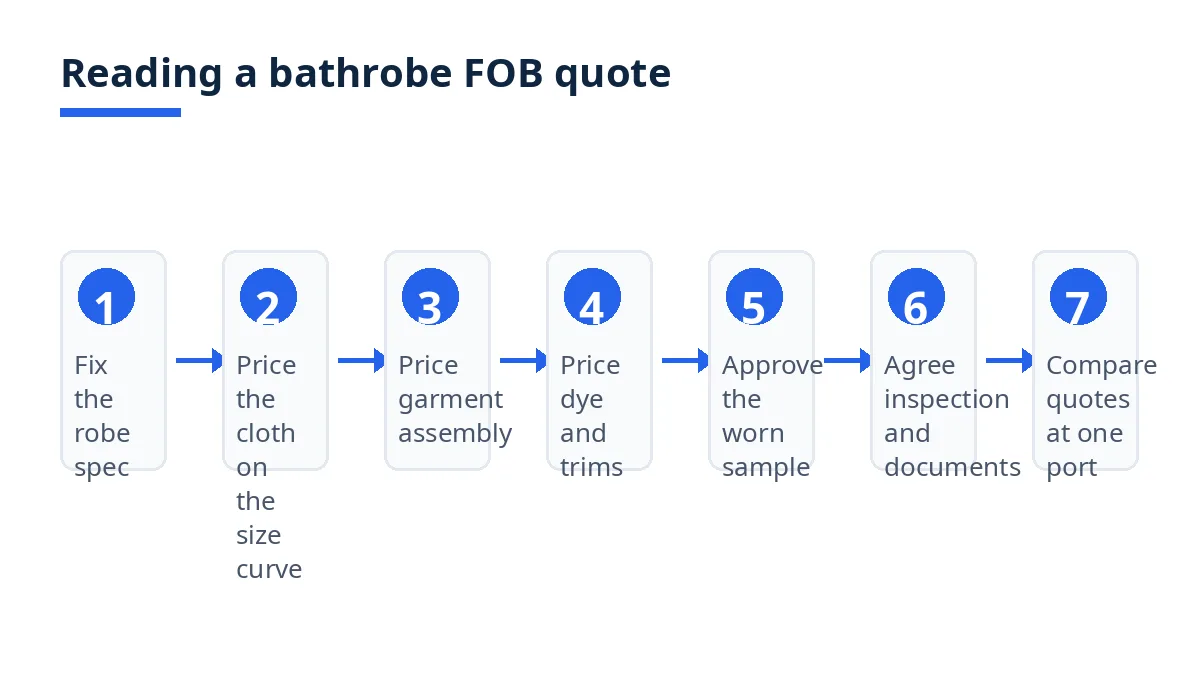
Fix the robe, part by part. State collar style, sleeve style, length, belt, pockets, hood or no hood, fibre, cloth weight, colours, and pack format. A specification that names only "terry bathrobe" is not a specification.
Price the cloth on the size curve, not on one size. Ask for cloth use averaged across your size ratio, with cutting waste stated. A larger robe consumes more cloth per piece, and the smallest-quantity size carries the highest cost per piece.
Price garment assembly as its own line. Cutting, sewing the body and sleeves, setting the collar, attaching the belt loops and belt, and setting pockets are garment operations, priced apart from cloth.
Price dyeing, printing, and trims separately. A dye lot, a print, a woven label, a care label, and a hang tag each carry their own run and minimum. A small colour or label run can bind before the robe quantity does.
Approve a sample you can wear and wash. Check collar roll, belt length and loop position, pocket placement, sleeve length, and overall length on a person, not only on a table. Measure again after washing, and record any change.
Agree inspection, documents, and port delivery before confirming. State the inspection plan, the document set, the named FOB port, and what packing and loading sit inside the price.
Compare quotes only on the same robe, size curve, and port. Line up the garment, cloth, and closing lines for every candidate. A quote that omits the belt, the hood, or the port delivery line is not cheaper.
Costs, timelines and documents
Worked example: one bathrobe, priced by its parts
Example figures: one shawl-collar terry bathrobe with a belt and two patch pockets, in a single colour, packed singly in a polybag, quoted FOB at a named Bangladesh port.
Cost line | Example figure per robe (USD) |
|---|---|
Terry cloth, averaged across the size curve | 6.40 |
Dyeing and finishing | 1.30 |
Garment assembly: cutting, sewing, collar, belt, pockets | 2.10 |
Trims, labels, and single packing | 0.85 |
Inspection | 0.30 |
Export documents | 0.20 |
Port delivery and loading | 0.55 |
FOB price per robe | 11.70 |
Example figures: the arithmetic is the point, not the amounts. Cloth is 6.40 of the 11.70 total, garment assembly is 2.10, and the three closing lines together are 1.05.
What each design change does to the price
Example figures: each change is applied to the worked example above, holding every other line fixed.
Design change | Example figure effect per robe (USD) |
|---|---|
Add a hood | +0.90 |
Lengthen the robe from knee length to ankle length | +1.20 |
Change patch pockets to welt pockets | +0.45 |
Add an embroidered chest motif | +0.60 |
Move from a single colour to two colours | +0.55 |
Example figures: a hood is a new component with its own cutting and sewing, and length is the largest lever here because it adds cloth, dyeing, and sewing together. Embroidery and an extra colour each add a setup of their own.
Reading three quotes for the same robe
Example figures: three quotes for the same example robe, size curve, and named port. Quote A totals 11.70 with all garment lines included. Quote B totals 10.95, but its belt is priced apart, not inside the total, so the 0.75 gap is not a saving. Quote C totals 11.40 to a different port, so its port delivery line cannot be compared with the others. Ask Quote B for an all-in total with the belt inside, and Quote C to re-price to the same named port, before ranking any of the three.
Timelines
There are no typical timelines a guide can state as fact for bathrobes, because sampling, cloth, dye lots, garment assembly, trim delivery, inspection, and vessel booking each depend on your specification and order size. Garment sampling takes longer than towel sampling, because the collar, belt, and pockets must be corrected on a worn sample. Ask for separate dated lines, not a single delivery week: sample approval, cloth ready, production, inspection, documents ready, and vessel loading. Record the loading date against the named FOB port in writing, since the seller's cost responsibility ends at loading.1
Which documents are needed?
The order documents are the robe specification sheet with the size curve, the itemised quotation, and the purchase order, with the garment lines, size ratio, and named port on all three. For export clearance, goods cannot be loaded for export until a Bill of Export (Shipping Bill) is submitted and approved, and the standard export documents include the export contract or purchase order, commercial invoice, packing list, EXP form certified by an authorized dealer bank, certificate of origin issued by the Export Promotion Bureau or a Chamber of Commerce, VAT registration certificate, and Taxpayer Identification Number certificate.2 Confirm any destination-specific certificate before confirming the order.
Bangladesh-specific rules and tips
Classify the robe before you compare prices. Heading 6302 covers bed linen, table linen, toilet linen, and kitchen linen.3 Within it, 6302.60 covers kitchen and toilet linen of terry towelling or similar terry fabrics, of cotton.4 A cotton terry bathrobe falls under the toilet-linen branch of that heading, while a bathrobe in man-made fibre or another material takes a different subheading.3 State fibre and construction on the enquiry, and confirm the subheading before the invoice is raised.
Agree the inspection standard in the purchase order, and inspect the garment points, not only the cloth. ISO 2859-1 specifies sampling schemes indexed by acceptance quality limit (AQL) for lot-by-lot inspection.5 Write the inspection level and AQL values into the purchase order, and add garment checks: collar symmetry, belt length and loop position, pocket placement, sleeve length by size, and overall length by size.
Check fibre labelling for your destination market before the labels are ordered. In the European Union, textile products must be labelled or marked to give an indication of their fibre composition whenever they are made available on the market, and the labelling must be durable, easily legible, visible, and accessible.6 In the United States, federal law requires that most textile and wool products have a label listing the fibre content, the country of origin, and the identity of the manufacturer or another business responsible for marketing or handling the product, with care instructions.7 A fibre change after quotation can change both the label and the price.
Fix the size curve in writing, not only the total quantity. State the quantity per size and the ratio across sizes on the quotation and the purchase order. A total without a size curve hides the cloth average, and a curve weighted toward large sizes that was never priced will raise the price late. When a size is dropped or added after quotation, ask for the cloth and assembly lines to be re-priced for the new curve.
Mistakes and red flags
Comparing an FOB robe with a CIF robe, or FOB at different ports. Under FOB, the buyer contracts and pays for the main carriage from loading onward.1 A CIF price adds freight and insurance to the seller's side. Compare FOB with FOB at the same named port, for the same robe and size curve.
Accepting a total that prices the robe as a towel. A quote with only cloth, dyeing, and packing lines has no room for sleeves, collar, belt, or pockets. If those operations are not on the quote, they are either missing or charged later. Ask for the garment assembly line by name.
Ignoring the size curve. A quote built on one size hides the average. An order with a small quantity in the largest size carries the highest cloth and assembly cost per piece in that size.
Approving a sample flat on a table. A bathrobe is worn. A collar that looks even flat can roll unevenly on a body, and a belt that measures correctly can sit too high or too low once looped. Approve the sample worn, and measure it again after washing.
Leaving the document list until loading week. Export clearance requires an approved Bill of Export and its enclosed documents, including the EXP form and certificate of origin.2 A late document or a name mismatch can delay loading. Agree the list at quotation stage.
Treating a profile or a badge as a price or quality promise. A badge records checks made. It is not a guarantee of capacity, quality, or delivery, and it does not replace the sample or the inspection plan.
Checklist
Before you confirm, every line below should be answered in writing.
Robe fixed part by part: collar, sleeve, length, belt, pockets, hood or no hood, fibre, cloth weight, colours, pack format.
Size curve stated: quantity per size and ratio across sizes, cloth averaged across the curve.
Garment assembly priced apart from cloth: cutting, sewing, collar, belt and loops, pockets visible or grouped as one named line.
Dyeing, printing, embroidery, labels, packing priced as their own lines, with run minimums stated.
Worked total checked: lines add up to the quoted FOB unit price at your size curve.
Named FOB port stated, with packing, inland transport, handling, and loading inside the price.1
Sample approved worn and after washing, with collar, belt, pockets, sleeve and overall length recorded by size.
Inspection level and AQL values in the purchase order, with garment points listed.5
Export documents agreed: Bill of Export, invoice, packing list, EXP form, certificate of origin, VAT registration, Taxpayer Identification Number.2
Fibre and care labelling agreed for each destination market before labels are ordered.6 7
Timeline as separate dated lines: sample, cloth, production, inspection, documents, loading.
Quotations compared only on the same robe, size curve, quantity, and named port.
How Exportain helps
On Exportain, browse suppliers and post a request for quotation on the RFQ board with your robe specification part by part, your size curve, and your named FOB port, so suppliers quote against the same garment and delivery point. Ask each reply for its garment assembly line, its cloth line averaged across your curve, and its closing lines, not only a total.
FAQs
What should I know first about terry bathrobes?
A bathrobe is a garment, not a flat towel. Its price moves on collar style, sleeve, length, belt, pockets, and hood, as well as cloth weight and colour. Under FOB, the seller delivers the robe loaded on board the vessel nominated by the buyer at the named port of shipment, and risk transfers at that point.1 A cotton terry bathrobe sits under heading 6302, in the terry towelling branch at 6302.60.4
What are the typical costs and timelines?
There are no typical costs or timelines a guide can state as fact for bathrobes, because each seller prices your robe parts, cloth weight, colours, size curve, pack format, and named port. Example figures show structure only: in the worked example above, cloth is 6.40 of an 11.70 total and garment assembly is 2.10. Ask for dated lines for sample, cloth, production, inspection, documents, and loading, rather than a single delivery week.
Which documents are needed?
The order documents are the robe specification sheet with the size curve, the itemised quotation, and the purchase order. The export set is the Bill of Export, with the export contract or purchase order, commercial invoice, packing list, EXP form certified by an authorized dealer bank, certificate of origin issued by the Export Promotion Bureau or a Chamber of Commerce, VAT registration certificate, and Taxpayer Identification Number certificate.2 For sales into the European Union, the fibre label must give an indication of fibre composition and be durable, easily legible, visible, and accessible.6 For sales into the United States, the label must list fibre content, country of origin, and the responsible business, with care instructions.7
What are the most common mistakes?
Comparing prices on different delivery terms or at different ports,1 accepting a towel-style total with no garment assembly line, ignoring the size curve, approving a sample flat instead of worn and washed, and leaving the export document list until loading week.2 Each is avoided by asking for the garment lines, the size curve, and the named port in writing before you confirm.
Next steps on Exportain
Browse suppliers, then post your robe specification, size curve, and named FOB port on the RFQ board so suppliers return itemised garment lines for the same robe. Before you confirm, read the MOQ guide to check how minimums apply to your size curve and colour split.
Sources
- FOB & FAS Incoterms® 2020 explained: Key differences. ICC Academy (accessed )
- Custom Clearance in Bangladesh: Port Procedures and C and F Agent Guide. Bizmend (accessed )
- HS 2017 - Code 6302: Bed linen, table linen, toilet linen and kitchen linen. United Nations Statistics Division (accessed )
- Classification Detail — HS Code 630260. United Nations Statistics Division (accessed )
- ISO 2859-1:2026 — Sampling for Inspection by AQL. American National Standards Institute (ANSI) (accessed )
- Regulation (EU) No 1007/2011 on textile fibre names and related labelling and marking of the fibre composition of textile products. European Union, (accessed )
- Textile, Wool, Fur, Apparel and Leather Matters. Federal Trade Commission (accessed )
- supplier verification
- buyer guide
- importing from Bangladesh
- Bangladesh sourcing
- Terry towels
- home textiles
About the author
Sourcing from Bangladesh?
Post a request for quotation and suppliers on Exportain can send you their quotes directly.
Post an RFQ