

Top Terry Bathrobes Manufacturers in Bangladesh: How to Find and Verify Them
Terry bathrobes from Bangladesh, judged the buyer way: seven checks — terry specification, fit, laundered sample, shade, label law, export papers and quotation comparability — with the evidence to ask for at each step. No named ranking, no invented capacities.
Short answer
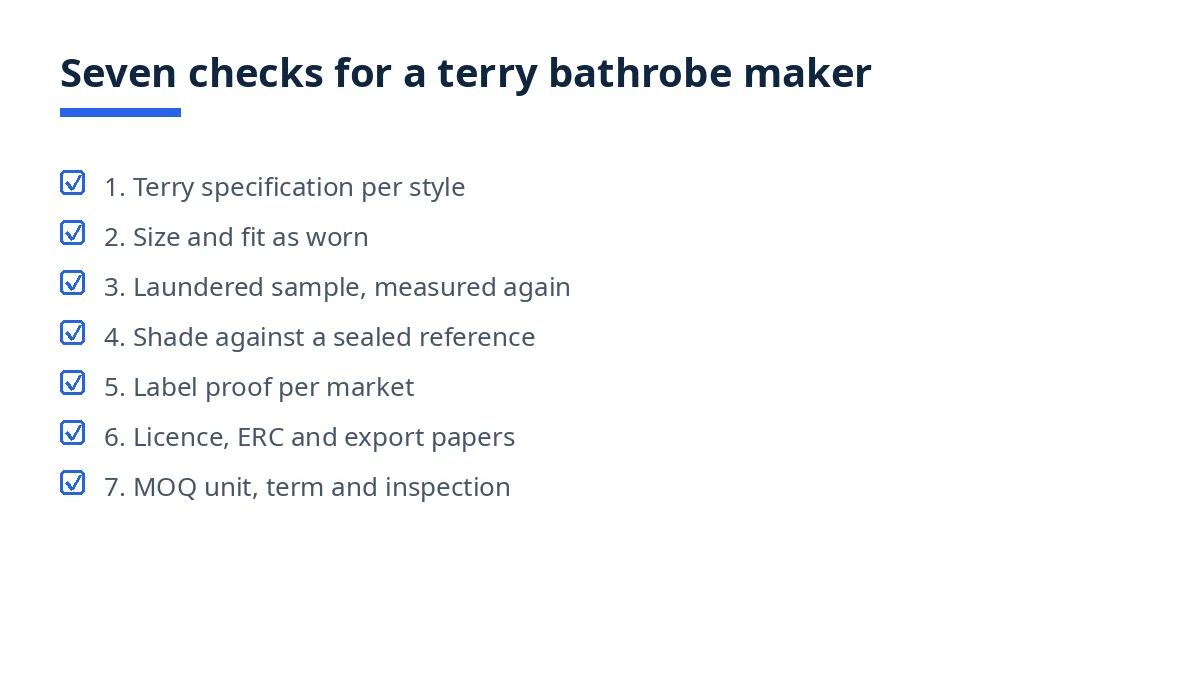
Do not choose a terry bathrobe maker from a ranking. Run seven checks instead: a written terry specification per style, a size chart fitted as worn, a sample washed under an agreed protocol, shade judged against a sealed reference, a label proof for each market, trade licence and ERC names matching the quotation, and quotations compared only when each states the MOQ unit, delivery term, and inspection plan. Keep only makers whose evidence survives all seven.
On this page
A buyer who searches for terry bathrobes manufacturers in Bangladesh usually wants a shortlist, not a ranking. This guide gives you something more useful than a ranking: seven checks to run on any maker before you pay, whether you buy for a hotel group, a spa chain, or a retail label. No maker is named here as a top choice, because a name on a list tells you nothing about whether that maker can cut your sizes, hold your shade, or survive your laundry test. Work through the seven checks in order, ask for the evidence named in each one, and keep only the makers whose answers survive all seven.
Start with one distinction that shapes everything else. A bathrobe is a garment, not a towel, even when it is made from the same terry fabric as the towels in the same order. The Harmonized System is a multipurpose international product nomenclature developed by the World Customs Organization, comprising more than 5,000 commodity groups, each identified by a six-digit code, and used by more than 200 countries and economies as a basis for their customs tariffs.1 Textile garments are classified under Chapter 61 if made from knitted or crocheted fabric, while Chapter 62 covers clothing made from woven or non-woven fabrics.2 Towels, by contrast, sit in heading 6302, which covers bed linen, table linen, toilet linen and kitchen linen, with subheading 6302.60 covering kitchen and toilet linen of terry towelling or similar terry fabrics, of cotton.3 A robe and a towel in one carton therefore take different codes, different label rules in some markets, and different quality tests.
Key takeaways
Judge a terry bathrobe maker by seven checks, not by a ranking: terry specification, size and fit, laundering durability, shade consistency, label law, export paperwork, and quotation comparability.
A robe is a garment under Chapters 61 or 62, while a terry towel sits under heading 6302, so the two products in one order need separate specifications, codes, and tests.1 3 2
Ask for evidence at every step: a written specification, a laundered sample, a shade reference, a label proof, and a quotation that states the MOQ unit, the delivery term, and the inspection plan.
A badge on a profile records a document and photo review, not a factory inspection and not a guarantee of capacity, quality, or delivery, so your own sample and inspection decisions still protect the order.
Example figures in this guide show structure only. They are never market rates, and every real figure must come from a quotation for your own specification.
The list: seven checks for a terry bathrobe maker
1. Terry specification, stated per style
What: A written specification for each robe style that names the fabric formation (knitted or woven), the fibre composition by weight, the pile construction, the fabric weight, and the finishing. Terry describes the looped pile, not the formation, so "terry" alone does not describe the fabric. Knitted fabric points to Chapter 61 and woven fabric to Chapter 62 under the classification rule above.2
Why it matters:
How to fix it: Put the specification in the request for quotation, not in a later email. Ask each maker to confirm, in writing, the formation, the fibre percentages, the weight, and whether the pile is cut, uncut, or mixed.
2. Size, fit, and the size curve
What: A size chart for the robe as worn, not just flat measurements of a finished garment. That means length, chest or wrap overlap, sleeve length, and belt length for each size, plus the intended wearer group. Where garments cannot be identified as for either sex, they must be classified in the headings covering women's or girls' garments, and most unisex wrap robes fall in that position, so state the wearer group on the order and keep it consistent with the code you file.2
Why it matters: A bathrobe is judged on the body, after wrapping and belting, and a robe that fits on a hanger can fail on a guest.
How to fix it: Ask for the size chart before the sample, then fit the sample on people of the sizes you sell, not on a mannequin alone. Check the wrap overlap when belted, the sleeve length with arms forward, and the belt length with a knot, not just a bow.
3. Laundering durability, proved on a washed sample
What: A sample that has been washed and dried under an agreed protocol, then measured again. The protocol should state the wash temperature, the detergent and bleach policy, the drying method, and the number of cycles, and the measurements should cover length, width, sleeve length, loop condition, and colour before and after washing.
Why it matters: A bathrobe lives in a laundry cycle, whether in a hotel laundry or a home machine, and an unwashed sample proves only how the robe looks once.
How to fix it: Agree the protocol in writing before the sample is made, and ask the maker to return the washed sample with its before-and-after measurements.
4. Shade and appearance consistency across sizes and colours
What: One sealed shade reference per colour, judged under one agreed light, against which every size, every colour lot, and every repeat delivery is compared. The reference should be a physical swatch or a finished robe kept sealed, not a photograph on a screen.
Why it matters: Terry pile catches light differently from flat fabric, so a shade that matches on a flat swatch can read differently on a finished robe, and a shade approved on one screen can differ on another.
How to fix it: Approve the shade on a finished robe, not on yarn or greige fabric, and keep the sealed reference yourself. State in the order who judges shade, under what light, and against which reference, and require the maker to hold its own matching reference.
5. Label law for each market, settled before artwork
What: A label proof, checked against the rules of each market where the robe will be sold or used, covering fibre composition, origin, the responsible business, and care instructions. In the EU, Regulation (EU) No 1007/2011 lays down harmonised provisions on textile fibre names and related labelling and marking of fibre composition.4 In the USA, federal law requires that most textile and wool products have a label that lists the fibre content, the country of origin, and the identity of the manufacturer or another business responsible for marketing or handling the product, and under the Care Labeling Rule, manufacturers and importers must provide instructions so consumers know how to clean the products they buy.5
Why it matters:
How to fix it: Give the maker your market list with the quotation, and ask for a physical label proof for each market before bulk. Check the fibre wording against the specification from check 1, the origin marking, the responsible business, and the care symbols as a set, not as separate lines.
6. Maker identity and export paperwork, checked as documents
What: Documents that prove the company you are paying is the company that will make or ship the robes, and that it can export them. At minimum, ask for the trade licence and the Export Registration Certificate (ERC), and check that the company name and address on those documents match the quotation and the invoice. On the export side, goods may not be loaded for export unless an export declaration, the Bill of Export or Shipping Bill, is submitted to Customs and approved, and the enclosed documents include the export contract or purchase order where there is no export letter of credit, the commercial invoice, the packing list, the EXP form certified by an authorized dealer, and a certificate of origin issued by the EPB or a Chamber of Commerce and Industry.6
Why it matters: A robe order fails in paperwork as often as in production. A profile badge shortens this check but does not replace it: verification is a document and photo review, not a factory inspection, and a badge is not a guarantee of production capacity, product quality, or delivery.7 8
How to fix it: Ask for the documents yourself and compare names and addresses across the quotation, the invoice, and the packing list before you pay.
7. Quotation comparability: MOQ unit, delivery term, and inspection
What: Quotations that can be compared line by line because each one states the same things: the specification version, the quantity and the MOQ unit (per order, per style, or per colour), the unit price and currency, the delivery term, the payment terms, the lead time, and the inspection plan. The Incoterms 2020 rules set out 11 rules with a clear allocation of cost, risk, and obligations.9
Why it matters: Most robe quotations that look cheaper are simply less complete. One quotation's price may include freight and another's may stop at the factory gate; one MOQ may count per order while another counts per colour, so the same headline number means a different total commitment.
How to fix it: Send every maker the same specification, quantity, and delivery term, and reject a quotation that omits any of them. Example figures: a quotation of 1,000 pieces per colour across 2 colours is a 2,000-piece commitment, while 1,000 pieces per order across the same 2 colours is 1,000 pieces; the figures show structure only, not a typical MOQ. Agree the inspection plan in writing before bulk: who inspects, on what sampling basis, against which specification version, and what a failed inspection means for that lot. Compare only quotations that answer all of those lines.
Summary table
Check | Evidence to ask for | Red flag |
|---|---|---|
1. Terry specification | Formation, fibre percentages, weight, pile type, in writing per style | "100% cotton terry" with no formation or weight |
2. Size and fit | Size chart as worn, wearer group stated, sample fitted on people | Flat measurements only, no graded sizes |
3. Laundering durability | Agreed wash protocol, washed sample, before-and-after measurements, written tolerance | Approval of an unwashed sample |
4. Shade consistency | Sealed shade reference per colour, judged under one light | A photograph offered as the shade reference |
5. Label law | Physical label proof per market, fibre, origin, responsible business, care | One template label for every market |
6. Identity and export papers | Trade licence, ERC, matching names, export document split | Refusal to share licence or ERC before payment |
7. Quotation comparability | MOQ unit, delivery term, payment terms, lead time, inspection plan | A price with no MOQ unit or delivery term |
How Exportain helps
On Exportain, browse suppliers and post your robe specification, size chart, shade reference plan, market list, and delivery term on the RFQ board, so makers quote against the same specification and the same MOQ unit. Ask each reply for the seven pieces of evidence in the table above, and shortlist only the replies that provide them. When you accept a quotation, the platform creates one order record from the accepted terms, which keeps the specification version, quantity, price, and delivery term in one place.
Read the badges for what they record. Exportain Verified means Exportain has checked identity, phone, email, and business registration, and Export Verified means it has checked the Export Registration Certificate (ERC).7 8 Factory Verified means it has reviewed photos of the manufacturer's factory, while Trading Company Verified means it has reviewed photos of the trading company's office or warehouse.7 8 Verification is a document review by staff, free, and never granted by membership plans.7 It is not a factory inspection,7 8 so the sample, shade, label, and inspection decisions in this guide stay with you.
FAQs
What is the biggest mistake?
The biggest mistake is approving a maker on a photograph, a price, and an unwashed sample, then discovering the faults after bulk: a robe that shrinks in the laundry, a shade that drifts between sizes, a label that fails a market rule, or a quotation whose MOQ counted per colour instead of per order.
How can I avoid it?
Work the seven checks in order and in writing. Send the same specification to every maker, fit a sample on people of the sizes you sell, wash that sample under an agreed protocol, approve shade against a sealed reference, approve a physical label proof for each market, compare trade licence and ERC names against the quotation, and compare quotations only when each one states the MOQ unit, the delivery term, and the inspection plan. Keep the specification version, the shade reference, the label proof, and the inspection plan in one order file, and make every repeat delivery reference that file.
Who is responsible?
Responsibility is shared, and the split should be written down. The maker is responsible for making the robe to the specification version you both agreed, in the sizes and shade you approved, with the labels you approved. You, the buyer, are responsible for the specification itself: the formation, fibre, sizes, shade reference, market list, and inspection plan you sent, and for approving the sample and the label proof before bulk. Exportain records the order from the accepted quotation and reviews the documents and photos behind a badge, but it does not inspect your goods or guarantee a delivery.7 8
Where can I get help?
Start with the evidence in this guide: the specification, the washed sample, the shade reference, and the label proof. For the marketplace steps, browse suppliers, post the full specification on the RFQ board, and read how supplier verification works on Exportain to see exactly what each badge records and what it does not. For the quantity mechanics, read the MOQ guide before you compare minimums.
Next steps on Exportain
Browse suppliers, then post your robe specification, size chart, and delivery term on the RFQ board so makers state their formation, fibre, shade process, and inspection plan against the same brief. Before you compare minimums, read the MOQ guide for how the same headline number changes when it is counted per order, per style, or per colour.
Sources
- What is the Harmonized System (HS)?. World Customs Organization (accessed )
- Classifying textile apparel. HM Revenue & Customs (GOV.UK), (accessed )
- HS 2017 - Code 6302: Bed linen, table linen, toilet linen and kitchen linen. United Nations Statistics Division (accessed )
- Regulation (EU) No 1007/2011 on textile fibre names and related labelling and marking of the fibre composition of textile products. European Union, (accessed )
- Textile, Wool, Fur, Apparel and Leather Matters. Federal Trade Commission (accessed )
- Customs Clearance Procedures for Export. Bangladesh Customs, National Board of Revenue (accessed )
- Supplier verification: Earn trust badges buyers can see. Exportain (accessed )
- How Supplier Verification Works on Exportain. Exportain, (accessed )
- Incoterms® 2020. International Chamber of Commerce (ICC) (accessed )
- supplier verification
- quality control
- buyer guide
- importing from Bangladesh
- home textiles
- Terry bathrobes
About the author
Sourcing from Bangladesh?
Post a request for quotation and suppliers on Exportain can send you their quotes directly.
Post an RFQ


