

Typical MOQ for Televisions in Bangladesh (and How to Negotiate It Down)
No single television MOQ in Bangladesh: what sets the minimum per screen size and model, how to ask, and how to negotiate a smaller order.
Short answer
There is no single typical MOQ for televisions from Bangladesh. Each supplier sets its minimum per screen size and per model, driven by panel and board lots, market variants, firmware set-up, remote and carton runs, and pallet and container loading. Ask for the minimum per size and per model in writing, then negotiate the split or the set-up costs.
On this page
Key takeaways
There is no single typical MOQ for televisions from Bangladesh, because each supplier sets its minimum per screen size and per model for your specification.
Panel and board lots, market variants, firmware set-up, remote and carton runs, and pallet and container loading are the drivers that set the floor.
Ask for the MOQ per size and per model in writing, with set-up costs itemized apart from the unit price.
Negotiate the structure first: fewer screen sizes, a shared market variant where it applies, and set-up paid as a separate line.
Exportain verification is a document and photo review, not a factory inspection, and a badge is not a guarantee.
Ask several suppliers for the television MOQ in Bangladesh for the same order and you will get different answers. There is no single typical MOQ for televisions from Bangladesh, because each supplier sets its minimum for your specification, usually per screen size and per model rather than for the order as a whole.
A television is not one interchangeable unit. Each screen size has its own panel, chassis, carton and pallet pattern, so a change of size is a change of production run. A change of model can add a different main board, power supply, tuner, remote control, firmware, language set or stand. The binding minimum is therefore rarely the headline total. It is the smallest line in the quotation that your split fails to meet.
Per screen size and per model. A supplier may accept a combined total across sizes yet still require a minimum per size and per model. State the quantity for each size and model separately, and ask which line is binding.
Panel and main board lots. Panels and main boards are bought in lots for a specific size and model. A size or model that needs a fresh lot carries that lot minimum with it. Ask whether the panel and board for each size are stocked, ordered for your run, or shared with another model.
Power supply, tuner and destination market. Voltage, plug, tuner standard and broadcast system vary by destination, and a variant built for one market may not be sold in another. A market-specific variant therefore carries its own minimum. State the destination market for each size and model at the start.
Firmware, language and branding. A private-label order can need its own firmware build, language set, start-up screen, remote layout and carton print. That work is fixed whether the run is short or long, so suppliers recover it through the minimum or a separate set-up charge. Ask which items are already built and which must be built for you.
Remote, stand and carton runs. Remote controls, stands, manuals and printed cartons are ordered in their own runs, each with its own minimum. An order can meet the assembly minimum and still fall below the carton print run for one size, because each size needs its own carton.
Container and pallet loading. Large screens fill a container with fewer units than small screens, and each size has its own stacking pattern. A supplier may set the minimum by full pallet or full container load for a size. Ask for the loading pattern per size, so you can see whether the minimum is a production floor or a shipping floor.
In the Harmonized System, heading 8528 covers monitors and projectors, not incorporating television reception apparatus, and reception apparatus for television.1 Color television reception apparatus falls under subheading 8528.72 in that heading.1 See the HS code for televisions guide and the MOQ definition guide.
Driver | What sets the floor | State in your enquiry |
|---|---|---|
Screen size | Panel and carton per size | Quantity per size |
Model | Main board, tuner and power supply | Quantity per model |
Market variant | Voltage, plug and tuner | Destination per size and model |
Firmware and branding | Firmware build and carton print | What is already built |
Remote and stand | Separate runs per size and model | Remote, stand, manual and carton spec |
Loading | Pallet and container pattern per size | Units per pallet and per container |
Example figures: a buyer splits an order across three screen sizes, with the smallest size taking only a fraction of the total. The total clears the headline minimum while the smallest size sits below its panel lot and carton run. The same total across two sizes can clear both lines. The example shows structure only, not a typical MOQ, price or lead time.
Why this matters for buyers and sellers
For the buyer, the MOQ decides how much cash sits in stock and whether a first order can test one size before a larger repeat. A television is bulky and fragile, so an order that is too large for the market is a warehouse problem as well as a cash problem. A first order that is too small for the panel lot may never be built at the quoted price.
For the seller, the minimum protects the run. Panels and boards bought for your size and model, firmware built for your brand and cartons printed with your artwork cannot be sold to another buyer. A short run still uses the lot, the set-up and the line change, so cost per unit rises as quantity per size falls.
Two controls keep the negotiation grounded. The first is an inspection plan agreed before production. ISO 2859-1 defines a system of acceptance sampling plans for inspection by attributes, indexed by acceptance quality limit (AQL) for lot-by-lot inspection.2 AQL is the maximum average percentage of defective items considered acceptable during random sampling, and it determines sample sizes and acceptance or rejection thresholds.2 The second is one delivery term for every quotation, under the Incoterms 2020 rules, which give a clear allocation of cost, risk and obligations.3
Step-by-step: how it works
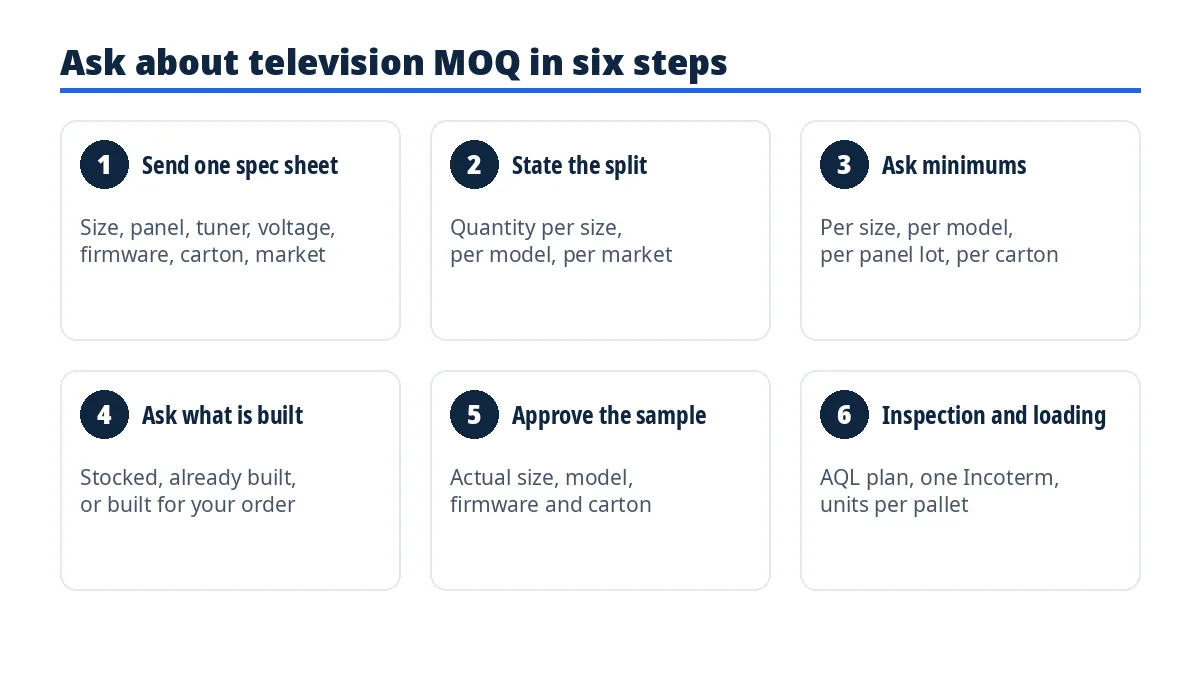
Send one specification sheet to every candidate. State screen size, panel type, resolution, tuner standard, voltage and plug, board features, remote and stand, firmware and language set, branding, carton and pallet pattern, and the destination market for each size and model.
State the split, not only the total. Give the quantity per size, per model and per destination market.
Ask for the minimums line by line. Ask for the MOQ per size, per model, per market variant and per panel lot, and any separate remote, stand, manual and carton minimums.
Ask what is already built. Record whether each panel, board, firmware build and carton is stocked, already built, or built only for your order.
Approve samples in writing. Order a sample in your actual size, model, firmware, language set, remote and carton. Test the tuner, inputs, remote, stand fit and carton protection, then approve or list corrections in writing.
Agree inspection and delivery term before you confirm. Write the inspection level and AQL values into the purchase order, following ISO 2859-1,2 and state one Incoterm and named place for every quotation. Compare MOQs only on the same term.3
Confirm the loading pattern. Agree units per pallet and per container for each size before you confirm.
How to negotiate the minimum down
Negotiation works when you change the structure that creates the minimum, not when you ask for an exception. Get the result in writing.
Reduce the number of sizes first. Sizes multiply panel lots, carton prints and pallet patterns. Cutting one size raises the quantity per remaining size at the same total, and it is the fastest way to clear a per-size floor.
Share one model across markets where the variant allows it. If two markets can take the same tuner, voltage and plug variant, ask whether the model minimum can be met across both markets combined, in writing. Confirm the variant first, then ask for the combined count.
Pay set-up as a separate line. Where the floor comes from a firmware build or carton print run, ask for those costs apart from the unit price. The run can then be shorter, and the same set-up serves the repeat order. Record which set-ups you have paid for.
Stage the order. If the supplier cannot move, place a smaller first order in fewer sizes, with a written repeat price and MOQ for the same specification. Do not negotiate by removing sample approval or inspection.
Costs, timelines and documents
What are the typical costs and timelines?
There are no typical costs or timelines a guide can state as fact, for the same reason there is no typical MOQ. Each supplier prices your panel, board, tuner, power supply, firmware, remote, stand, carton and packing, and the delivery term you choose.3 Ask for the price drivers as separate lines.
For timelines, sampling depends on panel and board availability and correction rounds, and bulk production on lot delivery, firmware build, line capacity and carton printing. Ask for sampling, panel and board ready, production, inspection and loading dates as separate lines, not a single delivery week. For destination duty and tax, ask your customs broker for the rate that applies to your size, model and destination, since that rate is set by the destination tariff, not by the supplier.
Which documents are needed?
For export clearance in Bangladesh, goods may not be loaded unless an export declaration, the Bill of Export or Shipping Bill, is submitted to Customs and approved.4 Enclosed documents include the export contract or purchase order where there is no export letter of credit, the commercial invoice, the packing list, the EXP form certified by an authorized dealer, and a certificate of origin issued by the EPB or a Chamber of Commerce and Industry.4
Bangladesh-specific rules and tips
Confirm the legal name on every paper. The export declaration names the exporter and the foreign buyer,4 so the name on the trade licence, quotation, proforma invoice and payment account should match.
Ask which inputs are bought in for your order. Panels, main boards, tuners and power supplies may be bought in for your size and model, and a bought-in input can set both the minimum and the earliest production date.
Keep one specification across the order papers. The size, model, market variant, firmware build and carton for each line should read the same on the specification sheet, quotation, purchase order, invoice and packing list. A television order with several sizes and models is easy to split by accident across papers.
Mistakes and red flags
What are the most common mistakes?
Asking for a total MOQ only. The binding minimum is usually per size, per model or per market variant. An order can clear the total and still fall below the panel lot or carton run for one size.
Comparing MOQs on different specifications. A lower minimum on a smaller screen, a standard model or a different term is a different offer. Compare only replies to the same specification sheet on the same Incoterm.3
Adding a size late in the negotiation. A late size adds a panel lot, a carton print and a pallet pattern after the price has been set. Finalize the size list before you ask for a final MOQ.
Accepting a verbal exception. Record any agreed lower minimum, shared lot or waived set-up on the quotation and purchase order, with the split it applies to.
Paying set-up twice. Keep the paid set-up lines from the first purchase order and attach them to the repeat enquiry.
Treating a profile or a badge as verification. A profile is a starting point for enquiries. It does not test whether a supplier can build your size and model.5
Skipping the inspection to save time. Sampling under ISO 2859-1 checks a lot against an agreed AQL.2
Checklist
Before you confirm, every line should be answered in writing.
Specification sheet sent: size, panel, resolution, tuner, voltage, plug, board, remote, stand, firmware, branding, carton, pallet, destination market.
Split stated per size, per model and per destination market.
MOQ confirmed per size and per model; binding line named.
Panel and board status per size recorded: stocked or ordered for your run.
Firmware, remote, stand and carton minimums confirmed apart from the assembly MOQ.
Set-up costs itemized apart from the unit price; paid set-ups recorded.
Sample in actual size, model and carton tested and approved in writing.
Inspection level and AQL values in the purchase order.2
Quotations compared on the same specification and Incoterm.3
Loading pattern agreed per size: units per pallet and per container.
Export set agreed: invoice, packing list, EXP form, certificate of origin, Bill of Export.4
How Exportain helps
On Exportain, browse suppliers and post a request for quotation (RFQ) on the RFQ board with your specification sheet summary, split per size and model, destination market and delivery term, so suppliers quote against the same specification. Ask each reply for its per-size and per-model minimums. When you accept a quotation, Exportain creates one order and issues one proforma invoice from the accepted terms.5
Read the badges for what they record. Exportain Verified means Exportain has checked identity, phone, email and business registration, and Export Verified means it has checked the Export Registration Certificate (ERC).5 Factory Verified means it has reviewed photos of the manufacturer factory.5 Verification is a document review by staff, free, and never granted by membership plans.6 It is not a factory inspection,5 6 so sample approval and inspection stay with you. See how supplier verification works on Exportain.
FAQs
What should I know first about televisions?
There is no single MOQ to look up. The minimum is set per screen size and per model by panel and board lots, market variants, firmware set-up, remote and carton runs, and pallet and container loading. Color television reception apparatus falls under HS subheading 8528.72, within heading 8528.1
What are the typical costs and timelines?
There are no typical figures a buyer can rely on, because each supplier sets its price, MOQ and lead time for your specification. Panel, board, tuner, power supply, firmware, remote, stand, carton and the delivery term drive the price,3 and panel and board availability, firmware build and carton printing drive the timeline. Ask your customs broker for destination duty and tax.
Which documents are needed?
The order documents are the specification sheet, itemized quotation and purchase order, with the MOQ per size and per model on both. The export set is the Bill of Export, commercial invoice, packing list, EXP form certified by an authorized dealer, and a certificate of origin issued by the EPB or a Chamber of Commerce and Industry.4
What are the most common mistakes?
The most common mistakes are asking only for a total MOQ, comparing minimums on different specifications or terms,3 adding a screen size late, and accepting a lower minimum verbally. A badge is not a guarantee of capacity, quality or delivery.5
Next steps on Exportain
Browse suppliers, then post your specification sheet summary and split per size and model on the RFQ board so suppliers state their MOQ per size and per model. Before you confirm, read how to import televisions from Bangladesh.
Sources
- Heading 8528 - Monitors and projectors, not incorporating television reception apparatus; reception apparatus for television. GOV.UK (accessed )
- ISO 2859-1:2026 - Sampling procedures for inspection by attributes — Part 1: Sampling schemes indexed by acceptance quality limit (AQL) for lot-by-lot inspection. ISO (accessed )
- Incoterms® 2020. International Chamber of Commerce (ICC) (accessed )
- Customs Clearance Procedures for Export. Bangladesh Customs, National Board of Revenue (accessed )
- Trust & Safety Center. Exportain (accessed )
- Supplier verification: Earn trust badges buyers can see. Exportain (accessed )
About the author
Sourcing from Bangladesh?
Post a request for quotation and suppliers on Exportain can send you their quotes directly.
Post an RFQ


