Telegraphic Transfer Insurance Payment: Complete Guide
Direct, practical answer to Telegraphic Transfer Insurance Payment for importers and exporters, with a checklist and FAQ. Free guide from Exportain.
Published 10 min read
Short answer
Telegraphic transfer is a bank wire transfer that moves money from buyer to seller. Insurance — such as trade credit insurance or export credit insurance — is a separate policy with an insurer that may protect the seller against a covered non-payment. A TT payment is not automatically insured, and the bank sending the transfer does not guarantee the goods.

On this page
A telegraphic transfer insurance payment sounds like a single product, but it is really two different things working side by side. Telegraphic transfer, often shortened to TT, is a bank wire transfer that moves money from the buyer's bank to the seller's bank. Insurance — usually trade credit insurance or export credit insurance — is a separate policy that can protect a seller against non-payment. Understanding how a telegraphic transfer insurance payment actually works, where the transfer ends and the insurance begins, and what neither one covers, helps buyers and sellers agree clear payment terms, avoid costly misunderstandings, and pay or get paid without surprises.
Key takeaways
A TT payment is a bank-to-bank wire transfer. It moves money; it does not, by itself, guarantee that goods will be shipped, that they will match the order, or that a buyer will pay.
Insurance is separate from the transfer. Trade credit insurance and export credit insurance are policies taken out with an insurer, not a feature a bank adds automatically to a wire.
Fees, exchange rates, and timelines vary by bank, country, currency, and intermediary banks involved. Always check the actual charges and value dates with your own bank before you commit.
The safest arrangements put everything in writing first: who pays which bank charges, when payment is due in relation to shipment, which documents trigger payment, and what insurance, if any, is in place.
For a plain overview of the transfer itself, see our guide to TT (telegraphic transfer): https://exportain.com/blog/tt-telegraphic-transfer
Why this matters for buyers and sellers
Payment is where most trade disputes start, and confusing a transfer with insurance makes them worse. A buyer who assumes a TT payment is "insured" may believe the bank will refund them if goods never arrive; a seller may believe they are protected if the buyer never sends the wire. In most cases, neither belief is correct.
For buyers, a TT payment is fast and widely accepted. The risk is timing: paying in full before shipment means trusting the seller to ship as agreed, while paying only after shipment shifts the risk to the seller. Splitting payment — part in advance, the balance against shipping documents — shares the risk, but the split is a commercial agreement, not something the bank enforces.
For sellers, a TT payment is simple to receive. The risk is the opposite: producing goods before any payment arrives. That is where insurance can help. A trade credit insurance policy, arranged separately, may cover part of a loss if a covered buyer fails to pay for a covered reason, subject to its terms, limits, and exclusions. Claims follow the insurer's process.
A letter of credit (https://exportain.com/blog/lc-letter-of-credit), by contrast, involves a bank undertaking to pay when specified documents are presented correctly. A TT payment has no such undertaking — money moves only when the buyer instructs their bank. Choose knowingly, based on trust, order size, and protection needed. Our overview of payment terms (https://exportain.com/payment-terms) compares the main options.
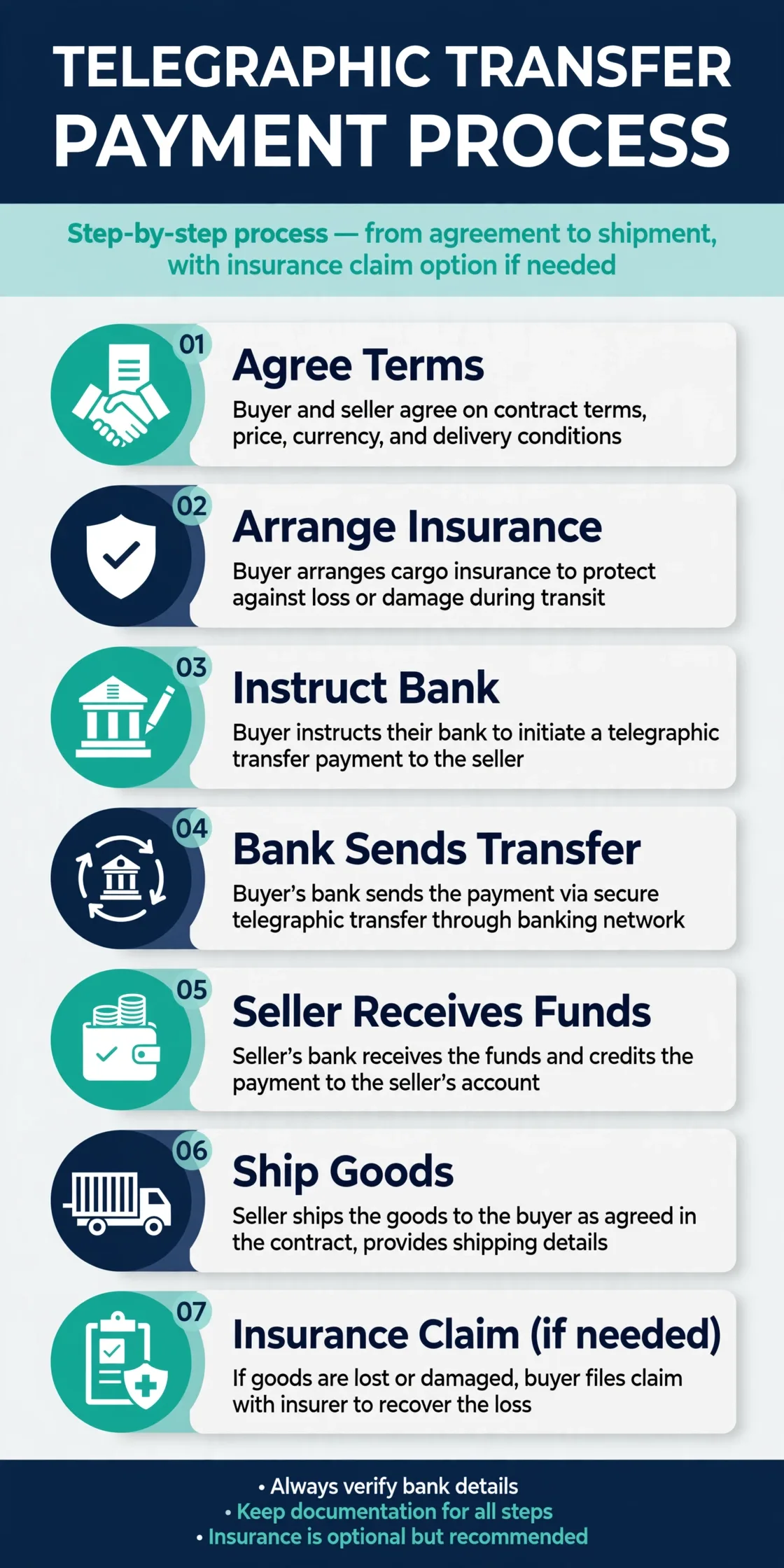
Step-by-step: how telegraphic transfer insurance payment works
The process below covers both parts: arranging any insurance first, then making the transfer itself.
Step 1 – Agree the payment terms in writing. Before any money moves, record the total amount and currency, when payment is due (in advance, against documents, after shipment, or in stages), who pays the bank charges, and the exact beneficiary details. Include these terms in the proforma invoice or sales contract so there is one reference both sides share.
Step 2 – Decide whether insurance is needed, and arrange it separately if so. If the seller wants protection against non-payment, they approach an insurer or broker for trade credit or export credit insurance before accepting the order. The insurer will usually assess the buyer, set a credit limit, and issue policy terms. Cargo or marine insurance is different again, covering physical loss or damage in transit, not payment default. Do not assume any policy exists unless a policy document has been issued.
Step 3 – The buyer instructs their bank. The buyer gives their bank the seller's beneficiary name, account number or IBAN where applicable, bank name and address, and SWIFT/BIC code, plus the amount, currency, and a payment reference such as the invoice number. Accuracy matters: a wrong digit can delay or misdirect the payment.
Step 4 – The bank sends the transfer. The buyer's bank debits the buyer's account and sends the funds, often through intermediary or correspondent banks if the two banks do not hold accounts with each other. Each bank in the chain may deduct a charge, depending on the charge instruction agreed, so confirm whether charges are to be borne by the sender, the receiver, or shared.
Step 5 – The seller's bank credits the seller. Once the funds arrive and pass the receiving bank's checks, the seller's bank credits the seller's account. The seller should confirm actual receipt — not just a copy of the buyer's transfer instruction — before releasing goods or documents, where the agreed terms require payment first.
Step 6 – Ship and exchange documents as agreed. The seller ships the goods and provides the agreed documents, such as the commercial invoice, packing list, and transport document. If payment was staged, the balance transfer follows the same instruction process when its trigger is met.
Step 7 – If a covered non-payment happens, follow the insurance process. Where a credit insurance policy is in place and a buyer fails to pay, the seller notifies the insurer within the policy's time limits, provides the required evidence, and follows the claims process. Payment, if the claim is accepted, comes from the insurer under the policy terms — not from the transferring bank.
Costs, timelines and documents
Costs. There is no single standard price. TT costs typically include a sending-bank fee, possible intermediary deductions, a possible receiving-bank fee, and the foreign exchange margin if currencies differ. Each varies by bank, country, currency, and amount, so check live charges with your bank before sending. Insurance premiums are separate, set by the insurer based on the buyer, market, and cover requested — get a written quotation.
Agree in advance who bears which charges: sender pays all, receiver bears them, or charges are shared. If this is not agreed, the seller may receive less than the invoiced amount — an avoidable dispute.
Timelines. How long a TT payment takes varies. Transfers involving intermediary banks, less common currencies, compliance checks, cut-off times, weekends, or public holidays can take longer. A term such as "payment three days before shipment" needs enough working days for the transfer to arrive and be confirmed. Insurance timelines also vary, so arrange cover before the order is confirmed, not after a problem arises.
Documents. For the transfer, the buyer usually needs the proforma or commercial invoice, the seller's full bank details, and any documentation their own bank requires. For the wider transaction, keep the contract or purchase order, invoices, packing list, transport document (such as a bill of lading or airway bill), and any required certificates. If insurance is in place, keep the policy document and buyer credit-limit approval in the same file.
Bangladesh-specific rules and tips
Bangladesh Bank regulates foreign exchange transactions, and authorised dealer banks handle export and import payments under its guidelines. Export proceeds are expected to be repatriated through banking channels, and shipments are documented through the banking system, including the EXP form process.
First, use the seller's exact business bank details from their official documents, confirmed in writing through a channel you already trust. Last-minute changes to bank details are a known fraud pattern.
Second, Bangladeshi exporters work within foreign exchange rules, including rules on advance payment and documentation their bank must complete. If a seller says their bank needs a particular document or reference, that is usually a genuine compliance need — include the invoice or order number on every transfer.
Third, consider currency. Payments are commonly made in US dollars or another major currency agreed in the contract. Confirm which currencies your bank can send to Bangladesh and which currency the seller's account can receive, to avoid unexpected conversion.
Fourth, factor in working days and holidays in both countries. A transfer sent late in your week may not be processed until the next working sequence, so build a small buffer into payment deadlines.
Finally, keep records: the transfer confirmation (often a copy of the SWIFT message), invoices, and correspondence in one file per order, so both banks can trace a delayed payment quickly.
Mistakes and red flags
Assuming TT means insured. The transfer and the insurance are separate. If no policy document exists, there is no insurance, whatever the conversation suggested.
Paying to changed bank details without verification. If bank details change by email at the last moment, stop and verify through a previously known phone number or contact. Payment-diversion fraud targets exactly this moment.
Sending the full amount in advance to a new supplier without safeguards. For first orders, consider staged payments, smaller trial orders, or a different payment method with more built-in protection until trust is established.
Not agreeing who pays the bank charges. Short-paid invoices caused by unallocated intermediary deductions are a frequent, avoidable dispute.
Releasing goods on a transfer instruction copy alone. A payment instruction or screenshot shows an intention to pay, not receipt. Sellers should wait for confirmed credit where the terms require it.
Ignoring insurance conditions. Credit insurance policies have conditions — credit limits, notification deadlines, and documentation duties. Missing a deadline can invalidate a claim even where cover exists.
Vague payment references. A transfer with no invoice reference slows reconciliation and can delay shipment release.
Choosing the payment method last. Payment terms shape price, risk, and trust. Agree them at quotation stage and write them into the contract, not after production has started.
Checklist
Before you send or accept a TT payment with insurance involved, work through this list:
Payment amount, currency, and due date or trigger are written into the contract or proforma invoice.
It is clear whether payment is in advance, staged, against documents, or after shipment — and who carries the risk at each stage.
It is confirmed in writing whether any insurance exists: credit insurance, export credit insurance, or cargo insurance — and a policy document has been seen if cover is being relied on.
The insurer's credit limit covers this buyer and this order value, where credit insurance is in place.
Beneficiary name, account details, and SWIFT/BIC code have been checked character by character and verified through a trusted channel.
Who pays sending, intermediary, and receiving charges is agreed, so the seller receives the expected amount.
The payment reference (invoice or order number) is agreed and will be included on the transfer.
Enough working days are allowed for the transfer to arrive, allowing for cut-off times and holidays in both countries.
The seller will confirm actual receipt before the agreed release step, and the buyer will keep the transfer confirmation.
All documents — contract, invoices, packing list, transport document, and any policy documents — are filed together for the order.
FAQs
What should I know first about Telegraphic Transfer Insurance Payment?
Know first that it combines two separate things. Telegraphic transfer is a bank wire transfer that moves money from buyer to seller. Insurance — such as trade credit insurance or export credit insurance — is a separate policy with an insurer that may protect the seller against a covered non-payment. A TT payment is not automatically insured, and the bank sending the transfer does not guarantee the goods or refund the buyer if the seller fails to ship. Put the payment timing, charges, and any insurance arrangements in writing before the order starts.
What are the typical costs and timelines?
Costs typically include the sending bank's transfer fee, possible intermediary and receiving bank charges, and any foreign exchange margin, plus a separate premium if credit insurance is arranged. Every one of these varies by bank, country, currency, and insurer, so there is no reliable universal figure — check charges with your bank and get an insurance quotation in writing. Timelines also vary: transfers can be delayed by intermediary banks, compliance checks, cut-off times, weekends, and holidays, so allow sufficient working days and confirm actual receipt rather than relying on the sending date.
Which documents are needed?
For the transfer, the buyer needs the seller's full and accurate bank details — beneficiary name, account number or IBAN where applicable, bank name and address, and SWIFT/BIC code — plus the invoice or proforma invoice showing the amount. For the transaction as a whole, keep the contract or purchase order, commercial invoice, packing list, transport document, and any required certificates. If insurance is relied on, keep the policy document and the insurer's credit approval for the buyer with the same file.
What are the most common mistakes?
The most common mistakes are assuming a TT payment is automatically insured when no policy exists, paying the full amount in advance to an unverified new supplier, accepting last-minute changes to bank details without independent verification, failing to agree who pays the bank charges so the invoice ends up short-paid, and — for sellers — releasing goods on a copy of a transfer instruction instead of confirmed receipt. Each is avoided by written terms, verified details, and the checklist above.
How Exportain helps
Exportain connects international buyers with verified Bangladeshi suppliers across apparel, textiles, leather, jute, and other export categories. You can compare suppliers, discuss an order before you commit, and agree payment terms clearly from the start — when payment is due, in what currency, and against which documents — so each TT payment, and any insurance arranged separately, sits inside a written, shared agreement rather than an assumption.
Post a free RFQ on Exportain and get quotes from verified Bangladeshi suppliers → https://exportain.com/rfqs
Sourcing from Bangladesh?
Post a request for quotation and suppliers on Exportain can send you their quotes directly.
Post an RFQ