Using Standby Letter of Credit (SBLC) When Buying From Bangladesh: Bank Rules and Tips
Standby LC Bangladesh: how a standby letter of credit covers a buyer default, what a complying demand requires under ISP98, and what buyers and sellers must confirm with their banks before shipment.
Short answer
A standby letter of credit is a secondary, default-contingent bank undertaking: the issuing bank pays the beneficiary on a complying demand when the applicant defaults, not on shipment documents. It is governed by the rules the standby states, usually ISP98, with UCP 600 applying only when expressly stated. The bank examines the demand on its face, not the goods, so the amount, expiry, demand wording, and place of presentation must be checked before shipment.
On this page
Key takeaways
A standby LC is a secondary, default-contingent undertaking: the bank pays on a complying demand when the applicant defaults, not on shipment documents.
ISP98 is the standard standby practice; UCP 600 applies to a standby only when the standby expressly states that it is subject to UCP 600.
Under the independent undertaking principle, the bank examines the demand and any required documents on their face against the standby wording, not the goods or the parties' performance dispute.
Partial and multiple drawings are permitted under ISP98 unless prohibited, and an evergreen extension applies only if expressly stated, so amount, expiry, demand wording, and place of presentation must be confirmed in writing before shipment.
A standby letter of credit, often shortened to SBLC or standby LC, is a bank undertaking that pays a named beneficiary only if the applicant defaults on an underlying obligation. It sits in the background while trade runs normally, drawn on only when a default triggers a complying demand.1
The undertaking is independent. The issuing bank deals with the demand and any documents the standby requires, judged on their face against the standby wording, and not with whether the goods were satisfactory. The bank's payment decision follows the standby, not the contract dispute.
The governing rules must be read from the standby itself. ISP98, the International Standby Practices 1998, is the standard practice designed for standbys, while UCP 600 is the rule set for documentary credits. A standby is governed by ISP98 when it states that it is subject to ISP98, and UCP 600 applies to a standby only when the standby expressly states that it is subject to UCP 600. The ICC Academy comparison notes that ISP98 is intended only for standby letters of credit, while UCP 600 may extend to standbys, with no reciprocity between the two frameworks.2
Why this matters for buyers and sellers
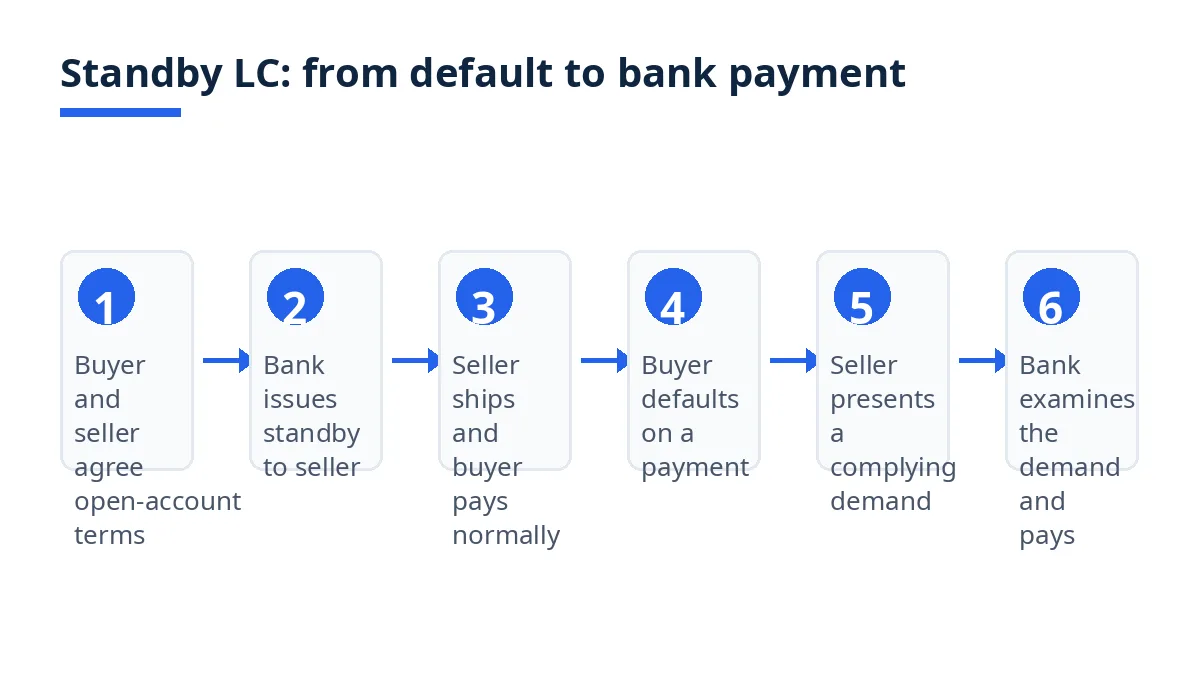
For a buyer, a standby can make open-account trade workable with a new supplier. Instead of a separate documentary credit per shipment, the parties agree payment terms in the contract, the seller ships, and the buyer pays by the agreed date. The standby covers the maximum outstanding balance, giving the seller bank-backed recourse if payment does not arrive.
For a seller in Bangladesh, the value is narrower than it first appears. A standby does not pay on shipment documents, nor replace agreed quality, inspection, and delivery terms. Its value is a defined route to the issuing bank after a buyer default. The seller should still check the issuing bank, amount, expiry, and demand wording first.
For both sides, the amount and expiry need the same care as the price. The amount should cover the maximum sum outstanding at any one time, not a year of orders. Expiry should run past the last payment due date, with time left to prepare and present a demand. The ISP98 model standby shows this shape: the issuer pays a demand in the annexed form, at the place for presentation, on or before expiration.3
Two forms are commonly distinguished: a financial standby backs a payment obligation, such as an unpaid invoice, while a performance standby backs a non-financial obligation. A buyer sourcing goods from Bangladesh will usually need the financial form.
Three nearby instruments are often confused with a standby. A commercial, or documentary, LC pays on complying shipment documents, not on a default demand. A bank guarantee is a separate instrument, usually governed by local law or demand-guarantee rules rather than ISP98. A back-to-back LC is a separate credit to an input supplier against a master export LC, not a standby. Exportain's LC guide describes a standby the same way: it pays against documents evidencing non-performance or default, usually under ISP98 or UCP 600.4
Step-by-step: how it works
Agree the underlying deal first. The buyer and seller sign a sales contract covering goods, price, payment terms, shipment terms, and the maximum outstanding balance.
Agree the standby terms in the contract. State the amount, expiry, governing rules, place of presentation, demand wording, and permitted drawings.
The applicant applies to its bank. The buyer, as applicant, asks its bank to issue the standby in favour of the seller. No issuance is guaranteed by the contract alone.
The issuing bank issues the standby. The bank sends the standby to the beneficiary directly or through an advising bank. Advising alone adds no payment undertaking.
The beneficiary checks every field. The seller compares the standby against the contract and raises any mismatch for amendment before shipment.
Trade runs normally and the standby stays undrawn. The seller ships and the buyer pays by the agreed date. Most standbys expire undrawn, because most applicants complete their obligations.1
On default, the beneficiary presents a demand. The beneficiary presents a demand in the form the standby requires, at the stated place, on or before expiry.
The bank examines and honours or dishonours. If it complies on its face, the bank honours it; if not, the bank gives notice of dishonour.
Worked example
Figures below are illustrative only, not a bank offer. A buyer in Europe agrees open-account terms with a Gazipur producer of cotton canvas work aprons: three consignments over four months, 60 days to pay after each shipment, and a standby for USD 30,000, equal to the maximum balance outstanding at any one time. The first consignment, USD 18,000, is paid on time. The second, USD 21,500, is not paid by its due date. The seller demands USD 21,500 in the required form, with the listed statement of non-payment, at the stated place and before expiry. If it complies, the bank pays. If the form or statement does not match the standby wording, the bank may dishonour it even though payment is genuinely overdue.
Demand, expiry, and drawing rules to confirm in writing
A complying demand has four tests. It must be in the form the standby requires, contain every statement the standby requires, be presented at the stated place and in the permitted medium, and be presented on or before expiry. A demand presented after expiry does not comply, even if the default happened before expiry.
Confirm the expiry date, place, and time of day at which expiry falls there, and what happens if expiry falls on a non-business day. Then work backwards, allowing time to learn of the default, prepare the demand, and present it, with a margin for correction after a dishonour.
Partial and multiple drawings depend on the standby wording. Under ISP98, partial drawings and multiple presentations are permitted unless the standby prohibits them, so a standby meant to be drawn on only once should state that expressly, for example by stating that multiple drawings are prohibited.3 A beneficiary who may need to draw twice should confirm that the wording allows more than one drawing and that the available amount is reduced by each honour, rather than reinstated.
An evergreen clause is also wording only: some standbys state a one-year expiry with automatic annual extension unless the issuer gives advance notice of non-extension. It takes effect only if expressly stated. Never assume renewal, or that a non-extension notice is itself a default permitting a demand, unless the standby says so.
Costs, timelines and documents
No universal charge, margin, timeline, or approval condition applies to every standby. Charges depend on the issuing bank, applicant, amount, expiry, risk assessment, and any confirmation or advising, so every figure must be confirmed in writing with the issuing bank before signing.
Timelines come from the standby and the banks: allow time for application, issuance and advising, the beneficiary check and any amendment, and the trade period plus a demand window after the last payment date.
The document set is short by design: usually the demand itself, plus any required beneficiary statement that the applicant has defaulted and the sum demanded is due and unpaid. Further documents must be named exactly, and the beneficiary must be able to make every statement in them truthfully.
Item | Confirm before shipment |
|---|---|
Governing rules | ISP98 or UCP 600, as expressly stated |
Demand form | Exact wording and required default statement |
Amount | Maximum outstanding balance covered |
Drawings | Partial and multiple drawings permitted or not |
Expiry | Date, time, place, and any evergreen clause |
Place and medium | Where and how to present a demand |
Confirmation | Whether a second bank has undertaken to pay |
Bank charges | Who pays each charge |
Applicant terms | Bank security or credit requirements |
Contract match | Same obligation, amount, and trigger throughout |
Exportain's payment terms are separate from bank charges on any standby or LC: they cover payments to Exportain and platform memberships, not money paid directly between buyer and seller outside the platform.5
Bangladesh-specific rules and tips
Bangladesh adds a bank-practice layer to settle at contract stage. Export transactions through Bangladeshi banks run through authorized dealer, or AD, banks, and the AD bank route, authenticated channel, and foreign exchange paperwork should be confirmed before issue.
Bangladeshi banks have handled incoming standbys by advising a standby issued abroad, adding confirmation, or issuing a local guarantee against a counter-standby. A Financial Express account describes that pattern, noting that advising alone involves no credit or operational risk, while confirmation and a local instrument against a counter-standby do involve both.6 Confirm practice at the named bank: a seller assuming confirmation where only advising was given is unprotected.
Bangladesh Bank has directed AD banks to take safeguards for export trade, including satisfying themselves of the bona fides of the applicant and issuing banks for LCs received through authenticated channels.7 A standby touching Bangladesh can therefore face checks the plan must allow time for. Name the banks and channel in the deal documents, and keep the parties and obligation consistent across the contract, application, and standby.
Three tips follow. First, confirm the seller's bank will accept the issuing bank and standby form before the buyer applies. Second, keep the outstanding balance under the standby amount at all times, including overlaps between consignments. Third, align expiry with the trade cycle, not one shipment, and extend or replace the standby before it lapses.
Mistakes and red flags
Treating a standby as payment for shipment. It pays on a complying default demand, not on shipment documents.
Leaving the governing rules unstated. A standby naming neither ISP98 nor UCP 600 leaves the framework in dispute.
Assuming the bank will investigate the goods. The bank examines documents and the demand, not performance.
Accepting a demand statement the beneficiary cannot make. Amend the standby before shipment if any required statement cannot be made truthfully.
Letting expiry fall too early. A standby expiring on the last payment date leaves almost no time to present a demand.
Assuming renewal. An evergreen extension applies only if expressly stated, with its notice period and method.
Assuming multiple drawings. Confirm whether partial and multiple drawings are permitted, or only one drawing is allowed.
Assuming confirmation from advising. An advising bank adds no payment undertaking.
Pricing on assumed bank terms. Confirm every figure and date with the issuing bank in writing.
Presenting late or at the wrong place. A demand after expiry, or at an unpermitted place or medium, does not comply.
Checklist
[ ] The contract states the goods, price, payment terms, and maximum outstanding balance.
[ ] The standby amount covers the maximum balance outstanding at any one time.
[ ] The standby states its governing rules, ISP98 or UCP 600, expressly.
[ ] The demand form and every required statement can be made truthfully by the beneficiary.
[ ] Partial and multiple drawings are confirmed as permitted or prohibited, as the deal requires.
[ ] The expiry date, time, and place leave a demand window after the last payment date.
[ ] Any evergreen extension and its notice method are stated expressly, or renewal is confirmed as absent.
[ ] The issuing, advising, and any confirming bank are named, with each undertaking confirmed.
[ ] The AD bank route, authenticated channel, and foreign exchange paperwork are confirmed.
[ ] All bank charges, and who pays each one, are confirmed in writing.
[ ] The beneficiary has checked the issued standby field by field against the contract.
[ ] The contract and standby describe the same obligation, amount, and trigger.
How Exportain helps
Exportain helps buyers and sellers agree the terms a standby will support, before either side approaches a bank. A buyer can post a request for quotation stating the goods, quantity, price, payment terms, and maximum outstanding balance, and compare supplier responses on the same terms. The recorded quotation trail keeps the request, every quotation version, every counter-offer, and the accepted terms in one place, so the contract, application, and standby can be checked against each other.8
Suppliers who apply for verification submit separate checks covering identity, business registration, export registration, and factory or office photos, each reviewed before any badge is shown. A badge is a record of checks reviewed, not a capacity, quality, or delivery guarantee. Before paying, agree the Incoterm, payment schedule, inspection, and shipment terms in writing, with the quotation record as the place to do it.8
FAQs
What should I know first about standby LC?
A standby LC is a secondary, default-contingent bank undertaking: the bank pays on a complying demand when the applicant defaults, not on shipment documents. It is governed by the rules the standby states, usually ISP98, with UCP 600 applying only when expressly stated. The bank examines the demand on its face, not the goods.
What are the typical costs and timelines?
There are no typical costs or timelines for every standby. Charges and processing times depend on the issuing bank, applicant, amount, expiry, and any confirmation, and must be confirmed in writing with the issuing bank. Timelines should allow for application and assessment, issuance and advising, the beneficiary check and any amendment, and the trade period plus a demand window after the last payment date.
Which documents are needed?
The core presentation is the demand itself, in the required form, plus any listed beneficiary statement that the applicant has defaulted and the sum demanded is due and unpaid. Further documents apply only where named. An invoice, packing list, or transport document is not part of a standby presentation unless expressly required.
What are the most common mistakes?
The most common mistakes are treating a standby as payment on shipment, leaving the rules unstated, assuming the bank will investigate the goods, accepting a statement the beneficiary cannot truthfully make, letting expiry fall too early, assuming renewal or multiple drawings without checking the wording, confusing advising with confirmation, and pricing on assumed bank terms. Avoid them by agreeing the wording before shipment, checking the issued standby field by field, and confirming every bank figure and date in writing.
Next steps on Exportain
Start with the deal terms, not the bank form. Post a free RFQ on Exportain at https://exportain.com/rfqs, stating the goods, quantity, payment terms, and maximum outstanding balance. Read the general LC guide at https://exportain.com/blog/lc-letter-of-credit, platform payments at https://exportain.com/payment-terms, and buyer protection at https://exportain.com/buyer-protection. Once terms are agreed in writing, take the contract to the issuing bank and confirm the wording, rules, amount, expiry, and charges before the first shipment.
Sources
- Guide to Standby Letters of Credit. ICC Academy (accessed )
- UCP 600 and ISP98: Key differences and applications. ICC Academy (accessed )
- ISP98 Form 1 - Model SBLC with Payment Demand. DocCredit World (accessed )
- LC Meaning (Letter of Credit). Exportain (accessed )
- Payment and Membership Terms. Exportain (accessed )
- International trade: Why Standby LC is becoming popular. The Financial Express, (accessed )
- BB directs ADs to safeguard export trade. Bangladesh Post (accessed )
- Buyer protection: What Exportain does to protect buyers. Exportain (accessed )
About the author
Sourcing from Bangladesh?
Post a request for quotation and suppliers on Exportain can send you their quotes directly.
Post an RFQ