Sportswear and Activewear Lead Time From Bangladesh: Production and Shipping Timeline
How to read a sportswear and activewear lead time from Bangladesh: performance-fabric tests, athletic-fit size-curve approval, sublimation print approval, flatlock seam approval, post-wash retesting, inspection and transit as dated stages, with a stage table, document checks and red flags.
Short answer
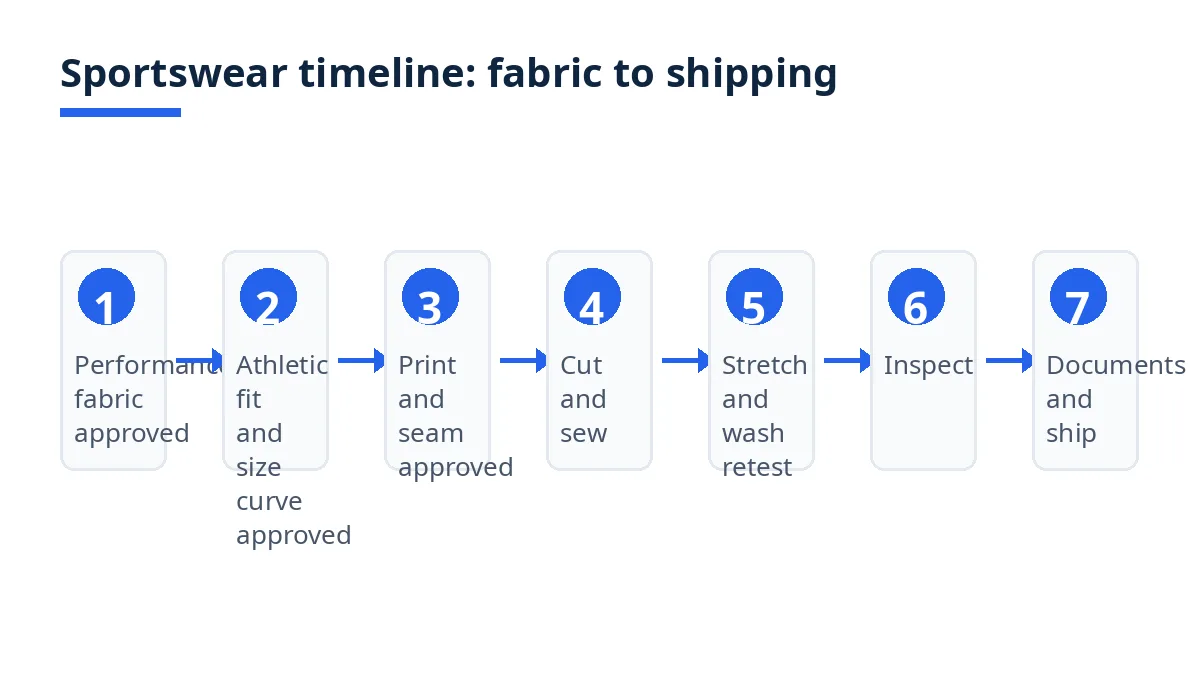
A sportswear and activewear lead time from Bangladesh is a chain of dated approvals: performance-fabric testing, athletic-fit size-curve approval, sublimation and print approval, seam-construction approval, cut-and-sew, post-wash retesting, inspection, and documents and transit. No single figure fits every order. Ask for dated stages, named tests, and a forwarder estimate, then work backward from your selling date.

On this page
Key takeaways
A sportswear lead time is a chain of dated approvals, not a single number, with sportswear-specific gates for performance-fabric testing, athletic-fit size-curve approval, sublimation print approval, and flatlock seam approval.
Performance-fabric properties are buyer-specification items only: each needs a named test, a stated method, and a recorded result, including any post-wash repeat, never a general claim about the fabric.
Bulk cutting should wait for size-set approval in every size, with movement checks recorded for the smallest and largest sizes, not a middle-size sample checked flat.
Sublimation print approval needs a strike-off on the actual fabric, with registration checked across every seam the artwork crosses and distortion checked on high-stretch zones.
Seam construction, inspection defect levels, and the Bangladesh document set are stages in their own right: each needs a dated check and a correction route before loading, and transit must be read from a dated forwarder estimate.
A sportswear and activewear lead time from Bangladesh is a chain of dated approvals, not a single number in a quote. The approvals that most often decide whether an order ships on time are narrow: a performance fabric whose test result was never recorded, a size at the end of the athletic size curve never tried on a moving body, a sublimation print never checked across a seam, or a flatlock seam whose stitch setting was never frozen before bulk sewing.
Why this matters for buyers and sellers
For a buyer, sportswear is judged in motion and after washing, not only on a hanger. A top that fits standing still can bind at the shoulder when an arm is raised, and a printed panel can distort where a seam crosses the artwork. For a seller, a dated stage table is a clearer offer than a short total: naming each approval, its evidence, and its date lets both sides see which later stage moves when one stage slips.
Step-by-step: how it works
Stage 1: Performance-fabric supply and approval as a buyer-specification item
Ask the quote to name the fabric construction, composition, weight range, and color, and to record the approved sample in writing before bulk fabric is booked. A buying-house account describes the same discipline: lap dips and strike-offs are checked before bulk work, and out-of-shade bulk lots are rejected before bulk cutting.1 For sportswear, add performance items as buyer-specification items to confirm in writing, with a named test, a stated method, and a recorded result. An activewear quality account lists the checks as stretch and recovery, moisture management, colorfastness to perspiration and washing, pilling resistance, and opacity under stretch, naming the methods ASTM D2594, AATCC 195, AATCC 15, AATCC 61, and ASTM D4970.2 Record whether each result must be repeated after washing.
Stage 2: Athletic-fit and size-curve approval
A sportswear fit sample must settle movement across the whole size curve, not only a middle size standing still. An activewear quality account lists fit validation as checking sizing across the range during movement, as part of pre-production approval.2 A buying-house account adds the general rule: size-set samples are made in each size, with bulk cutting approved only after the size set is approved.1 Ask for size-set samples in each size before bulk cutting is approved, and record movement checks, not only flat measurements: arm raise and torso twist for a top, squat, stride, and waistband hold for leggings or tights.
Stage 3: Sublimation and print approval
Print approval is a separate gate in sportswear because the decoration method changes what the fabric, the panel layout, and the timeline must allow. A sublimation guide explains the process in plain terms: disperse dyes turn to gas under heat and bond inside polyester fiber, so the color becomes part of the fabric rather than a layer on top of it, and the method needs a polyester base.3 Ask the quote to confirm in writing, before print approval, the fabric composition for every printed panel, the base color, and whether the design is printed on flat panels before sewing or applied after assembly. The same guide notes that cut-and-sew sublimation prints flat panels before stitching, giving edge-to-edge coverage, while post-assembly printing can leave white lines at seams.3 Ask for a printed strike-off on the actual fabric, checked for color, for registration across every seam the artwork crosses, and for distortion on high-stretch zones.
Stage 4: Seam-construction approval, including flatlock as a buyer-specification item
Ask the quote to name the seam type for each part of the garment, the stitch setting, the thread, and the sample that proves it. A seam guide for activewear describes the three main choices: a flatlock seam lies almost level with the fabric surface, with both edges butted together so no bulky ridge sits against the skin, and it is used on training leggings, running tops, and cycling jerseys; an overlock seam wraps thread around the raw edge and is the fast choice for joining panels; and a coverstitch gives a flexible, finished hem for cuffs, waistbands, and bottom edges.4 Where flatlock is specified, treat it as a buyer-specification item: seam type, stitch per inch, thread type, and the finished sample, all recorded in writing before bulk sewing. The same guide notes that flatlock stitch settings are tightly controlled, and that inline checks cover stitch per inch, seam puckering, and thread tension.4 A seam type changed after approval needs a new approval.
Stage 5: Cut-and-sew
Cut-and-sew joins the approved fabric, print, and seam settings into finished garments. Ask for the sewing sequence: how printed panels are matched at seams, how stretch panels are handled so they are not distorted, and how first pieces are checked against the approved samples. A buying-house account describes the general control: patterns are checked so size-set comments are corrected before bulk cutting, and initial and mid-line inspections catch faults while production is still running.1 Ask for reporting by size and by color during sewing, not only a total quantity, since a fault in one size or one color panel can be systematic.
Stage 6: Stretch, recovery, and wash retesting
A sportswear garment must be retested after it is made, not only as fabric. Agree in writing which performance checks are repeated on finished garments, on which samples, and after how many washes. An activewear quality account describes a five-stage control running from raw-material testing through pre-production approval, in-line inspection, final inspection, and reliability testing after washing, with performance retention and dimensional stability measured after wash cycles.2 Use that structure as the buyer checklist: fabric, pre-production, in-line, final, and post-wash results, each with a date and a recorded figure or rating. Do not accept a general statement that garments were wash-tested; ask for the method, sample, wash route, and recorded result, and for the decision rule if it fails.
Stage 7: Inspection
Inspection is a stage in its own right, not a formality at the end. During-production checks catch a systematic fault, such as a flatlock seam that puckers after washing, while remaining units can still be corrected. An activewear quality account describes final inspection on an Acceptable Quality Level basis, with defect levels set for critical, major, and minor defects, and performance testing on random samples for stretch and recovery, opacity, moisture management, and seam strength under stress.2 Agree in writing which faults count as major for sportswear: a seam that opens or puckers beyond the buyer specification, a print that misregisters beyond the approved sample, a measurement outside tolerance, a waistband or cuff that loses hold, and any stretch, opacity, or colorfastness result outside the recorded buyer specification. Agree the defect levels before production, with a defect list by size and color and a correction route with a date.
Stage 8: Documents and transit
Transit starts when packed, inspected goods are handed to the carrier and ends when they reach the buyer warehouse, cleared for import. Its variables are sailing schedule, transhipment, port congestion, documentation readiness, and destination clearance. Bangladesh Customs requires an export declaration, known as a Bill of Export or Shipping Bill, to be submitted and approved before goods are loaded or stuffed, with the commercial invoice, packing list, EXP form certified by an authorized dealer, certificate of origin, VAT registration certificate, and taxpayer identification number enclosed.5 Confirm who prepares each document and who checks the size and color split on the packing list. For containers handed over at a terminal in Bangladesh, FCA, CPT, or CIP describe the handover more accurately than FOB, CFR, or CIF in many cases.6
Costs, timelines and documents
How to read a supplier timeline
Ask for a table with five columns: stage, start date, finish date, approval closing the stage, and what happens if it slips. Use the table below only as a planning example, not a promise about any order. Replace every cell with the dated figures in the written quote and forwarder estimate.
Stage | Illustrative planning example | Confirm in writing |
|---|---|---|
Performance-fabric supply and approval | 1 to 3 weeks across samples and tests | Fabric, named test, method, recorded result |
Athletic-fit and size-curve approval | 2 to 4 weeks across rounds | Size-set approval, every size, in movement |
Sublimation and print approval | Within the sampling stage, as agreed | Panel artwork, strike-off, seam registration |
Seam-construction approval | Before bulk sewing, as agreed | Seam type, stitch setting, thread, sample |
Cut-and-sew | 2 to 5 weeks after fabric and approvals are in hand | Reporting by size and color |
Stretch, recovery, and wash retesting | 1 to 2 weeks after sewing, plus rework | Post-wash test, method, recorded result |
Inspection | After packing, before loading | Defect list and defect levels |
Documents and transit | Dated forwarder estimate only | Document set and sailing |
How to read the costs
Read costs as a breakdown to compare, not as a single price. Separate the garment price from sampling and testing, print and strike-off, inspection, inland transport, export documentation, freight, insurance, and destination handling, duty, and delivery. Price every quote to the same delivery point and delivery term before comparing, and ask which charges change if a stage slips or apply again after rework.
Documents to check before loading
Check the document set against the stage table before loading is approved: commercial invoice, packing list with quantity, weight, and the size and color split, EXP form, certificate of origin, VAT registration certificate, and taxpayer identification number.5 Add the buyer documents: size-set record, fabric test results, print strike-off approval, seam approval record, post-wash test results, and final inspection report.
Bangladesh-specific rules and tips
First, check the packing list size curve against the approved size set before the Bill of Export is filed, because a size-curve error discovered at destination cannot be fixed by a document correction. Second, confirm the utilization declaration position for garments exported under a bonded warehouse where it applies, since Bangladesh Customs lists it among the additional documents for certain export categories.5 On delivery terms, use the terminal-handover point as the test: if the container is handed to the carrier at a yard, depot, or terminal before loading on board, FCA, CPT, or CIP usually match the handover better than the sea-only rules.6 For air freight from Dhaka, use only the any-mode rules.
Mistakes and red flags
A single total with no stage dates is a red flag, because it hides which approval can slip and by how much. A fabric approval based on hand feel alone, with no named test, method, or recorded result, is a red flag for sportswear. A size set approved in a middle size only, or checked flat rather than in movement, is a red flag, as is a print approved on a flat swatch with no seam-registration check. A seam type changed after approval with no new sample, a post-wash result missing from the order file, and a defect list agreed only at the packing table are further red flags. A quote that prices a seam change, a print change, or a retest as an unexplained lump sum is also worth questioning.
Checklist
Use this checklist before bulk cutting is approved, and before loading:
Fabric named in writing, with composition, weight range, color, and approved sample identified.
Performance items listed as buyer-specification items, each with a named test, method, and recorded result, including any post-wash repeat.
Size-set samples approved in every size, with movement checks recorded for the smallest and largest sizes.
Print artwork approved panel by panel, with a strike-off on the actual fabric and registration checked across every seam crossed.
Seam type, stitch setting, and thread recorded for each area, with a finished sample approved after stretching and washing.
Cut-and-sew reporting agreed by size and color, with a rule for recutting if an approval changes.
Post-wash retest agreed, with method, sample, wash route, recorded result, and a decision rule if it fails.
Inspection defect levels agreed before production, with a defect list by size and color and a correction route.
Document set checked before loading, including the Bill of Export set and buyer approval records.
Delivery term named with rule, place, and edition, and transit read from a dated forwarder estimate.
How Exportain helps
Exportain helps a buyer turn a sportswear requirement into comparable replies by putting the stage table at the center of the request. Post a requirement naming the garment, fabric direction, size curve, print method, seam requirement, performance tests, and selling date, and ask each reply to answer on one stage table. Use the supplier and buying-lead pages in the Next steps section to start that comparison, and the Incoterms guide there to check the delivery term before the price is compared.
FAQs
What should I know first about sportswear and activewear?
Know first that sportswear is approved in motion and after washing, not only on a sample rail. Before ordering, settle the fabric tests, the size curve to be tried in movement, the print registration across seams, and the seam construction for each garment area.
What are the typical costs and timelines?
There is no single figure that fits every sportswear order, and this guide states none as fact. Costs divide into garment price, sampling and testing, print, inspection, transport, documentation, freight, insurance, and destination charges. Timelines divide into the dated stages in the table above, each replaced by the written quote and the dated forwarder estimate for the specific order.
Which documents are needed?
The Bangladesh export set includes the Bill of Export or Shipping Bill, commercial invoice, packing list, EXP form certified by an authorized dealer, certificate of origin, VAT registration certificate, and taxpayer identification number.5 Add the buyer approval records: fabric tests, size-set approval, print and seam approvals, post-wash results, and final inspection report.
What are the most common mistakes?
The most common mistakes are accepting a single total with no stage dates, approving fabric on hand feel alone, approving a size set in a middle size only or flat rather than in movement, approving print on a flat swatch with no seam-registration check, changing a seam type after approval with no new sample, and agreeing defect levels only at the packing table.
Next steps on Exportain
Browse Bangladeshi suppliers and compare replies on one stage table, with fabric tests, size-set plan, print and seam records, and inspection levels shown for each reply.
Read the Incoterms guide for shipments from Bangladesh and check the delivery term, named place, and edition in each quote before comparing prices.
Post your requirement as an RFQ with the stage table attached, so each reply answers fabric, fit, print, seam, testing, inspection, documents, and transit on the same lines.
Sources
- Preproduction Inspection Stages Followed by Buying House. Online Clothing Study (accessed )
- Ensuring Product Excellence: Quality Control and Manufacturing Standards for Activewear and Yoga Wear Sourcing. HAVING (accessed )
- What Is Sublimation Printing for Activewear? Your Complete Technical Guide. Custom Ink (accessed )
- 9 Expert Ways Flatlock Vs Overlock Vs Coverstitch Impacts Activewear. Ninghow (accessed )
- Customs Clearance Procedures for Export. Bangladesh Customs, National Board of Revenue (accessed )
- Incoterms for Shipments From Bangladesh. Exportain (accessed )
- Incoterms
- export documents
- quality control
- buyer guide
- Bangladesh sourcing
- aql inspection
- bangladesh garments
- Sportswear
About the author
Sourcing from Bangladesh?
Post a request for quotation and suppliers on Exportain can send you their quotes directly.
Post an RFQ