Sportswear and Activewear Exporters in Bangladesh: Verified Supplier Checklist
A supplier checklist for sportswear and activewear exporters in Bangladesh: verify the ERC and trade license, exporter type, capacity and MOQ structure, itemized prices, audit reports, certificate scopes and label claims before you place an order.
Short answer
Use this checklist to find and verify sportswear and activewear exporters in Bangladesh: check the Export Registration Certificate and trade license, confirm whether the supplier is a factory or a trading company, test stated capacity and MOQ structure, compare itemized quotations, and read audit reports, certificate scopes and label claims for the actual production site before ordering.
On this page
Key takeaways
Check the ERC, trade license, association membership and bank account name first: all four must belong to the company you contract with.
Classify each supplier as a factory, a factory using named subcontract sites or a trading company, and file the production site address for every order.
Compare only itemized quotations against the same brief, with MOQ stated per style and per color and every exclusion listed before totals are compared.
Read audit reports and certificates for the production site, scope and expiry date, and drop any product claim the filed evidence does not support.
If you buy sportswear or activewear, this checklist helps you find sportswear and activewear exporters in Bangladesh and verify each one before you commit to samples or an order. Bangladesh is a large apparel exporter: ready-made garment exports reached $39.346 billion in fiscal 2024-25, of which knitwear accounted for $21.159 billion, according to provisional Export Promotion Bureau (EPB) data.1 The problem is not finding names. It is telling a factory that makes your product from a trading desk that subcontracts it, using documents you can check.
Why this checklist matters
Sportswear and activewear sit inside the knitwear base that the Bangladesh Knitwear Manufacturers and Exporters Association (BKMEA) represents: BKMEA states that it currently represents approximately 2,540 knitwear member factories.2 That depth helps only if your shortlist is built on evidence. A supplier may sew well but hold no export registration, quote a price that excludes fabric or trims, or hold an audit report for a different site.
A written checklist turns each claim into a document, a number or a sample recorded as checked, failed or not applicable. Work in order: legal identity, production route, capacity, price, compliance, labels. See also the guide to sportswear and activewear manufacturers in Bangladesh.
Before you start
Fix your own brief first: product list by style, fabric composition and weight, size range, quantity per style and per color, destination market, and the delivery term you want quoted, such as FOB Chattogram. A vague brief produces answers you cannot compare.
An Export Registration Certificate (ERC) is a mandatory requirement for business entities exporting any kind of goods from Bangladesh, and the Office of the Chief Controller of Imports and Exports (CCI&E) is the sole authority that provides it.3 The documents required for an ERC include a trade license, a chamber of commerce or trade association certificate, a bank solvency certificate and an e-tax identification certificate.3 If a supplier cannot show a current ERC in the name of the company you will contract with, record a failure at this first gate.
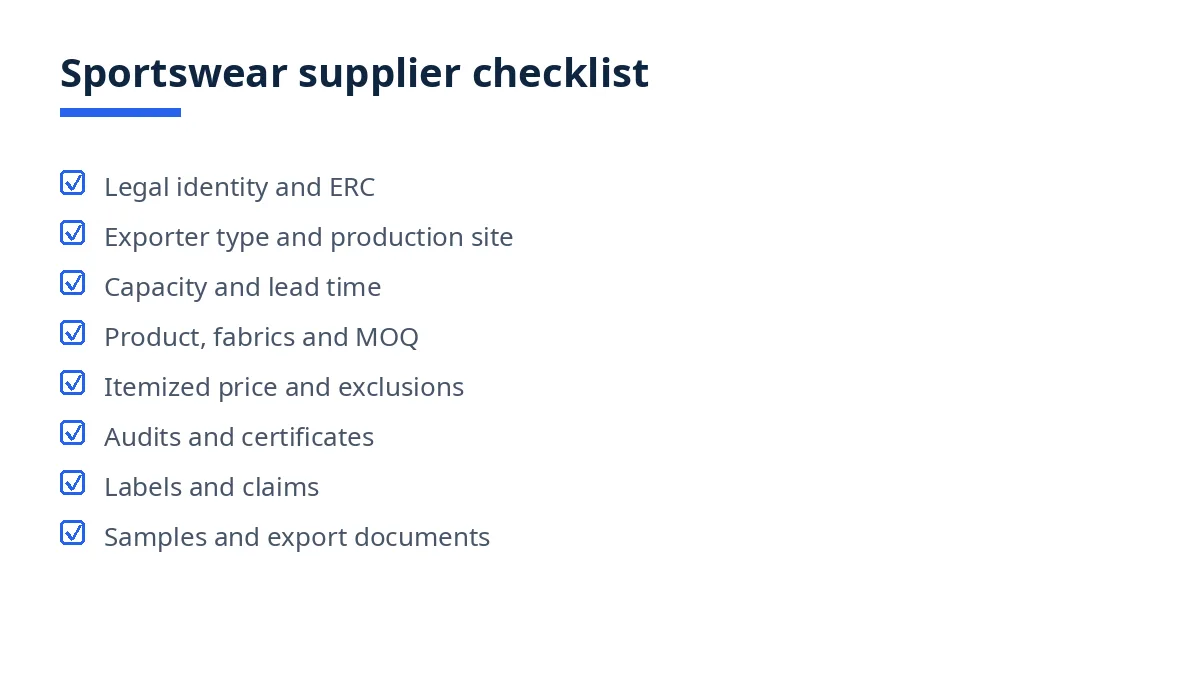
The full checklist (numbered, printable)
Legal identity and export registration
Record the legal company name, trade license number and registered address, and check the same name appears on the quotation, proforma invoice and bank account you are asked to pay.
Ask for a copy of the current ERC and check holder name and validity against the contracting company. The ERC is issued by CCI&E,3 so a certificate in a sister company's name does not cover your exporter.
Ask for the trade association membership certificate, from BKMEA, BGMEA or a chamber of commerce, and check it is current. Membership supports the identity check; it does not replace it.
Check that the tax identification and VAT registration (BIN) details match the legal name, and record who signs contracts.
Exporter type and production route
Classify the supplier in writing as a factory exporting its own production, a factory that subcontracts named steps, or a buying house or trading company. An unstated route cannot be checked.
If production is subcontracted, ask which site sews and which finishes and packs, and get both addresses. Audit reports, photos and capacity figures must belong to the site that will make your goods.
Ask what the supplier makes in-house, such as cutting, sewing, printing, embroidery or bonding, and what it buys in.
On Exportain, read badges for what they state. Suppliers submit documents in five areas, and a badge appears only once its checks are approved; the Export badge records a check of the seller's ERC, and the Factory badge records a review of factory photos, not an inspection.4
Capacity, lines and lead-time evidence
Ask for sewing lines and machines by operation, and the monthly capacity the supplier will state in writing for your styles, not a generic factory total.
Ask which months are already committed to other buyers and what share of capacity your order would take.
Ask for the lead time split: fabric and trim sourcing, sampling, bulk sewing, finishing and packing, and export documentation.
Check the capacity story against factory photos, the machine list and a live video walkthrough if you cannot visit.
Product range, fabrics and minimum order structure
Confirm the supplier already produces your product family, such as leggings, sports bras, shorts, tees or hooded tops, and ask to see current production or sealed samples.
Record the fabrics the supplier works with, including composition, weight and finish, and whether fabric is made in-house or bought from named mills.
Get the minimum order quantity (MOQ) stated per style, per color and per size ratio, with any fabric minimum separate. See the MOQ minimum order quantity explainer and the sportswear and activewear MOQ guide.
Ask what happens below the minimum: a surcharge, a combined-color option or a refusal, and get the answer in the quotation.
Price drivers and quotation checks
Require an itemized quotation: fabric, trims, printing or embroidery, sewing, finishing, packing, testing and the delivery term, each as its own line. Compare only quotations built from the same brief.
Check which currency the price is in, how long it stays valid, and what change, such as a fabric price move, would reopen it.
Check what the unit price excludes, for example labels, hang tags, polybags, cartons, lab tests or inspection, and add missing lines before comparing totals. See the wholesale sportswear and activewear guide.
Confirm the payment route matches the identity checks above: the beneficiary name must be the contracting company.
Compliance, audits and certificates
Ask which social and safety audits the production site holds, the audit date, the rating or findings status, and whether a corrective action plan is open.
If a report is under the amfori Business Social Compliance Initiative (BSCI), treat it as an audit result, not a certificate: factories receive a grade from A through E, and a C, D or E rating requires a corrective action plan.5
For any product certificate cited, record the certificate number, holder, scope and expiry date, and confirm the scope covers your product and site.
If a harmful-substances claim will appear on the product, check it against the certificate scope. Under OEKO-TEX STANDARD 100, the label is awarded only if all components meet the criteria, including fabric, threads and accessories, and a certificate is valid for 12 months.6
Labels, claims and destination rules
Fix label content before sampling: fibre composition, size, care instructions, origin and brand elements. For the EU, Regulation (EU) No 1007/2011 requires the name and percentage by weight of all constituent fibres in descending order on the label.7
Check every performance claim you plan to print, such as moisture management, stretch recovery or recycled content, against a test report or certificate for the actual fabric, and drop claims you cannot support.
Confirm who supplies labels, tags and packaging, who approves the artwork, and that bulk labels print only after written approval of the final artwork.
Samples, orders and export documents
Order samples against the same brief, record them against the supplier file, and keep one approved sample as the reference for bulk.
Before the order, agree in the purchase order the specification, tolerances, test methods, inspection point and documents to be provided.
Ask which export documents the supplier prepares, including commercial invoice, packing list and certificate of origin, and who books freight.
Use the find suppliers in Bangladesh guide to widen the longlist, then re-run items 1 to 4 on every new name before requesting prices.
Common failures and how to fix them
The most common failure is a name mismatch: the ERC, trade license and bank account belong to different companies. Contract only with the entity that holds the ERC and receives payment, or record the supplier as failed. Next is the wrong-site audit: the report is genuine but covers another site. Treat a missing site report as an open item, not a pass.
A low headline price usually traces to missing lines: fabric quoted lighter than specified, printing excluded, or tests and packing left out. Re-issue the same itemized brief and compare again. A claim with no certificate scope behind it is fixed by removing the claim or testing the actual fabric, never by copying a certificate from another product.
Downloadable template / summary table
Copy the table into your sourcing sheet and record one result per supplier per block.
Block | Checks | Evidence to file |
|---|---|---|
Legal identity | Trade license, ERC, association, tax | Copies, holder names, dates |
Production route | Factory, trader, subcontract sites | Site addresses, process list |
Capacity | Lines, monthly capacity, lead-time split | Written statement, photos |
Product and MOQ | Styles, fabrics, minimums | Per style and color figures |
Price | Itemized quote, validity, exclusions | Quotation per brief |
Compliance | Audits, certificates, claims | Reports, scopes, expiry dates |
Labels | Composition, care, artwork approval | Approved artwork, label plan |
How Exportain helps
Exportain is a B2B marketplace connecting buyers with Bangladeshi suppliers, so these checks can start at the profile stage. Browse suppliers, read how supplier verification works on Exportain before you rely on a badge, and use structured quotations stating unit price, MOQ, lead time and delivery term against the same brief.4 Badges record document and photo reviews by the Exportain team. Exportain is not a party to the goods contract and does not inspect goods.
FAQs
When should this checklist be used?
Use it when you build a shortlist, before samples or a first order, and again whenever a supplier changes the production site, contracting entity or fabric source.
Who should complete it?
The buyer or sourcing manager who owns the brief should complete it, with test and audit reports checked by whoever handles compliance in the buying business.
What are the most common failures?
Name mismatches between the ERC, trade license and bank account, audit reports for the wrong site, quotations with missing cost lines, and product claims with no certificate scope behind them.
Can a third party do it?
Yes. An inspection company or sourcing agent can complete it if you give them the brief and the rule that unchecked items are recorded as open, not passed.
Next steps on Exportain
Start with the longlist in find suppliers in Bangladesh, run items 1 to 4 on each name, then post a free RFQ via RFQs with your itemized brief.
Sources
- Bangladesh's RMG exports up 8.8% to $39.3 bn in FY25. Fibre2Fashion (accessed )
- BKMEA at a Glance. BKMEA (accessed )
- Bangladesh Trade Portal FAQ: Export Registration Certificate (ERC). Bangladesh Trade Portal (accessed )
- Exportain | Bangladesh B2B Export Marketplace. Exportain (accessed )
- BSCI Audit: Requirements, Process & A-to-E Scoring. Tetra Inspection (accessed )
- OEKO-TEX STANDARD 100 for textiles tested for harmful substances. Hohenstein (accessed )
- Regulation (EU) No 1007/2011 on textile fibre names and related labelling and marking of the fibre composition of textile products. European Union, (accessed )
About the author
Sourcing from Bangladesh?
Post a request for quotation and suppliers on Exportain can send you their quotes directly.
Post an RFQ