Socks Price in Bangladesh: FOB Cost Breakdown for Buyers
No standard socks FOB price exists in Bangladesh. This guide breaks down the per-pair cost build-up, what moves each line, and how to compare quotes on the same terms and pricing unit.
Short answer
There is no standard FOB price for socks from Bangladesh. Each supplier prices your yarn, gauge, heel, toe and cuff work, colour and size split, pairing and packing, and the named FOB port. Convert every quote to per pair, ask for an itemized build-up on one tech pack, compare quotes only on the same specification, term, port and pricing unit, and approve a pre-production sample before you confirm.
On this page
Key takeaways
There is no standard FOB price for socks from Bangladesh: each supplier prices your yarn, gauge, heel, toe and cuff work, colour and size split, pairing, packing and named FOB port.
Convert every quote to per pair before ranking: a per-dozen figure divided by 12 is the per-pair figure, and packing may sit inside or apart from the unit price.
Ask for the FOB build-up in lines: yarn and knitting, heel, toe and cuff work, finishing and inspection, testing and packing, and inland transport and export handling.
Compare quotes only on the same tech pack, Incoterm, FOB port and pricing unit; an FOB price and a delivered price cannot be ranked together.
Exportain verification is a document and photo review, not a factory inspection, and a badge is not a guarantee.
The most expensive line on a socks quotation is often the one that is missing. One supplier quotes per dozen, another per pair, a third folds carton packing into the unit price while the next bills it apart, and the totals look nothing alike. Every reply has to be restated in one unit, on one term, for one port, against one specification sheet before it can be compared.
No catalogue figure covers a made-to-order sock, so this guide publishes none. Instead it shows how to read a quotation: the lines inside an FOB figure for socks, the workshop steps that move each line, and the checks that stop a cheap-looking reply turning into a dear order. Example figures, labelled as such, show the arithmetic only.
Why this matters for buyers and sellers
A buyer who sells socks by the pair needs costs by the pair: a dozen price must be divided before it can sit next to a margin, and a delivered price must be stripped back to the port before it can sit next to an FOB price. Freight, insurance, clearance and duty are added after the goods are on board, so an FOB error travels through the whole landed cost.
On the factory side, the same sock can take very different machine time: a fine gauge, a cushioned sole and six colourways instead of one all consume knitting and dyeing capacity, so a quotation against a vague description is a guess one side will later pay for.
Under the Incoterms 2020 rules, FOB means the seller places the goods on board at the port you both name, and once the cartons are on board the risk is yours.1 Write term and port together, for example FOB Chittagong, Incoterms 2020, and never rank an FOB reply against one priced to your door. The FOB guide explains the split of cost and risk in full.
Gauge and yarn. Gauge is the fineness of the knit: a finer gauge packs more stitches into each inch, takes longer on the machine and changes the feel, while a heavier yarn uses more material per pair. State the blend in percentages, yarn count and gauge together, and note which colours use stock yarn and which must be dyed.
Cushioning and the heel and toe. A terry-cushioned sole and reinforced heel and toe each add knitting or linking work, and the cuff elastic has to grip without cutting in. State the sole type, heel and toe construction, and cuff height and type.
Lengths and the size curve. Ankle, crew and knee-high lengths use different amounts of yarn, and a wide size curve changes how machines are set. Give every length, the size range and the ratio between sizes, plus a measurement chart with tolerances.
Colourways and dye lots. Each colourway can mean its own dye lot, and small lots cost more per pair because dyeing and setup do not shrink with the order. A single-colour and a six-colourway order at the same pair total are different jobs, so list every colourway with its pairs.
Pairing and dozen packing. Socks leave the factory in pairs: pairing, banding or bagging, and packing into inner and outer cartons carry their own labour and material. State the pairing method, pairs per inner carton and dozen per outer carton, and whether packing sits inside or outside the unit price.
Step-by-step: how it works
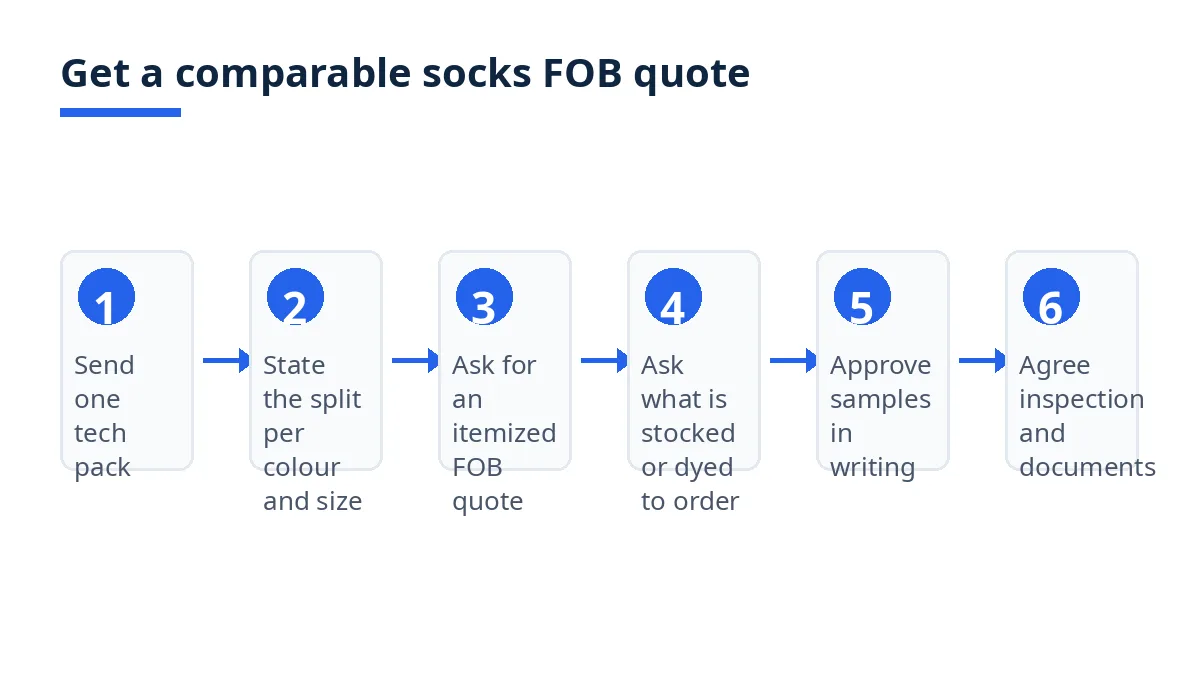
Write one specification sheet and send the same sheet to every candidate. Include fibre percentages, gauge, cushioning zones, heel, toe and cuff construction, lengths, size curve, colourways, label text and carton plan, with the FOB port at the top.
Fix the dozen maths on the sheet. State total pairs and dozen, pairs per inner carton and dozen per outer carton, and require replies to quote both per pair and per dozen.
Ask for the build-up in lines, not a single total. Ask for yarn and knitting, toe-linking with heel and cuff work, boarding and inspection, pairing and dozen packing, testing and outer packing, and inland transport and export handling, each in the same unit.
Sort stocked yarn from dyed yarn before judging a lead time. Record which colourways use stock yarn and which need dyeing, and confirm the minimums per dye lot.
Sample the edges, not just the middle size. Order a first sample, then a pre-production sample in your actual yarn, colour, cuff and labels; measure, wash and wear-test it, and test the smallest and largest sizes for heel fit and cuff hold. Approve it in writing, or list corrections.
Lock inspection, pairing checks and paperwork into the purchase order. Put the inspection plan, pairing and packing check, FOB port, term, unit and colourway and size split on the same document as the price.
Costs, timelines and documents
Reading the FOB build-up, line by line
A typical price would be fiction: the same factory charges differently for a fine-gauge cushioned crew sock and a plain coarse-gauge ankle sock. What matters is the shape of the quotation: which line moved when a total moves.
Build-up line | What it pays for | What pushes it up or down |
|---|---|---|
Yarn and knitting | Yarn, dyeing, machine time | Blend percentages, gauge, colourway count |
Toe-linking, heel and cuff work | Toe closing, heel shaping, cuff elastic | Reinforced zones, cuff height, elastic type |
Boarding and inspection | Shaping, pressing, checking each pair | Quality standard, defect rate, rework |
Pairing and dozen packing | Pairing, banding, bagging, inner cartons | Pairing method, pairs per carton |
Testing and outer packing | Lab checks, export cartons, marking | Test list, carton count and print |
Inland transport and export handling | Factory to port, loading on board | Distance to port, carton count |
Example figures, in US dollars per pair: 0.42 for yarn and knitting, 0.10 for toe-linking, heel and cuff work, 0.06 for boarding and inspection, 0.09 for pairing and dozen packing, 0.05 for testing and outer packing and 0.08 for inland transport and export handling, totalling 0.80 per pair (0.42 + 0.10 + 0.06 + 0.09 + 0.05 + 0.08 = 0.80). At 0.80 per pair, the per-dozen figure is 9.60 dollars (0.80 x 12 = 9.60), and 18,000 pairs are 1,500 dozen (18,000 / 12 = 1,500) worth 14,400 dollars (18,000 x 0.80 = 14,400). These are example figures only, shown so the pair-to-dozen arithmetic can be checked, not a market price or a supplier offer.
Use the same arithmetic on a rival reply: a second reply at 10.80 dollars per dozen is 0.90 dollars per pair (10.80 / 12 = 0.90), so it sits above the 0.80 example even though 10.80 looks close to 9.60 at a glance. When a reply undercuts the rest, trace the gap to a line: coarser gauge, plain sole, fewer colourways, stock labels, simpler packing, or a different port. If every line matches and the gap stays, ask in writing and wait for a line-by-line answer.
Reading the timeline, date by date
Ask for separate dates for dyeing, knitting, boarding, pairing and inspection, rather than one shipment week: a delay in dyeing moves every date after it.
Paperwork to agree before production
The order papers are the specification sheet, itemised quotation and purchase order, carrying the port, term, pricing unit, colourway and size split and the pairing and inspection checks. Keep one legal name for buyer and seller across every paper.
Bangladesh Customs requires an export declaration, the Bill of Export or Shipping Bill, to be submitted and approved before goods may be loaded.2 The enclosed set includes the export contract or purchase order where there is no export letter of credit, the commercial invoice, the packing list, the EXP form certified by an authorized dealer, and a certificate of origin from the EPB or a Chamber of Commerce and Industry.2 Agree the full set before production.
Treat label text as a yarn-order decision. Regulation (EU) No 1007/2011 requires a textile product to be labelled or marked with the name and percentage by weight of all constituent fibres in descending order.3 If the blend changes after dyeing, label and heading change with it, so settle the percentages when the yarn is ordered.
Bangladesh-specific rules and tips
Check a membership claim with the body that grants it. Ask which association, then confirm with it. The Bangladesh Knitwear Manufacturers and Exporters Association (BKMEA), established in 1996, is the apex trade body for the knitwear sector and represents approximately 2,540 knitwear member factories.4 That standing tells you about sector representation, not spare capacity for your gauge and colourways, or the price of your sock.
Let the blend fix the heading early. Confirm the subheading with your customs broker once the blend is fixed, because it travels with the goods into the import declaration and duty calculation. Under heading 6115, knitted or crocheted hosiery is divided by material, with separate subheadings for wool or fine animal hair (611594), cotton (611595) and synthetic fibres (611596).5 A blend changed late can change the subheading too.
Keep one legal name from enquiry to payment. The export declaration names the exporter and the foreign buyer,2 and the EXP form is certified by an authorized dealer, so the name on the trade licence, quotation, proforma invoice and payment account should be identical. A trivial-looking spelling difference on a quotation can hold up payment later.
Mistakes and red flags
Ranking a dozen figure against a pair figure. Divide first, rank second: a dozen figure divided by 12 is the pair figure, and a pair figure multiplied by 12 is the dozen figure. Until both replies sit in the same unit, the ranking is guesswork. Check whether banding, bagging and carton costs sit inside or outside the unit price: that placement alone can flip the order.
Pricing six colourways at a one-colourway rate. A rate quoted for one colourway assumes one dye lot and one setup. Split the same pairs across six colourways and each lot shrinks, setup repeats, and small lots are often repriced. Ask for the rate per colourway at the actual split before agreeing the total.
Sampling only the middle size. A sample in a middle size proves the middle size. Heel fit and cuff hold differ at the smallest and largest ends of the curve, so sample the ends too and wash-test them: a cuff that grips when new and slackens after washing is a fault to find before bulk.
Letting pairing and packing float outside the price. Pairing is labour; banding, bagging and cartons are materials. If a quotation leaves them vague, the cost appears later as an extra or the packing is thinned to fit the price. Name the pairing method, pairs per inner carton and dozen per outer carton in the quotation.
Accepting one total with no lines. A single total cannot be interrogated: when it rises, you cannot tell whether yarn, dyeing, packing or transport moved, or trade one line against another. Keep the build-up attached to the purchase order so later changes are priced line by line too.
Letting the order drift by message thread. A dropped colourway, a shifted size ratio or a shared dye lot agreed in chat has no standing until it reaches the order papers. Move every change onto the quotation and purchase order, with the split it covers, so factory, inspector and invoice share one version.
Reading a listing as proof of capacity. A supplier listing is a place to start an enquiry, not evidence that a factory has the machines, dye capacity or time for your gauge and colourways. Capacity is proven by the specification sheet, sample and production dates, not by the listing.
Checklist
Work through this list before confirming.
Specification sheet sent unchanged to every candidate: percentages, gauge, cushioning, heel, toe, cuff, lengths, sizes, colourways, label, carton plan.
Pair, dozen and carton maths on the sheet; replies restated per pair and per dozen.
Build-up in lines with port and term named; packing placement confirmed inside or outside the unit.
Yarn status per colourway recorded, with dye-lot minimums.
Label, banding and carton minimums confirmed separately from the per-pair price.
Samples at smallest, middle and largest sizes, washed, wear-tested, approved in writing.
Inspection and pairing checks written into the purchase order.
Replies compared on the same sheet, term, port and unit only.
Document set agreed: invoice, packing list, EXP form, certificate of origin, label text.3 2
Payment terms, currency and order value on the proforma invoice.
How Exportain helps
Post the specification sheet on Exportain rather than a short product description. Browse suppliers to shortlist, then put the sheet, the pair and dozen maths and the FOB port on the RFQ board and ask each reply to quote per pair and per dozen with the build-up in lines. Replies written against different sheets cannot be ranked, so send the same sheet to everyone. When you accept a reply, the agreed terms are carried into a single order and its proforma invoice.
Badges on a listing record document and photo checks, not factory inspections or guarantees, so sample approval and inspection stay with you; the checks behind each badge are on how supplier verification works on Exportain.6 7
FAQs
What should I know first about socks?
Know the sock before you ask for a price: fibre percentages, gauge, cushioning zones, heel, toe and cuff, lengths, size curve, colourways and carton plan. The fibre split also fixes the subheading under heading 6115,5 so a price asked without it is a price for an unspecified sock.
What are the typical costs and timelines?
No reliable typical figure exists: price follows your gauge, cushioning, colourways and delivery term, and timing follows dyeing, knitting, boarding and pairing capacity. Ask for the build-up in lines and the schedule in separate dates, and judge each reply on those lines.
Which documents are needed?
The order papers are the specification sheet, itemised quotation and purchase order, carrying the port, term, unit, split and inspection plan. The export papers are the Bill of Export, commercial invoice, packing list, EXP form certified by an authorized dealer and certificate of origin,2 and label text follows your market rules, including Regulation (EU) No 1007/2011 for the EU.3
What are the most common mistakes?
The repeat traps are ranking dozen and pair figures without converting, pricing many colourways at a one-colourway rate, sampling only the middle size, accepting a single total with no lines, and treating a listing as proof of capacity.
Next steps on Exportain
Start with the MOQ definition guide to check how minimums interact with dye lots and carton counts, then put your specification sheet on the RFQ board and compare replies per pair. Browse suppliers, and read how to import socks from Bangladesh before confirming an order.
Sources
- Incoterms® 2020. International Chamber of Commerce (ICC) (accessed )
- Customs Clearance Procedures for Export. Bangladesh Customs, National Board of Revenue (accessed )
- Regulation (EU) No 1007/2011 on textile fibre names and related labelling and marking of the fibre composition of textile products. European Union, (accessed )
- BKMEA at a Glance. BKMEA (accessed )
- Classification Detail — HS Code 6115. United Nations Statistics Division (accessed )
- Trust & Safety Center. Exportain (accessed )
- Supplier verification: Earn trust badges buyers can see. Exportain (accessed )
About the author
Sourcing from Bangladesh?
Post a request for quotation and suppliers on Exportain can send you their quotes directly.
Post an RFQ