Typical MOQ for Socks in Bangladesh (and How to Negotiate It Down)
No single socks MOQ in Bangladesh: what sets the minimum per colour and size on a machine run, how to ask for it in pairs and dozens, and how to negotiate or structure a smaller order.
Short answer
There is no single typical MOQ for socks from Bangladesh. Each factory sets its minimum per colour and per size for your specification, driven by machine set-up, yarn and dye lots, heel and toe finishing, dozen-based packing and label runs. Ask for the minimum per colour and per size in writing, then negotiate the split, the size curve or the set-up costs.
On this page
Key takeaways
There is no single typical MOQ for socks from Bangladesh, because each factory sets its minimum per colour and per size for your specification.
Machine set-up, yarn and dye lots, heel and toe finishing, dozen-based packing and label and carton runs are the drivers that set the floor.
Ask for the MOQ per style, per colour and per size in writing, in pairs and dozens, with set-up costs itemized apart from the unit price.
Negotiate the structure first: fewer colours, a narrower size curve, one yarn shared across sock styles, and set-up paid as a separate line.
Exportain verification is a document and photo review, not a factory inspection, and a badge is not a guarantee.
A buyer who wants 600 pairs of socks in four colours expects one number back from a factory: the minimum order. The reply usually comes back as a question instead: how many pairs in each colour, and how many in each size inside that colour? Until that grid is answered, no factory can say whether the order runs, because a sock minimum is set cell by cell rather than on the order total.
The reason sits in how a sock is made. One machine setting knits one size in one yarn and one design, so a new size means a new setting and a new colour means a fresh dye lot. After knitting, each sock still needs its toe closed, its shape pressed on a board, and a matching partner found before dozen-based packing. Every stage has its own floor, and the smallest floor inside your grid decides whether the order can proceed.
So the useful question is not what the typical socks MOQ is. It is what your grid looks like, which cells fall short, and which changes lift those cells above the floor.
What sets the socks MOQ in Bangladesh
What should I know first about socks?
A socks MOQ from Bangladesh is a set of minimums, one per colourway and size cell, rather than a single order total. A factory may accept your total pairs and still refuse one thin cell inside it, so the grid is the unit that matters. Socks are counted in pairs and packed in dozens, so state every quantity in pairs and dozens per colour and size.
One machine setting per size. Circular sock machines run a set needle count for a size range, and the design programme covers the cuff, heel, toe and any pattern. Another size means a reset, and another design means a new programme, so factories quote minimums per size too.
One dye lot per colourway. Yarn dyed to order carries the lot floor with it, while a stocked yarn in a standard colour may carry a lower one. Give the fibre blend and yarn count per colourway, and note whether it is stocked or dyed to order.
The grid multiplies thin lines. Every colourway you add and every fringe size you keep slices the same total into smaller cells. A size curve with a long tail creates cells that sit alone below the floor, even when the headline total looks comfortable.
Closing, boarding and pairing. After knitting, the toe is closed, the sock is boarded and pressed to shape, and pairs are matched. Heel, toe, cushioning and grip changes alter the set-up for that run, so put those details on the spec sheet from the start.
Dozen packing and cartons. Pairs are banded or bagged and packed by the dozen into cartons, so a quantity that is not a whole number of dozens per colour and size leaves loose pairs. Factories often round the minimum to full dozens.
Labels, header cards and cartons. Woven labels, size labels, hang tags, header cards and printed cartons each come from their own print run. A private-label order can clear the sock minimum yet fall short of the label run, so ask for those minimums separately.
See the HS code for socks guide and the MOQ definition guide for more detail.
Floor driver | Why it sets a floor | Give the factory |
|---|---|---|
Machine setting | Needle count, size setting and design programme | Style, size range and design detail |
Dye lot | One lot per dyed colourway | Fibre blend, yarn count, stocked or dyed |
Grid shape | Colourways times sizes slice the total | Pairs per colourway and per size |
Closing and boarding | Toe closing, pressing and pair matching | Heel, toe, cushioning and grip spec |
Dozen packing | Pairing and cartons run by the dozen | Pairs per dozen and carton quantity |
Print runs | Labels, header cards and cartons print separately | Label, tag, header card and carton spec |
Example figures: take 1,200 pairs, or 100 dozen, in a single colourway across four sizes at 300 pairs per size. Spread the same 1,200 pairs across four colourways and the same four sizes and each cell drops to 75 pairs, which can sit below the per-size floor even though the order total has not moved. The arithmetic is the point: every colourway you add divides every size line. These example figures show structure only, not a typical MOQ, price or lead time.
Why this matters for buyers and sellers
For a buyer, the grid decides how much cash sits in stock and whether a first order can test a design before a larger repeat. A total that looks small can still tie up stock across many colourways and sizes.
For a factory, the floor protects work that cannot be reused: dyed yarn, a machine setting and printed labels cannot be sold to another buyer. That is why the cost per pair climbs as pairs per cell fall.
Trade figures show the scale: EPB data reported in the press put knitwear exports at $5.963 billion in July to September 2026, up 6.88 percent year on year, within $10.578 billion of ready-made garment exports.1 Plenty of factories may bid on the same grid, yet no common minimum follows, because each setting is built for one buyer specification alone.
Step-by-step: how it works
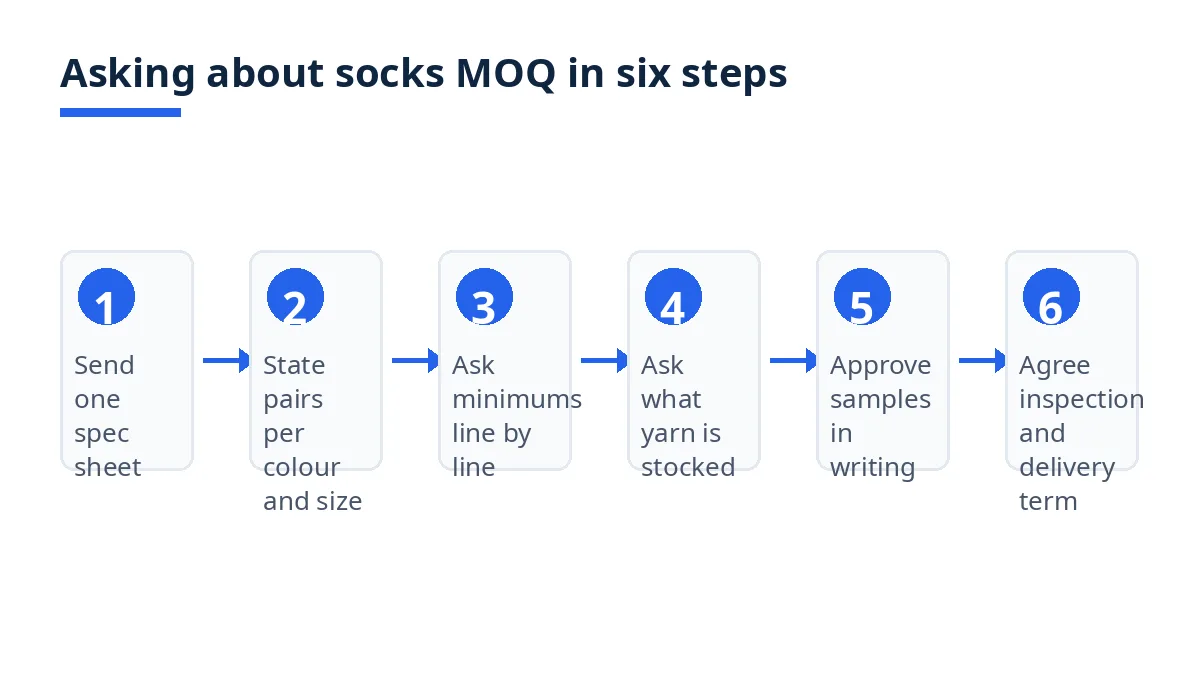
Draw the grid first. List every colourway, the sizes inside each, the pairs per cell, and the size ratio per colourway. Reshape a thin fringe cell now, before it reaches a factory.
Send one spec sheet with the grid attached. State fibre blend and yarn count, cuff style, heel and toe construction, cushioning or grip detail, size chart, artwork method, labels, pairing, packing and carton quantity, identical for every candidate.
Ask for cell minimums, and which cell binds. Ask for the minimum per style, per colourway, per size and per dye lot, plus separate label, tag, header card and carton minimums, and ask the factory to name the binding cell for your grid.
Check the stocked list before fixing colours. Record whether each yarn colourway is stocked or dyed to order, and whether labels and header cards are stock items. Stocked inputs are where a lower minimum is most often found.
Sign off samples in writing. Order a proto sample, then a pre-production sample in your final yarn, colourway, size, construction, artwork and labels. Measure it, wash it, check pair matching, then approve it or list corrections in writing.
Lock sampling and term in the purchase order. Write the inspection level and AQL values into the purchase order, following ISO 2859-1,2 and state one Incoterm and named place for every quotation.3
How to negotiate or structure a smaller order
A lower total rarely moves a factory; a smaller grid usually does. Work the cells, and put every agreed change on the quotation and the purchase order.
Pool one dye lot across styles. A crew sock and an ankle sock knitted from the same yarn and colourway draw on one dye lot, so ask whether the yarn minimum can be met across both styles combined.
Drop fringe sizes or fold them into core sizes. An edge size with very few pairs drags its whole column down. Cut it, or move its pairs into the core sizes.
Run colour drops in sequence. When the factory cannot take every colourway at once, keep the total but deliver it as staged colour drops: a first drop in fewer colourways and a narrower size curve, with later drops repeating the same specification at an agreed price and MOQ.
Choose colours already on the shelf. When a colourway already sits in stock as yarn, and the header cards are stock items too, the dye lot disappears and part of the print set-up with it. Ask for that stock list while colours are still open, not once they are fixed.
Separate the set-up charges. Where the floor comes from design programming, toe-closing set-up or label runs, ask for those costs as lines apart from the unit price, so the run can be shorter and the same set-up serves the repeat order.
Trade a written repeat for a smaller first run. Offer a repeat commitment in writing, with the repeat price and MOQ for the identical specification, in exchange for a smaller first drop. Never trade away sample sign-off or inspection to win it.
Costs, timelines and documents
What are the typical costs and timelines?
Any price or lead time you are quoted belongs to one specification only, so treat published figures as placeholders at best. The price follows the yarn, the knit, the closing and boarding, the pairing and packing, the print runs and the chosen delivery term.3
For timelines, sampling depends on yarn availability and correction rounds, and bulk production on dyeing, machine slots, boarding and packing capacity. Ask for sampling, yarn ready, production and inspection dates as separate lines.
Which documents are needed?
Assemble the export file as a checklist before shipment:
The Bill of Export, also called the Shipping Bill: the export declaration filed with Customs and approved before loading.4
The commercial invoice and the packing list, matching the order in pairs and dozens.
The EXP form, certified by an authorized dealer.4
The certificate of origin, issued by the EPB or a Chamber of Commerce and Industry.4
The order papers behind the file: spec sheet, itemized quotation and purchase order, each carrying the MOQ per style, colourway and size.
Bangladesh-specific rules and tips
Check a membership claim with the association. If a supplier claims knitwear association membership, ask for the document and check it with the association itself.5 Membership describes the business, not the MOQ or capacity for your grid, and it does not replace the spec sheet, samples or inspection.
Use one legal name on every paper. Put the identical legal name on the trade licence, quotation, proforma invoice and payment account, so the export file matches throughout.4
Ask what must be bought in for your order. Specialty yarns, elastane, grip yarn and some labels may be imported for your specification, and an imported input can set the floor and earliest start date. Settle the size ratio per colourway before knitting starts.
Label for the EU market. When the destination is the EU, the label must carry fibre names with their weight percentages in descending order under Regulation (EU) No 1007/2011.6 Confirm the spec sheet blend matches the label text before bulk labels are printed.
Mistakes and red flags
What are the most common mistakes?
Quoting a grand total with no grid. A total can clear the factory floor while one cell inside it fails, and that cell then carries a surcharge or drops out. Send the grid, not just the total.
Comparing quotes built on different inputs or terms. A lower minimum on a stocked yarn, a plain cuff instead of a patterned cuff, stock labels or a different term is a different offer. Compare only replies to the same spec sheet on the same Incoterm.3
Counting pieces instead of pairs and dozens. A quotation in pieces hides the pairing and carton maths. State pairs and dozens, so factory, sample and packing list all count the same unit.
Get concessions onto the order papers. A factory may agree to bend a cell minimum in conversation, but only the quotation and purchase order bind that agreement, so have the revised minimum, the pooled lot or the waived charge written there against the exact grid before you pay anything.
Reading a badge as a capacity promise. A listing and a badge do not show whether a factory can knit your specification, and neither promises capacity, quality or delivery.7 Treat them as a starting point, then test the factory with the spec sheet and samples.
Cutting inspection to recover a date. Inspection is the last check before the shipment becomes your stock, and dropping it to save days removes the control that catches mismatched pairs and wrong sizes.2
Checklist
Check each line off in writing before you confirm.
Grid drawn: colourways times sizes in pairs and dozens, one size ratio per colourway.
Cell minimums confirmed per style, colourway and size; the binding cell named.
Yarn status per colourway recorded: stocked or dyed to order.
Label, tag, header card and carton minimums confirmed apart from the sock minimums.
Set-up charges itemized apart from the unit price; paid set-ups recorded for repeats.
Pre-production sample measured, washed, pair-matched and signed off in writing.
Inspection level and AQL values in the purchase order.2
Quotations compared on the same specification and Incoterm.3
Export file assembled: invoice, packing list, EXP form, certificate of origin, Bill of Export.4
How Exportain helps
On Exportain, browse suppliers and post your grid, spec summary and delivery term on the RFQ board, asking each reply for cell minimums. Acceptance turns the agreed terms into a single order with a single proforma invoice.7
Badges record document and photo checks carried out by staff, not factory inspections, so sample sign-off and inspection remain your controls. The verification guide explains what each badge records: how supplier verification works on Exportain.7 8
FAQs
What should I know first about socks?
Start from the grid: the minimum is set per colourway and size cell by machine settings, dye lots, closing and boarding work, dozen packing and label runs. For tariff classification, socks sit under heading 6115 alongside other knitted or crocheted hosiery such as tights, stockings and graduated compression hosiery.9
What are the typical costs and timelines?
No buyer can rely on a standard price or lead time here, since every factory quotes for one specification alone. What moves the price is the yarn, the construction, the finishing, the shape of the grid and the delivery term,3 while the timeline moves with sampling rounds, dyeing, machine availability and packing capacity.
Which documents are needed?
You need two sets of papers. The commercial set is the spec sheet, the itemized quote and the purchase order, each showing the minimum per style, colourway and size. The shipment set is the Bill of Export, the invoice, the packing list, the EXP form with authorized-dealer certification, and a certificate of origin from the EPB or a chamber of commerce.4
What are the most common mistakes?
The most common mistakes are quoting only a grand total, comparing minimums built on different specifications or terms,3 counting in pieces instead of pairs and dozens, leaving a concession in chat, and reading a badge as a promise of capacity.7
Next steps on Exportain
Read the MOQ definition guide first, then post your colourway-size grid and delivery term on the RFQ board and compare replies from suppliers on that term.
Sources
- Exports up over 6% to $13.1bn in Q1 of current fiscal. United News of Bangladesh (accessed )
- ISO 2859-1:2026 - Sampling procedures for inspection by attributes — Part 1: Sampling schemes indexed by acceptance quality limit (AQL) for lot-by-lot inspection. ISO (accessed )
- Incoterms® 2020. International Chamber of Commerce (ICC) (accessed )
- Customs Clearance Procedures for Export. Bangladesh Customs, National Board of Revenue (accessed )
- BKMEA at a Glance. BKMEA (accessed )
- Regulation (EU) No 1007/2011 on textile fibre names and related labelling and marking of the fibre composition of textile products. European Union, (accessed )
- Trust & Safety Center. Exportain (accessed )
- Supplier verification: Earn trust badges buyers can see. Exportain (accessed )
- Classification Detail — HS Code 611522. United Nations Statistics Division (accessed )
About the author
Sourcing from Bangladesh?
Post a request for quotation and suppliers on Exportain can send you their quotes directly.
Post an RFQ