Socks Lead Time From Bangladesh: Production and Shipping Timeline
Socks lead time from Bangladesh: gated stages, yarn dyeing and shade, toe closure, cuff and size-curve approvals, pairing checks, plus a planning table and checklist for buyers.
Short answer
A socks lead time from Bangladesh is a chain of gated stages, not a single number. Yarn dyeing and shade, toe closure and reinforcement, and cuff and size-curve approvals across foot sizes must close in writing before bulk knitting, and inspection and export clearance must close before loading. Every duration is a planning example or a dated quotation figure.
On this page
Key takeaways
A socks lead time is a chain of gated stages, not a single number: yarn dyeing and shade, toe closure and reinforcement, and cuff and size-curve approvals close in writing before bulk knitting.
The socks-specific gates are yarn dyeing and shade approval per colour, the linked versus seamed toe choice, heel and toe reinforcement, elastic cuff approval on the foot, a size curve across foot sizes, and pairing checks that treat the pair as the unit.
Pairing and packing checks are buyer-specification items only: name the pair check and the carton size and colour mix check, and require the result recorded on the report for the bulk lots.
Inspection and export clearance close before loading, and transit is read only from a dated forwarder estimate for the exact route and port pair.
Compare supplier replies on the same gate table, the same tech pack and the same delivery term, working backward from the on-sale date with a buffer after inspection.
A socks order is decided at the level of the pair. Two socks in the same carton must match in shade, length, cuff tension and toe finish, in every foot size in the order. A shade that passes on one colour, a toe seam that passes on one size, or a cuff that passes on one foot does not prove the rest of the order. Read every supplier reply against the gates below, and replace every planning figure here with the dated figures in the written quotation and forwarder estimate for the actual order.
Socks add gates where timetables slip most often: yarn dyeing and shade, the linked versus seamed toe choice, heel and toe reinforcement, cuff approval, a size curve across foot sizes, and pairing checks that treat the pair as the unit. Skipping an approval moves the failure later, when correction means re-knitting, re-dyeing or re-pairing.
Why this matters for buyers and sellers
For a buyer, the socks timetable decides whether a complete, matched range reaches the shelf together. A range that arrives with one colour still in dyeing, one foot size still in correction, or pairs split across cartons is not a complete delivery, even if most cartons have arrived. Working backward from the on-sale date, with a buffer after inspection, protects the range.
Bangladesh has a deep knitwear base for this work. The Bangladesh Knitwear Manufacturers and Exporters Association (BKMEA), established in 1996, is the apex trade body for the knitwear sector and represents approximately 2,540 knitwear member factories.1
Step-by-step: how it works
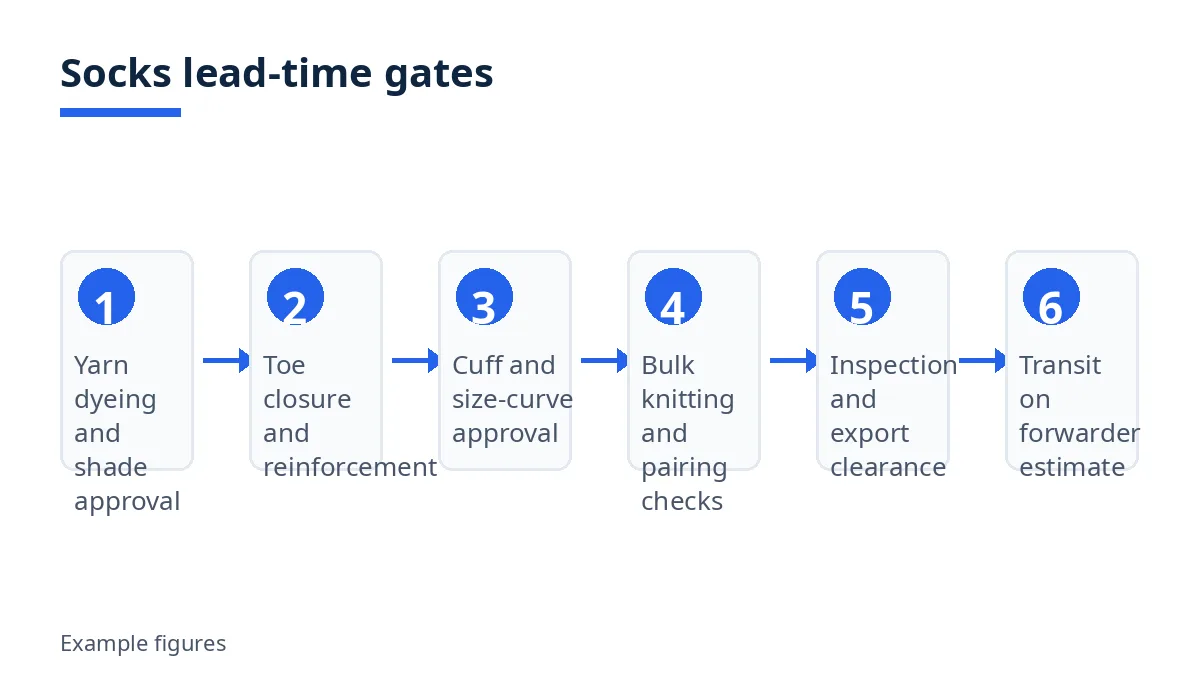
Read any supplier timeline against six gates, in this order: yarn dyeing and shade, toe closure and reinforcement, cuff and size curve, bulk knitting and pairing, inspection and clearance, and transit. If a reply skips a gate, ask where that approval sits. A gate closes only by written approval naming the lot, colour, toe method, size or pair check it covers.
Close the dye gate first: yarn dyeing and shade approval. State the yarn in the tech pack as a buyer specification: fibre composition, yarn count and colour reference for each colour. Approve it against a dyed yarn sample and a knitted swatch for each colour, recording the lot covered. A sample knitted from stocked yarn does not prove a later dyed lot will match in shade, so bulk approval is a separate written step. Regulation (EU) No 1007/2011 governs fibre names and labelling, so the approved composition is the labelled composition.2 If one colour is rejected, only that colour returns for re-dyeing, and bulk knitting of that colour waits.
Close the toe gate: linked versus seamed closure, with heel and toe reinforcement. Approve the toe-closure method as a buyer-spec item in the tech pack: a linked toe, closed loop by loop on a linking machine, or a seamed toe, closed with a seam across the toe. The choice changes the feel at the toe, the equipment used and the checking method, so it must be written into the tech pack before bulk knitting, not decided on the line. Approve heel and toe reinforcement in the same gate: reinforced yarn, area and stitch density as buyer specifications, recorded against a physical sample. A photograph cannot show whether a toe seam sits flat or reinforcement covers the wear area, so this gate closes on a physical sample.
Close the cuff and size gate: elastic cuff approval and a size curve across foot sizes. Approve the elastic cuff as a buyer specification: cuff width, rib structure, elastic type and finished measurement, checked on the foot rather than only laid flat. Then approve the size curve: the full foot-size range, with length, heel position and cuff fit recorded per size, with measurements against tolerance and photographs of the sock on the foot. A failing size returns for correction on its own.
Run bulk knitting only after the three approvals above are in writing. Knitting follows the approved yarn lots, toe method and reinforcement settings, and finishing follows the approved cuff specification. Ask for written progress of pairs knitted, linked, finished and paired against target from the start, so drift in one colour or size is visible while it can still be corrected. Any change after approval reopens its gate, and bulk work on that point waits for the new written approval. Pairing sits inside this stage: pairs are matched by shade, length and size as they are finished.
Inspect against the approved standard, then clear for export. Agree the inspection plan before production starts: sampling plan, acceptance numbers, and correction and re-inspection window. ISO 2859-1 defines acceptance sampling plans for inspection by attributes, indexed by acceptance quality limit (AQL), and AQL is the maximum average percentage of defective items considered acceptable during random sampling.3 Pairing and packing checks enter here only as buyer-specification items: name the check in the purchase order, for example that each pair is checked for shade, length and size before packing, and that each carton is checked for size and colour mix against the packing list. Require the result recorded on the report for the bulk lots. Loading waits for the written report plus the export set.
Move the goods on a dated forwarder estimate, never on a fixed transit figure. Transit starts when paired, inspected goods are handed to the carrier and ends at the buyer warehouse, cleared for import. Ask the forwarder for a dated estimate for the exact route and port pair, naming sailing or flight, transhipment, congestion and destination clearance variables, and what happens if the booked sailing is missed. The delivery term decides who arranges each leg and where risk passes. The Incoterms 2020 rules allocate cost, risk and obligations across 11 rules.4 Write the rule, named place and edition together, for example FCA Chattogram, Incoterms 2020, and compare every quotation on the same term.
Costs, timelines and documents
Reading costs and timelines
There is no figure in this guide that can be used as a price or a delivery date for an actual order. Costs move with yarn, colour count, toe method, reinforcement, cuff specification, foot-size range, pairing and packing checks, inspection and delivery term, and the timetable moves with approval rounds, dye lots, line allocation, inspection results and the forwarder estimate. The table below is a planning example only, and every cell must be replaced by the dated figures in the written quotation.
Gate | Illustrative planning example only | What closes the gate |
|---|---|---|
Yarn dyeing and shade approval | Two approval rounds in the example | Written approval per colour, naming the yarn lot |
Toe closure, heel and toe reinforcement | One approval round on a physical sample | Written approval of toe method and reinforced areas |
Cuff and size-curve approval | One wear check across the foot-size range | Written result per foot size, with measurements |
Bulk knitting, pairing and packing | Written progress blocks, counting pairs knitted, linked, finished and paired | Written progress, pairs matched before packing |
Inspection, correction and export clearance | A correction and re-inspection window before loading | Written inspection report plus the export set |
Transit and import clearance | Dated forwarder estimate only, for the exact route and port pair | Dated estimate naming sailing and clearance variables |
Example figures: a buyer plans one adult crew sock in four colours, a small-to-large adult foot-size range, a linked toe, reinforced heel and toe, and a ribbed elastic cuff. In the worked example, the dye gate comes before the toe gate, the cuff and size gate after both, and bulk knitting only after all three approvals are in writing. If the shade check rejects one colour, only that colour returns. If the toe check rejects the seam finish, only the toe returns. If the size check rejects one foot size, only that size returns. The example shows sequencing only, not a price, a delivery date or a promise about any supplier or order.
Which documents are needed?
The order documents are the tech pack, itemized quotation and purchase order, with the yarn, colour references, toe method, reinforcement, cuff specification, foot-size range and named pairing and packing checks on all three. The inspection report, yarn lot approvals and size-check record sit with the purchase order as evidence that each gate closed. For classification, heading 6115 covers pantyhose, tights, stockings, socks and other hosiery, knitted or crocheted; confirm the entry for the actual fibre and style with the destination customs rules before filing.5
For export clearance in Bangladesh, goods may not be loaded unless an export declaration, the Bill of Export or Shipping Bill, is submitted to Customs and approved.6 Enclosed documents include the export contract or purchase order where there is no export letter of credit, the commercial invoice, the packing list, the EXP form certified by an authorized dealer, and a certificate of origin issued by the EPB or a Chamber of Commerce and Industry.6 Prepare that set during production, and ask the forwarder to check the draft invoice and packing list against the inspection report and carton mix before sealing.
Bangladesh-specific rules and tips
Confirm the yarn route before approving the pre-production sample: a sample knitted from stocked yarn does not prove bulk yarn from a new dye lot will match in shade. Confirm who handles export clearance and which agent is named, because the Bill of Export and EXP form must be approved before loading, and a late document is a missed sailing even when goods are ready.6
Keep one legal name across every paper. The export declaration names the exporter and the foreign buyer,6 so the names on the licence, quotation, invoice and payment account should match. Check invoice, packing list and inspection report against each other and the carton mix before sealing cartons.
Mistakes and red flags
What are the most common mistakes?
Approving bulk from a photograph of a sample. A photograph cannot show shade under different light, whether a linked toe sits flat, whether reinforcement covers the wear area, or whether a cuff grips or slips on the foot. Physical review, including a wear check across the foot-size range, remains the safer approval, and bulk knitting should wait for it.
Treating a single total as a plan. A reply giving only a number of weeks, with no gate dates, approval points or correction route, cannot be managed. Ask for the gate table, and treat the order as unplanned until it arrives. A timetable listing dyeing, toe approval and size approval all starting the same day usually means the gates were not sequenced, because bulk knitting cannot start before approval and the size check cannot run before the toe and cuff samples exist.
Accepting a bare shade, cuff or pairing claim. Shade, cuff fit and pairing are buyer-specification items, not adjectives. If the reply states no yarn lot, no colour reference, no cuff measurement and no pair check for the bulk lots, the claim is unapproved. Name the lot, the reference and the check, and require the report.
Checklist
Tech pack complete: yarn, colour references, toe method, reinforcement, cuff, foot-size range and packing.
Dye gate closed: yarn and shade approved per colour, lot named.
Toe gate closed: linked or seamed toe and reinforced heel and toe approved on a physical sample.
Cuff and size gate closed: cuff approved on the foot, size curve approved per foot size, with measurements and photographs.
Production reporting agreed: written counts of pairs knitted, linked, finished and paired.
Pairing agreed: pairs matched by shade, length and size before packing, carton mix checked against the packing list.
Inspection agreed: sampling plan, acceptance numbers, correction and re-inspection window, named pairing checks with recorded results.3
Documents prepared during production: draft invoice and packing list checked against the inspection report and carton mix, export set listed, agent named.6
Delivery term written in full: rule, named place and edition, for example FCA Chattogram, Incoterms 2020.4
Transit estimated by the forwarder: dated estimate for the exact route and port pair, transhipment and congestion named.
How Exportain helps
On Exportain, browse suppliers and post a request for quotation on the RFQ board with your tech pack summary, yarn, toe method, cuff, foot-size range and delivery term. Ask each reply for its gate dates in writing, and keep the accepted gate table with the purchase order.
Post a free RFQ on Exportain at https://exportain.com/rfqs, and read the Incoterms for shipments from Bangladesh guide before fixing the delivery term.
FAQs
What should I know first about socks?
A socks lead time is a chain of gated stages, not a single number. Yarn dyeing and shade, toe closure and reinforcement, and cuff and size-curve approval must all close in writing before bulk knitting, and inspection and export clearance before loading. The gates that matter most are the dyed yarn lot per colour, the linked versus seamed toe choice, reinforcement, the cuff on the foot, the size curve, and pairing checks.
What are the typical costs and timelines?
There is no single figure that fits every socks order, so treat any single number with caution and ask for the order-specific version. Costs move with yarn, colour count, toe method, reinforcement, cuff, foot-size range, pairing checks, inspection and delivery term,4 and the timetable moves with approval rounds, dye lots, line allocation, inspection results and the forwarder estimate. Use the planning example only to lay out the gates, then replace every cell with the dated quotation figures.
Which documents are needed?
The order documents are the tech pack, itemized quotation and purchase order, with yarn, colour references, toe method, reinforcement, cuff, foot-size range and named pairing checks on all three, plus the yarn lot approvals, size-check record and inspection report. The export set is the Bill of Export, commercial invoice, packing list, EXP form certified by an authorized dealer, and a certificate of origin issued by the EPB or a Chamber of Commerce and Industry.6 For the European Union, the composition approved in the dye gate is also the composition that must be labelled under Regulation (EU) No 1007/2011.2
What are the most common mistakes?
The most common mistakes are approving bulk from a photograph, treating a single total as a plan, accepting a bare shade, cuff or pairing claim with no yarn lot, colour reference, cuff measurement or pair check,3 booking freight before inspection passes, comparing quotations on different toe methods or terms,4 and reading a listing as a capacity promise.
Next steps on Exportain
Browse suppliers, then post your tech pack summary, yarn, toe method, cuff, foot-size range and delivery term on the RFQ board so suppliers state gate dates in writing. Before fixing the delivery term, read the Incoterms for shipments from Bangladesh guide. Post a free RFQ on Exportain at https://exportain.com/rfqs to compare replies.
Sources
- BKMEA at a Glance. BKMEA (accessed )
- Regulation (EU) No 1007/2011 on textile fibre names and related labelling and marking of the fibre composition of textile products. European Union, (accessed )
- ISO 2859-1:2026 - Sampling procedures for inspection by attributes — Part 1: Sampling schemes indexed by acceptance quality limit (AQL) for lot-by-lot inspection. ISO (accessed )
- Incoterms® 2020. International Chamber of Commerce (ICC) (accessed )
- Classification Detail — HS Code 611594. United Nations Statistics Division (accessed )
- Customs Clearance Procedures for Export. Bangladesh Customs, National Board of Revenue (accessed )
About the author
Sourcing from Bangladesh?
Post a request for quotation and suppliers on Exportain can send you their quotes directly.
Post an RFQ