Checklist for Sneakers Exporters in Bangladesh
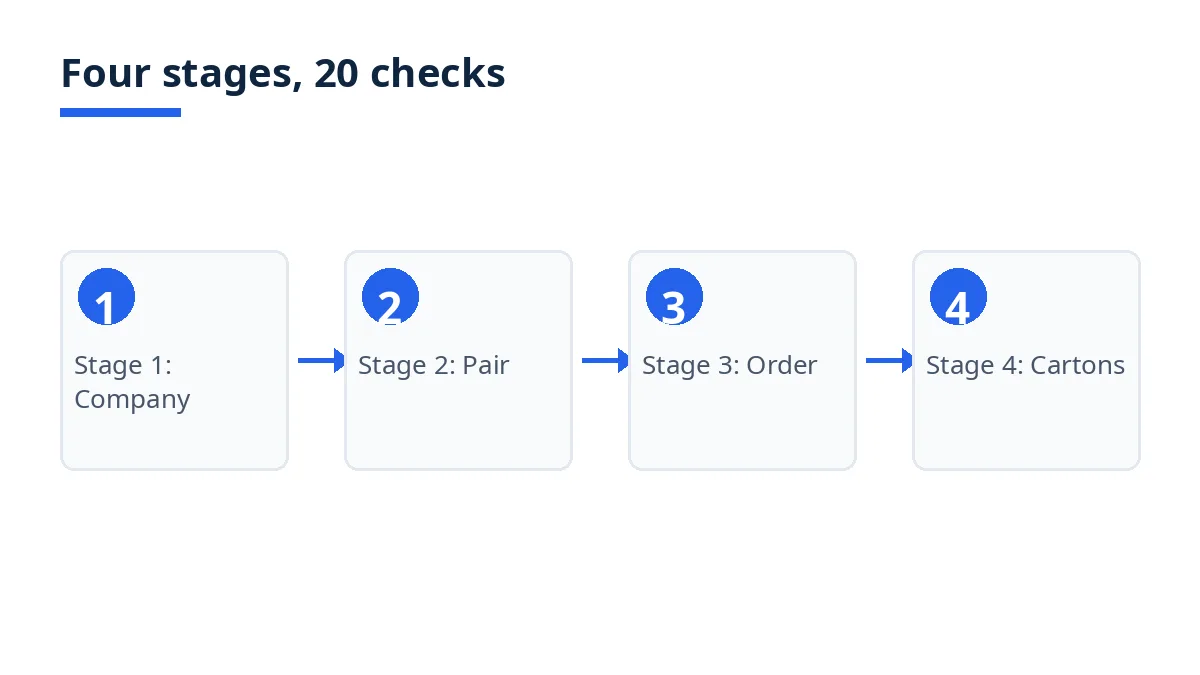
Twenty checks in four stages for sneakers exporters in Bangladesh: the company, the pair, the order, and the cartons, each check settled by a document, a measurement, or a written answer before any deposit is paid.
Short answer
Check a sneakers exporter in Bangladesh in four stages before paying a deposit: the company (matching documents, named maker, current certificates); the pair (last, panel materials, build, sole bond, size curve, labeling, substance reports); the order (held-back pair, trial lot, minimum basis, full quotation fields, fitting delivery term); and the cartons (packing marks, classification record, shipment file). Reopen the affected stage when the last, a material, a colorway, or the delivery term changes.
On this page
Key takeaways
Work four stages in order: company, pair, order, then cartons, and hold the deposit until every stage is signed off.
Example figures: a minimum of 750 pairs per colorway across 4 colorways and 2 lasts means a smallest order of 6,000 pairs, not 750.
Example figures: a 900-pair order on the 2-3-4-4-3-2 curve means 100, 150, 200, 200, 150, and 100 pairs per size.
A stage is closed only by an entry in the record: a document, a measurement, or a written answer.
Treat the heading as provisional until a broker settles the full national code; confirm duty from the schedule for your market, never from a quoted rate.
Price and photographs settle very little about a sneaker order. The questions that matter when choosing sneakers exporters in Bangladesh are narrower: is the company answering the inquiry the company that will make the shoes, does the pair fit across the whole size range, will the sole stay bonded, and do the quotation, the sample, and the shipment file describe one order? This article turns those questions into 20 checks in four stages, run in order, with a close, repair, or stop decision at each stage. Close means the evidence is in the record. Repair means the exporter supplies what is missing and the stage is checked again from the start. Stop means the evidence contradicts earlier evidence, or the exporter will not supply what a check asks for. No company is named and no exporter is ranked. Numbers that show a calculation are labeled "Example figures" throughout.
Why sneakers need a check of their own
A sneaker upper is usually several materials at once: knit or mesh for the main panels, synthetic leather or textile overlays, a padded collar and tongue, and a heel counter. One material name for the whole shoe hides whichever panel was swapped. The sole is a bonded stack, so cushioning and grip depend on a foam midsole, a rubber outsole, and the bond between them and the upper. Fit depends on the last grading cleanly from the smallest size to the largest, and the end sizes are where grading errors show.
A company-only check misses all of that. A price-only check misses it too, because a cheaper quotation often means a different midsole, a different panel material, or a smaller size range. The stages below keep the company questions, then add pair questions, then test the commercial terms against the same written specification.
Send one requirement pack to every exporter
Give every exporter the same pack before prices are discussed: the specification sheet reference and version, the last reference and width, the size range with pairs wanted in each size, the materials for each upper panel, the build method, the delivery term with its named place, and the destination market. Ask back the same fields from each: a per-pair price, a lead time, validity dates, payment terms, the delivery term, and the minimum with its counting basis.
Keep one record per exporter, in the same order, dated and attributed on every entry. Keep superseded answers instead of deleting them, and note which specification version each answer was priced against. Two quotations priced against different specification versions cannot be compared, even when the headline prices look close.
The 20 checks for sneakers exporters in Bangladesh, in four stages
Run the stages in order. A check is settled only by an entry in the record: a document, a measurement, or a written answer. A spoken assurance, a photograph of a different shoe, or a price on its own settles nothing.
Stage 1: the company behind the offer
Does the company name match on the license, the quotation, and the invoice? Ask for the trade license and the export registration certificate, then compare the name and address on them with the quotation and invoice. Any difference in spelling, address, or company form holds the stage until the documents agree.
What does the badge record actually name? Open the badge record on the profile and write down which checks it names. Treat it as desk work already done on documents and photographs. It settles none of the pair checks, and an empty space means no check of that kind is recorded, not that one failed.
Who makes each part of the pair, and where? Record the maker and site for cutting and stitching the upper, lasting, the sole unit, and sole bonding, plus any stage bought in outside. If a trading company answers, get the factory behind the pair in writing before any deposit, and name that factory in the order terms.
Is the claimed association membership on the body's own list? Ask which trade body the exporter claims, then put the claim to that body. LFMEAB's own site presents it as the footwear and leather-goods trade body for Bangladesh.1 Membership is one line in the record. It says nothing about any single pair.
Are certificates current, and are the bank details frozen? For any certificate that bears on the order, confirm scope, site covered, and expiry date with the issuing body. Settle the payment account before accepting a quotation, freeze the bank details in writing, and stop the stage if they change late until the change is confirmed in writing through the quotation channel.
Stage 2: the pair on the foot
Is the sample pair built on the named last, in the named width? Write down the last code, the width, and who the shoe is meant to fit, and require the sample on that last. A different last or width restarts the fit evidence. Lasts can be assessed manually or digitally, digital last data can be set against a foot dimensions database for a population coverage value, and fitting trials test new ranges in wear.2 Try the smallest, a middle, and the largest size on wearers who match the target market, noting length, width, heel slip, and toe pressure.
Is every upper panel named, with its own material and color? List the vamp, quarters, tongue, collar, toe cap, heel counter, and eyelet stays separately, with a swatch beside the sample pair. Under UK classification guidance, the upper takes the material with the largest share of the outside surface, small add-ons do not count toward that share, and the sole takes the material with the largest share of ground contact.3 A textile upper points to heading 6404 and a leather upper to 6403, so settle the panel record before settling the heading. Treat any heading as provisional until a customs broker settles the full national code for that exact shoe and market.
Which build method is used, and what was done to the bonding surfaces? Get the method in writing: cold cement, vulcanized, injection molded, or another method, with the midsole and outsole materials on separate lines. Cold cement bonding runs at lower heat, which is why foam and mesh uppers survive it; the lasted upper and the prepared sole unit are primed, cemented, pressed, and cooled.4 Vulcanizing cures rubber with heat, needs a metal last, and rules out EVA foam.4 A change of method or sole unit needs a fresh sample gate.
What method and load prove the sole bond? Agree the test method, the pass load, and the pairs to test in writing before bulk. Do not assume one pass mark fits every order; no source used here gives one. A sole adhesion tester measures bond strength at the toe and heel of finished footwear while the shoe is still on its last, with a rising force, and a set pass load can be used instead so production pairs can be checked without damage when the bond holds.5 Look along the bond line at the featherline for gaps and lifted edges, at the toe and heel first.
Is the size curve written size by size, with the arithmetic checked? A range is not a curve. Write each size, its pairs, and the total, and check the sum before comparing quotations. Example figures: a six-size curve in the ratio 2-3-4-4-3-2 totals 18 parts, so a 900-pair order means 100, 150, 200, 200, 150, and 100 pairs per size. Pairs moved between sizes after pricing change the order and need a fresh quotation.
Does the label match the market the shoes will be sold in? For the European Union, labeling turns on an 80 percent share: a material is labeled when it makes up at least 80 percent of the upper surface, of the lining-and-sock surface, or of the outer sole by volume, and when nothing reaches that share the two largest materials are shown; the label covers all three parts, may be written or pictogram, must sit on at least one shoe of the pair, and the first placer of imported footwear on the EU market answers for it.6 Keep a label record per market, and judge color under the lighting the specification names.
Which restricted-substance rules apply, and what report proves the shoe meets them? Ask by destination market, and hold a laboratory report naming the product, the material tested, and the method. EU REACH Annex XVII puts the compliance duty mainly on the manufacturer, or the importer for goods made outside the EU, and compliance is shown by check testing or a technical audit of materials and processes.7 The same source gives, for dyed textiles and leathers in skin contact, 30 mg/kg for aromatic amines from certain azo dyes, 3 mg/kg for chromium VI in finished leather, under 100 mg/kg for cadmium in plastics and synthetic rubbers, and under 1 mg/kg for listed polycyclic aromatic hydrocarbons in prolonged skin contact.7 One certificate does not prove every material in the shoe.
Stage 3: the order on paper
Is one approved pair held back for each colorway and last? Hold back one pair per colorway and last, showing upper, color, finish, stitch work, and sole build, stored apart from other colorways. Judge bulk lots against that pair, never against a photograph. A change of last, upper material, midsole compound, or sole material restarts the sample evidence.
Was the trial lot made on the bulk line, in the full range, and packed as bulk will be? Ask the normal single-run lot size and whether the order runs in one lot or several, with a sample approval for each run. Open one trial-lot carton and compare its contents with the packing list, checking left and right match in style, color, and size. A sample-room lot proves the design, not the line.
On what basis is the minimum counted, and what is the smallest order in total? Ask if it is counted by pair, by style, by colorway, by last, by size set, or by order value, and if two bases run together. Example figures: 750 pairs per colorway, 4 colorways, 2 lasts: 750 × 4 × 2 = 6,000 pairs as the smallest order, not 750. Judge quotations by their totals, not by the per-pair price alone. Example figures: 1,100 pairs at 9.20 dollars a pair totals 10,120 dollars, while 1,200 pairs at 8.40 dollars a pair totals 10,080 dollars, so 100 more pairs costs 40 dollars less in total.
Is every quotation field present, and does the delivery term match how the cartons will be handed over? A quotation must state the price, the validity dates, the lead time, the payment terms, the delivery term and named place, and the minimum and its counting basis. Four Incoterms 2020 rules, and only four, are for sea and inland waterway transport only: FAS, FOB, CFR and CIF. CPT is any-mode, DPU is any-mode, and DDP is any-mode, with the seller clearing import customs and paying duty while the buyer unloads. FAS and FOB both apply only to sea or inland waterway transport, and where goods are containerized the seller normally delivers to a container terminal rather than alongside the ship, so the FCA rule is more appropriate.8 A sea-only term on a container handover at a terminal mistimes the transfer, since a container can sit in the terminal for days before it is loaded.8
Are payment, documents, and inspection settled in one written record? Record the payment schedule, the documents that trigger payment, and who inspects, against which held-back pair, and over which lots, before shipment. Paying in advance puts the loss on the buyer when goods never ship, while documentary payment turns on papers that show shipment as agreed. Do not let a later message alter one term alone.
Stage 4: the cartons at the dock
Are carton contents and marks settled before bulk packing starts? Settle the pairs per carton, the size split inside it, and the print outside: style, color, size split, and quantity. Repeat the trial-lot carton check on the first bulk carton. Sorting wrong cartons after arrival costs far more than settling the marks in advance.
Is the classification record written for the exact shoe, with duty left to the schedule? List the heading and full national code the broker confirmed, the upper and outer sole materials behind it, and any binding rulings. Classification turns on upper and outer sole material, type and purpose, ankle coverage, insole length, heel height, and intended wearer, and trainers count as sports footwear only when they are tennis shoes, basketball shoes, gym shoes, training shoes, and the like.3 No duty rate is stated in this article: confirm duty, taxes, and any preference from the schedule for your market and the exact code, with your broker, before pricing the landed cost.
Is the shipment file listed before loading, and the record re-read whole? List the specification version, the settled code, any rulings that bind, and proof of origin, invoicing styles separately. Cross-check names, sites, codes, units, quantities, and dates across the license, quotation, specification sheet, sample record, and shipment file. Anything unexplained holds the shipment until the exporter supplies the missing or corrected evidence.
Four failure patterns, and what repairs each
A last swapped after approval is the most expensive pattern: the sample evidence, the size curve, and the fit trial all rest on the old last, so the pair must be remade and the fit evidence run again, and bulk cutting on the old last ends the order. A single material name for a mixed upper is the most common pattern: it hides the panel that was swapped, so the repair is a panel-by-panel record with swatches, and a second single-name answer ends the stage. A sole bond asserted without a method or load is the hardest pattern to catch from a photograph, because the bond line can look closed while the bond is weak; the repair is a written method and load, tested on production pairs. A sea-only delivery term on a container handover is the quietest pattern: nothing looks wrong until risk and cost fall in the gap between terminal handover and loading, so the term must be restated to match the handover before the order is placed.
Gate sign-off sheet
Copy this sheet for each exporter. A stage is signed only when every check in it has its entry in the record.
Stage | Checks | Evidence filed | Sign-off and date |
|---|---|---|---|
1. Company | 1-5 | ||
2. Pair | 6-12 | ||
3. Order | 13-17 | ||
4. Cartons | 18-20 |
Where two exporters both reach sign-off on all four stages, weigh identical quotation fields, the held-back pair, and the sole bond record. Keep the sheet with the quotation, the specification sheet, and the shipment file, and reopen it whenever the last, a material, a colorway, or the delivery term changes.
When should a buyer run this sneakers exporter checklist?
Run it at three moments: the shortlist stage, sample approval, and before any deposit is paid. A single late run cannot change the shortlist, and a single early run cannot judge the trial lot. Reopen the file after any change to last, material, colorway, or delivery term, and rerun Stage 2 after a build-method or sole-unit change.
Who should run each stage of the sneakers checklist?
You keep the record and make the call. Bring in a broker for classification, an inspector for sample and shipment checks, and a lab for test methods; each works to your specification and reports in writing. The supplier provides papers, site names, stage names, and the sample pair, and does not sign off its own work. Give each stage a named owner before quotations are compared.
Which failures show up most often on sneakers exporter checks?
A last still unnamed when the price is agreed; a single material name for a mixed upper; a sole bond asserted with no method or load; one held-back pair stretched across several colorways or lasts; a minimum stated with no counting basis; and a sea-only term on a container handover. In each case the documents went wrong before the shoes did.
Can a third party run the sneakers exporter checklist?
Partly. An inspector can cover sample, in-production, and pre-shipment work to your specification and held-back pair; a broker can cover classification; a lab can cover named test methods. Require a written report per part: the lot, the pairs examined, the measurements, and the packing observed. The call stays yours: nobody closes a stage on evidence they did not see, and a badge record is not a factory visit.
Next steps on Exportain
Start in the Exportain supplier directory, read each profile's badge record before you shortlist, and read the badge-check explainer. Then read the MOQ explainer. When specification, last, colorway quantities, size split, and delivery term are all settled, send them together in the request and compare quotations field by field.
Post a free RFQ on Exportain and get quotes from verified Bangladeshi suppliers →
Sources
- President's Message - LFMEAB. Leathergoods and Footwear Manufacturers and Exporters Association of Bangladesh (LFMEAB) (accessed )
- Footwear fit and comfort. SATRA (accessed )
- Classifying footwear for import and export. GOV.UK (accessed )
- Vulcanized Shoe Construction vs. Cold Cement Process. Shoemakers Academy, (accessed )
- The SATRA STD 185 sole adhesion tester. SATRA (accessed )
- Footwear labelling. European Commission, EUR-Lex (accessed )
- How REACH Annex XVII affects the manufacture of consumer products. SATRA (accessed )
- FOB & FAS Incoterms® 2020 explained: Key differences. ICC Academy (accessed )
About the author
Sourcing from Bangladesh?
Post a request for quotation and suppliers on Exportain can send you their quotes directly.
Post an RFQ