Using Sight Letter of Credit When Buying From Bangladesh: Bank Rules and Tips
Sight LC for Bangladesh buyers: payment on a complying presentation, the five-banking-day examination window, discrepancy risk at sight, and when sight suits an order — and when it does not.
Short answer
A sight LC pays the seller when the bank determines documents comply, with no maturity date to wait for. State sight availability expressly, set shipment, presentation and expiry dates with buffer, and decide any discrepancy waiver inside the five-banking-day examination window. On Bangladesh orders, check the EXP Form and transport-document route with the seller bank before issuance.

On this page
Key takeaways
A sight LC pays at sight on a complying presentation, with no maturity date: the bank examination window of at most five banking days is the whole payment timetable, so shipment, presentation and expiry dates must carry buffer before issuance.
Sight and usance differ only in when payment falls due, not in document discipline: a discrepant sight presentation earns no payment until the buyer waives it or the seller re-presents before expiry, and a waiver request does not extend the examination period.
On Bangladesh orders, the EXP Form declaration and the four-month repatriation period run beside the LC, and transport documents for land or sea exports are generally drawn to the order of the seller AD bank.
Choose sight when funds are ready at shipment and the seller needs fast payment; choose another term when the buyer needs a credit period or post-arrival inspection, because sight pays on documents before arrival.
A sight letter of credit (LC) pays the seller when the bank determines that the presented documents comply with the credit, with no waiting period to a maturity date. That feature drives every decision in this guide: the credit wording, the dates you set, and how fast you must answer when documents do not comply.
UCP 600, the Uniform Customs and Practice for Documentary Credits, 2007 Revision, is the rule set most documentary credits are issued under. The International Chamber of Commerce approved the revision in October 2006, cut the articles from 49 to 39, replaced the old "reasonable time" for document examination with a maximum period of five banking days, and implemented it on 1 July 2007.1 Under those rules, honour means to pay at sight if the credit is available by sight payment, and to incur a deferred payment undertaking and pay at maturity if the credit is available by deferred payment.2 A credit is irrevocable even if no indication to that effect appears in it, and it is a separate transaction from the sale contract on which it may be based.2 Banks deal with documents and not with goods, services or performance to which the documents may relate.2
For the short definition of an LC, see the letter of credit (LC) guide. This guide covers one type only: sight LC, for a buyer ordering from Bangladesh. The question here is narrower than the general LC chapter: what changes when payment falls due at sight rather than at a future maturity date, and when does that suit a Bangladesh order.
Why this matters for buyers and sellers
For the buyer, a sight LC moves the payment decision to the document table. Once your bank issues the credit, the seller can earn payment by presenting documents that comply with it, without waiting for the goods to arrive or for you to sell them. If the documents comply on their face, the bank must honour the presentation, even if you have not yet seen the goods. Your control sits before issuance, in the credit wording, and during examination, in a fast waiver decision.
For the seller in Bangladesh, sight payment changes the cash position of the whole order: payment follows a complying presentation instead of a maturity date weeks or months later. That matters most where the seller has already paid for fabric, trims and labour. Expect a seller to prefer sight on a first order.
The sight-versus-usance choice is a financing choice: sight suits a buyer with funds ready at shipment, usance suits a buyer that needs a credit period. A credit must state whether it is available by sight payment, deferred payment, acceptance or negotiation.2
Step-by-step: how it works
The sight LC runs on one clock: shipment, presentation, examination, payment. There is no maturity date after presentation.
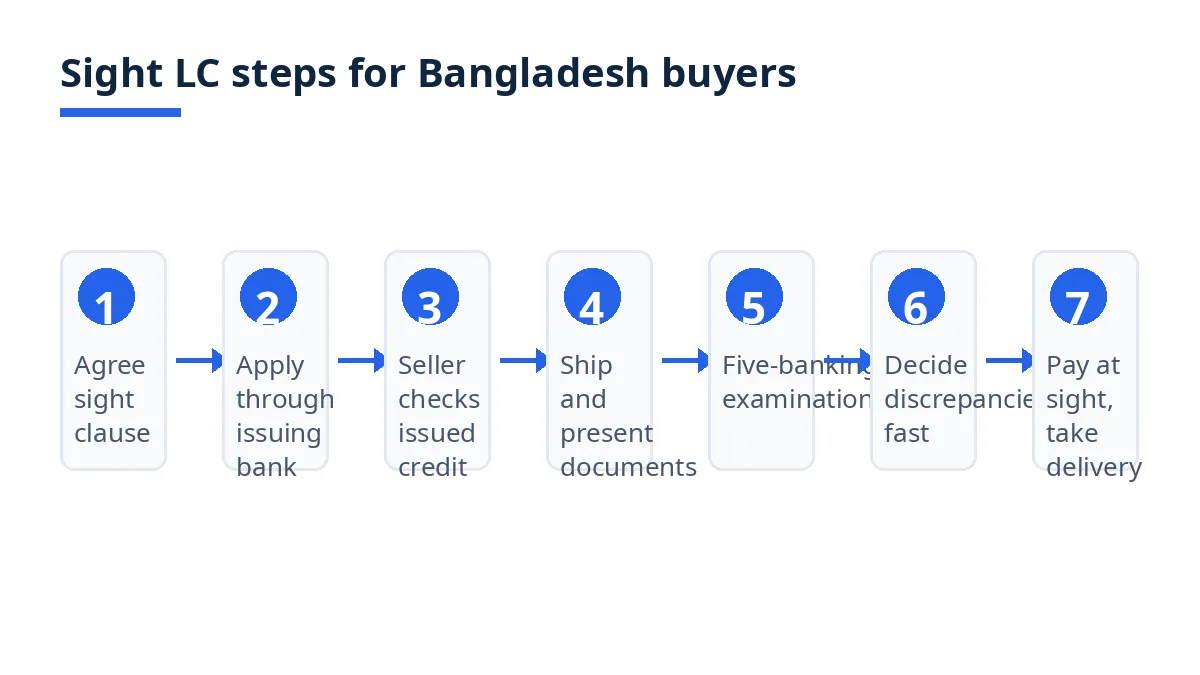
Write "available by sight payment" into the contract clause, with no usance tenor. State the credit type, currency and amount, latest shipment date, expiry date and place for presentation, required documents, ports, goods description, and whether confirmation is required. A sight credit must not also carry a tenor such as "90 days after bill of lading date". If the contract says sight but the issued credit says otherwise, the issued credit governs.
Apply through your bank and confirm the facility and the charge allocation first. Your bank is the issuing bank. Ask your bank, in writing, for its full charge schedule and for the confirmation route if you want confirmation. A confirming bank adds its own undertaking in addition to that of the issuing bank.3 If your bank cannot issue on the agreed terms, renegotiate now.
Have the seller check the issued credit line by line, before production ends. Your bank sends the credit to a bank in Bangladesh, which advises it to the seller. An advising bank that is not a confirming bank advises without an undertaking to honour or negotiate.2 Ask the seller to confirm in writing that every line is workable.
Track presentation, not only shipment. On shipment, the seller builds the document set the credit names and presents it through its bank. A presentation that includes an original transport document must be made not later than 21 calendar days after shipment, and in any event not later than the expiry date.2 Ask the seller for the shipment date and expected presentation date as soon as goods ship.
Count the examination window from the day after presentation. Each examining bank has a maximum of five banking days following the day of presentation to determine if the presentation complies.2 That period is an examination ceiling, not a payment date: a bank that determines compliance earlier may honour earlier. For a sight credit, honour means payment within that window, not at a maturity date months later.
Decide on discrepancies inside the same window. If the issuing bank determines that a presentation does not comply, it may in its sole judgment approach you for a waiver, but that approach does not extend the examination period.2 A waiver decision made after the window closes does not repair a refusal notice already given. Record your decision in writing.
Take delivery on the documents once payment is made. On honour, the documents are released to you, and the transport document lets you take delivery. Because payment at sight precedes arrival, arrange forwarding and customs clearance from the copies the seller sends.
Costs, timelines and documents
What are the typical costs and timelines?
There is no universal sight LC fee or timeline that a guide can state as fact. Issuance, advising, confirmation, amendment, discrepancy and courier charges vary by bank, LC type and amount. Confirmation adds a second undertaking and a second charge, priced by the banks, not by a published table. Ask each bank for its charges in writing before issuance, and write who bears each charge into the contract.
Timelines are set by the credit and the rules, not by a standard schedule. The fixed points are the latest shipment date, the 21-calendar-day presentation limit where an original transport document is included, the expiry date, and the five-banking-day examination maximum per examining bank.2 Build your cash plan around payment inside the examination window after a complying presentation, not around goods arrival.
Example figures: a buyer in Spain orders denim jeans for USD 27,500 on a sight LC, with shipment on 12 March, presentation on 19 March, a latest shipment date of 15 March and expiry on 5 April. Example figures: the presentation sits inside the 21-day limit and before expiry, so a complying set earns payment at sight after examination. The dates show structure only, not a typical fee or processing time.
Which documents are needed?
The credit decides the document set. No fixed list applies to every sight LC, and a document not named in the credit will be disregarded by the bank. The usual set, where named, is the commercial invoice, the transport document (bill of lading for sea, air waybill for air), the packing list, and, where required, an insurance document and a certificate of origin. Add an inspection certificate only where the credit names the issuer, timing and wording.
Document discipline matters more at sight than at usance, because there is no maturity period in which to repair papers. Data in a document must not conflict with data in another stipulated document or the credit.2 The commercial invoice description must correspond with the credit description.2 A document presented but not required by the credit will be disregarded and may be returned.2 Draft the invoice description from the credit wording.
Bangladesh-specific rules and tips
Start with the seller bank file, because it runs beside the LC and can delay document release even when the LC itself is clean. All exports from Bangladesh, unless exempted, must be declared on the EXP Form, and exporters undertake on it to repatriate full export proceeds within the period specified by Bangladesh Bank.4 The prescribed period is four months, and if full proceeds are not received within it without special or general authorization from Bangladesh Bank, exporters are subject to action under the Foreign Exchange Regulation Act, 1947.4 For a sight LC, that period rarely binds the buyer: payment on a complying presentation normally lands well inside four months.
Export payments may be received through an authorized dealer (AD) in freely convertible foreign currency, including Chinese Yuan, or in taka from a non-resident taka account.4 Before executing an export transaction, the AD must satisfy itself about realization arrangements, title documents, and, where necessary, buyer bona fides.4 Keep company details, order value and shipment plan consistent across the contract and invoice.
Ask about transport documents before you agree the clause. Transport documents for land or sea exports from Bangladesh must generally be drawn to the order of an AD and handed to its authorized representative, and air waybills should be drawn to the order of a bank in the country of import nominated by the AD.4 A separate facility allows ADs, for shipment value up to USD 100,000 or equivalent and subject to conditions, to allow transport documents in the name of foreign importers.4 Do not assume the bill of lading will arrive in your name: ask how it will be drawn and endorsed, and write the answer into the clause. State UCP 600 expressly in the credit, since Bangladesh Bank requires ADs to ensure LC terms conform to the prevailing UCP.4
Mistakes and red flags
What are the most common mistakes?
Treating the five banking days as a cure window. The examination period is the time the bank has to decide compliance, not extra time for the seller to fix documents. A discrepant sight presentation made two days before expiry has almost no cure room: after expiry, a presentation never complies, even if shipment was on time.
Case at sight: a description mismatch that stops payment. Example figures: a sight LC describes the goods as "men's 5-pocket denim jeans", while the presented invoice says "denim jeans" only. Example figures: the bank treats the invoice description as not corresponding with the credit, refuses to honour, and gives a single refusal notice. The seller has shipped, the buyer has not paid, and the goods sit behind documents the buyer cannot yet use. The fix is a waiver inside the window or a corrected invoice re-presented before expiry. The case shows structure only.
Case at sight: a late shipment that cannot be waived away quietly. Example figures: a sight LC sets a latest shipment date of 15 March, the vessel sails on 18 March, and the seller presents on 20 March. Example figures: late shipment is a discrepancy even though the goods match the order, and the bank must refuse unless the buyer waives it. Read the discrepancy list before answering.
Waiving without reading the refusal notice. When a bank decides to refuse, it must give a single notice stating the refusal, each discrepancy, and how the documents are held, no later than the close of the fifth banking day following the day of presentation.2 If the bank fails to act in accordance with that article, it is precluded from claiming that the documents do not constitute a complying presentation.2
Choosing sight when you need a credit period. Sight pays on documents, before arrival and before resale. A buyer that needs 60 days after shipment to turn stock into cash, or that wants to inspect goods on arrival before paying, is mismatched to sight terms.
Checklist
Before you ask your bank to issue a sight LC, answer every line.
Availability stated expressly: sight payment, with no usance tenor or maturity date.
Currency, amount, and any tolerance for quantity or amount stated in the credit.
Latest shipment date, expiry date, place for presentation, and presentation period set with buffer.
Delivery term and named place agreed, with ports and transhipment position stated.
Document list complete: invoice, transport document, packing list, and insurance, origin or inspection documents only where named.
Invoice description copied from the credit wording, not paraphrased from a catalogue.
Beneficiary legal name and address checked against the seller bank account.
Confirmation decision made expressly, with route and charge confirmed where applicable.
Bank charges allocated in the contract, charge by charge.
Seller written confirmation that every named document, port, date and description is workable.
Bangladesh file checked: EXP Form position, transport document endorsement route, payment timing inside the repatriation period.4
Waiver process agreed internally: who reads a discrepancy list, who decides, and how fast the answer reaches your bank.
How Exportain helps
Post a free RFQ on Exportain at https://exportain.com/rfqs with the sight LC clause you intend to use: availability by sight payment, latest shipment date, document list, delivery term and named place. Suppliers quote against the same clause.
Exportain platform payments are separate from your LC. The payment terms page covers membership payments and platform charges, not the bank undertaking between you and the seller.5
For the trust side, read buyer protection for what Exportain checks and records: supplier verification submissions reviewed by the Exportain team, a recorded quotation history, private document storage, and a route to report problems.6 A badge is a record of checks reviewed, not a guarantee.6
FAQs
What should I know first about sight LC?
A sight LC is a bank undertaking to pay at sight on a complying presentation, with no maturity date after presentation.2 The credit is irrevocable, separate from the sale contract, and examined on documents alone.2
What are the typical costs and timelines?
There are no typical sight LC costs or timelines a guide can state as fact, because charges vary by bank, LC type and amount. The fixed points are the latest shipment date, the 21-calendar-day presentation limit, the expiry date, and the five-banking-day examination maximum per examining bank.2
Which documents are needed?
Only the documents the credit names, and each must match the credit: invoice, transport document, packing list, and, where required, insurance, origin and inspection documents. Data in a document must not conflict with data in another stipulated document or the credit.2 On the Bangladesh side, the export is declared on the EXP Form through the seller AD bank, and transport documents are generally drawn to the order of that AD.4
What are the most common mistakes?
The most common mistakes are treating the five banking days as a cure window, waiving discrepancies without reading the full refusal notice, and choosing sight when a credit period is needed. Each turns a document problem into a payment delay on goods already shipped.
Next steps on Exportain
Post a free RFQ on Exportain at https://exportain.com/rfqs with your sight LC clause, latest shipment date and document list. Before you confirm, read the letter of credit (LC) guide for the short definition, and buyer protection for what Exportain checks and records.6
Sources
- ICC's new rules on documentary credits now available. International Chamber of Commerce, (accessed )
- Uniform Customs and Practice for Documentary Credits (UCP 600). LegalGuide (accessed )
- A guide to types of documentary credit. ICC Academy (accessed )
- Consolidated circular on foreign exchange regulations — export trade transactions (FEPD-1 Circular No. 26, July 30, 2026). Bangladesh Bank (accessed )
- Payment and Membership Terms. Exportain (accessed )
- Buyer protection: What Exportain does to protect buyers. Exportain (accessed )
About the author
Sourcing from Bangladesh?
Post a request for quotation and suppliers on Exportain can send you their quotes directly.
Post an RFQ