

Shorts Lead Time From Bangladesh: Production and Shipping Timeline
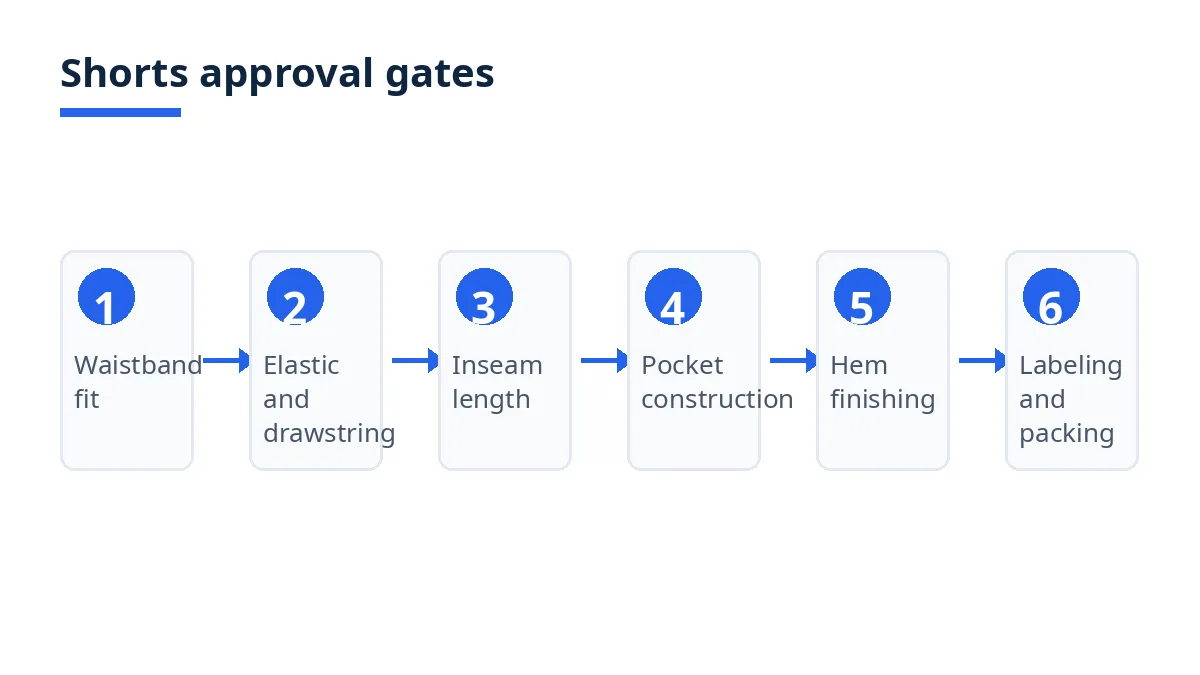
Plan a shorts lead time from Bangladesh by approval gates: waistband and fit, elastic and drawstring, inseam length, pocket construction, hem, labeling, pressing and folding, then inspection, documents, and loading.
Short answer
A shorts lead time from Bangladesh runs on approval gates, not a single production run: waistband construction and fit, elastic and drawstring, inseam length, pocket construction, hem finishing, wash-care labeling, then pressing, folding, inspection, export documents, and loading. Every duration is an illustrative planning example only. Replace it with the dated figures in the written quote and the dated forwarder estimate before setting a selling date.
On this page
Key takeaways
A shorts order runs on approval gates in a fixed order: waistband construction before elastic and drawstring details are locked, waistband before inseam approval, inseam before pocket placement is locked, and pocket, hem, and labeling before inspection and packing.
Treat elastic and drawstring as separate buyer-spec items: state the casing width against the elastic width, the drawstring material, width, length, and end finish in writing, and pass a pull test after washing, so neither end disappears into the casing.
State inseam or outseam in words on every length approval, and check the inseam and leg opening on more than one size, since the outseam includes the waistband and rise and the two measurements are not interchangeable.
Read every duration as an illustrative planning example only, replace it with the dated figures in the written quote and the dated forwarder estimate, and keep a buffer after waistband approval, after inseam approval, after hem approval, and after inspection.
A shorts order from Bangladesh is decided at the waistband, at the inseam, at the pocket mouth, and at the hem. A pair that measures correctly on paper can still fail when the elastic twists inside its casing, when the drawstring disappears into the waistband, when the inseam on the order means something different from the inseam on the sample, when a pocket sits too high on a small size, or when a hem rolls after pressing. This guide reads a shorts order through approval gates, so a buyer can see which decision is holding the order at any point. Every duration here is an illustrative planning example only, or an item to confirm in the written quote and the dated forwarder estimate.
Why this matters for buyers
Shorts compress several fitting decisions into a short garment. The waistband must stay in place, the leg must end at the agreed point, and the pockets must work when worn, not only when flat. Those decisions interact: a waistband change moves the outseam, and a rise change moves where an inseam falls. The shorts-specific order is: waistband before elastic and drawstring details are locked, waistband before inseam approval, inseam before pocket placement is locked, pocket and hem before labeling, and labeling, pressing, and folding before inspection and packing.
Step-by-step: how it works
Read a shorts order against seven gates, in this order.
Gate 0: Waistband construction and fit approval
Gate 0 fixes the waistband as a working closure, not as a single waist measurement. The buyer states the waistband style in writing: elasticated, structured with a button and fly, or a drawstring hybrid of both.1 A waistband sits at, or just below, the natural waist.1 Gate 0 also fixes the rise, the distance from the crotch seam up to the top of the waistband, since a higher rise sits closer to the navel and a lower rise sits on the hips.1 A Gate 0 approval names the waistband style, the rise, the waist measurement method, and the fit check: the shorts are judged worn or on a form, sitting and walking, not only measured flat. If the style or rise changes, the order returns to Gate 0.
Gate 1: Elastic and drawstring options as buyer-spec items
Gate 1 approves the elastic and the drawstring as buyer-spec items, stated in writing for this order. The two parts do different jobs and must not be treated as interchangeable. The casing topstitching should create a channel that is equal to, or slightly wider than, the elastic width, so the elastic moves without twisting or bunching.2 The drawstring runs through buttonholes in the waistband, not through the same opening as the elastic, and the buttonhole area is stabilized with interfacing so the holes hold their shape.2 A Gate 1 approval names the elastic width and length rule, the casing width, the drawstring material, width, length, and end finish, and the buttonhole positions. It closes only with a pull test: pull the drawstring, tie it, untie it, wash the sample, then check that the elastic lies flat, the drawstring still runs freely, and neither end has disappeared into the casing.
Gate 2: Inseam length approval
Gate 2 approves the length of the shorts, and it exists because shorts length is measured in two ways that are not interchangeable. The inseam is the seam running along the inside of the leg, from the crotch down to the hem, while the outseam is the seam running along the outside of the leg, from the top of the waistband down to the hem.1 A Gate 2 approval must state which measurement the order uses, inseam or outseam, and the method: flat, with the tape at the crotch seam and run straight down to the hem for the inseam, or from the top of the waistband down the outer side seam for the outseam.1 It must also state the leg opening, the circumference of the hem, which affects how fitted or relaxed the bottom of the short looks.1 Check the inseam on more than one size. If a quote gives a length number with no word saying inseam or outseam, Gate 2 is still open.
Gate 3: Pocket construction
Gate 3 approves every pocket on the shorts. A patch pocket is attached to the outside of a garment, can be made in a number of sizes and shapes, with or without a flap, and its size should accommodate the hand.3 Gate 3 fixes, for each pocket in writing and on a marked sample or diagram, the pocket type, position, size, depth, opening, and flap or closure, if any. It also fixes the construction behind the pocket: interfacing assists in retaining the shape of the pocket, and the weight and drape of the base fabric should be considered when selecting it.3 The finished pocket is steam-pressed.3 Gate 3 includes a pair check: when making a pair of pockets, both pockets must be identical, and placement must be checked on more than one size.3 Reinforcement is part of this gate: state the stitching required at each pocket mouth and corner, and check a loaded pocket on the sample, since an empty pocket hides a weak mouth.
Gate 4: Hem finishing
Gate 4 approves the hem as a construction check, not as a length number alone. The hem method, depth, and finish must be stated in writing, and the hem must be checked on the finished shorts, after pressing. A plain hem sequence shows what pressing does: press the raw edge under, press the hem under again at the stated depth, pin, then edge stitch and topstitch to complete the hem, followed by a final press.2 A hem approved before pressing can roll or sit unevenly once pressed. Gate 4 closes only with a hem check on both legs, measured at the inseam and at the side seam, after pressing and after any wash the order requires.
Gate 5: Wash-care labeling as a buyer-spec item
Gate 5 fixes the wash-care labeling wording. The buyer states the care instructions, fiber content wording, size marking, and country-of-origin marking required for the destination market, in writing, for this order. Labels for garments exported from Bangladesh carry required information such as size, material composition, care instructions, and country of origin.4 Gate 5 closes when the label wording, position, and care symbols are approved in writing, and the labels are checked on a finished pair of shorts, not only on a label sheet, so a label sewn into a waistband casing or under a pocket facing is still readable and in the agreed position.
Gate 6: Pressing, folding, inspection, and packing
Gate 6 runs bulk production only after Gates 0 to 5 have closed, and it ends with pressing, folding, inspection, and packing. Pressing and folding are a packing stage, not an afterthought: the buyer states the fold method, whether each pair is folded flat or rolled, the pairs per polybag and per carton, the size and color assortment per carton, and the carton marking, and checks a packed carton against that standard. A final press belongs in this gate, since shorts are pressed again before packing and a crease set at packing is the crease the buyer receives.2 Final inspection measures the packed shorts against the approved samples for each gate. Goods that fail inspection stay out of the packed cartons.
Costs, timelines and documents
The table below is a stage framework only.
Stage | Illustrative planning example only | Gate that closes the stage |
|---|---|---|
Waistband construction and fit | Illustrative example: 1 week | Gate 0 waistband and rise approved |
Elastic and drawstring | Illustrative example: 1 week | Gate 1 pull test passed after wash |
Inseam length | Illustrative example: 1 week | Gate 2 inseam or outseam approved on more than one size |
Pocket construction | Illustrative example: 1 week | Gate 3 pockets approved on more than one size |
Hem finishing | Illustrative example: 1 week | Gate 4 hem approved on both legs after pressing |
Wash-care labeling | Illustrative example: 1 week | Gate 5 wording approved on finished shorts |
Bulk, pressing, folding, inspection, packing | Illustrative example: 4 weeks | Gate 6 report and packing list complete |
Documents and transit | Confirm in the dated forwarder estimate | Documents complete, goods loaded |
A worked example shows how the gates change a date. A buyer orders stone cotton twill chino shorts with an elastic waist and a drawstring, side pockets and a back welt pocket, and a stated inseam length. The first sample comes back with the elastic twisted inside a casing wider than the elastic, the drawstring end pulled inside the waistband after washing, and a length sheet that gives a number with no word saying inseam or outseam. Gates 1 and 2 stay open while the casing width is restated, the drawstring end finish is fixed, and the length is remeasured as an inseam on three sizes. The corrected sample is approved, but the back pocket sits too high on the smallest size and one hem rolls after the final press, so Gates 3 and 4 stay open for a pocket reposition and a second pressed hem check. Each reopened gate moves bulk sewing.
For cost reading, use example figures only to compare quotes, and replace them with the written quote before planning. Illustrative example only: a single shipment at USD 19,800 on one delivery term, USD 1,450 for ocean freight, and USD 260 for marine insurance.
The document set gates loading and clearance. Export documentation for garments from Bangladesh includes commercial invoices, packing lists, bill of lading or air waybills, export declaration forms, and certificates of origin.4 Goods shall not be loaded or shipped for export unless an export declaration, known as the Bill of Export or Shipping Bill, is submitted to Customs in the prescribed format and approved by the Customs authority, and the documents enclosed with it include the commercial invoice, the packing list, the EXP form certified by authorized dealers, and the certificate of origin.5 The Incoterms guide on Exportain explains the 11 rules and the split between cost and risk under each rule.6 Write the rule, named place, and edition together.
Bangladesh-specific rules and tips
Bangladesh-specific timing comes from the document chain as much as from production. The export document set must be complete before loading, and a buyer who treats loading as a factory date, rather than a document date, will misread the schedule. Ask the seller to confirm, in writing, who prepares each document and by which gate date, and confirm the EXP form and certificate of origin owners early, since both sit inside the Bill of Export set.5 A second point is waistband and hem capacity at bulk: confirm that a waistband and hem approved on a sample hold at bulk dates with the same casing and elastic widths.
Mistakes and red flags
Approving a waistband without naming its style, rise, and fit check.
Approving elastic and drawstring with no casing width, elastic width, or end finish stated.
Accepting a length number with no word saying inseam or outseam.
Approving pockets on the sample size only.
Approving a hem before pressing.
Starting bulk before the waistband, inseam, pocket, hem, and label wording are approved.
Treating a quoted delivery date as a loading date when the document set is not complete.
Checklist
Use this checklist before bulk starts.
[ ] Waistband style, rise, and fit check named, judged worn or on a form.
[ ] Elastic width, casing width, drawstring details, and end finish approved, pull test passed after wash.
[ ] Inseam or outseam named, method stated, checked on more than one size.
[ ] Leg opening approved for each size.
[ ] Every pocket approved: type, position, size, depth, opening, interfacing, reinforcement, checked on more than one size.
[ ] Hem method, depth, and finish approved, both legs checked after pressing.
[ ] Care, fiber content, size, and origin wording approved, label position checked on finished shorts.
[ ] Pressing, folding, and carton standard agreed, packed carton checked.
[ ] Bulk inspection plan agreed: waistband, elastic and drawstring, inseam, pockets, hem, labels.
[ ] Invoice, packing list, EXP form, certificate of origin, and shipping bill owners and dates confirmed.
[ ] Dated forwarder estimate received, replacing every illustrative planning example here.
How Exportain helps
Exportain gives buyers a place to put the gate table from this guide into a sourcing request, so each reply can be compared gate by gate rather than date by date. A buyer can list the waistband, elastic and drawstring, inseam, pocket, hem, label, and document points as requirements, and ask each seller to reply against them in writing.
FAQs
What should I know first about shorts?
Start with the order of approvals: waistband before elastic and drawstring details are locked, waistband before inseam approval, inseam before pocket placement is locked, pocket and hem before labeling, and labeling, pressing, and folding before inspection and packing.
What are the typical costs and timelines?
Read costs and durations as a stage framework only. Every duration is an illustrative planning example, and every cost figure is an example figure for comparing quotes. Replace both with the written quote and the dated forwarder estimate before setting a selling date, and keep a buffer after waistband, inseam, and hem approval, and after inspection.
Which documents are needed?
The core set is the commercial invoice, packing list, bill of lading or air waybill, export declaration, and certificate of origin, with the EXP form certified by authorized dealers enclosed with the Bill of Export or Shipping Bill.5 Confirm who prepares each document and by which gate date.
What are the most common mistakes?
The most common mistakes are approving a waistband without naming its style and rise, approving elastic and drawstring with no casing width or end finish, accepting a length number with no inseam or outseam word, approving pockets on one size only, and approving a hem before pressing. Each reopens a gate.
Next steps on Exportain
Browse the Exportain suppliers page and compare replies gate by gate.
Read the Incoterms guide for shipments from Bangladesh before agreeing a delivery term.
Post the gate table as a requirement on the Exportain RFQs page and ask each seller to reply against each gate in writing.
Sources
- A Complete Guide to Shorts: From Casual to Sport. All Cotton and Linen (accessed )
- Bamberton Shorts Sew-Along: Day 6 - Waistband, Hem. Thread Theory (accessed )
- Construction of Patch Pocket. Fashion2Apparel (accessed )
- How to export garments overseas from Bangladesh. DHL (accessed )
- Customs Clearance Procedures for Export. Bangladesh Customs, National Board of Revenue (accessed )
- Incoterms for Shipments From Bangladesh. Exportain (accessed )
About the author
Sourcing from Bangladesh?
Post a request for quotation and suppliers on Exportain can send you their quotes directly.
Post an RFQ


