Shorts Exporters in Bangladesh: Verified Supplier Checklist
A 28-point checklist for judging shorts exporters in Bangladesh before committing to a repeat programme: legal standing, factory capacity, fabric, waistband, drawcord and wash evidence, sampling terms, and a trial order before later drops.
Short answer
Use this checklist to judge a shorts exporter from Bangladesh before committing to a repeat programme: confirm legal standing and the Export Registration Certificate, check factory capacity and outsourced steps, collect fabric, stretch, waistband, drawcord and wash evidence, agree sampling and inspection terms, then place a trial order and review it before confirming later drops.
On this page
Key takeaways
Confirm legal standing and the Export Registration Certificate in the exporter's own name before discussing price or capacity.
Make wash, stretch, waistband and drawcord evidence mandatory items for the exact fabric and color, not generic claims.
Name every outsourced step and partner in the order, and require written notice before any partner changes.
Place a trial order under the agreed inspection plan and review it against this checklist before confirming later drops.
This checklist helps you judge a shorts exporter from Bangladesh before you commit volume to a repeat programme, not after the first shipment lands. A supplier that sews a good sample can still fail on wash consistency, shade control, or capacity when later drops are due. Score each item as pass, fail, or evidence missing before ordering the programme.
Why this checklist matters
A one-off order tests one shipment; a repeat programme tests whether the same waistband, wash, and shade come back drop after drop. The risks that break repeat programmes rarely show in a sample room: a fabric lot that changes mid-programme, a laundry partner swapped without notice, a drawcord shortened to save cost, or a size range that drifts because the pattern was never locked.
This checklist is built for that decision. It covers legal standing, factory capability, fabric and wash evidence, sampling discipline, and commercial terms, ending with a trial-order rule so a programme is earned, not assumed. It does not replace shipment inspection: for piece-by-piece checks on a finished lot, use the shorts quality control checklist and agree the sampling plan before production. ISO 2859-1 specifies an acceptance sampling system for inspection by attributes, indexed in terms of the acceptance quality limit (AQL), for lot-by-lot inspection, intended primarily for a continuing series of lots, which matches a repeat programme.1
Before you start
Do not start scoring until you have the exporter's pack: tech pack, fabric specification, wash reference, size chart with tolerances, and label and packing plan. Ask who owns your programme, which factory cuts and sews it, and which steps are outsourced: washing, embroidery, printing. A vague answer counts as evidence missing, not a pass.
Agree the decision rule in advance: how many failed items stop the programme, which items are mandatory, and what evidence closes each gap. A supplier with no wash report for the exact fabric and color has failed a mandatory item, not a detail. Record the outcome per item, keep the documents sent, and date every record.
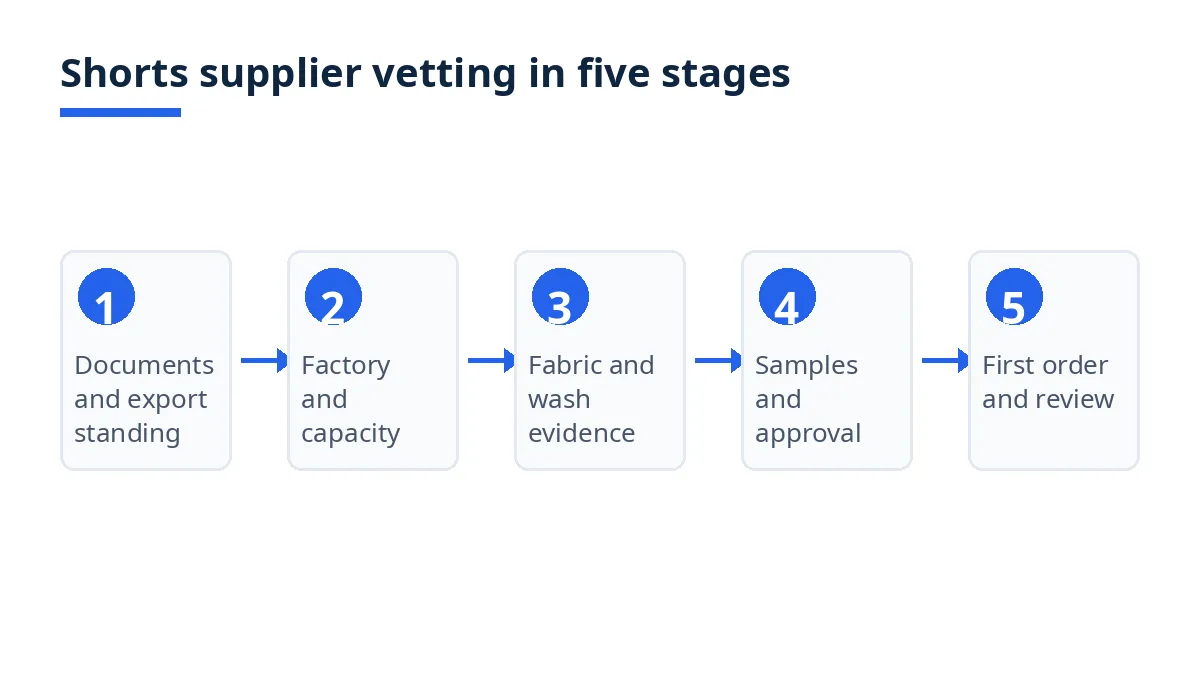
The full checklist (numbered, printable)
Legal standing and export readiness
Ask for the trade licence, tax identification, and, for a company, incorporation documents, checking the legal name matches on every document and the quotation.
Ask for the current Export Registration Certificate (ERC) in the exporter's own legal name, not a third party's.
Ask whether the exporter is the manufacturer, a trading company, or both for your style, and name the factory if production is not in-house.
Ask which trade association or chamber memberships the exporter claims, and check each with the issuing body.
Agree payment terms, currency, and the documents triggering each payment in writing, and confirm the exporter can receive payment on those terms through its own bank account.
Factory capability and capacity
Ask which shorts the factory has made in the same construction as yours: woven or knit, denim or twill, elasticated or fly-front. Ask for comparable styles, not a general product list.
Ask for monthly shorts capacity in pieces, current order load, and your programme's share at peak.
Ask which steps run in-house and which are outsourced, naming the partner for each: washing, dyeing, embroidery, printing.
Ask about wash capability: in-house or a named partner laundry, which wash types it runs, and how recipes are recorded so a later drop repeats the first.
Ask how repeat styles stay consistent: how patterns, fabric lots, and wash recipes are stored for reorder.
Fabric, fit, and shorts-specific evidence
Ask for the fabric specification: fiber composition, weight, weave or knit structure, mill or supplier, and lab dip approval per color.
For stretch shorts, ask for stretch and recovery evidence for the exact fabric, agree the test method and acceptance limit in the order, and reject any generic stretch claim with no method behind it.
For the waistband, ask for the elastic specification and relaxed and extended waist measurements on the approved sample, and check bulk elastic matches sample elastic.
For drawcords, ask for the cord specification, anchoring so it cannot slip into the casing, and eyelet reinforcement. For children's shorts, ask for the cord specification against the destination market's cord rules and record the age range. A UK risk assessment records a 342 mm cord on a young child's garment set as prohibited under EN 14682:2014, showing why cord length and age range must be specified, not assumed.2
For wash evidence, ask for dimensional change reports for bulk fabric and color under a named method. ISO 5077 specifies a method for determining dimensional change of fabrics, garments, or other textile articles in specified washing and drying procedures.3
For color evidence, ask for color fastness reports for washing per color. ISO 105-C06 specifies methods for determining the resistance of textile color to domestic or commercial laundering using a reference detergent.4
Ask how shade is controlled across a full size set: whether complete sets are cut from matched lots, and how a mid-programme lot change is flagged before cutting.
Labels, claims, and certificates
Ask for the label plan before bulk labels are printed. Under Regulation (EU) No 1007/2011, a textile product shall be labelled with the name and percentage by weight of all constituent fibers in descending order.5
Ask for the care label symbols against the agreed system. ISO 3758 establishes a system of graphic symbols for care labelling, based on the most severe treatments that do not cause irreversible damage during care.6
For any certificate claimed, ask for the certificate itself, check its scope covers your product and components, and check its expiry date. Under OEKO-TEX STANDARD 100, the label is awarded only if all components meet the criteria, and a certificate is valid for 12 months.7
Ask the exporter to state in writing which product claims, such as fiber content or a harmful-substances claim, are backed by a named certificate, and which are marketing wording.
Sampling, inspection, and repeat discipline
Agree sample stages in writing: proto, pre-production, and any shipment sample, the approver of each stage, and the result of rejection.
Agree that a graded size set is approved before bulk cutting, so fit is confirmed across the range, not one sample size.
Agree the inspection plan before production: sampling approach, defect classes, and acceptance numbers, using the AQL system above.1 Then run finished-lot checks in the shorts quality control checklist.
Agree how production problems are reported: who contacts whom, how quickly, and what stops the line on a fault.
Commercial terms and the trial order
Agree what the price includes: fabric, wash, trims, labels, packing, and testing, and what counts as an extra. Example figures: a quotation covering fabric and wash but excluding testing leaves a cost found later, so list each item.
Agree lead time from fabric confirmation to shipment, capacity booking per drop, and the rework buffer before shipping.
Place a trial order before committing the full programme, inspect it under the agreed plan, and review the result against this checklist before the second drop.
Common failures and how to fix them
The most common failure is a programme approved on a sample with no wash evidence behind it. The first bulk wash then shifts waist, leg length, or shade, and the whole drop is reworked. Fix it by making wash and dimensional change reports mandatory items.
The second is a shade split across sizes, usually from more than one dye lot in one size set. Fix it by asking how lots are matched to sets before cutting, and checking shade across the full size set at trial.
The third is a silent subcontractor change: washing or printing moves to a new partner mid-programme, changing the finish. Fix it by naming every outsourced partner in the order, with written notice before any change.
The fourth is a drawcord that shortens or slips in bulk because the cord specification was never written. Fix it by recording cord length, anchoring, and eyelet reinforcement in the tech pack, and checking them on the trial order.
The fifth is capacity promised twice: the same lines are booked for your peak drop and another buyer's peak. Fix it by asking for current load in writing and booking capacity per drop.
Downloadable template / summary table
Copy the checklist into your supplier file with columns for evidence, result, and date, one file per exporter.
Section | Checks | Evidence to file |
|---|---|---|
Legal standing | 1-5 | Licence, tax, ERC, payment terms |
Factory capability | 6-10 | Capacity, outsourced steps, wash setup |
Fabric and fit | 11-17 | Fabric spec, stretch, waist, cord, wash reports |
Labels and claims | 18-21 | Label plan, certificates, scope and expiry |
Sampling and inspection | 22-25 | Sample approvals, inspection plan, reporting route |
Commercial and trial | 26-28 | Priced quotation, lead time, trial result |
How Exportain helps
Exportain is a B2B marketplace connecting buyers with Bangladeshi suppliers, so work through this checklist at the enquiry stage. Browse suppliers and check the document and photo checks on each profile, including the export registration check on the trust-center page. Exportain verification is a document and photo review, not a factory inspection, and a badge is not a guarantee of capacity, quality, or delivery, so use the checks above alongside any badge you see. Read the shorts manufacturers guide and the how to import shorts guide for types and order sequence.
FAQs
When should this checklist be used?
Use it before committing to a repeat programme, when comparing shortlisted exporters, again after the trial order, and before any large drop.
Who should complete it?
The buyer, a sourcing agent, or an independent inspector can complete it, provided they see the evidence, not a summary. Whoever completes it should sign and date the file.
What are the most common failures?
Missing wash evidence for the exact fabric and color, shade splits from mixed dye lots, silent partner changes, drawcords that slip or shorten in bulk, and capacity promised to more than one buyer at peak.
Can a third party do it?
Yes, if you share the tech pack, mandatory items, and decision rule first, and the third party sends the evidence itself, not a pass mark alone.
Next steps on Exportain
Work through the mandatory items with each exporter, place a trial order with the strongest candidate, and review it against this checklist. Browse suppliers, check each profile's document and photo review on the trust-center, and post your programme via RFQs so exporters quote against the same specification.
Sources
- ISO 2859-1:1999 - Sampling procedures for inspection by attributes — Part 1: Sampling schemes indexed by acceptance quality limit (AQL) for lot-by-lot inspection. International Organization for Standardization (accessed )
- PRISM: Narrative style risk assessment - non-compliant cords and drawstrings identified in clothing intended for children. GOV.UK (accessed )
- ISO 5077:2007 - Textiles — Determination of dimensional change in washing and drying. International Organization for Standardization (accessed )
- ISO 105-C06:2010 Textiles — Tests for colour fastness — Part C06: Colour fastness to domestic and commercial laundering. International Organization for Standardization, (accessed )
- Regulation (EU) No 1007/2011 on textile fibre names and related labelling and marking of the fibre composition of textile products. European Union, (accessed )
- ISO 3758:2023 - Textiles — Care labelling code using symbols. International Organization for Standardization (accessed )
- OEKO-TEX STANDARD 100 for textiles tested for harmful substances. Hohenstein (accessed )
About the author
Sourcing from Bangladesh?
Post a request for quotation and suppliers on Exportain can send you their quotes directly.
Post an RFQ