Typical MOQ for School Uniforms in Bangladesh (and How to Negotiate It Down)
No single school uniforms MOQ in Bangladesh: what sets the minimum per piece, color and size, how shade, crest and size grid drive it, and how to negotiate a smaller order.
Short answer
There is no single typical MOQ for school uniforms from Bangladesh. Each factory sets its minimum per piece, per color and per size for your school specification, driven by the dye lot for the school shade, the roll yield for each cloth, crest digitizing and set-up, and the smallest size cell in the grid. Ask for each floor in writing, then negotiate the structure: carry the shade forward, share cloth across pieces, and pay the crest set-up once.
On this page
Key takeaways
There is no single typical MOQ for school uniforms from Bangladesh, because each factory sets its minimum per piece, per color and per size for your school specification.
The binding floor is usually the dye lot for the school shade, the roll yield for each cloth, the crest digitizing and set-up, or the smallest size cell in the school size grid.
Ask for every floor in writing, with the MOQ per piece, per color and per size on both the quotation and the purchase order.
Negotiate the structure: carry the school shade forward to a dated replenishment, share cloth across pieces of the set, and pay the crest set-up once as a separate line.
Exportain verification is a document and photo review, not a factory inspection, and a badge is not a guarantee.
A school order is a deadline order before it is a garment order. On the first day of term every pupil needs a complete set that matches the rest of the class: the same shirt, trouser or skirt, tie, sweater or blazer, in the same school colors, carrying the same crest, in a size that fits. A factory therefore does not quote one number for a school. It quotes a set of floors, and the order can only run when every floor is cleared for every piece, color and size in that set.
Four school-specific floors usually decide whether the quantity works. First, the school color is normally dyed for that school alone, so the dye batch for the shade must be filled before cutting can begin. Second, each cloth arrives in rolls of a fixed length, so a short order can still consume a whole roll of shirting, trousering or skirt fabric. Third, the crest needs its own digitized file and machine set-up for each placement, a fixed cost whether the run is long or short. Fourth, a school size range stretches from young children to senior pupils, so a healthy-looking total can split into very thin quantities at the two ends of the range.
Example figures: a 150-metre roll of trousering, at 1.5 metres per trouser, cuts 100 trousers. Spread those 100 trousers across ten sizes and the average is ten per size, while the smallest and largest sizes may take far fewer once the real pupil numbers are applied. The illustration shows only how a roll becomes a size problem; it is not a typical MOQ, price or lead time. Before asking for a lower total, find out which of the four floors is binding for your school, because each one is negotiated in a different way.
Minimum to test | School detail that decides it | Put this in the enquiry |
|---|---|---|
Shade dye batch | One dyed color per school, per cloth | Shade reference for each cloth |
Roll yield | Length per roll and cloth per piece | Cloth, width and consumption per piece |
Crest file and set-up | Artwork, size and placement | Artwork, thread colors and placement per piece |
Size cells | Pupil numbers per size | Quantity per size, per piece and per color |
Trim and label runs | Buttons, ties, labels and cartons | Trim, label and carton requirements |
Later top-up match | Same shade and crest as the first run | Original shade reference and crest file |
Why this matters for buyers and sellers
For a buyer, a missed floor rarely shows up as a cancelled order. It shows up on term morning, when one size is missing, one piece of the set is short, or a top-up delivered months later sits a shade apart from the original uniforms in the same classroom. Getting floors in writing early protects the term date, since approvals precede bulk cutting.
For a factory, the same floors protect work that has no second customer. Cloth dyed to one school color, a pattern cut to one school set and a crest digitized for one school badge cannot be sold on to another buyer if the order shrinks. That is why a short school run still carries the full dye batch and the full crest set-up, and why a factory will usually discuss changing the order structure rather than simply waiving a floor.
Step-by-step: how it works
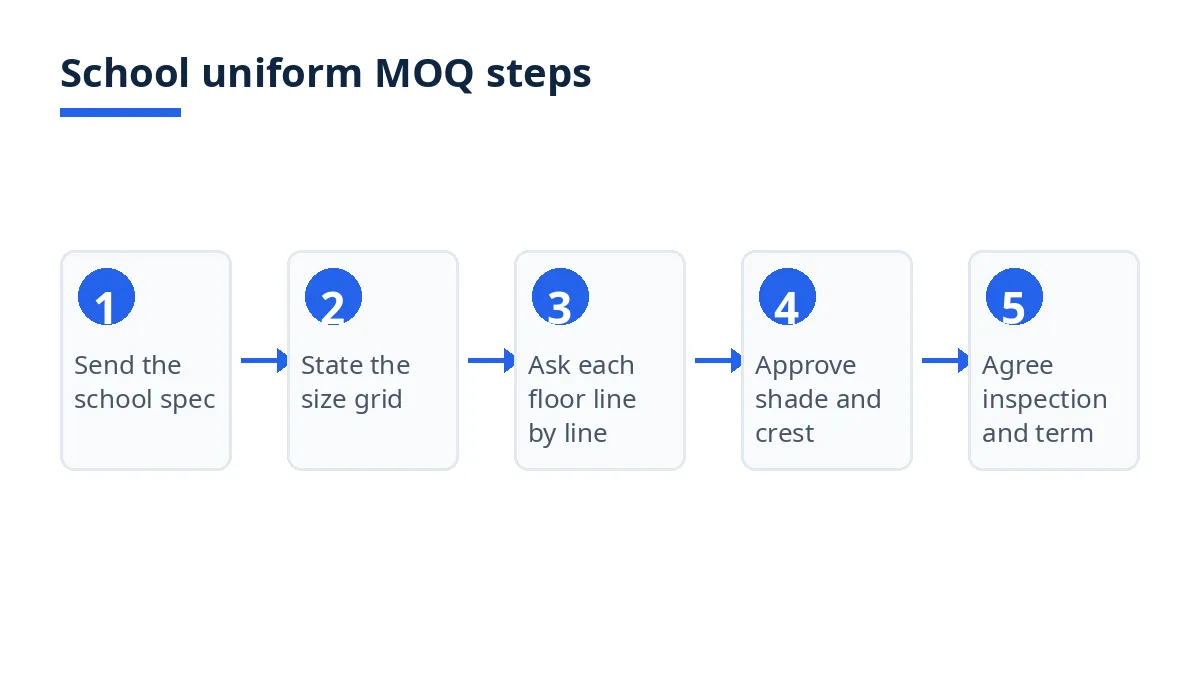
Send one school pack to every candidate. Include each piece in the set, the cloth for each piece, the shade reference, crest artwork with size and placement, the full size list from the youngest pupil to the oldest, and the packing for a complete set.
Show the cells, not just the sum. List how many of each piece, color and size you need, so a thin cell cannot hide inside a comfortable-looking total.
Get a separate figure for every floor. For each shade, cloth, crest placement and trim, ask for its own floor, then ask the factory to say which one limits your cells.
Sort inputs into held stock versus school-only production. For every cloth, button, tie and label, note which side of that line it falls on.
Approve shade, crest and size set before bulk work. Ask for a shade swatch, a crest sample in the real thread colors and placement, and samples at the smallest and largest sizes. Measure them, wash them, compare them with the approved reference, and record approval or corrections in writing.
Put inspection and delivery terms into the order first. Record the inspection level and AQL values agreed under ISO 2859-1,1 and name one Incoterm with a named place on every quotation. The Incoterms 2020 rules give 11 rules that allocate cost, risk and obligations,2 so a minimum quoted on one term cannot be judged against a minimum quoted on another.
Negotiation levers that change the floor
A lower figure usually follows a changed order, not a repeated request. Each lever below works on a different floor, so use the one that matches the binding line for your school.
Hold leftover shade cloth for the next term. When the dye batch is larger than one term order, ask in writing whether the remaining cloth can be kept for a dated top-up in the same shade, and which shade reference will govern the match.
Cut more than one piece from one cloth. A trouser and a skirt from the same trousering, or a shirt and a blouse from the same shirting, can draw on a single dye batch. Ask in writing whether the cloth floor can be met across the combined pieces rather than piece by piece.
Separate the crest charge from the piece price. When digitizing drives the floor, ask for that cost as its own line. The paid file then serves the repeat order, and the repeat quotation should carry no second set-up charge for the same crest.
Trim crest placements before trimming sizes. The same crest on a shirt, a blazer and a sweater means three set-ups. Price each placement on its own so an extra placement's cost is visible.
Book the main term order together with its top-up. If the first order alone cannot clear a floor, place it with a written top-up quantity, price and floor for the same shade, crest and size range, so the factory can plan both runs from one dye batch and one crest file.
Costs, timelines and documents
What are the typical costs and timelines?
No guide can state a standard school uniform price or lead time, because the price follows your cloth per piece, your shade dyeing, your crest work, your size range, your trim and label runs, finishing and packing, and the delivery term you select.2 A quotation that leaves any of those items out is not comparable with one that includes them.
For timing, work backward from the term date and put approvals first. Ask for separate dates for shade approval, crest approval, size-set approval, cloth readiness, production and inspection, rather than a single delivery week. A late shade correction moves every date after it, so the approval sequence usually decides whether the term date holds.
Which documents are needed?
The order papers are the school specification, the size range with quantities per cell, the crest artwork, the itemized quotation and the purchase order, with the floor per piece, per color and per size shown on both the quotation and the order. For the shipment itself, follow the standard Bangladesh export-declaration guidance published by Bangladesh Customs.3
Bangladesh-specific rules and tips
Read the woven base in proportion. Bangladesh has a large woven sector to search within. According to the association's official website, the Bangladesh Garment Manufacturers and Exporters Association (BGMEA) currently has around 4,500 member factories, of which about 60 per cent are woven garment manufacturers, and BGMEA member factories account for 100 per cent of woven garment exports.4 Woven garment exports reached $4.61 billion in July to September of fiscal 2026-27, up 5.11 per cent year on year, within ready-made garment exports of $10.58 billion, according to Export Promotion Bureau (EPB) data.5 That scale widens the search only; each factory still answers your school alone.
Check a membership claim directly with the association. When a supplier states BGMEA membership, confirm it with BGMEA itself. Membership points to an active woven business, not to a shade capability, a crest service or room in the production window before your term date.
Keep a physical shade reference, not just a color name. Names such as navy or maroon drift between dye batches. Keep a dated swatch or shade reference with the order and require every top-up to be matched against that reference, so later uniforms do not sit visibly apart from earlier ones.
Ask for the production window early. School orders bunch before term starts, so ask which window the factory is offering and whether shade dyeing, crest work and size-set approval all fit inside it.
Classify each woven piece on its own. In the Bangladesh Customs Tariff, Chapter 62 covers articles of apparel that are not knitted or crocheted, with heading 62.03 for men's or boys' suits, ensembles, jackets, blazers, trousers and shorts, heading 62.04 for the women's or girls' equivalents including dresses and skirts, heading 62.05 for men's or boys' shirts and heading 62.06 for women's or girls' blouses and shirts.6 See the MOQ definition guide for how a minimum order quantity is defined. If the uniforms are sold into the European Union, Regulation (EU) No 1007/2011 requires fibre names with their weight percentages in descending order on the textile label.7
Mistakes and red flags
What are the most common mistakes?
Judging an offer by its headline total. A total can clear the factory floor while one piece, one color or one size cell inside it fails. The cells, not the headline, decide whether the set can be completed.
Forgetting the two ends of the size range. School ranges run to small child sizes at one end and senior sizes at the other, and those end cells hold the fewest pieces. They are the first to fall below a per-size floor, even when the middle sizes look comfortable.
Lining up quotes that answer different papers. A lower floor on a stock color, a printed crest rather than embroidery, or a different delivery term is a different offer. Judge rival quotes only when they answer identical school papers on an identical delivery term.2
Leaving a shade or crest promise unwritten. A carried shade, a shared dye batch, a waived set-up or a dropped crest placement only binds when it appears on the quotation and the purchase order, with the shade reference and size range it covers.
Treating a top-up as a brand-new order. A repeat enquiry sent without the original shade reference and crest file can return in a visibly different shade or with a redrawn crest. Attach both references to every repeat enquiry, however small the top-up.
Treating a badge as proof of capacity. A listing only opens the conversation; it cannot show whether a factory has room before your term date or can hold your shade and crest standard.8
Sacrificing the final check for speed. When days run short, removing the ISO 2859-1 sample check against an agreed AQL takes away the last chance to catch a wrong shade, crest or size mix before the sets reach pupils.1
Checklist
Settle every item below on paper before signing anything.
School pack issued: pieces, cloths, shade reference, crest artwork and placement, set packing.
Pupil numbers listed for every piece, color and size, youngest to oldest.
Each piece, color and size cell has a stated floor, and the limiting one is identified.
Dye batch per shade and roll yield per cloth on record.
Crest digitizing appears as its own charge, and the paid file is kept for later runs.
Approvals for swatch, crest and end sizes are recorded after measuring and washing.
Trims and packaging are priced against separate floors, not folded into garment numbers.
Shade reference and crest file kept with the order for future top-ups.
The order must carry your agreed sample size and acceptance limit.1
Comparison is fair only across offers built from one brief and one shipment term.2
Supplier confirms shipment papers well before the term date.3
How Exportain helps
Put your school pack, size cells, crest details and delivery term on the RFQ board after browsing suppliers, and ask each reply to state its floor per piece, per color and per size cell plus its crest set-up terms. Checks behind a badge on Exportain are document and photo reviews, not factory inspections, and a badge is not a guarantee,8 9 so keep shade, crest and size approvals in your own hands. See how supplier verification works on Exportain.
FAQs
What should I know first about school uniforms?
Start from the set, not the total: a school uniform floor is set per piece, per color and per size cell, and the binding line is usually the shade dye batch, a cloth roll yield, the crest set-up or the thinnest size cell. Woven school pieces fall under Chapter 62 of the Bangladesh Customs Tariff, classified piece by piece under headings 62.03 to 62.06.6
What are the typical costs and timelines?
There is no reliable standard price or lead time, because each factory prices and schedules your school pack alone. Cloth per piece, shade dyeing, crest work, the size range and the delivery term move the price,2 while shade approval, crest approval, dyeing and line availability move the timeline.
Which documents are needed?
You need the school specification, the size range with quantities per cell, the crest artwork, the itemized quotation and the purchase order, with the floor per piece, per color and per size shown on both the quotation and the order. For the shipment itself, follow the standard Bangladesh export-declaration guidance published by Bangladesh Customs.3
What are the most common mistakes?
The usual errors are judging an offer by its headline total, forgetting the smallest and largest sizes, lining up quotes that answer different papers or terms,2 leaving a shade or crest promise unwritten, ordering a top-up without the original shade and crest references, and reading a badge as a promise of capacity.8
Next steps on Exportain
Browse suppliers, then post your school pack, size cells and crest details on the RFQ board so suppliers state their floor per piece, per color and per size cell. Before you confirm, read how supplier verification works on Exportain.
Sources
- ISO 2859-1:2026 - Sampling procedures for inspection by attributes — Part 1: Sampling schemes indexed by acceptance quality limit (AQL) for lot-by-lot inspection. ISO (accessed )
- Incoterms® 2020. International Chamber of Commerce (ICC) (accessed )
- Customs Clearance Procedures for Export. Bangladesh Customs, National Board of Revenue (accessed )
- BGMEA sets new membership criteria to ensure factory safety, operational standards. The Financial Express, (accessed )
- RMG exports grow 6.1% in Q1. The Business Standard, (accessed )
- Bangladesh Customs Tariff, Chapter 62. Bangladesh Trade Portal (accessed )
- Regulation (EU) No 1007/2011 on textile fibre names and related labelling and marking of the fibre composition of textile products. European Union, (accessed )
- Trust & Safety Center. Exportain (accessed )
- Supplier verification: Earn trust badges buyers can see. Exportain (accessed )
- MOQ
- supplier verification
- buyer guide
- woven garments
- Bangladesh sourcing
- bangladesh garments
- School uniforms
About the author
Sourcing from Bangladesh?
Post a request for quotation and suppliers on Exportain can send you their quotes directly.
Post an RFQ