

School Uniforms Lead Time From Bangladesh: Production and Shipping Timeline
School uniform lead time guide from Bangladesh: fabric durability, size-range, crest, colour, wash durability, and size-sorted packing gates, with a bottle-green polo and grey trouser worked example.
Short answer
A school uniform lead time from Bangladesh runs on approval gates, not a single production run: school-wear fabric durability, size-range approval across children sizes, logo and crest approval on each garment type, colour consistency across sets and colourways, wash durability, and size-sorted packing, then bulk sewing, inspection, and export documents. Every duration and figure is an illustrative planning example only. Replace it with the written quote and the dated forwarder estimate before setting a hand-out date.

On this page
Key takeaways
School-wear fabric durability approval comes before cutting: a new lot reopens the gate, because pieces cut from different lots may not read as one set.
Size-range approval covers the full children size range on try-on samples, with a measurement table for every size, not on one middle size.
Logo and crest approval is checked on every garment type it will sit on, since a crest that reads crisply on a shirt can blur on a sweater knit.
Colour consistency is approved on the set worn together and again after washing, with each colourway approved as its own item.
Every duration and cost figure is an illustrative planning example only, and the hand-out date must be set from the written quote and the dated forwarder estimate, not from this guide.
A school uniform order is planned backwards from the day the sets must be ready to hand out, not forwards from the day the order is placed. Every approval still open when bulk cutting starts is a risk to the hand-out date, because a correction found on a finished, washed set costs far more time than the same correction found on a swatch or a single sample shirt.
A gate is a named approval, sample, or document that must close before the next stage starts. Every duration and cost figure in this guide is an illustrative planning example only, or an item to confirm in the written quote and the dated forwarder estimate. No figure here is a promise for any real order.
Why this matters for buyers and sellers
For a buyer, the risk in a school uniform order sits in agreement across pieces, sizes, and washes. A shirt, a trouser or skirt, and a sweater are not three separate garments that happen to share a colour name. They are one set worn together, washed together, and judged together, and a difference invisible on a single piece can stand out once the set is worn as a whole.
Bangladesh garment production is described in one manufacturing guide as a chain from inquiry and tech pack review through fabric sourcing, sampling, cutting, sewing, quality control, finishing, packing, and export shipment, with uniforms among the products sourced from Bangladesh.1 A school set adds its own links, because fabric durability, size range, crest, colour, and wash behaviour must all be approved on the finished set.
School uniform fabric is described in one fabric guide as facing daily wear and frequent washing, with a need to resist pilling, tearing, and colour fading.2 That demand is why fabric approval for school wear is its own gate here. A fabric that looks right on a swatch can still fail the set once it has been cut, sewn, crested, and washed with the other pieces.
Step-by-step: how it works
Read the order against six gates, then bulk, inspection, and documents.
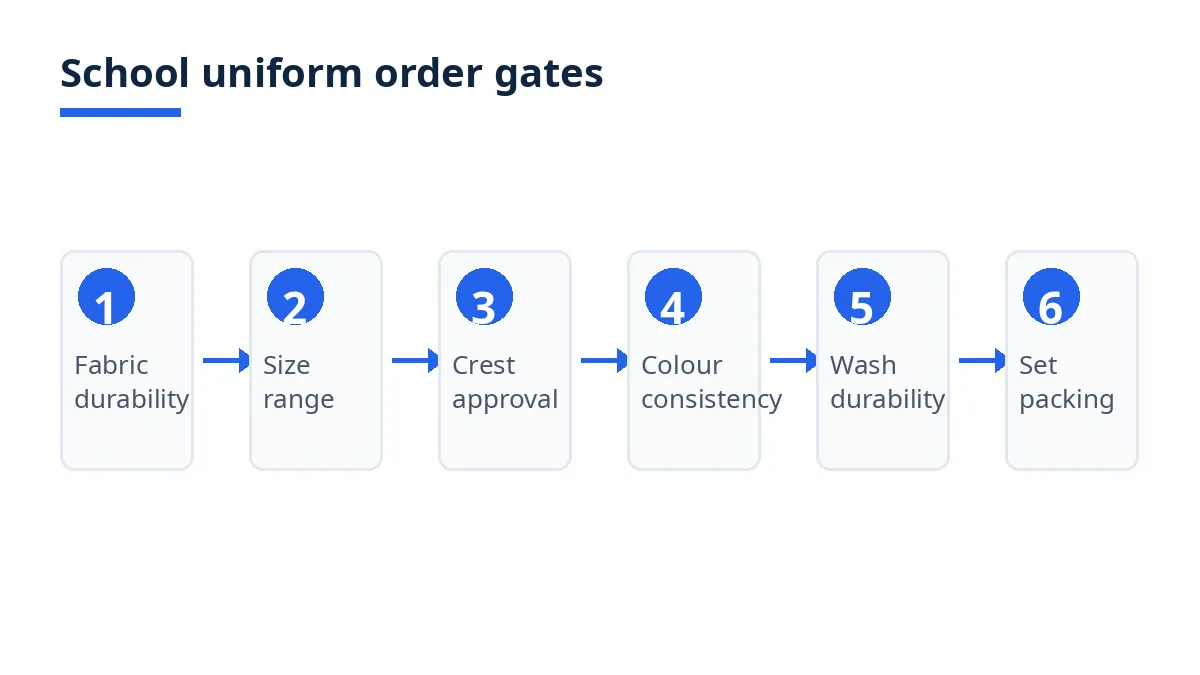
Gate 0: School-wear fabric durability approval
Gate 0 fixes the school-wear fabric before cutting. The buyer specification should name fabric type, fibre composition where specified, shade reference, and cutting lot for each piece. A manufacturing guide notes that a manufacturer should confirm composition, shrinkage, colour fastness, hand feel, stretch, and durability before bulk production.1 Ask the seller to confirm in writing whether the fabric is in stock or is to be dyed, finished, or woven for this order, and which lot each piece and size will be cut from. A new lot reopens Gate 0, because pieces cut from different lots may not read as one set.
Check durability on a finished or washed sample, not on a swatch alone. A fabric guide notes that school uniforms undergo rigorous daily wear and frequent washing, and that poor fabric selection can lead to frequent replacements.2 Carry that same check into Gate 4, so fabric and wash approvals are judged on the same set.
Gate 1: Size-range approval across children's sizes as buyer-spec options
Gate 1 approves fit across the full children's size range in the order, not on one middle size. The buyer specification should list every size as a buyer-spec option, with a measurement table for every size and the tolerance at each point of measure. One school uniform guide describes a try-on event at the school, with one piece in each size, so sizes are checked on wearers rather than on a chart alone.3
Check the smallest and largest sizes with the same care as the middle sizes. A shirt that fits well in a middle size can still sit wrong at the smallest size, where a pocket, crest, or hem lands in a different place, or at the largest size, where sweater or trouser length changes how the set looks together. Record any growth allowance or adjustable waistband as a written buyer-spec option. If pattern, grading, or the size range itself changes, Gate 1 reopens.
Gate 2: Logo, embroidery, and school-crest approval
Gate 2 approves the logo, embroidery, and school crest as a controlled specification, not as decoration added after garment selection. A Gate 2 approval should name the method for each position, artwork version, placement from fixed points, and thread or print colour reference for each garment type. One school uniform guide describes crest digitization as converting the crest to an embroidery file stored for future orders, with consistent appearance across garment types.3
Check the crest on every garment type it will sit on, not only on the easiest one. A crest that reads crisply on a woven shirt can blur or sink on a knit sweater, and a crest on a polo chest can sit differently on a sweater chest once the knit stretches. Approve placement, size, and thread colour on finished samples of each piece. If method, artwork, placement, thread, or garment type changes, Gate 2 reopens.
Gate 3: Colour consistency across uniform sets
Gate 3 approves colour consistency across the whole set, across sizes, and across lots. A Gate 3 approval should name the colour reference for each piece, the approved shade sample where specified, and the cutting lot for each piece. One manufacturing guide lists colour approval as a separate approval before production, alongside fabric and trim approval.4 Check the set worn together under the same light, and again after washing at Gate 4, since a set that matches before washing can drift apart if one piece shifts more.
Where a school uses more than one colourway, approve each colourway as its own Gate 3 item. A second colourway is not covered by approval of the main colourway, because dye lot, thread colour, and crest thread visibility all change with the background colour. Record the thread colour adjustment for each background in writing. If colour reference, dye lot, fabric lot, or colourway changes, Gate 3 reopens.
Gate 4: Wash durability as a buyer-specification item
Gate 4 approves wash durability as a buyer-specification item, with cleaning method and sample evidence agreed in writing before bulk. A Gate 4 approval should name the laundering method, sample pieces to be washed, and what will be checked after washing: shade, crest appearance and attachment, fit and shape, shrinkage, and whether the pieces still match as a set. A fabric guide notes that fabrics with good colour fastness maintain a neat appearance throughout the school year.2
Wash the set together. Do not approve wash durability from an unworn sample or a single piece. The washed set from Gate 4, with Gate 0 and Gate 3 approvals, becomes the standard bulk must match. If fabric, crest method, thread, or cleaning method changes, Gate 4 reopens.
Gate 5: Set completeness and size-sorted packing approval
Gate 5 approves set completeness and size-sorted packing before bulk is packed. A Gate 5 approval should name every piece in a complete set, how sizes are sorted within each carton, and how cartons are marked so a missing size or piece is found before shipment rather than at distribution. One manufacturing guide notes that packaging is customized according to buyer specifications.4 A carton mixing sizes without a clear mark slows hand-out and hides a shortfall until the last carton is opened.
Check a packed carton against the set list and the size list, not only against a piece count. Confirm that each carton label carries the set contents and size breakdown. If a piece, size, or carton mark changes, Gate 5 reopens.
Bulk sewing, inspection, and documents
Bulk sewing should add no new decisions. Cutting follows Gate 0, sizes follow Gate 1, crest follows Gate 2, colour follows Gate 3, the washed standard follows Gate 4, and packing follows Gate 5. In-line checks should compare finished pieces against approved samples at each stage. One manufacturing guide describes quality control as fabric, trims, cutting, in-line sewing, measurement, finishing, final random, and carton checks.1 Another guide describes inline inspections during production and a final inspection before shipment that verifies appearance, measurements, labelling, packaging, carton markings, and quantity accuracy.4
Documents gate loading, so the document set must be ready before a ship date is promised. A DHL export guide for garments from Bangladesh lists commercial invoices, packing lists, bill of lading or air waybills, export declaration forms, and certificates of origin, and notes labels should carry size, material composition, care instructions, and country of origin.5
Costs, timelines and documents
The table below is an illustrative planning example only. Replace every figure with the written quote and dated forwarder estimate.
Stage | Illustrative planning example | Confirm in the written quote |
|---|---|---|
Fabric, size-range, and crest approvals | Example planning allowance of 5 weeks from tech pack to approved washed set | Fabric availability and crest digitization route |
Colour, wash, and packing approvals | Example planning allowance of 2 weeks of sample rounds after the first set | Sample rounds included and cost per round |
Bulk sewing and finishing | Example planning allowance of 5 weeks for the bulk run in the example | Line capacity and in-line check schedule |
Inspection, labelling, and documents | Example planning allowance of 1 week before the booked loading date | Inspection booking and full document list |
Sample courier in the example | Example figure of USD 110 per courier parcel | Courier route and payer per round |
Forwarder estimate in the example | Example figure of USD 1,180 for the sea freight leg in the example | Dated estimate, named places, and delivery rule |
A worked example shows why the gates matter: a bottle-green polo, grey trouser, and matching sweater set reached its second sample round with three faults. The crest read crisply on the polo but blurred on the sweater knit, the grey trouser shade read lighter than the sweater after the set was washed together, and the smallest-size polo body sat short once crest and hem were both in place. The crest was re-digitized for the knit, the shade was re-approved as a washed set, and the smallest-size pattern was corrected. Bulk then matched the re-approved set.
Bangladesh-specific rules and tips
Keep one dated version of the approved tech pack, measurement table, sample comments, crest artwork, colour references, and allowed differences as the production reference, so a later sample round cannot silently replace an earlier approval.
Treat shade lots as a scheduling item: when pieces, sizes, or repeat sets are cut from different lots, Gate 0 and Gate 3 must both be re-approved. The same applies to thread lots.
Plan term-start timing as a buyer-side scheduling item: work backwards from the internal distribution date and hold a buffer for one washed-set re-approval round.
Mistakes and red flags
Approving school-wear fabric on a swatch without a washed, finished set.
Approving fit on one middle size, leaving the smallest and largest sizes to grading.
Approving a crest on a woven shirt without checking it on the sweater knit.
Approving colour before washing, so a set that matches new drifts apart after washing.
Approving one colourway and assuming a second colourway is covered.
Setting a distribution date from example figures instead of from the written quote and forwarder estimate.
Packing mixed sizes without a clear carton mark, so a shortfall is found only at distribution.
Changing fabric lot, thread lot, or crest artwork after approval without reopening the gate.
Checklist
Fabric, shade reference, and cutting lot approved in writing for each piece at Gate 0.
Every size approved on try-on samples with a measurement table at Gate 1.
Crest method, artwork, placement, and thread colour approved on each garment type at Gate 2.
Colour reference and dye lot approved for each piece and colourway at Gate 3.
Washing method and washed-set standard approved in writing at Gate 4.
Set list, size sorting, and carton marks approved at Gate 5.
Written quote checked to the same delivery point as any competing quote.
Dated forwarder estimate, named places, and delivery rule confirmed in writing.
Inspection booked with time for correction and re-inspection before loading.
Full document set, including labels, ready before a ship date is promised.
How Exportain helps
Use the Exportain listing pages to compare sellers against the gates in this guide, and put the gate list into the requirement itself: fabric and lot, size range, crest method, colour reference, washing method, set list, and carton marks. A requirement written that way lets a seller quote against the same approvals. Compare quotes to the same delivery point before bulk starts.
FAQs
What should I know first about school uniforms?
Know the gates before the dates. A school uniform order turns on fabric durability, size-range approval, crest approval on each garment type, colour consistency, wash durability, and size-sorted packing, each needing written approval on a finished or washed sample.
What are the typical costs and timelines?
Use the illustrative planning example in the costs table above as a starting point only, and replace every figure with the written quote and the dated forwarder estimate. Costs depend on fabric and dye route, sample rounds, crest method, size range, inspection scope, document set, and delivery rule, and timelines depend on which gates are already closed when the order is placed. No figure here is a promise for any real order.
Which documents are needed?
Confirm the document set in the written quote, and check it against the destination market before loading is booked. The core set in the export guides cited here includes the commercial invoice, packing list, certificate of origin, transport document for the agreed mode, and export declaration form, plus labels carrying size, material composition, care instructions, and country of origin.5
What are the most common mistakes?
The most common mistakes are approving fabric on a swatch instead of on a washed set, approving fit on one size instead of across the range, approving a crest on one garment type instead of on every type it will sit on, approving colour before washing, and setting a distribution date from example figures instead of from the written quote and forwarder estimate.
Next steps on Exportain
Browse suppliers on Exportain and compare listings against the school-set gates before requesting a quotation.
Read the Incoterms guide for shipments from Bangladesh and confirm the delivery rule and named places in writing.
Post your requirement as an RFQ on Exportain, naming fabric and lot, size range, crest method, colour reference, washing method, set list, and carton marks.
Sources
- Inside Bangladesh Garment Manufacturing Process. Minmax Textile (accessed )
- How to Choose Fabric for School Uniforms. Fabric for Uniform, (accessed )
- Custom School Uniforms Guide 2026. T-Shirt Elephant (accessed )
- Garment Manufacturer for Solomon Islands | Bangladesh Clothing Factory. SiATEX (accessed )
- How to export garments overseas from Bangladesh. DHL (accessed )
About the author
Sourcing from Bangladesh?
Post a request for quotation and suppliers on Exportain can send you their quotes directly.
Post an RFQ


