Sandals and Slippers Price in Bangladesh: FOB Cost Breakdown for Buyers
A sandals FOB figure hides the sole unit, straps, molds, checking and pack. This guide takes it apart line by line, with example figures, and shows how to restate competing quotations onto one basis.
Short answer
A sandals and slippers price in Bangladesh is best read as an FOB figure built from seven lines: sole unit, straps and upper, footbed, labor and assembly, molds spread over the order, checking and pack, and port lines plus margin. No single figure holds across suppliers, because the pair description, mold spread, and charges inside the figure differ. Restate every quotation to one pair on the same delivery rule and named port before ranking. All figures here are example figures.
On this page
Key takeaways
Read the FOB figure as seven lines: sole unit, straps, footbed, labor and assembly, mold spread, checking and pack, and port lines plus margin.
Example figures: a 2,700 US dollar mold charge spreads to 3.00 US dollars at 900 pairs, 1.00 at 2,700 pairs, and 0.50 at 5,400 pairs.
Restate every quotation to one pair on the same delivery rule, named port, currency, and validity date, with fixed charges separated, before ranking.
No duty rate is stated: a customs broker confirms the national code and duty line for the exact pair and market, and labeling is agreed before production.
The worked example totals 3.40 US dollars FOB per pair at 5,400 pairs, with the mold spread at 0.50 US dollars inside that figure.
A sandals quotation from Bangladesh usually arrives as a single figure per pair, quoted FOB at a named port. That figure hides the whole pair: the sole unit, the straps, the footbed, the assembly, the molds, the checks, and the short haul to the ship. Two figures for pairs that look alike can sit far apart without either supplier mispricing, because the pairs, the packs, or the charges inside the figures differ.
FOB means Free On Board. Under Incoterms® 2020, the seller loads the goods on the vessel the buyer names.1 Risk passes when the goods are on board. The seller pays for the haul, the loading, and the export papers. The buyer books the carrier and pays the freight. Import papers are the buyer's.1 FOB ends at the ship. Freight, insurance, duty, and onward carriage sit outside the figure. Add them separately.
Bangladesh has a large footwear base behind these quotations. LFMEAB calls itself the association for the country's leather, footwear, synthetic, and allied makers and exporters.2 Membership proves only membership. Judge the pair, the pack, and the paper, in that order. Every money figure in this guide is an example figure. No duty rate is stated anywhere in it.
Start from the pair, not the headline figure
Fix the pair in writing before comparing prices. Name the sole unit and its compound. Name the strap material and its fixing. Name the footbed, the sizes, the colors, the pack, and the label. A quotation leaving any of those open is not yet a price. It is a starting figure for a pair that may change.
Send every supplier the same description. Same sizes and colors. Same pack. Same delivery rule, with its version year and named port. A cheaper figure for a thinner sole, a different strap fixing, or a bulk pack is not a saving. It is a different purchase.
Ask what the figure leaves out. Samples, mold charges, lab evidence, inspection visits, and sample freight can sit inside the per-pair figure or outside it. Put the answer in the quotation itself. A chat message that no one can find later does not count.
Four rules belong to sea and inland waterway movement only. They are FAS, FOB, CFR, and CIF. CPT, DPU, and DDP are not tied to one mode.1 Container cargo often sits at a terminal for days before loading. The ICC Academy summary says FCA fits that movement better than a rule tied to the ship.1 If your sandals move in a container handed over at a terminal, ask whether FCA matches the movement better. Record the rule agreed on, with its version year and named place.
The seven lines inside a sandals FOB figure
One published cost guide gives share ranges for shoe manufacturing. Upper materials take the top share, at 25 to 45 percent.3 Labor follows, at 15 to 25 percent. The outsole sits at 8 to 18 percent. Factory margin runs 8 to 15 percent. Overhead, packaging, development, and inspection take smaller shares.3 The ranges shift by shoe type. Sandals and slippers sit at the simple end. No laces, no tongue, no closed upper. The sole unit and the straps carry more weight than they do in a closed shoe.
Line in the figure | Contents | Put this to the supplier |
|---|---|---|
Sole | Compound, density, hardness range, thickness, tread pattern | Which compound, at which hardness, on which test record? |
Straps | Material, width, edge finish, fixing, buckles or plugs | Which material for each strap, and which fixing holds it? |
Footbed | Build, sock, cushioning, cover material | Which build, which cover, for which sizes? |
Hands | Cutting, stitching, lasting, bonding, trimming, finishing | Which assembly method, checked at which stages? |
Molds | Sole molds, lasts, cutting dies, sample rounds | Which fixed charge, spread over how many pairs, owned by whom? |
Checks and pack | Line checks, final checks, lab evidence, pair pack, carton | Checked by whom, against which approved pair, packed how? |
Port and margin | Haul, port handling, loading, export papers, margin | Which port lines are inside, and until which date does the figure hold? |
Start at the sole and work up. The sole decides the mold. The mold decides much of the fixed charge. The fixed charge decides how far the per-pair figure falls as the order grows. A blank line in a quotation will be priced later, when you have less room to refuse it.
Sole units: why one mold changes the whole arithmetic
The sole unit carries the greatest weight in the pair cost on most sandals and slippers. It is also the hardest to compare. One published guide gives broad per-pair bands for outsole materials. EVA sits at the lower end. Rubber sits higher, for abrasion resistance. PU sits higher again, for comfort builds. Mold cost sits apart from material cost per pair.3 Treat the bands as questions, not prices. Which compound? At which density and hardness? On which test evidence? A quotation naming only "EVA sole" has named a family, not a sole.
Test evidence needs a method name. SATRA's sole adhesion test checks the bond at the toe and heel of finished footwear.4 A bond failing at the set check load should start an investigation into the process or the materials.4 SATRA also tests repeated compression. A domed striker repeats the heel strike at a set load, for a set number of cycles.4 Ask for the method name and the result. Do not accept a general promise that the sole "passes testing."
Molded soles add a second cost shape. An injection-molded EVA or PVC sole needs a mold set for the size range. The set is paid for once, whether the order is small or large. A cemented sole from sheet material needs cutting dies instead. Dies cost less to make. They cost more in labor per pair. Neither shape is wrong. The error is ranking a molded-sole figure carrying its mold charge against a cemented-sole figure carrying none, and calling the second one cheaper.
Size ends matter too. The smallest and largest sizes often need their own mold cavities. Ask which sizes the existing molds cover. Ask what a wider range would add. Ask before extending the size curve in the enquiry.
Strap and upper choices that pull the figure up or down
Straps look simple. They price like anything but. Material sets the first move. Textile, synthetic, and leather straps cost differently, finish differently at the edge, and age differently in sun and water. Fixing sets the second move. A plugged strap, a cemented and stitched vamp, and a buckled strap need different labor, different checks, and different failure points. Name the fixing. Ask how the line checks it.
Count and width move labor directly. One wide strap needs one fixing operation per side. A design with toe post, side straps, and heel strap needs several, each aligned separately. Printed straps, woven labels, metal buckles, and contrast stitching each add a material line and a handling step. A decorated quotation and a plain quotation should never be ranked on the headline figure alone.
Color moves the strap line as well. Every strap color needs its own batch, its own shade agreement, and its own approved pair. The same color on a different strap material is a different approval, because dyes and coatings sit differently on different bases. Keep the color list short. Tie it to sales evidence. Approve one pair in each color, in the pack it will ship in. For slippers, settle the vamp and covering in the pair description too. The covering can change the classification as well as the cost.
Molds, sizes, and color splits: the fixed-charge spread
Fixed charges explain most of the gap between a small order and a large one. A mold set, a last set, and a cutting die set are bought once. Spread over few pairs, they weigh heavily on each pair. Spread over many, they fade. The table below uses example figures only. The fixed figure, the order sizes, and the per-pair charges are all invented for illustration.
Order size (example figures) | Fixed mold charge | Mold charge per pair |
|---|---|---|
900 pairs | 2,700 US dollars | 3.00 US dollars |
2,700 pairs | 2,700 US dollars | 1.00 US dollar |
5,400 pairs | 2,700 US dollars | 0.50 US dollars |
2,700 divided by 900 is 3.00. Divided by 2,700, it is 1.00. Divided by 5,400, it is 0.50. The pair has not changed across the three rows. Only the spread has changed. The per-pair figure falls by 2.50 US dollars from the smallest order to the largest, on this line alone.
Put four questions on every fixed charge. Who owns the molds and lasts when the relationship ends? Does a repeat order pay the charge again? Inside the pair price, or billed apart? Spread over how many pairs? A repeat order paying the mold charge a second time is not a repeat price. It is a new first order.
One paragraph covers the minimum-order effect on price. A minimum counted per style-and-color combination multiplies the smallest order across the range. Each combination has to hit the minimum alone. A minimum counted once for the whole order does not multiply. Example figures: 450 pairs per combination, 2 styles, 3 colors, gives 2,700 pairs (450 x 6). Get the counting basis in writing. Test both sides of each tier break. Get any below-minimum surcharge in writing before fixing the assortment.
Reading a quotation line by line
Treat the table below as a completeness test. Rank a reply only when every line carries an answer, on matching terms. A gap means the reply is unfinished. The gap gets priced later.
Line to fill | Check this |
|---|---|
Rule and port | Rule, version year, named port, import clearance, freight payer |
The pair | Sole compound, strap material and fixing, footbed, sizes, colors |
Price and date | Per-pair price, currency, last date the price holds |
Fixed sums | Mold, last, die, and sample sums; inside or apart; spread; ownership |
Size of the order | Total pairs, split by style, color, and size, carton total |
Samples | Pairs per color, approval steps, last date for changes |
Faults | Checker, approved pair used as the reference, remedy for failures |
Pack and mark | Pair pack, carton print, artwork agreed, pairs in each carton |
Payment | Deposit, balance, papers tied to each payment |
Papers | Invoice, packing list, transport paper, origin proof, checking evidence |
Now restate the figures. The table below uses example figures only, for the same written pair on the same delivery rule and named port.
Quote | Figure quoted | How it restates | FOB per pair after restating |
|---|---|---|---|
Quote A | 3.40 US dollars FOB | Mold spread and checking inside the figure | 3.40 US dollars |
Quote B | 3.15 US dollars FOB | Mold spread of 0.45 US dollars per pair billed separately | 3.60 US dollars |
Quote C | 3.85 US dollars CIF | Freight and insurance of 0.40 US dollars per pair removed | 3.45 US dollars |
3.15 + 0.45 = 3.60. 3.85 − 0.40 = 3.45. Quote B looks cheapest before restatement. It is dearest after it. Rank only on the restated column. Keep the restatement sheet with the order file.
Watch for three habits. A figure with no validity date can move before the purchase order lands. A figure naming a custom sole but no mold sum leaves money for later. A sudden move after approval usually means the description changed. Ask what changed, in writing. Re-approve the pair if the description moved.
From the port to your warehouse: the lines FOB leaves out
The landed figure needs the lines that follow loading. The table below uses example figures at 5,400 pairs. Duty is left for a customs broker. The pair price is the restated FOB figure from the worked breakdown later in this guide.
Landed line (example figures) | Sum |
|---|---|
Pairs: 5,400 at 3.40 US dollars | 18,360.00 US dollars |
Sea freight and insurance (example figure) | 1,150.00 US dollars |
Handling and broker fees (example figure) | 310.00 US dollars |
Duty | Broker figure, on the customs value; add it here |
Sum, duty not yet added | 19,820.00 US dollars |
Per pair, duty not yet added | 3.67 US dollars |
18,360.00 + 1,150.00 + 310.00 = 19,820.00. 19,820.00 divided by 5,400 is 3.67 US dollars per pair. Rework every line with the carrier's freight figure and the broker's duty figure. Only then compare with a home-market purchase or a retail price.
Classification decides the duty line. Classification follows the materials of the pair. The WCO calls the Harmonized System a multipurpose nomenclature.5 It holds over 5,000 groups. Each group carries a six-digit code. More than 200 economies use it for tariffs.5 The first six digits are shared. Countries add digits of their own. The full national code runs longer than the shared six.
United Kingdom guidance lists the factors for footwear. Upper and outer sole materials come first. Then type and purpose. Then ankle coverage. Then insole length, against a 24 centimeter line. Then heel height and intended wearer.6 The upper counts by greatest external surface area. Accessories and reinforcements, such as buckles, tabs, and edging, do not count.6 The outer sole counts by greatest ground contact.6 Sandal lines follow the same logic: heading 6402 for rubber or plastics, heading 6403 for leather, subheading 6404 19 90 for textile uppers with rubber or plastics soles.6 Treat every line as indicative only. Ask a customs broker for the full national code and duty line covering the exact pair and market. Take no duty rate from a heading page.
Labeling can add cost when left late. The EU rule names three parts: upper, lining and sock, outer sole.7 A material reaching 80 percent of a part must be shown. Below 80 percent, show the two main materials.7 The label may be written or pictogram. It must be visible, firmly fixed, and easy to reach.7 It must sit on at least one item of each pair.7 For imports, the first placer on the EU market answers for the label and its accuracy.7 Agree the artwork before production. Recheck it whenever a material change crosses the 80 percent line.
Papers must match the pairs in the cartons. Start with the invoice. It states the description, value, and terms. It underpins customs valuation. For Bangladesh, it must show the Export Registration Certificate number and the HS code.8 Next, the transport paper. A bill of lading covers sea freight and acts as a document of title. An air waybill covers air freight and does not.8 Then origin. The Export Promotion Bureau issues the Export Registration Certificate. A chamber of commerce or another authorized body issues the certificate of origin.8 Check description, value, quantity, code, and origin across the whole set before the cartons leave.
Cost traps that look like savings
A low figure can hide cost in four places. First, the checking line. A quotation pricing the pair without pricing the check leaves you paying for the check anyway, in returns and rework. Ask who checks, against which approved pair, and what happens to failures.
Second, the strap substitution. A strap material swapped after sampling changes feel, color, and failure point at once. Hold one approved pair of each color as the checking reference. Record every change after the sample, with its date and the person who agreed it. A change with no record is a new pair at the old price.
Third, the size ends. A wear check on a middle size only misses where open footwear fails. The smallest size pulls the strap tightest. The largest size flexes the sole most. SATRA's fitting work covers lasts, trials, and sizing advice.9 Check three sizes: first, middle, and last in the range. Record length, width, heel grip, and strap pressure for each.
Fourth, the pack downgrade. A bulk pack with no pair bags, carton print, or barcode labels costs less per pair. It costs more at goods-in, where staff must open and count every carton by hand. Price the pack the channel needs. Count the pairs per carton in the quotation.
Worked breakdown: one pair, priced line by line
The table below prices one pair from the lines in this guide, using example figures only. It ties to the 5,400-pair order used in the mold-spread and landed tables, so the mold spread line is 0.50 US dollars. Change the order size and that line changes with it.
Cost line (example figures) | Per pair | Share |
|---|---|---|
Sole, EVA compound, molded | 0.95 US dollars | 27.9% |
Straps, synthetic, plugged | 0.62 US dollars | 18.2% |
Footbed and cover | 0.28 US dollars | 8.2% |
Hands and assembly, cemented | 0.58 US dollars | 17.1% |
Factory overhead and energy | 0.22 US dollars | 6.5% |
Mold spread, 2,700 over 5,400 pairs | 0.50 US dollars | 14.7% |
Checks, bag, and carton | 0.15 US dollars | 4.4% |
Port lines | 0.06 US dollars | 1.8% |
Margin | 0.04 US dollars | 1.2% |
FOB total per pair | 3.40 US dollars | 100.0% |
0.95 + 0.62 + 0.28 + 0.58 + 0.22 + 0.50 + 0.15 + 0.06 + 0.04 = 3.40. The shares are rounded and add to 100.0 percent. The diagram shows the same split.
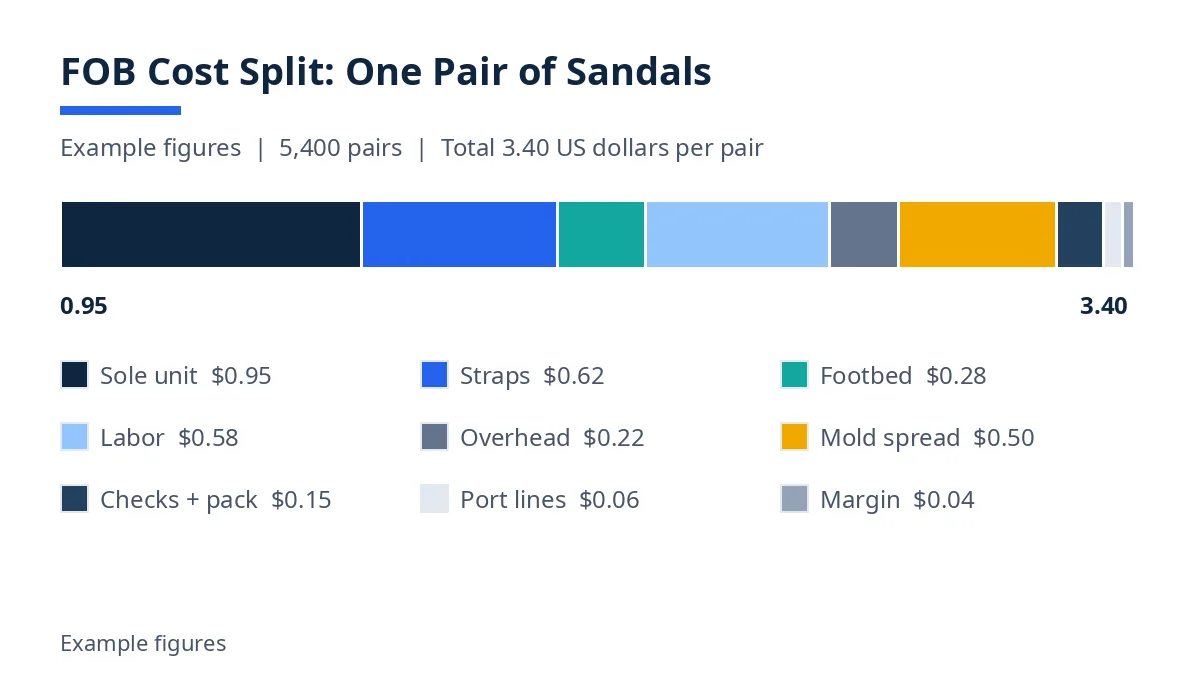
Send the table to each supplier with the pair description. Ask each one to fill in its own lines, or mark where its lines differ. A supplier filling the sheet has given a comparable quotation. A supplier answering with a single figure has given a headline. The sheet also shows where negotiation helps. Pressing margin alone saves cents. Pressing the mold spread, by raising the order size or reusing an existing mold set, saves far more.
Final pass over the figure before you accept it
Fill every row below before accepting a quotation. An empty row leaves its figure open, however firm the total sounds.
Check | Answer to hold in writing |
|---|---|
The pair | Sole compound and hardness, strap material and fixing, footbed, sizes, colors |
Basis | Rule, version year, named port, currency, validity date |
Parts list | Named grades, consumption, labor, overhead, margin, per line |
Fixed sums | Sums, spread, ownership, repeat treatment, sample rounds |
Order split | Total pairs, split by style, color, and size, carton total |
Samples | Rounds, mold billing, lab evidence, inspection, sample freight |
Pack and mark | Pairs per carton, carton print, artwork agreed |
Duty and code | Broker letter giving the national code and duty line for the exact pair |
Papers | Invoice, packing list, transport paper, origin proof, checking evidence |
What does an FOB sandals price include, and what sits outside it?
An FOB sandals price includes the pair, the pack, the haul to the named port, loading on board, and export formalities.1 Freight, insurance, duty, and onward carriage sit outside it. The buyer books and pays for them.1 The delivery rule, its version year, and the named port must appear in the quotation. A quotation on a different rule must be restated onto the same rule before ranking.
Why can two sandals quotations sit far apart for a similar pair?
Two quotations can sit far apart because the pairs, packs, or charges inside them differ. The sole compound, the strap fixing, the mold spread, the checking line, or the pack may differ. A published cost guide shows wide share ranges that shift by shoe type, so similar-looking pairs can carry very different cost structures.3 Fix the pair description. Separate fixed charges from the pair price. Bring every figure onto one basis: one pair, one rule, one port, one currency, one date. Then rank.
How do mold charges change the per-pair figure?
Mold charges are fixed, so the per-pair charge falls as the order grows. In the example figures in this guide, a fixed mold charge of 2,700 US dollars spreads to 3.00 US dollars per pair at 900 pairs, 1.00 US dollar at 2,700 pairs, and 0.50 US dollars at 5,400 pairs. Ask whether the charge sits inside or outside the pair price, over how many pairs it was spread, whether a repeat order pays it again, and who owns the molds. Record the answers in the quotation.
Which duty line applies to sandals and slippers from Bangladesh?
No duty line is stated in this guide. The line follows the exact pair and the destination market. The Harmonized System gives each commodity group a six-digit code, shared across more than 200 economies.5 Countries add digits of their own. Footwear classification turns on upper and outer sole materials, type and purpose, and insole length, among other factors.6 Ask a customs broker for the national code and duty line covering the exact pair. Keep the broker's letter with the order file.
Next steps on Exportain
Start by browsing the supplier directory on Exportain with the pair description and priced-parts sheet from this guide in hand, read how Exportain checks supplier documents and photos before shortlisting, and use the counting-basis explanation in the MOQ guide to frame the order-size question in the enquiry. Send every supplier the same pair description and the same restatement sheet, so the replies arrive comparable.
Sources
- FOB & FAS Incoterms® 2020 explained: Key differences. ICC Academy (accessed )
- President's Message - LFMEAB. Leathergoods and Footwear Manufacturers and Exporters Association of Bangladesh (LFMEAB) (accessed )
- How Much Does It Cost to Manufacture Shoes? A Brand's Cost Guide. Columbus News Online, (accessed )
- Test equipment used for assessing soles – part 2. SATRA (accessed )
- What is the Harmonized System (HS)?. World Customs Organization (accessed )
- Classifying footwear for import and export. GOV.UK (accessed )
- Footwear labelling. European Commission, EUR-Lex (accessed )
- Essential export documents for shipping from Bangladesh. DHL (accessed )
- Footwear fit and comfort. SATRA (accessed )
About the author
Sourcing from Bangladesh?
Post a request for quotation and suppliers on Exportain can send you their quotes directly.
Post an RFQ