Top Sandals and Slippers Manufacturers in Bangladesh: How to Find and Verify Them
Six gates for judging sandals and slippers makers in Bangladesh: sole, straps, footbed and fit, moulding, labelling and packing, and capacity proved by a trial lot, with the evidence to hold before bulk.
Short answer
Judge sandals and slippers makers in Bangladesh through six gates: the sole unit, the straps and vamp, the footbed and size curve, moulding and assembly, labelling with classification and packing, and capacity proved by a trial lot. Hold a named record for each gate, run a three-size wear trial, and start bulk only when every gate has its evidence in the maker file.
On this page
Key takeaways
Open footwear fails at the strap anchor, the sole flex line, or the ends of the size curve, so check those places first.
Name the sole compound, hardness with its scale, and density, and hold compression, flexing, abrasion, and adhesion records by method name.
Confirm the label for upper, lining and sock, and outer sole, and confirm the heading with a broker before shipment, with no duty rate taken from a heading page.
Prove capacity with a trial lot on the bulk line in the full size range, and read papers for scope and expiry before bulk starts.
A sandal or a slipper has nowhere to hide a weak point. A closed shoe shares the load across a stiffener, a lining, and a lacing system. An open pair carries the foot on a sole, a footbed, and a few straps, and every part is on show. When a strap anchor gives way, a sole splits along the flex line, or a size runs short, the buyer sees it on the first wear. This article sets out six gates for judging sandals and slippers makers in Bangladesh. A maker passes a gate only when a named piece of evidence supports it. Keep one file per maker, holding the specification, the test records, the photographs of the parts checked, and the trial-lot notes beside the approved sample pair. When a detail changes after approval, the gate that covers it opens again.
What open footwear puts at risk before you order
Start from the pair itself, not from the factory. In the United Kingdom classification guidance, a sandal is footwear whose vamp — the front of the upper — is made of straps, or of material with one or more cut-out pieces.1 Slippers and other indoor footwear sit in a separate group in the same guidance, covering mules, ballet slippers, ballroom dancing shoes, and other indoor footwear.1 The two groups fail in different places: a sandal fails at the strap, the anchor, or the flex line of the sole, while an indoor slipper fails at the sole covering, the heel grip, or the part that keeps it on the foot. Ask the maker to name the construction of the exact pair before you discuss price: moulded in one piece, cemented from separate parts, or stitched, and which parts are rubber, plastics, leather, or textile. The heading turns on the upper and outer-sole materials, on type and purpose, and on insole length against a 24 centimetre line, among other tests.1
Gate 1: Read the sole unit before you read anything else
Name the compound first: ethylene vinyl acetate (EVA), polyurethane (PU), rubber, or a named rubber compound, and state whether the sole is one layer or a midsole plus an outsole. Then name hardness, density, and thickness at the heel and at the forefoot. Hardness is commonly read on a durometer, with Shore A suited to flexible compact polymers, Shore D to hard plastics, and Shore OO to soft foams.2 Record the scale with the number. Soles that are too thick add weight and lose flexibility, while soles that are too thin give too little ground insulation and wear out sooner.2 Hold test records that name their methods. For compression set — thickness lost after squeezing and release — one standard method keeps specimen discs pressed for a full day and then measures the change.2 For flexing, another method for non-leather soles nicks the specimen, bends it repeatedly, and ends the test when the nick lengthens by 6 mm or the count reaches 150,000, whichever happens first.2 A third weighs a specimen, runs it against abrasive paper under a defined load, and weighs it again, so the material lost can be worked out from the density.2
Finish the gate on the finished pair. On the finished pair, a rapid adhesion test pulls at the sole-to-upper join around the toe and heel edges, and the buyer can set a floor load for production pairs to meet.3 Agree that floor load in writing. A pair that holds at the set load comes through the check undamaged.3 Add a slip resistance record for the tread you are buying, tested wet and dry where the method calls for it, since the outsole material and the tread pattern both shape the result.3
Gate 2: Straps, the vamp, and where the upper meets the sole
Name the strap material, its width, its thickness, and the way it is fixed: stitched, cemented, plugged through the sole, riveted, or buckled. The classification guidance lists sandals with straps across the instep and a counter or heel strap attached to the sole, and describes a plastics pair whose strap is attached across the foot to raised side parts by four horizontal plugs.1 Your specification should be at least that concrete. A strap described only as "PVC strap" leaves the width, the anchor, and the edge finish open, and each decides whether the strap cuts the foot, stretches, or pulls out. Check the anchor before the strap: pull each strap gently at its fixing and look at the underside where it meets the sole. On a thong sandal the post between the toes takes the load on every step, so ask for the post material and a photograph of the fixing from below. On a slide, check both side fixings and the centre of the vamp for stitching that stops short or cement that has not reached the edge.
Material naming for the upper follows one rule. The material of the upper is the material covering the greatest external surface area, with no account taken of accessories or reinforcements such as ankle patches, edging, ornamentation, buckles, tabs, or eyelet stays.1 A decorative leather patch on a textile strap does not make the upper leather, and a buckle does not change the material of the strap it fastens. Ask the maker to state the upper material on that basis, part by part, and compare the statement with the sample pair.
Gate 3: Footbed, last, and the full size curve
Ask for the footbed material, its contour, and whether it is fixed, removable, or moulded as part of the sole. Press the footbed at the heel and at the ball of the foot and note how far it recovers. A footbed that stays compressed under the heel will feel thinner after a short time in wear, and the compression record from Gate 1 is the laboratory side of the same question. Settle the last and the size system before sampling. The last is the foot-shaped form the pair is built around, and it sets the length, width, and shape of the finished pair. A fitting service can measure lasts against the market they are meant for, trial new ranges on wearers, and match digital last data against foot-measurement records to estimate what share of a chosen population the last should fit.4 Get its questions answered in writing: last measurements per size, the size system used, the width fitting, and the insole length for each size.
Run a wear trial on three sizes: the smallest, a middle size, and the largest. Fit trouble rarely sits in the middle size. It sits at the ends of the range, where grading stretches the shape furthest from the sample size, and in widths never tried on. Record length, width, heel grip, strap pressure, and heel slipping, with each wearer walking, standing, and climbing a step. Agree the size marking on the pair and the carton before the trial lot.
Gate 4: Moulding, bonding, and the way the pair is assembled
Name the assembly method in the specification, in words the factory floor would use. One-piece moulded pairs, cemented pairs, and stitched pairs are different jobs, and a quotation that does not say which one it prices cannot be compared with another. The classification guidance lists the ways waterproof footwear made of rubber or plastics can be formed: press moulding, injection moulding, slush moulding, rotational casting, dip moulding, vulcanising, bonding and vulcanising, high frequency welding, and cementing.1 Those methods are named there for waterproof footwear, and they serve here as a vocabulary for asking how a pair was formed, not as a claim that every sandal uses every method. Ask which method formed the sole, which formed the upper where the upper is moulded, and how the two were joined. For a moulded sole, ask for the mould set: how many sizes the moulds cover, whether each size has its own mould, and what happens to the sole shape at the smallest and largest sizes.
For a cemented or bonded pair, hold a peel-strength record for the adhesive bonds, including the bond between an outsole and a midsole where the pair has both.2 Ask for the primer, the cement, the open time, and the pressing step, in that order. For a stitched pair, check the stitching where the strap meets the sole and where the vamp meets the footbed, looking for skipped stitches and loose thread ends at the flex points. Require a fresh sample gate whenever the assembly method, the sole compound, or the mould set changes.
Gate 5: Labelling, classification, and packing that matches the pair
Labelling comes first in this gate because it is fixed by law in the destination market, not by the factory. In the European Union, three components must be named on the label: the upper, the lining and sock, and the outer sole.5 A material is named only when it reaches 80 percent or more: of the upper by surface area, of the lining and sock by surface area, or of the outer sole by volume. If none reaches 80 percent, the two main materials are named instead.5 The information can be printed as words or shown as pictograms, and the label must stay visible, firmly fixed, and easy to reach on at least one item in the pair.5 For imported footwear, the duty to supply an accurate label falls on whoever first puts the footwear on the European Union market, while retailers must still make sure the footwear they sell carries the right label.5 Ask the maker for the label artwork before the trial lot, and check it against the specification materials.
Classification follows the materials, and the same pair can fall under different headings when its materials change. Chapter 64 of the United Kingdom tariff holds six headings: waterproof footwear of rubber or plastics, other footwear of rubber or plastics, footwear with leather uppers, footwear with textile uppers, other footwear, and parts of footwear.1 The table below gives the sandal and slipper lines a buyer meets most often. Treat every line in it as indicative only, and confirm the code for your exact pair with your broker before shipment.
Pair in front of you | Indicative heading |
|---|---|
Outer sole and upper both rubber or plastics, sandal with strap vamp | 6402, including 6402 99 10 for rubber uppers and 6402 99 31 or 6402 99 39 for plastics uppers |
Outer sole and upper both leather, sandal with strap vamp | 6403, including 6403 59 and 6403 99 lines that turn on size and sole construction |
Upper of textile, outer sole of rubber or plastics, sandal | 6404 19 90 |
Upper of textile, outer sole of leather, sandal | 6404 20 90 |
Outer sole and upper of materials outside headings 6401 to 6404, including some indoor slippers | 6405 |
The subheading lines for leather sandals and for plastics sandals are drawn in the classification guidance, which also records that sandals can fall under various subheadings depending on the materials of the upper and the outer sole.1 Do not carry a duty rate from this article into a quotation. No duty rate is stated here, and none should be taken from a heading page without the schedule for your market, your date of trade, and any preference or relief that applies to your shipment. Confirm the duty treatment with your broker, in writing, for the exact pair, the exact materials, and the exact market, and keep that confirmation beside the classification note in the maker file. A rate quoted without a schedule, or carried over from a different pair, is not a basis for a landed cost.
Packing closes the gate. Agree the pairs per carton, the size breakdown inside each carton, the tissue or shape holder used, and the carton print: style, colour, size breakdown, and quantity. Each pair must match left and right in style, colour, and size, and the marks on the carton must match the packing list. Have one trial-lot carton opened — by you or your inspector — and check every pair inside against the packing list. For a textile-covered slipper sole, hold the Martindale result: the textile must show no worse than moderate wear after 51,000 revolutions to count as the outer sole.1
Gate 6: Capacity, papers, and a trial lot on the bulk line
Capacity is proved by a trial lot, not by a number in a message. Ask how many pairs per day the assigned line can complete, which lines will work on the order, what materials are in stock, and which deliveries are already committed in the same period. Then put the answers to the test with a short run on the line that will make the bulk order, covering every size and packed exactly as bulk will be. Score the trial lot with the same six gates, against the sample pair you approved, and inspect it before any bulk starts. Read every paper for what it covers, and nothing more. The Leathergoods and Footwear Manufacturers and Exporters Association of Bangladesh presents itself as the trade body for the country's makers and exporters of leather goods, footwear, and synthetic and allied products.6 If a maker says it belongs to an association, look for its name on that association's own list, and read the scope of any certificate the same way: one site, one product range, one period. Read a supplier profile's badge record the same way: staff look at the documents and photographs behind a badge, but a badge does not amount to a visit to the factory, a search of a government database, or an assurance on capacity, quality, or delivery timing.7 Score this gate only when the trial lot has been inspected and the papers have been read for scope and expiry date.
How minimums and price move through the six gates
Minimum order quantity and price sit inside the six gates. They do not replace them. The count may run per order, per style, per colour, or per size group, and two or more of those bases may apply together, so one headline figure can hide very different totals.8 Get the counting basis in writing before you fix the colour and size mix. Example figures: a minimum of 900 pairs per style and colour, for 3 styles in 2 colours, means 5,400 pairs (900 x 6), and at USD 3.20 per pair free on board the total is USD 17,280 (5,400 x 3.20). Example figures only; the real numbers are in your quotation. What moves the price follows the same order as the gates: sole compound and thickness, strap material and anchor, footbed and last work, mould set and assembly method, labelling and packing, and the size curve. A cheaper quotation that changes the sole compound, drops a size from the curve, or swaps a stitched anchor for a plugged one is a different pair, and the gates run again starting at the gate that changed. Agree the delivery term in the same record as the price. Only FAS, FOB, CFR, and CIF are confined to sea and inland waterway transport.9 CPT, DPU, and DDP, by contrast, work with any transport mode: DPU makes the seller unload at the named place, DDP puts import clearance and duty on the seller, and DAP leaves import customs duties, fees, and taxes with the buyer.9 Name the rule, the named place, and the version year in the contract.
Summary table: six gates, the evidence to hold, and the call each one makes
Gate | Evidence to hold before bulk | Call it makes |
|---|---|---|
Sole unit | Compound, hardness with scale, density, thickness, compression, flexing, abrasion, and adhesion records | Whether the sole keeps its shape and stays attached |
Straps and vamp | Strap material and fixings, anchor photographs, buckle and edge checks | Whether the upper holds the foot |
Footbed, last, and sizes | Footbed record, last measurements, three-size wear trial | Whether the range fits |
Moulding and assembly | Named method, mould set, bonding and pressing record | Whether the build repeats |
Labelling, classification, and packing | Label artwork, broker-confirmed heading, opened carton against the packing list | Whether the pair clears and arrives as ordered |
Capacity, papers, and trial lot | Trial-lot inspection on the bulk line, papers read for scope and expiry | Whether the maker can repeat the result |
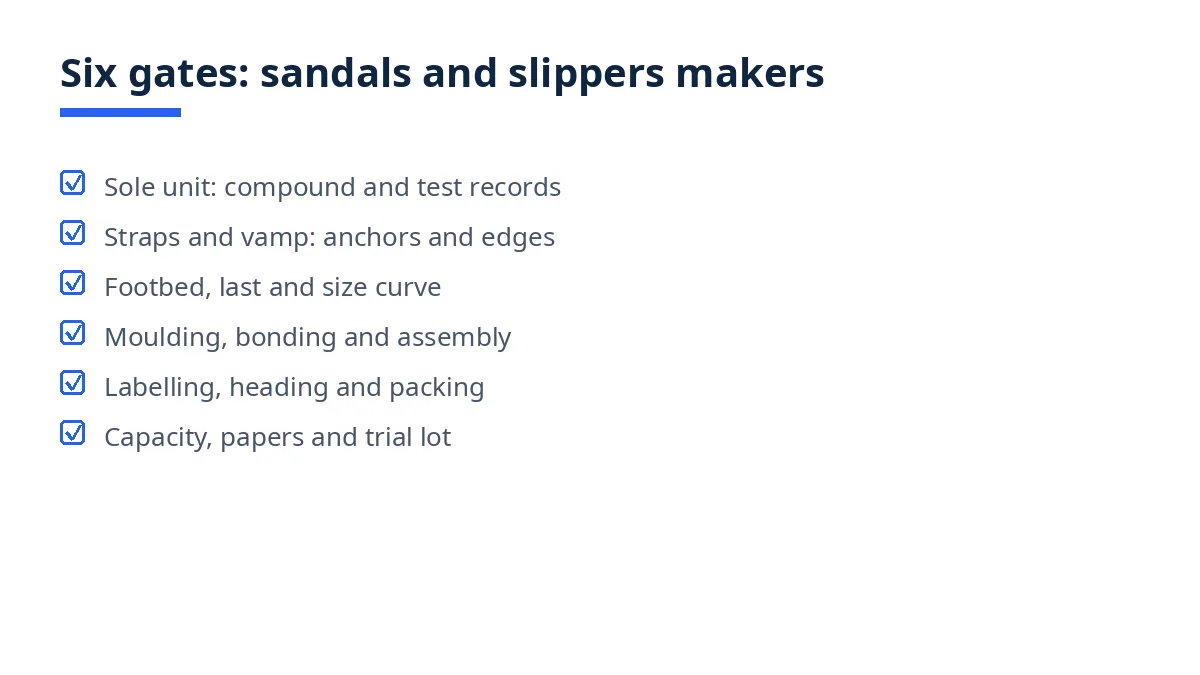
The diagram below lists the six gates in order.
What is the biggest mistake buyers make with sandals and slippers from Bangladesh?
Approving the sample pair and treating that approval as approval of the maker. The sample proves the design on one size, on one line, with one set of hands. Bulk proves the mould set, the materials, the strap anchors, and the packing across the full size range. Leave out the trial lot, the three-size wear trial, or the reading of the papers, and the gap shows up only when the cartons arrive.
How can I avoid a strap or sole failure in a sandals order?
Put the specification in writing before bulk starts, with the sole compound and hardness, the strap material and fixing, the footbed, the last and size system, the assembly method, the labelling, and the delivery term each named. Check the trial lot against that record, pair by pair: flex every sole and pull every strap at its anchor. Demand a new sample whenever any named item changes, and keep the adhesion and flexing records, each named by method, beside the sample pair.
Who is responsible for labelling and classification on a sandals shipment?
Responsibility is shared, and each party owns a different part. For imported footwear, whoever first puts the pair on the European Union market answers for the label and its accuracy, and retailers must still make sure the footwear they sell carries the right label.5 Your broker owns the classification advice and the duty confirmation for your market, and only the body that issued a certificate can confirm that certificate. You own the order itself: the specification, the sample approval, the trial lot, and the pre-shipment inspection.
Where can I get help finding and checking sandals and slippers makers on Exportain?
Begin in the supplier directory, reading the badge record on each profile, and send the six-gate specification to several makers through one RFQ thread so their answers arrive on the same basis for comparison.7 Put the same questions to each maker — sole records, strap fixings, last and fit, mould set and assembly, labelling artwork, and trial-lot timing — and keep the answers beside the approved sample pair.
Next steps on Exportain
Start from the directory of suppliers on Exportain and check the badge record behind every profile you keep on the list; then read how a badge is recorded on Exportain and how Exportain counts a minimum order before you send the six-gate specification.
Sources
- Classifying footwear for import and export. GOV.UK (accessed )
- Test equipment used for assessing soles – part 1. SATRA (accessed )
- Test equipment used for assessing soles – part 2. SATRA (accessed )
- Footwear fit and comfort. SATRA (accessed )
- Footwear labelling. European Commission, EUR-Lex (accessed )
- President's Message - LFMEAB. Leathergoods and Footwear Manufacturers and Exporters Association of Bangladesh (LFMEAB) (accessed )
- How Supplier Verification Works on Exportain. Exportain, (accessed )
- MOQ Meaning (Minimum Order Quantity). Exportain (accessed )
- Incoterms 2026: Meaning, Chart & List Of Incoterms. Freightos, (accessed )
About the author
Sourcing from Bangladesh?
Post a request for quotation and suppliers on Exportain can send you their quotes directly.
Post an RFQ