Checklist for Sandals and Slippers Exporters in Bangladesh
Eighteen checks in three parts for sandals and slippers exporters in Bangladesh: standing and identity, making capability for your pair, and commercial terms, each check settled by a document, a measurement, or a written answer before any deposit is paid.
Short answer
Shortlist sandals and slippers exporters in Bangladesh in three parts before paying a deposit: standing and identity (matching documents, named maker and site, membership and certificates read for scope); making capability (construction, sole unit and test records, last and size record, label artwork, substance reports); and commercial terms (minimum counting basis, price drivers, full quotation fields, fitting delivery term, classification record, and a trial lot on the bulk line).
On this page
Key takeaways
Work three parts in order: standing and identity, making capability, then commercial terms, and hold the deposit until all three pass.
Example figures: a minimum of 600 pairs per size set across 5 size sets and 3 colors means a smallest order of 9,000 pairs, not 600.
Example figures: 1,500 pairs at $2.80 a pair totals $4,200, while 1,800 pairs at $2.40 totals $4,320, so judge quotations by their totals.
A part is settled only by an entry in the record: a document, a measurement, a test record, or a written answer.
Treat every heading as provisional until a broker settles the full national code; confirm duty from the schedule for your market, never from a quoted rate.
Ten exporters will quote ten prices for the same sandal, and the prices will look close enough to choose from. The choice stops being close once every exporter answers the same written questions: who makes the pair, where, from which sole compound, in which sizes, under which delivery term, and with what record behind the label and the heading. This article judges the exporter, not the goods. It sets out 18 checks in three parts, worked before a sample is ordered, and it ends with one of three calls for each exporter: shortlist, hold, or stop. This article names no company and ranks none. Every calculation is marked "Example figures" where it appears.
Why the shortlist comes before the sample
One sample pair shows what one pair can look like. It cannot show that the company answering the inquiry owns the line that will run the order, that the sole compound in the sample is the compound that will run in bulk, or that the minimum in one quotation counts the same way as the minimum in the next. A maker can finish a single pair by hand, on a sample bench, from materials bought for that pair alone. Bulk production runs on a line, from bought-in materials, against a date, and that is where the differences appear.
The shortlist check closes that gap before money moves. It asks for papers, names, methods, and counts, and it counts an answer as settled only when it sits in the record in writing. A spoken assurance settles nothing, and a photograph of a pair that may not be the pair on offer settles nothing either. Work the three parts in order. Part A settles whether the exporter is who it claims to be. Part B settles whether it can make your pair, in your sizes, under your market's rules. Part C settles whether the commercial terms describe the order you intend to place. A hold in any part pauses the shortlist until the missing evidence arrives. A stop ends the conversation with that exporter.
Before you start: send every exporter the same inquiry pack
Send one pack to every exporter on the long list, before prices are discussed. The pack names the pair: sandal or indoor slipper, construction (one-piece molding, cementing of separate parts, or stitching), materials by part for upper and sole, colors, the size range with the pairs wanted of every size, label and packing needs, the destination market, and the delivery term with its named place. Ask each exporter for the same fields back: price per pair, lead time, validity dates, payment terms, delivery term, and the minimum with the unit it is counted in.
Keep a file per exporter, laid out the same way each time, with a date and a name on every entry. File each answer under the specification version it was priced against, and never set a version-1 price beside a version-2 price: the two prices describe different pairs, even when the headlines sit close together. Keep replaced answers on file instead of deleting them. When an exporter answers only some fields, record which fields are missing and hold the shortlist until they arrive. A partial answer is not a low price. It is an unfinished check.
The checklist: 18 checks in three parts
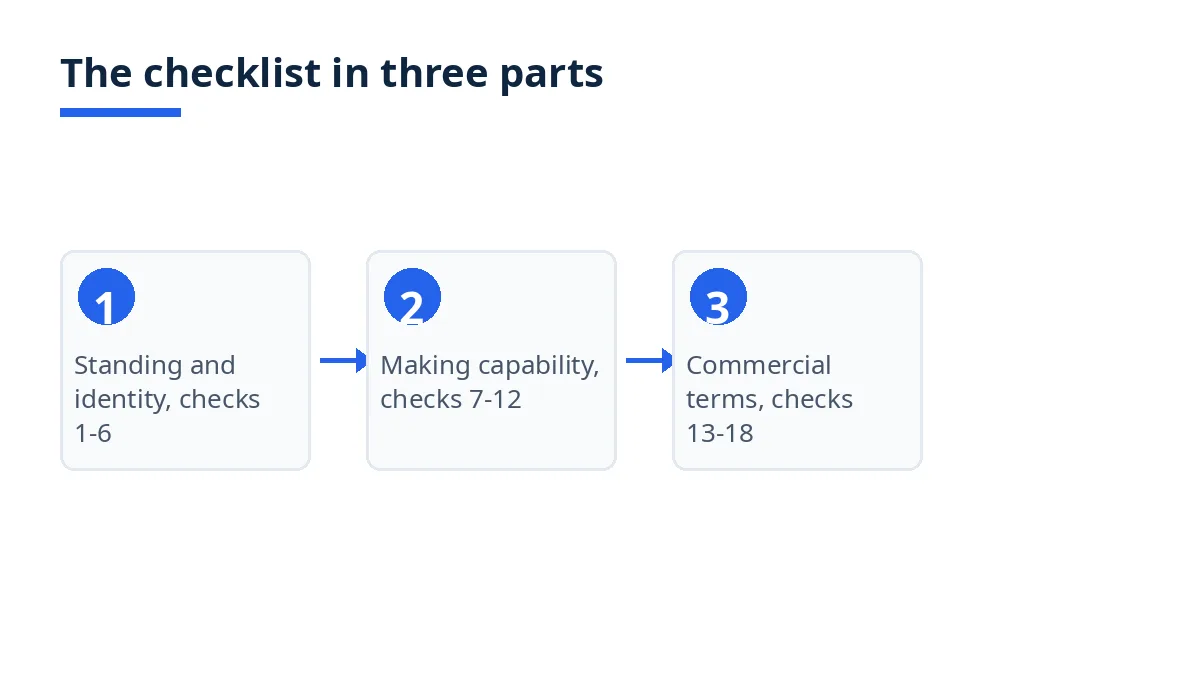
Work the checks in order. Each one needs a filed entry before it counts as done: a document, a measurement, a test record, or an answer in writing. The diagram below shows the three parts and the checks inside each one.
Part A: standing and identity (checks 1-6)
Do the license, the quotation, and the invoice carry the same company name? Get the export registration certificate and the trade license, then lay the name, street address, and legal form they show against the name on the quotation and on the pro forma invoice. A mismatch in the spelling of the name, in the address, or in the legal form pauses Part A until every paper says the same thing. If the exporter says the papers belong to a parent company or a sister unit, get that relationship in writing and name the company that will sign the contract.
Which factory makes the pair, and does the order name it? Write down who makes the pair and where: the site for upper cutting and stitching, for lasting, for the sole unit, and for joining sole to upper, and note any stage bought in from outside. When a trading company answers the inquiry, insist on the factory name in writing ahead of any deposit, and carry that name into the order terms. A maker that will not name its factory has not passed this check, whatever the price.
Does the body's own list carry the exporter's name? Ask for the name of the trade body claimed, then test that claim against the body's own published list. The Leathergoods and Footwear Manufacturers and Exporters Association of Bangladesh (LFMEAB) describes its own role as the trade body for the country's makers and exporters of leather products, footwear, and synthetic and allied goods.1 Membership adds one line to the record. It proves nothing about any single pair, and it does not replace the checks in Part B.
Has each certificate been read for scope, site, and expiry date? Take each certificate that touches this order back to the body that issued it, and ask what product range it covers, which site it covers, and when it runs out. A certificate for one site does not cover a second site, and a certificate that expired last quarter does not cover this order. For the European Union, access to the market increasingly turns on chemical compliance, on ZDHC protocols, and on Leather Working Group certification, so a certificate claim aimed at the EU market needs its scope read closely rather than taken at face value.2 File the scope and expiry beside the certificate, and hold the part when the issuing body cannot be reached or will not confirm.
Which checks does the badge record on the profile name? Go to the badge record on the exporter's profile and note every check it lists. Badges rest on reviews of documents and photographs. They are not factory inspections, certifications, or guarantees, and membership alone never grants a badge. Treat the record as desk work already done. Treat a blank space as no check of that kind recorded, not as a check failed. The badge record settles none of the Part B checks.
Are payment details fixed in writing before a price is accepted? Agree the payment account and the payment schedule before any price is accepted, and put the account particulars in the same written thread as the quotation. If the particulars change late, stop the part: nothing moves until the change comes back in writing through that same thread. A price accepted against unfixed payment details is not a settled order.
Part B: making capability for your pair (checks 7-12)
Does the exporter make your type of pair, in the construction you specified? A strap sandal and an indoor slipper are different jobs. The exporter should describe the exact pair before price is discussed: molded as a single piece, put together by cementing separate parts, or stitched, with the material of each part named. The United Kingdom guidance calls footwear sandals when the front of the upper is straps, or material with cut-out pieces in it, and it groups slippers with other indoor footwear, including mules, separately.3 Ask the exporter to describe your pair in those terms, part by part. A catalog page in place of a construction description is not an answer.
Is the sole unit described layer by layer, with methods named on the test records? Ask for one line per layer: the compound, EVA, PU, rubber, or another named compound, and whether the sole runs as a single layer or as midsole plus outsole. Then ask which methods sit behind the exporter's test records. Testing of whole shoes covers five areas: shock absorption, sole adhesion, repeated compression, sole abrasion, and slip resistance, and SATRA methods cover all five, as TM142, TM404, TM156, TM362, and TM144 in that order.4 File the records beside the sample pair, and ask for the method name on each record. A record that names no method cannot be set beside another exporter's record.
Which load must the sole bond hold? Agree the test method, the load to hold, and which pairs go for testing, and put all three on file before bulk starts. In a sole adhesion test, force rises against the bond between sole and upper at the toe and heel of the lasted margin of finished footwear, and a required minimum load can be fixed so production pairs can be checked against it. A pair that holds at that load comes through the check undamaged, while a pair that fails to hold it points to the process or the materials behind the bond.4 Do not take one load as fitting every order, and do not accept a bond asserted with neither method nor load. Look down the sole-to-upper join at the featherline, checking the toe and the heel first for openings and for edges that have lifted.
Is the last fixed, with an insole length for every size? Ask for the last reference, the size system, the width fitting, and the insole length of each size, in writing, before sampling. At the ends of the range, grading pulls the shape furthest from the size the sample was built on, so put three sizes on feet — the smallest size in the range, one from the middle, and the largest — and note heel slipping, strap pressure, heel grip, width, and length while each wearer walks, stands, and climbs a step. Insole length also decides classification: the United Kingdom guidance classifies footwear partly by whether the insole runs over or under 24 centimeters.3 Fix the size record before fixing the heading, and fix the size marks for pair and carton ahead of the trial lot.
Can the exporter supply label artwork that fits the destination market's rule? In the European Union, the rule turns on an 80 percent share. The 80 percent test runs three ways: share of the upper surface, share of the lining-and-sock surface, and share of the outer sole by volume. A material that reaches 80 percent on its measure is labeled. Where none does, the two largest materials are shown instead.5 The label names three parts, the upper, the lining and sock, and the outer sole, in words or pictograms, and it must be visible, firmly fixed, easy to reach, and carried on no fewer than one shoe in each pair.5 For imported footwear, the party that first places the pair on the EU market carries responsibility for the label and for getting it right, and retailers keep their own responsibility for the labels on the footwear they sell.5 Ask for the artwork before the trial lot and set it against the specification materials. Check the colors in the light the specification calls for.
Which substance rules apply to your pair, and which report proves the pair meets them? Put the question market by market, and file a laboratory report that states the product, what was tested, and how it was tested. REACH Annex XVII restricts harmful chemicals in consumer products through 77 entries, and responsibility rests first with the manufacturer; for pairs made outside the EU it rests with the party bringing them in, while retailers also carry a duty to make certain goods comply before placing them on the market. Compliance is shown by testing samples or by auditing raw materials and production processes.6 The limits that apply to footwear materials are set out in the table below, taken from the same source.6
Material | Substance | Limit |
|---|---|---|
Dyed textiles and leathers in skin contact | Aromatic amines from certain azo dyes | 30 mg/kg |
Finished leather | Chromium VI | 3 mg/kg |
Plastics and synthetic rubbers | Cadmium | Under 100 mg/kg |
Materials in prolonged skin contact | Listed polycyclic aromatic hydrocarbons | Under 1 mg/kg |
One report proves one material, not the whole pair. The report must name the material it tested, and each material in the pair needs its own line.
Part C: commercial terms and the shortlist call (checks 13-18)
How is the minimum counted, and how large is the smallest order in total? Ask what unit the count uses — pair, style, color, size set, or order value — and whether two units apply at once. Example figures: a minimum of 600 pairs per size set, across 5 size sets and 3 colors, comes to 600 x 5 x 3 = 9,000 pairs as the smallest order, not 600. Compare the totals, not the per-pair prices. Example figures: 1,500 pairs at 2.80 dollars a pair come to 4,200 dollars, while 1,800 pairs at 2.40 dollars a pair come to 4,320 dollars, so 300 more pairs cost 120 dollars more in total. A minimum with no counting basis stated is an unfinished check.
Can the exporter point to the lines that move its own price? Ask which lines push the price up or down: labeling and packing, the size curve, sole compound and thickness, strap material and fixing, footbed and last work, and the mold set and assembly method. The input side carries weight for sandals and slippers: an estimated 80 to 90 percent of key synthetic inputs, including EVA and PU compounds, rubber soles, and adhesives, arrive in Bangladesh as imports, mainly from China, Taiwan, and South Korea.2 Ask the exporter to say which inputs it imports and which it buys locally, so a compound or currency movement can be traced to a line in the quotation instead of arriving as one revised price. Scale by itself proves nothing: yearly footwear output stands at approximately 423 million pairs from more than 3,600 units, of which roughly 90 are large export-oriented factories, so most units are small and mid-size operations, and the line assigned to your order, not the sector total, is what the order runs on.2
Does the quotation carry every field, and does the delivery term fit the handover? Every quotation should state, in one place: the price; the delivery term with its named place; the lead time; the validity dates; the payment terms; and the minimum with the unit it counts in. The sea and inland-waterway-only rules are four — FAS, FOB, CFR, CIF. CPT is any-mode. DPU is any-mode. DDP is any-mode (seller clears import customs, pays duty). FCA is any-mode. When cartons go to a container terminal, FCA fits the handover and a sea-only rule does not: the goods change hands at the terminal, days ahead of loading, so the rule in the contract should name that point.7 Write the rule, the named place, and the version year into the contract.
Is there a classification record for the exact pair, with duty left to the schedule? Ask the broker to put the heading and the full national code in writing, with the upper and outer sole materials behind them and any binding rulings attached. Classification weighs type and purpose, the materials of the upper and outer sole, ankle coverage, heel height, the intended wearer, and insole length against the 24 centimeter line, and the upper material is the one with the greatest outside surface, small additions such as buckles excluded from the count.3 The heading tracks the materials: leather uppers sit under heading 6403 and textile uppers under heading 6404, footwear whose outer soles and uppers use materials outside headings 6401 to 6404 sits under heading 6405, and sandal subheadings follow the upper and outer sole materials, including 6402 99 10 for rubber uppers and 6402 99 31 or 6402 99 39 for plastics uppers where sole and upper are both rubber or plastics.3 Treat each heading as provisional until a broker fixes the full national code for that exact pair and market. No duty rate appears in this article: ask your broker to settle duty, taxes, and any preference from the tariff schedule that covers your market, using the exact code, before you price the landed cost. One analysis puts the potential most-favored-nation tariff exposure for Bangladesh after graduation from least developed country status at 10 to 17 percent in the EU and 12 to 18 percent in the UK, a shift large enough to change a landed cost where no preferential arrangement takes the place of current access, so the broker's written confirmation counts for more than any rate quoted in a message.2
Are carton contents and marks fixed before bulk packing begins? Decide the print outside the carton before bulk packing starts: style, color, size split, and quantity. Decide next how many pairs go in a carton and how the sizes divide inside it. On the first bulk carton, repeat the trial-lot opening: lift the lid, lay each pair against the packing list, and pair lefts with rights for style, color, and size. For indoor slippers with a textile-covered sole, ask how the sole material shows it is durable. The classification guidance gives one way: a Martindale abrasion test, in which the textile counts as durable when it shows no worse than moderate wear after 51,000 revolutions.3 Untangling wrong cartons after they arrive costs far more than settling the marks before packing starts.
Did the trial lot run on the bulk line, across the full range, packed as bulk will be packed? Find out the size of a normal single run, and whether your order fills one run or is split across several; each run needs its own sample approval. Take one carton from the trial lot, open it, and match its contents to the packing list line by line. A lot made in the sample room shows the design works; it says nothing about the bulk line. Judge the trial lot by the same 18 checks and against the approved specification, and inspect it before bulk starts. Pay no deposit until Parts A, B, and C are all settled. When the last, a material, a color, or the delivery term changes after approval, reopen the part that covers it and work its checks again.
Five answers that close the conversation
Five answers end the conversation at once, with no second round: the factory behind the pair stays unnamed; a mixed upper is described by a single material name; a sole bond is claimed without a method and without a load; a minimum is stated without saying what it counts; a container-terminal handover is written under a sea-only term. In every one of them, the record failed before the shoes did, and no sample can repair a record that will not name its own facts. The table below states each stop plainly, so a shortlist meeting can apply it without debate.
Answer heard | What it means | Call |
|---|---|---|
Factory stays unnamed | Maker or site cannot be checked | Stop |
Single material name, mixed upper | Swapped panel stays hidden | Stop |
Sole bond claimed, no method, no load | No test can repeat it | Stop |
Minimum stated, no counting unit | Total order size cannot be worked out | Stop |
Sea-only term for a terminal handover | Risk and cost sit in the gap at the terminal | Stop |
A hold differs from a stop. A hold means the evidence is missing but obtainable: a certificate awaiting confirmation from the issuing body, label artwork not yet supplied, a test report that names the product but not the material. Hold the shortlist, name the missing item and the date it falls due, and work the part again from the start when it arrives. A stop means the exporter refuses what a check asks for, or the evidence contradicts evidence already filed. Do not turn a stop into a hold because the price looks attractive. The price was quoted against a record that does not hold together.
Shortlist score sheet
Copy the sheet below for each exporter on the long list. Score a part only once its checks each hold an entry in the record. Mark each part pass, hold, or stop, and shortlist only exporters with three passes. Where two exporters both reach three passes, start from identical quotation fields, then the trial-lot record, then the sole bond record.
Part | Checks | Evidence filed | Pass, hold, or stop |
|---|---|---|---|
A. Standing and identity | 1-6 | ||
B. Making capability | 7-12 | ||
C. Commercial terms | 13-18 |
Keep the sheet filed with the quotation, the specification, and the shipment file, and open it again whenever the last, a material, a color, or the delivery term changes. When an exporter is stopped, write the reason on the sheet in one line and keep the sheet. The next inquiry to the same exporter starts from the recorded reason, not from a fresh conversation.
When does this checklist belong in a sourcing trip?
Work through it when the shortlist is built, when the sample is approved, and before any deposit is paid. One late pass cannot undo a shortlist, and one early pass cannot judge a trial lot. Open the file again after any change to the last, a material, a color, or the delivery term, and run Part B a second time after a change to the sole compound, the assembly method, or the mold set.
Who owns each part of the checklist?
The record and the decision stay with you. A broker takes classification, an inspector takes the sample and shipment checks, and a lab takes the test methods, and each of the three reports back in writing against your specification. The exporter supplies the papers, the names of the site and of each stage, and the sample pair, and never marks its own work. Put a name against each part before quotations are compared, and treat a part as signed only once its checks are settled.
Which failures turn up most on sandals exporter checks?
Label artwork arriving after the trial lot, not before it. A sea-only term written for a container-terminal handover. A minimum with no stated counting unit. A sole bond claimed with no method and no load. A single material name covering a mixed upper. A factory still unnamed when the price is agreed. In all six, the record was settled after the price, or never settled at all, and the failure showed up in the cartons rather than in the conversation.
Can someone else complete the checklist on my behalf?
Partly. Sample, in-production, and pre-shipment work can go to an inspector working to your specification, classification can go to a broker, and named test methods can go to a lab. For each part, ask for a report in writing covering the lot, the pairs looked at, the measurements taken, and the packing seen. The decision stays with you: no part closes on evidence nobody saw, and a badge record never stands in for a visit to the factory.
Next steps on Exportain
Open the Exportain supplier directory, read the badge record on each profile before shortlisting, and read the badge explainer. Before sending the inquiry pack, read the MOQ definition, the HS-code guide for sandals and slippers, and the sandals quality-control checklist. Once the specification, the size split, the color quantities, and the delivery term are all fixed, send them in one request and set the quotations side by side, field by field.
Post a free RFQ on Exportain and get quotes from verified Bangladeshi suppliers →
Sources
- President's Message - LFMEAB. Leathergoods and Footwear Manufacturers and Exporters Association of Bangladesh (LFMEAB) (accessed )
- Leather & Footwear as The Next Export Frontier of Bangladesh. LightCastle Partners (accessed )
- Classifying footwear for import and export. GOV.UK (accessed )
- Test equipment used for assessing soles – part 2. SATRA (accessed )
- Footwear labelling. European Commission, EUR-Lex (accessed )
- How REACH Annex XVII affects the manufacture of consumer products. SATRA (accessed )
- FOB & FAS Incoterms® 2020 explained: Key differences. ICC Academy (accessed )
About the author
Sourcing from Bangladesh?
Post a request for quotation and suppliers on Exportain can send you their quotes directly.
Post an RFQ