Private Label Women's Dresses Manufacturing in Bangladesh: A Brand Owner's Guide
Private-label women's dresses from Bangladesh need one written standard for the whole garment: fit across sizes, print placement at the waist seam, wash-tested embellishment, and an identical label and trim pack on every piece.
Short answer
A private-label women's dress order from Bangladesh starts with one written standard for the whole garment: silhouette, bodice and waist fit, hem length, print placement across the bodice-to-skirt seam, embellishment durability after washing, and the label and trim pack. Woven dresses fall under HS heading 6204 and knitted dresses under 6104, so state the construction, size range and inspection plan before any factory quotes.
On this page
Key takeaways
Fix the dress as one written standard before cutting: silhouette, bodice and waist fit, hem length, print placement across the bodice-to-skirt seam, embellishment durability, and the label and trim pack.
Approve fit on a worn dress in the sample size and at the ends of the size range, and approve print placement on the finished dress rather than as a flat swatch.
Wash-test embellished samples, because beads, sequins and embroidery that survive sewing can still loosen, snag or fade after laundering.
State the construction on the tech pack: woven dresses fall under HS heading 6204 and knitted dresses under heading 6104, and the two are quoted and inspected differently.
Badges record document and photo reviews, not factory inspections, so sample approval and inspection stay with the buyer.
A women's dress carries a brand across its whole length, from neckline to hem, and a customer reads that brand in one glance. A print that shifts at the waist seam, a bodice that fits on the sample size but pulls on the next size up, a bead row that loosens after two washes, or a label sewn at a different height on each size all register at once, because the dress is worn as a single piece rather than assembled from separate parts. Private-label ordering for women's dresses from Bangladesh therefore turns on fixing the full garment as one standard before cutting starts: the silhouette, the fit across the size range, the print and embellishment as they appear on the finished dress, and the label and trim pack that repeat identically on every piece.
Bangladesh's garment sector gives a brand owner a wide base to work from. The Bangladesh Garment Manufacturers and Exporters Association (BGMEA) describes itself as the apex trade body representing the apparel sector, and notes a shift under way toward value-added, high-end apparel items and product diversification.1 That breadth matters for dresses, which span woven and knitted constructions, plain and printed fabrics, and plain and embellished finishes. The task for the buyer is to narrow that breadth to one written dress standard, then hold every sample, bulk lot and reorder to it.
Classification is the first practical split. Woven women's dresses fall under heading 6204, which covers suits, ensembles, jackets, dresses, skirts and related women's or girls' garments that are not knitted or crocheted, with subheading 620443 covering dresses of synthetic fibres on that basis.2 Knitted or crocheted women's dresses fall under heading 6104, which covers the same range of women's or girls' garments in knitted or crocheted form.3 State the construction on the tech pack, because a woven dress and a knitted dress are cut, graded, printed and inspected differently, and a quotation for one is not a quotation for the other.
Why this matters for buyers and sellers
For the buyer, a dress order concentrates risk in a way a separates order does not. A blouse or a trouser can be corrected in isolation, but a dress fault at the waist, the hem or the print repeat spoils the whole garment, and a fault found after bulk cutting is expensive to rework across every size. The brand standard is also the repeat-order standard: if the bodice length, the waist position, the hem length, the print placement and the embellishment density are not written down, the second order will drift from the first even when the fabric name is unchanged.
For the seller, the same standard protects the run. Dress fabric, lining, zips, buttons, belts or sashes, beads or sequins and printed labels are each bought or made for your specification, and none of them can be transferred to another buyer's dress if your order is cancelled mid-run. A clear standard lets the factory cost the dress once, buy the right trims once, and cut with confidence, which is why factories respond better to a complete dress brief than to a long list of open questions.
Step-by-step: how it works
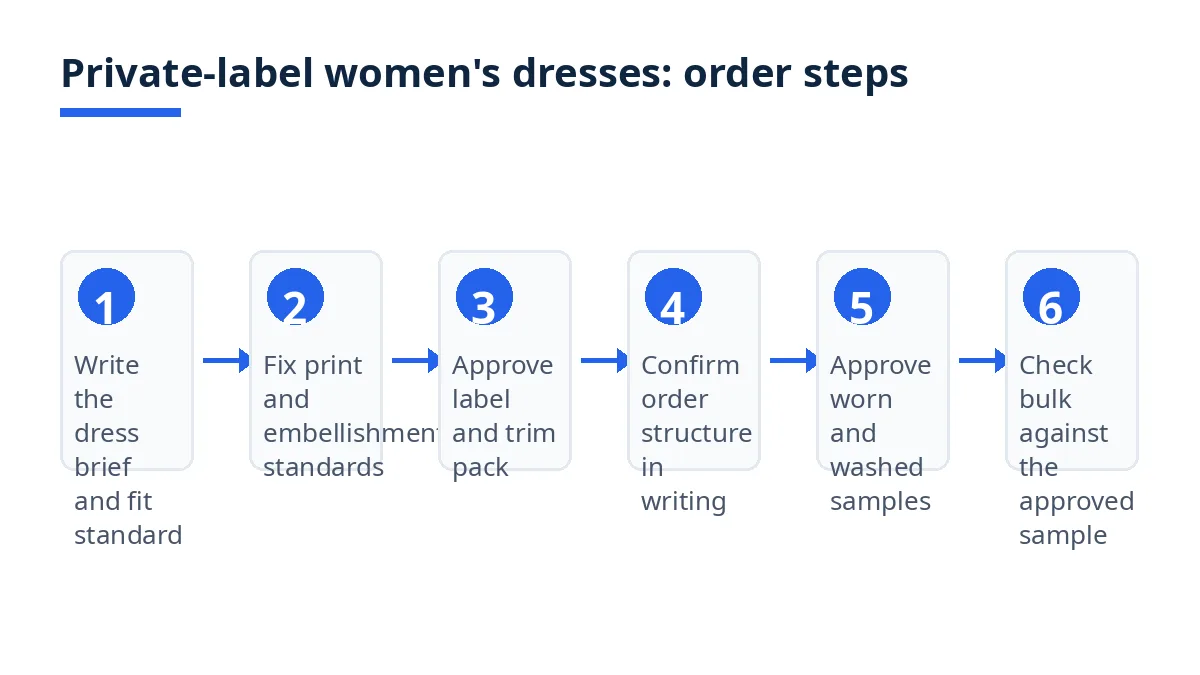
Write the dress brief as one garment, not a parts list. State the silhouette and length, the neckline and sleeve, the bodice construction, the waist position and treatment, the skirt shape and hem finish, the fabric and lining, and the size range with its grade rules. Add the print or embellishment standard and the full label, trim and packing specification.
Fix the fit standard on a fit model or dress form. Record the bodice length, waist circumference, hip, hem length and key circumferences for the sample size and for the smallest and largest sizes, with tolerances for each. A dress fit standard is a set of body and garment measurements across sizes, not a single sample that looked right.
Approve the print and embellishment on the finished dress. Ask for a sample that shows the print repeat across the bodice-to-skirt seam, the placement of any motif relative to the waist and hem, and the embellishment density on the bodice and skirt. Check the sample after washing, since print and embellishment faults often appear only after laundering.
Approve the label and trim pack separately. Confirm the main label, size label, care label, hang tag, zip or button, lining and any belt or sash on one approval sheet, with positions marked on a photograph of the sample. A label approved in isolation can still be sewn in the wrong place on the dress.
Confirm the order structure in writing. Give the quantity per style, per colour and per size, the fabric and trim status for each colour, the inspection plan and the delivery term, and record any agreed set-up charges as separate lines.
Run bulk against the approved sample, not against memory. Measure bulk pieces against the fit standard, compare print placement and embellishment against the approved sample, and wash-test a bulk piece before shipment is released.
See the women's dresses quality control checklist for dress-specific inspection points.
Costs, timelines and documents
What are the typical costs and timelines?
There are no typical costs or timelines that apply to every women's dress order, because each factory prices your fabric, construction, lining, print or embellishment, trim and label runs, finishing and packing, and the delivery term you choose. The Incoterms 2020 rules provide 11 rules with a clear allocation of cost, risk and obligations,4 so compare quotations only when they share the same rule and named place.
Example figures: a dress with a lined bodice, a placed print and a beaded neckline will cost more per piece and take longer to sample than a plain unlined dress in a stocked fabric, because the lining adds a construction step, the placed print adds a placement check, and the beading adds a hand or machine step with its own wash test. The example shows structure only, not a typical price or lead time. Ask for sampling, fabric ready, production and inspection dates as separate lines, not a single delivery week, and record which steps depend on imported trims or embellishment materials.
Which documents are needed?
The order documents are the dress tech pack with its fit, print, embellishment, label and trim standards, the itemized quotation, and the purchase order carrying the same standards and the agreed inspection plan. For shipment, the supplier files the export declaration described on the Bangladesh Customs export clearance page.5
For inspection, settle the sampling plan before production. ISO 2859-1 provides sampling plans by attributes indexed by AQL for lot-by-lot checks,6 and AQL caps the average share of defective items a lot may carry while still passing random sampling. Write the inspection level and AQL values into the purchase order, and apply them to dress-specific faults: print shift at the waist seam, embellishment loss after washing, hem unevenness.
Bangladesh-specific rules and tips
Separate woven and knitted dress capacity at the enquiry stage. A factory set up for woven dresses cuts from woven cloth and grades a woven bodice and skirt, while a knitted dress factory works with knitted fabric behaviour and a different cutting and sewing set-up. Ask which construction the factory produces in volume, and ask for a recent dress sample in that construction rather than a general garment sample.
Confirm association claims at the source. If a supplier claims BGMEA membership, confirm it with the association itself. BGMEA is the apex trade body representing the apparel sector,1 and membership signals an active apparel business, not capacity for your dress, your print standard or your size range.
One legal name on every paper. Before the purchase order, confirm the trade licence, quotation, proforma invoice and payment account all carry the same name — the export declaration itself names the exporter and the foreign buyer,5 so a variant found at shipment stage delays a dress order that is otherwise ready to go.
Write the fibre and care label for the market of sale, not only for the factory. If you sell into the European Union, Regulation (EU) No 1007/2011 states that a textile product shall be labelled or marked with the name and percentage by weight of all constituent fibres in descending order.7 Give the factory the exact fibre composition, care wording and label positions for your market, and check them on the pre-production sample rather than on a label artwork alone.
Ask which dress inputs are imported for your order. Lining fabric, zips, buttons, beads, sequins and print pastes for a particular shade may be bought in for your specification, and an imported trim or embellishment material can set both the minimum quantity and the earliest production date. Agree the size ratio per colour before production, because a dress size curve that is heavy at the middle sizes and thin at the ends changes cutting and trim consumption.
Mistakes and red flags
What are the most common mistakes?
Approving a flat sample instead of a worn dress. A dress that looks correct laid flat can pull at the bodice, ride at the waist or flare unevenly when worn. Fit-approve on a form or model in the sample size and at least one size at each end of the range.
Approving print artwork without its placement on the dress. A print approved as a flat swatch can break across the waist seam, sit off-centre on the bodice, or repeat at a different scale on the skirt. Approve placement on the finished dress, with the repeat marked relative to the waist and hem.
Treating embellishment as decoration rather than a durability item. Beads, sequins and embroidery that survive sewing may still loosen, snag or fade after washing. Wash-test the embellished sample, and write the wash result into the approval.
Grading the dress from one size only. A bodice, waist and hem graded by eye from the sample size will drift at the extremes. Require a grade rule for every key measurement and check the smallest and largest sizes in bulk.
Comparing dress quotations on different standards. A lower price on an unlined dress, a stock print, plastic buttons instead of your specified trim, or a different delivery term is a different offer. Compare only replies to the same dress brief on the same Incoterm.4
Accepting a spoken exception on fit, print or embellishment. Any agreed change to the fit standard, print placement or embellishment density belongs in writing on the quotation and purchase order, with the sizes and colours it covers.
Reading a profile or a badge as proof of dress capability. A profile opens the enquiry; it cannot show whether a factory holds your dress fit, print and embellishment standards across sizes, and a badge on its own guarantees nothing about capacity, quality or delivery.8
Checklist
Before you confirm, every line should be answered in writing.
Dress brief sent: silhouette, length, neckline, sleeve, bodice, waist, skirt, hem, fabric, lining.
Fit standard recorded: bodice length, waist, hip and hem length for the sample, smallest and largest sizes, with tolerances.
Print standard approved on the finished dress: repeat, placement relative to waist and hem, and seam behaviour.
Embellishment standard approved and wash-tested: type, density, placement and wash result.
Label and trim pack approved on a photographed sample: main, size and care labels, hang tag, zip or button, lining, belt or sash.
Split stated per style, colour and size, with one size ratio per colour.
Set-up costs for print screens, embroidery digitising, embellishment tooling and label runs itemized apart from the unit price.
Pre-production sample measured, worn, washed and approved in writing.
Inspection level and AQL values in the purchase order.6
Quotations compared on the same dress brief and Incoterm.4
Export declaration filed by the supplier under the Bangladesh Customs process.5
How Exportain helps
On Exportain, browse suppliers and post a request for quotation on the RFQ board with your dress brief, fit standard, print and embellishment standards and split per colour and size, so suppliers quote against the same garment. Ask each reply for its per-style and per-colour minimums, and read the MOQ definition guide before you compare them. When you accept a quotation, Exportain creates one order and issues one proforma invoice from the accepted terms.8 Badges on the platform record document and photo reviews, not factory inspections, so sample approval and inspection stay with you; see how supplier verification works on Exportain.9
FAQs
What should I know first about women's dresses?
A women's dress is ordered as one full-length garment, so fix the silhouette, bodice and waist fit, hem length, print placement across the bodice-to-skirt seam, embellishment durability and label pack as a single written standard before cutting. Woven dresses fall under heading 62042 and knitted dresses under heading 6104,3 and the two constructions are quoted and inspected differently.
What are the typical costs and timelines?
There are no typical figures a buyer can rely on, because each factory prices your fabric, lining, construction, print or embellishment, trims, labels and delivery term for your specification. Example figures: a lined, placed-print, beaded dress costs more and samples more slowly than a plain unlined dress in stocked fabric, because each added step carries its own set-up and wash test. The example shows structure only, not a typical price or lead time.
Which documents are needed?
The order documents are the dress tech pack with its fit, print, embellishment, label and trim standards, the itemized quotation and the purchase order. For shipment, the supplier files the export declaration described on the Bangladesh Customs export clearance page.5
What are the most common mistakes?
The most common mistakes are approving a flat sample instead of a worn dress, approving print artwork without its placement on the dress, treating embellishment as decoration rather than a wash-tested durability item, grading from one size only, and comparing quotations on different dress standards or delivery terms.4
Next steps on Exportain
Browse suppliers, then post your dress brief, fit standard and split per colour and size on the RFQ board so suppliers state their minimums against the same garment. Before you confirm, read the women's dresses quality control checklist and the MOQ definition guide.
Sources
- BGMEA President emphasizes on shifting towards high-end apparels. BGMEA (accessed )
- Classification Detail — HS Code 620443. United Nations Statistics Division (accessed )
- Classification Detail — HS Code 6104. United Nations Statistics Division (accessed )
- Incoterms® 2020. International Chamber of Commerce (ICC) (accessed )
- Customs Clearance Procedures for Export. Bangladesh Customs, National Board of Revenue (accessed )
- ISO 2859-1:2026 - Sampling procedures for inspection by attributes — Part 1: Sampling schemes indexed by acceptance quality limit (AQL) for lot-by-lot inspection. ISO (accessed )
- Regulation (EU) No 1007/2011 on textile fibre names and related labelling and marking of the fibre composition of textile products. European Union, (accessed )
- Trust & Safety Center. Exportain (accessed )
- Supplier verification: Earn trust badges buyers can see. Exportain (accessed )
About the author
Sourcing from Bangladesh?
Post a request for quotation and suppliers on Exportain can send you their quotes directly.
Post an RFQ