

Private Label Women's Blouses Manufacturing in Bangladesh: A Brand Owner's Guide
No single private label blouse price or lead time applies in Bangladesh. This guide fixes the brand decisions that set them: collar, neckline, sleeve, placket, embellishment, labels and size grading, with steps, documents, mistakes and a pre-confirmation checklist.
Short answer
A private label women's blouse from Bangladesh is built on brand-owned collar, neckline, sleeve, placket, button and embellishment details, graded across bust, waist, hip, shoulder, armhole and sleeve length. This guide shows how to specify those details, approve collar and sleeve samples, approve graded sizes, and compare quotes on one specification and one delivery term.
On this page
Key takeaways
A private label blouse is defined by brand-owned collar, neckline, sleeve, placket, button and embellishment details, not only by its label, and each detail must be fixed in one specification sheet before pricing.
Size grading across bust, waist, hip, shoulder, armhole and sleeve length must be approved on the smallest, base and largest sizes, because a grade checked only on the base size hides tight sleeves and short lengths on other sizes.
Collar and sleeve work and embellishment must be approved on a worn fit, on bulk cloth and in final placement, after one wash, before bulk cutting starts.
There is no typical blouse price or lead time: cloth, collar and sleeve construction, buttonholes, embroidery stitch count, label runs, size range and delivery term drive each quote, so compare replies only on the same specification and the same delivery term.
Exportain verification is a document and photo review, not a factory inspection, and a badge is not a guarantee of capacity, quality or delivery.
A private label women's blouse is a woven garment that carries your brand in its shape, not only on its label. The collar stand, the neckline depth, the sleeve head, the placket, the button spacing and the hem finish are all brand decisions, and each one has to survive cutting, sewing, washing and packing in the same form on every size. A factory that makes woven shirts well may still struggle with a blouse if its collar rolls unevenly, its sleeve gathers pucker, or its lightweight fabric shifts under an embroidered motif.
Woven blouses sit apart from knit tops because the fabric does not stretch to forgive a pattern error. A woven blouse is cut from a stable cloth, sewn along a set pattern, and fitted through darts, seams and shaping rather than through stretch. That makes the pattern, the grading and the sample approvals more important than for a stretch garment, and it turns small changes, such as moving a neckline by a centimetre, into changes that ripple through the whole size range.
In the Harmonized System, heading 6206 covers blouses, shirts and shirt-blouses for women or girls, not knitted or crocheted, with separate subheadings by fibre, including cotton under 620630 and man-made fibres under 620640.1 Your fibre choice therefore affects classification as well as drape, care and labelling, so record it in the specification from the start and keep it identical on the quotation, the purchase order and the label.
Why this matters for buyers and sellers
For a buyer, a blouse range lives or dies on fit and finish at the points a customer notices first: the collar lying flat, the neckline sitting at the same depth on every size, buttons closing without pulling, and a sleeve that moves without tightness at the armhole. For a seller, those same points are where rework concentrates, because a collar, a sleeve cap and an embellished panel each take handling time and cannot be corrected by pressing alone.
What should I know first about women's blouses?
Start with five brand decisions, and write each one down before you ask for a price. First, the silhouette and neckline: a pointed collar, a mandarin collar, a V-neck, a round neck or a tie neck each needs its own pattern piece, its own interfacing and its own stitching sequence. Second, the sleeve: short, three-quarter, long, puffed or gathered, with a cuff, a hem or an elastic finish, each with its own cap height and ease. Third, the opening: a full button placket, a partial placket, a concealed placket or a back opening, with button size, buttonhole type and spacing fixed in writing. Fourth, embellishment: embroidery, lace insertion, pintucks, smocking or beadwork, with motif size, stitch density, placement and thread colours fixed, and with a note on whether the motif sits on one panel or crosses a seam. Fifth, the brand pack: main label, size label, care label, hang tag and any hem label, with artwork, size, material, fold and exact placement on the garment.
Size grading is the decision buyers most often leave vague, and it causes the most blouse returns. A blouse is graded across bust, waist, hip, shoulder width, armhole depth and sleeve length, and a grade that works on a straight body may fail on a curved one. State your base size, your full size range, the grade rule between sizes, and which measurements are checked on the sample for every size, not only on the base size. Ask the factory to confirm in writing whether the sleeve cap and armhole are re-graded at each size or held constant, because holding them constant is a common source of tight sleeves on larger sizes.
Step-by-step: how it works
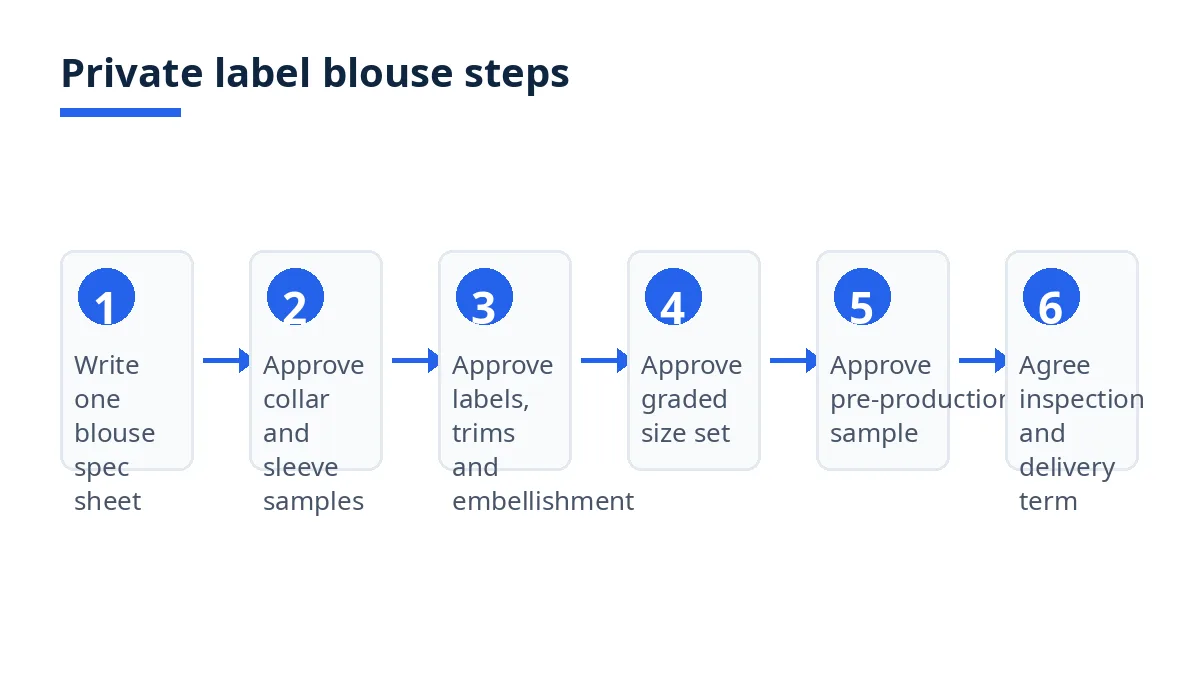
Write one blouse specification sheet. Include the silhouette, collar and neckline drawing, sleeve drawing, placket and button details, fabric composition and weight, embellishment artwork and placement, label pack with placements, size chart with grade rules, and packing instructions. Send the same sheet to every candidate factory.
Shortlist woven blouse makers and ask the same questions. Ask about woven blouse experience, collar and sleeve work, embroidery or embellishment capacity, and whether embellishment is done in-house or sent out.
Approve a proto sample for collar and sleeve first. Check the collar stand and roll, the neckline depth, the sleeve cap and armhole, the placket alignment and the button spacing on a worn fit, not only laid flat. List corrections in writing with measurements.
Approve labels, trims and embellishment separately. Check the main, size and care labels for wording, fold and placement, the buttons for size and colour match, and the embroidery for motif size, placement, thread colour and behaviour after one wash. A motif approved on a different cloth is not an approval.
Approve a graded size set. Ask for the smallest, base and largest sizes in your range, and measure bust, waist, hip, shoulder, armhole and sleeve length on each. Confirm the grade rules in writing before bulk cutting starts.
Approve a pre-production sample in bulk fabric and trims. This sample must carry the final fabric, colour, collar, sleeve, buttons, labels and embellishment, and it must be measured and washed before you sign it off.
Agree inspection and one delivery term before confirming. Write the inspection criteria, the measurements to be checked, the acceptable fault limits and one delivery term with a named place into the purchase order. The Incoterms 2020 rules give 11 rules with a clear allocation of cost, risk and obligations.2
Costs, timelines and documents
What are the typical costs and timelines?
There is no typical blouse price or lead time a guide can state as fact, because each factory prices your cloth, your collar and sleeve construction, your placket and button work, your embellishment, your label runs, your size range and your delivery term. Compare quotes on the same specification and ask which line drives each quote. Woven cloth and its cutting yield, collar interfacing and stitching, sleeve setting, buttonholes, embroidery stitch count, label print runs and the number of sizes in the grade all move the unit price, and imported buttons or lace can move the start date as well as the price.
For timelines, ask for sampling, cloth ready, embellishment ready, bulk sewing, inspection and shipment as separate lines, not a single delivery week. Collar and sleeve corrections, embellishment approval and graded-size approval each add a round, and a correction made after bulk cutting costs far more time than the same correction made at proto stage.
Example figures: a buyer orders 1,200 blouses in three colours at 400 per colour. Cutting one colour from the range leaves the same 1,200 pieces in two colours at 600 per colour, which changes the dye, trim and cutting position for each remaining colour even though the total is unchanged. The example shows structure only, not a typical price, quantity or lead time.
Which documents are needed?
The buyer documents are the blouse specification sheet, the collar and sleeve drawings, the embellishment artwork with placement, the label artwork with placement, the size chart with grade rules, the itemized quotation, and the purchase order showing the split per style, colour and size, the delivery term and the inspection criteria. Keep one legal name for your business across the quotation, the purchase order and the payment account. For export clearance, check the Bangladesh Customs export procedure before shipment, since goods are not loaded until the Bill of Export is approved.3
Bangladesh-specific rules and tips
Bangladesh has a large woven garment base, and the association picture helps explain why blouse capacity is available. The Bangladesh Garment Manufacturers and Exporters Association represents the readymade garment industry across woven garments, knitwear and sweater sub-sectors, and around 60 percent of its member factories are woven garment manufacturers, with the rest knitwear and sweater manufacturers.4 That woven share is a reason to ask specifically about woven blouse work, rather than assuming any garment factory handles collars, sleeve caps and lightweight woven cloth in the same way.
Confirm any association claim with the association itself, and treat membership as evidence of an active garment business, not as evidence of blouse capacity or delivery reliability. Check the fibre and care wording for each destination market before labels are printed: for the European Union, Regulation (EU) No 1007/2011 requires a textile product to be labelled or marked with the name and percentage by weight of all constituent fibres in descending order.5 A blouse with a lace panel, a lining or a contrast collar needs its composition worked out for the whole garment, not copied from the main cloth alone. Finally, confirm which trims are imported for your order, because buttons, lace, interfacing and embroidery thread bought in for your specification can set both the earliest sewing date and the smallest practical run.
Mistakes and red flags
What are the most common mistakes?
Approving a collar or sleeve from a flat photograph. A collar can look correct laid flat and roll badly when worn, and a sleeve can look smooth flat and pull at the armhole in movement. Approve collar and sleeve work on a worn fit, with measurements, before bulk sewing.
Grading from the base size alone. If only the base size is measured, a tight armhole or a short sleeve on the largest size is discovered at inspection, when correction means rework. Measure the smallest, base and largest sizes at graded-size approval.
Approving embellishment on the wrong cloth. Embroidery and beadwork behave differently on a light blouse cloth than on a stiff sample cloth, and a motif that crosses a seam needs its placement checked on the sewn garment, not on a flat panel. Approve embellishment on the bulk cloth, in its final placement, after one wash.
Leaving label placement to habit. A main label sewn a centimetre high, a hem label on the wrong side, or a care label with wording for a different market all become retail faults. Mark every label placement on the drawing and check it on the pre-production sample.
Comparing quotes on different blouse specifications. A lower price on a concealed placket instead of a button placket, a plain sleeve instead of a gathered sleeve, stock labels instead of your brand labels, or a different delivery term is a different offer. Compare only replies to the same specification sheet on the same delivery term.2
Treating a profile or a badge as a guarantee. A profile is a starting point for enquiries. It does not test whether a factory can sew your collar and sleeve to your standard, and a badge is not a guarantee of capacity, quality or delivery. Read what each badge records on the Trust & Safety page before relying on it.6
Checklist
Before you confirm, every line should be answered in writing.
Specification sheet sent: silhouette, collar, neckline, sleeve, placket, buttons, fabric, embellishment, labels, sizes, packing.
Collar and sleeve approved on a worn fit, with corrections listed by measurement.
Buttons, interfacing, lace and embroidery thread confirmed, including any imported trim and its timing.
Label artwork, material, fold and placement approved for main, size, care and hem labels.
Embellishment approved on bulk cloth, in final placement, after one wash.
Graded size set measured: smallest, base and largest sizes, including armhole and sleeve length.
Pre-production sample in final fabric, colour, trims and labels measured, washed and approved in writing.
Split stated per style, colour and size, with one size ratio per colour.
Inspection criteria, measurements and fault limits written into the purchase order.
Quotations compared on the same specification sheet and the same delivery term.2
Export clearance pointer checked with the supplier before shipment.3
How Exportain helps
On Exportain, browse suppliers and post your blouse specification summary, split per colour and size, and delivery term on the RFQ board, so suppliers quote against the same collar, sleeve, embellishment and label details. Ask each reply for its woven blouse experience, its embellishment route and its graded-size approval step. The MOQ guide explains how per-style and per-colour minimums are set. Read how supplier verification works on Exportain and the Trust & Safety page, which states that verification is a document review by staff, not a factory inspection.6 7 When a buyer accepts a quotation, Exportain creates one order and issues one proforma invoice from the accepted terms.6 Sample approval, graded-size approval and inspection stay with you.
FAQs
What should I know first about women's blouses?
Know that a blouse is a woven, patterned garment whose brand value sits in its collar, neckline, sleeve, placket and embellishment, and whose fit is graded across bust, waist, hip, shoulder, armhole and sleeve length. Fix those details in one specification sheet before you ask for a price, and approve collar and sleeve work on a worn fit. Heading 6206 covers women's or girls' blouses, shirts and shirt-blouses, not knitted or crocheted, with subheadings by fibre.1
What are the typical costs and timelines?
There are no typical figures a buyer can rely on, because each factory sets its price and lead time for your cloth, collar and sleeve construction, placket and button work, embellishment, label runs, size range and delivery term.2 Ask for sampling, cloth ready, embellishment ready, sewing, inspection and shipment as separate dated lines, and compare quotes only on the same specification sheet and the same delivery term.
Which documents are needed?
The documents you control are the blouse specification sheet, collar and sleeve drawings, embellishment artwork with placement, label artwork with placement, size chart with grade rules, itemized quotation and purchase order with the split per style, colour and size. For export clearance, check the Bangladesh Customs export procedure before shipment, since goods are not loaded until the Bill of Export is approved.3
What are the most common mistakes?
The most common mistakes are approving a collar or sleeve from a flat photograph, grading from the base size alone, approving embellishment on the wrong cloth, leaving label placement unmarked, comparing quotes on different specifications or delivery terms,2 and reading a badge as a guarantee. A badge is not a guarantee of capacity, quality or delivery.6
Next steps on Exportain
Browse suppliers, then post your blouse specification summary, split per colour and size, and delivery term on the RFQ board. Before you confirm, read the women's blouses manufacturers guide to shape the questions you put to each reply.
Sources
- UNSD Classification Detail: HS Code 6206. United Nations Statistics Division (accessed )
- Incoterms® 2020. International Chamber of Commerce (ICC) (accessed )
- Customs Clearance Procedures for Export. Bangladesh Customs, National Board of Revenue (accessed )
- Bangladesh Garment Manufacturers and Exporters Association (BGMEA). Devex (accessed )
- Regulation (EU) No 1007/2011 on textile fibre names and related labelling and marking of the fibre composition of textile products. European Union, (accessed )
- Trust & Safety Center. Exportain (accessed )
- Supplier verification: Earn trust badges buyers can see. Exportain (accessed )
About the author
Sourcing from Bangladesh?
Post a request for quotation and suppliers on Exportain can send you their quotes directly.
Post an RFQ


