

Private Label Winter Coats Manufacturing in Bangladesh: A Brand Owner's Guide
Private label winter coats from Bangladesh, from the brand owner's side: mark and label control, shell, fill and lining locks, sample gates, and the labelling rules for the US, UK, EU and UAE.
Short answer
Private label winter coats manufacturing in Bangladesh means a factory makes a winter coat to a brand owner's specification, labels and packaging, while the brand owner keeps ownership of the mark, design and label artwork. Lock the mark file, shell, fill and lining, label proofs and size chart in writing, approve a complete branded pre-production sample, and check label rules for each sales market before bulk.
On this page
Key takeaways
Private label means you own the brand decisions and answer for the label claims, while the factory makes the coat to your specification.
Lock the mark file, shell, fill and lining specification, label set and size chart in writing before sampling, and clear the trademark for each sales market.
Labels, tags and cartons need separate written approvals from the coat sample, checked word for word against the rules of each sales market.
Approve a pre-production sample as a complete branded coat, with labels, tags, packaging and carton together, before bulk.
Exportain verification is a document and photo review, not a factory inspection, and a badge is not a guarantee.
A winter coat carries a brand in a way a basic tee does not. It is heavy, layered and worn in public through a whole season, so the label, the fit over layers, the closure and the fill all speak for the name on the neck label. A private label winter coats Bangladesh order is therefore a brand programme, not a catalogue purchase: you supply the mark, the artwork and the decisions, and a factory in Bangladesh makes the coat to your specification.
This guide follows that programme from the brand side. It starts with the coat, because shell, fill and lining choices decide what the label can honestly say. It then covers the brand assets to lock before sampling, the gates from brief to bulk, and the labelling rules for the United States, the United Kingdom, the European Union and the United Arab Emirates. Costs, timelines and documents follow, since the brand decisions set them.
Your brand on a winter coat: what private label means here
Private label means the factory makes the coat while you own the brand decisions: the name and mark, the label and tag wording, the packaging, the colour palette, the size chart and the care instructions. If the factory chooses the fill weight or the closure without your written approval, the coat that arrives may be warm and well made and still not your coat.
Record ownership before sampling: who owns the mark, the label artwork, the packaging artwork and the tech pack, and whether the factory may use your mark, artwork or coat design for any other buyer, and for how long. Put the restriction in the quotation and the purchase order, not in a message thread.
Trademark protection is separate from factory paperwork. Under the WIPO-administered Madrid system, a trademark owner may protect a mark in multiple designated countries by filing one application, in one language, with one set of fees, in one currency, after first applying in a relevant national or regional office.1 Each designated office then decides whether protection is refused under its own law.1 Clear the mark in the markets where the coats will sell before printing thousands of woven labels.
European textile law shows why the brand owner answers for the label. When a distributor places a product on the market under his own name or trademark, attaches the label himself or modifies its content, he is considered a manufacturer for the purposes of Regulation (EU) No 1007/2011.2 Check the label against the coat actually made, not the sample approved three months earlier.
Choose the coat before you choose the factory
Factories differ in what they make well. A factory set up for padded anoraks, one for wool-blend overcoats and one for bonded softshells use different machines, pressing and lining work. Choose the coat first, then shortlist factories that already make that construction.
Shell. State composition, construction and weight, and whether the shell is coated, laminated or treated, since a treatment changes care instructions and label wording. State the performance requirement you will check, and keep the specification identical across quotations.
Fill and insulation. State the fill material, its form (sheet, blown fibre, down or a blend), the fill weight per size or per panel, and how it is held in place (quilted channels, baffles or bonded). Approve quilting on a washed sample. If the coat uses down or feather, state the claim you intend to print and ask how the factory will evidence it before bulk.
Lining. State lining composition and weight separately from the shell. European rules require a product with two or more components of different fibre content to state the content of each component, with an exception only where components are not main linings and represent less than 30 percent of total weight.2 A coat lining is a main lining in practice, so plan to label shell, lining and fill separately.
Fit over layers. State the fit reference (garments worn underneath), key measurements over a stated layer, and the size chart with a tolerance per point of measure. Approve fit on a sample worn over the stated layers, photographed from front, side and back.
Closures and trims. Zips, snaps, buttons, storm plackets, toggles, drawcords and pocket bags each carry their own supply lot and failure mode. State the closure type and test, and ask whether trims are stocked or bought for your order, since a bought-in trim can set the minimum quantity and earliest production date.
Classification. Woven winter coats for men and boys fall under heading 6201 and for women and girls under heading 6202, covering overcoats, car coats, capes, cloaks, anoraks, windcheaters, wind jackets and similar articles, other than those of the suit and jacket headings.3 Six-digit subheadings split by fibre: wool or fine animal hair, cotton, man-made fibres and other textile materials.3 Knitted coats sit elsewhere, so confirm construction before quoting a code, and ask the factory to confirm the heading in writing.
Example figures: a brand orders 1,000 coats in two colours. The shell is shared, so the shell lot clears, while the lining is dyed per colour, so each colour carries its own lining lot. The total looks comfortable while one colour sits below its lining minimum. The example shows structure only, not a typical quantity, price or lead time.
Brand assets to lock before sampling
A private label line fails most often in the artwork file, not on the sewing line. Lock the brand assets as one file, version-numbered, with one owner on your side and one named contact at the factory. Every later approval refers to a version number, not to "the latest file".
The mark file. Supply the mark in the formats the printers need, with minimum size, clear space, colour values and versions for light and dark grounds. State which version goes on the woven label, the hang tag and the carton. A mark supplied only as a small image file will be redrawn or stretched.
Label set. List each label, its size, material, attachment point and exact wording: brand label, size label, composition and care label, and hang tag. In the European Union, a multi-fibre product must show the name and percentage by weight of all constituent fibres in descending order, with limited exceptions for small shares that cannot easily be stated at manufacture.2 In the United States, federal law requires most textile and wool products to carry a label listing fibre content, country of origin and the identity of the manufacturer or another business responsible for marketing or handling the product, with care instructions under the Care Labeling Rule.4 Use one label set for all markets where the rules allow it; one label removes a source of error.
Care symbols. ISO 3758 establishes a system of graphic symbols for marking textile articles, giving information on the most severe treatments that do not cause irreversible damage, in the sequence washing, bleaching, drying, ironing and professional textile care.5 Choose symbols from wash tests on the actual shell, lining and fill combination. A coat that must be dry cleaned as a finished coat takes the stricter instruction, even if the shell alone could be washed.
Tags, packaging and cartons. Hang tags, poly bags, tissue, carton labels and barcodes are separate print runs with separate minimums and lead times. State tag size and material, carton size and print, packing ratio per carton and code format. A branded carton that arrives after packing will delay shipment or be replaced by a plain carton.
Size and listing file. Supply the size chart, grade rules, points of measure and tolerances, with size label wording identical to the chart. Write online listings from the approved label file, so composition, care and origin match in every channel.
Private label winter coats Bangladesh: from brand brief to bulk
The sequence below is written as brand gates. A gate is a written approval that opens the next spend. Do not let sampling, label printing and bulk cutting run ahead of the gate that governs them.
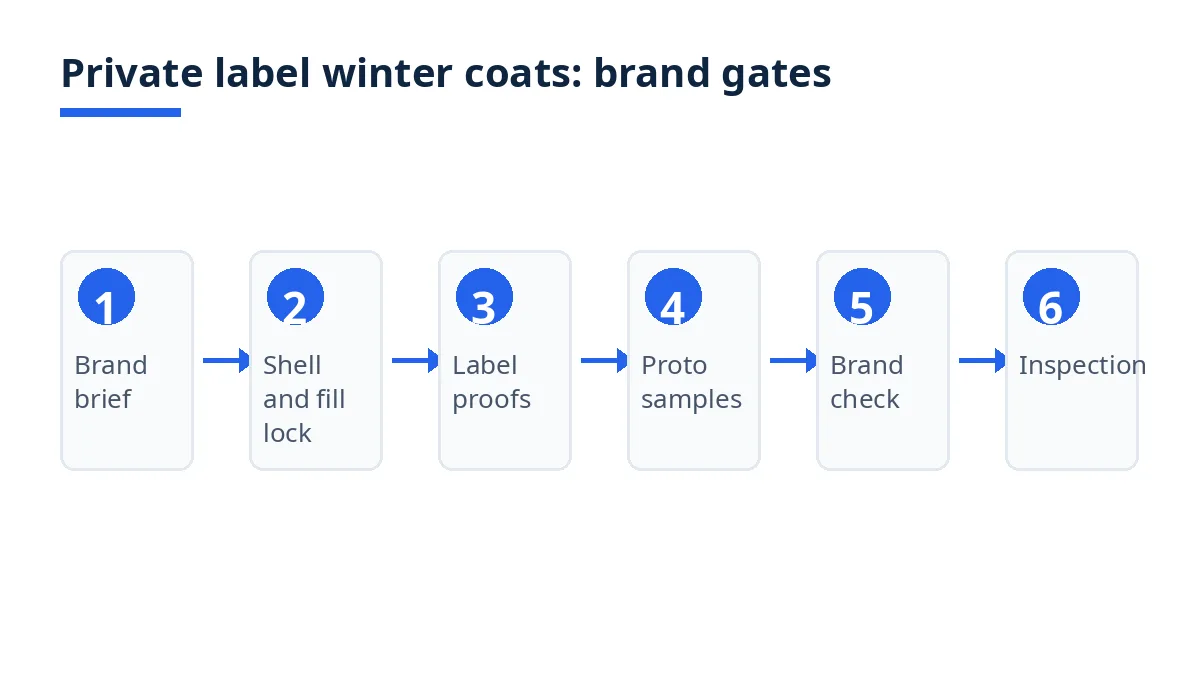
Send the brand brief and the mark file. State the coat, the markets, the mark file version, the label set, the size chart and the packing requirement, and ask each candidate for the same brief.
Lock shell, fill and lining in writing. Record composition, weight and supply status per component, and the label lines each will carry. No sample should be cut until this lock is signed.
Approve label, tag and carton proofs word for word. Check every word, percentage, symbol and code against the locked specification and each sales market, and approve in writing with the version number.
Approve a proto sample, then a sales sample in the actual materials. Measure the proto, check fit over the stated layers, wash the sales sample, and record corrections as a numbered list.
Approve a pre-production sample as a complete branded coat. Check the coat with its labels, tags, packaging and carton together. This is the last point at which a label error is cheap to fix.
Confirm inspection, packing and the reorder file before bulk. Write the inspection level, defect classes and acceptance numbers into the purchase order, and agree who holds the mark file, label artwork, size chart and approved sample.
Agree the inspection plan before bulk. ISO 2859-1 specifies an acceptance sampling system for inspection by attributes, indexed by acceptance quality limit (AQL), intended for a continuing series of lots, with switching rules that tighten inspection when quality deteriorates.6 Write the inspection level, the AQL values for critical, major and minor defects, and the sample size into the purchase order.
Labelling rules by market: United States, United Kingdom, European Union and United Arab Emirates
Check each market with the importer or a local adviser before printing. This guide states the framework, not legal advice for a specific coat.
United States. Federal law requires most textile and wool products to have a label listing fibre content, country of origin and the identity of the manufacturer or another business responsible for marketing or handling the product, with care instructions under the Care Labeling Rule.4 For wool coats, labels must accurately reflect fibre content, country of origin and either the name or the Registered Identification Number issued by the Federal Trade Commission, and apparel labels must show a safe cleaning method. Wool claims carry their own definitions: the word cashmere may identify fibre content only where the fibre meets the stated definition for Cashmere goat undercoat fibre. Check the definition for any fibre with a protected name before printing, and keep the test evidence in your file.
United Kingdom. Labelling in Great Britain follows the assimilated Regulation (EU) No 1007/2011 framework. Labels must be in English, durable, legible, visible, readily accessible and securely attached, use only approved fibre names, accurately reflect fibre content and list the content of each component where a product includes more than one material.7 Terms such as "100%", "pure" or "all" may be used only where the product contains only one fibre type, and products containing non-textile parts of animal origin must state that fact.7 A coat with a fur trim, leather trim or bone button needs the animal-origin statement as well as the fibre composition. For business-to-business sales, fibre composition may be listed in accompanying commercial documents instead.7
European Union. Regulation (EU) No 1007/2011 requires textile products to be labelled or marked to give an indication of fibre composition whenever they are made available on the market, with labelling that is durable, easily legible, visible and accessible and, for a label, securely attached.2 A multi-fibre product must show the name and percentage by weight of all constituent fibres in descending order, and a product with components of different fibre content must state the content of each component.2 Products containing non-textile parts of animal origin must carry the phrase "Contains non-textile parts of animal origin".2 The manufacturer must ensure the supply of the label and the accuracy of the information in it, and where the manufacturer is not established in the Union, the importer must do so.2 Composition descriptions must also appear in catalogues, trade literature, packaging, labels and markings in a manner that is easily legible, visible and clear, and clearly visible to the consumer before purchase, including online.2 Labelling must be in the official language or languages of the Member State where the products are made available, unless that Member State provides otherwise.2
United Arab Emirates. This guide states no UAE-specific labelling rule, because no UAE labelling source was opened for this article. Do not assume a label correct for the United Kingdom or the European Union is correct for the United Arab Emirates. Ask the importer to confirm the language, fibre content, care and origin wording for the sales channel, in writing, before the label run.
Market | Confirm before printing |
|---|---|
United States | Fibre content, country of origin, manufacturer or marketer identity, care instructions4 |
United Kingdom | Fibre content per component, approved fibre names, animal-origin statement, English wording7 |
European Union | Fibre content in descending order, content per component, animal-origin phrase, Member State language2 |
United Arab Emirates | Wording confirmed with the importer in writing; no rule stated in this guide |
Costs, timelines and documents
What are the typical costs and timelines?
There are no typical costs or timelines a guide can state as fact for a branded winter coat line. Each factory prices your shell, fill, lining, closure, label and carton runs, finishing, packing and delivery term. Brand costs sit apart from the unit price: label and tag runs, carton printing, artwork, samples, tests, inspection, and any reprint caused by a label correction. State each as a separate line, and state who owns the artwork and print files after payment. A set-up paid once should serve the repeat order.
Ask for separate dates for brand lock, label proof, proto sample, sales sample, pre-production sample, bulk start, inspection and shipment. Label and carton printing, trim delivery and fill supply each have their own lead time, and a coat cannot be packed until the carton and hang tag exist. Agree the selling season and work backwards from it, with a written date for each gate.
Compare quotations on one delivery term. The Incoterms 2020 rules provide 11 rules with a clear allocation of cost, risk and obligations, and all costs for a given rule appear in its consolidated costs article.8 The CIF rule is reserved for maritime trade and carries Institute Cargo Clauses (C) as the default insurance cover, while the CIP rule requires the higher Institute Cargo Clauses (A) cover.8 State one Incoterm and a named place on every quotation.
Which documents are needed?
Two document sets travel with a branded line: the brand file and the export file. The brand file is the mark file, the locked specification, the approved label proofs, the size chart, the sample approvals and the inspection plan.
For export clearance in Bangladesh, goods may not be loaded unless an export declaration, the Bill of Export or Shipping Bill, is submitted to Customs in a prescribed format and approved.9 Enclosed documents include the export letter of credit or, where there is none, the export contract or purchase order or export guarantee approved by the negotiating bank, the commercial invoice, the packing list, the EXP form certified by an authorized dealer, and a certificate of origin issued by the Export Promotion Bureau or a Chamber of Commerce and Industry.9 The declaration specifies the description of goods, value, name of exporters, name of foreign buyers or importers and name of transport operators.9 Keep one legal name for the exporter across the trade licence, quotation, proforma invoice and payment account. Where export is under a bonded warehouse, a Utilization Declaration for ready-made garments is among the additional documents that may be required.9
Bangladesh-specific rules and tips
Confirm association claims at the source. The Bangladesh Garment Manufacturers and Exporters Association (BGMEA) describes itself as serving major global fashion brands with more than 4,000 factories, and states that garments with a "Made in Bangladesh" tag reach people in more than 150 countries.10 Treat those statements as the association's own description, not as a guarantee for any factory. If a supplier claims BGMEA membership, confirm it through the association's member search.
Ask which inputs are imported. Shell fabric, fill, zips and some linings may be bought in for your specification. An imported input can set the minimum quantity and earliest production date, and can change origin wording on the label. Ask for input origin and supply status per component at the brand lock, not at bulk.
Hold the brand file in two places. Keep a copy of the approved sample, label proofs and size chart yourself, and agree who holds the factory copy. Name the approved sample plus the version-numbered brand file as the reorder file in the purchase order. Agree the packing ratio per carton, carton size and weight, and the container plan before bulk, and check packing on the pre-production sample with the actual hang tag, poly bag and carton.
Mistakes and red flags
What are the most common mistakes?
Approving a sample without the labels. A sample without brand labels, tags and carton proves the sewing, not the brand. Approve the pre-production sample as a complete branded coat.
Printing from the sales sample description. The sales sample may carry a provisional composition or care instruction that changed after wash tests. Print from the locked, version-numbered proof, after the tests that support it.
Using a fibre claim without its definition. "100%", "pure", "virgin wool" and fibre names with protected meanings each carry conditions in the sales market.2 A claim true in general and wrong under the applicable definition is still a wrong label.
Treating a profile or a badge as a factory check. A badge records a document and photo review, not a factory inspection, and is not a guarantee of capacity, quality or delivery.11
Comparing quotations on different brand files. A lower price on a lighter fill, a stock label, a different closure or a different delivery term is a different offer.8 Compare only replies to the same brief on the same Incoterm.
Letting the label run ahead of the trademark check. A printed run for a mark refused or opposed in a sales market is a sunk cost. Clear the mark before the label run.1
Accepting a verbal change to the brand lock. Record any change to shell, fill, lining, label wording or packing on the quotation and purchase order, with the version number it replaces.
Checklist
Before you confirm, every line should be answered in writing.
Brand brief sent: coat, markets, mark file version, label set, size chart, packing.
Mark ownership, exclusivity and artwork ownership recorded in writing.
Trademark position checked for each sales market before the label run.1
Shell, fill and lining locked, with label lines per component.2
Label, tag and carton proofs approved word for word, version-numbered.
Care symbols chosen from tests on the actual coat combination.5
Proto and sales samples measured, worn over stated layers and washed before approval.
Pre-production sample approved as a complete branded coat, with labels, tags and carton.
Inspection level, defect classes and AQL values in the purchase order.6
Quotations compared on the same brand brief and the same Incoterm.8
Export set agreed: contract or purchase order, invoice, packing list, EXP form, certificate of origin, Bill of Export.9
Reorder file named: approved sample plus version-numbered brand file, with the holder of each copy stated.
How Exportain helps
On Exportain, browse suppliers and post a request for quotation (RFQ) on the RFQ board with your brand brief summary, coat specification, markets and delivery term, so suppliers quote against the same brand file. Ask each reply for its shell, fill and lining lots, label and carton runs, and sample gates in writing. Read the supplier verification guide before you shortlist, and the MOQ guide for how minimum quantities are set per style, colour and input lot.
Read badges for what they record. Exportain verification is a document review by Exportain staff, not a factory inspection and not a check against any government database.11 Approved checks earn trust badges: Exportain Verified means Exportain has checked identity, phone, email and business registration; Export Verified means it has checked the Export Registration Certificate; Factory Verified means it has reviewed photos of the manufacturer's factory; Trading Company Verified means it has reviewed photos of the trading company's office or warehouse.11 A badge is not a guarantee of production capacity, product quality or delivery, and verification is free and never purchased.11 When you accept a quotation, Exportain creates one order and issues one proforma invoice from the accepted terms.11 Sample approval, label checks and inspection remain your controls.
What should I know first about private label?
Private label means you own the brand decisions and answer for the label claims in each sales market, while the factory makes the coat to your specification. Lock the mark file, the shell, fill and lining specification, the label set and the size chart in writing before sampling, and clear the trademark for the markets where the coats will sell.1 In the European Union, a distributor who places a product on the market under his own name or trademark, or who attaches or modifies the label, is considered a manufacturer for labelling purposes.2 Woven winter coats for men and boys sit under heading 6201 and for women and girls under heading 6202, with subheadings split by fibre.3
What are the typical costs and timelines?
There are no typical figures a buyer can rely on, because each factory prices your shell, fill, lining, closure, label and carton runs, finishing and packing, and the delivery term you choose.8 Brand costs sit apart from the unit price: label and tag runs, carton printing, artwork, samples, tests and inspection. Timelines run by gate: brand lock, label proof, proto sample, sales sample, pre-production sample, bulk, inspection and shipment, each with its own date. Work backwards from the selling season and hold each gate to its date.
Which documents are needed?
The brand file is the mark file, the locked specification, the approved label proofs, the size chart, the sample approvals and the inspection plan. The export set is the export contract or purchase order where there is no export letter of credit, the commercial invoice, the packing list, the EXP form certified by an authorized dealer, and a certificate of origin issued by the Export Promotion Bureau or a Chamber of Commerce and Industry, enclosed with the Bill of Export.9 The declaration must be submitted to Customs in a prescribed format and approved before the goods may be loaded.9
What are the most common mistakes?
The most common mistakes are approving a sample without its labels, printing from a sales sample description instead of a locked proof, using a fibre claim without checking its definition in the sales market, reading a badge as a factory check, and letting the label run ahead of the trademark check.2 1 11 Each is cheap to prevent at the brand lock and expensive to fix after bulk. Keep every change version-numbered and in writing, and approve the pre-production sample as a complete branded coat.
Next steps on Exportain
Browse suppliers, then post your brand brief, coat specification, markets and delivery term on the RFQ board so suppliers quote against the same brand file. Before you shortlist, read how supplier verification works on Exportain and the MOQ guide so you read each reply for what its badges and minimums actually record.
Sources
- India Joins the International Trademark System. World Intellectual Property Organization (accessed )
- Regulation (EU) No 1007/2011 on textile fibre names and related labelling and marking of the fibre composition of textile products. European Union, (accessed )
- HS, 2012 - Code 6201. United Nations Statistics Division (accessed )
- Textile, Wool, Fur, Apparel and Leather Matters. Federal Trade Commission (accessed )
- ISO 3758:2023 — Textiles — Care labelling code using symbols. International Organization for Standardization (accessed )
- SIST ISO 2859-1:2003 - Sampling procedures for inspection by attributes, Part 1: Sampling schemes indexed by acceptance quality limit (AQL). International Organization for Standardization, (accessed )
- What a textile label must include. Invest Northern Ireland (accessed )
- Incoterms® 2020. International Chamber of Commerce (ICC) (accessed )
- Customs Clearance Procedures for Export. Bangladesh Customs, National Board of Revenue (accessed )
- BGMEA | Home. Bangladesh Garment Manufacturers and Exporters Association (BGMEA) (accessed )
- Trust & Safety Center. Exportain (accessed )
About the author
Sourcing from Bangladesh?
Post a request for quotation and suppliers on Exportain can send you their quotes directly.
Post an RFQ


