Private Label Socks Manufacturing in Bangladesh: A Brand Owner's Guide
No single private-label sock spec fits every brand: size breaks by foot length, knitting programs, gauge charts, boarding specs, and pair and dozen packing decide whether the repeat order matches the first.
Short answer
A private-label sock order from Bangladesh starts from the foot, not from a sample. The brand owner fixes the sock length, cuff, heel and toe construction, yarn blend, gauge, and size breaks by foot length, approves the knitting program and boarding specification on a washed sample, packs by pair and dozen with a barcode per size and colour, and collects the program, gauge chart, and artwork files at shipment.
On this page
Key takeaways
A private-label sock is specified by the pair and by the foot: length, cuff, heel, toe, yarn blend, gauge, and size breaks by foot length, not by a showroom sample.
The knitting program, gauge chart, and boarding specification are the bulk standard: approve them on a washed, boarded sample across the size range.
Heel, toe, and cuff artwork must be approved on the boarded sock at stretch, because artwork placed flat distorts when the sock stretches.
Packing, barcodes, and inspection all count in pairs, with a barcode per size and colour combination, not per style.
Set-up lines for the program and artwork belong apart from the unit price, and the handover pack at shipment is what lets a repeat order match the first.
A private-label sock order is won or lost on details that do not exist in other knitwear. The garment is sold by the pair, sized by the foot, and knitted to a program rather than cut from cloth. A brand owner who specifies only yarn and colour will get a sock, but not necessarily the sock their customers expect in length, fit, cuff grip, or heel and toe placement. This guide sets out how to specify, sample, pack, and hand over a private-label sock order from Bangladesh, so the repeat order matches the first.
Heading 6115 covers pantyhose, tights, stockings, socks and other hosiery, knitted or crocheted.1 Its lines divide further by fibre, including cotton and synthetic fibres, and count the supplementary unit in pairs.1 That pair unit runs through the order: quotations, packing, barcodes, and inspection all work in pairs, not pieces.
Why this matters for buyers and sellers
For the buyer, the sock is a fit product before it is a fashion product. A size break that is wrong by one step does not produce one bad pair; it produces a whole size run that slips, bunches, or cuts into the ankle. A cuff that loses grip, a heel that sits off the foot, or a toe seam that rubs will be felt on the first wear, and the complaint will name the brand on the cuff.
For the seller, the knitting program is the constraint. Once a program is set for a gauge, a needle count, and a size range, changing one element can mean reprogramming, re-sampling, and re-boarding. A late change to size breaks, cuff branding, or heel and toe artwork therefore touches the program itself, not a pattern piece.
What should I know first about private label?
Private label means the sock carries your brand: your cuff wording or logo, your heel and toe artwork where you use it, your labels, your packing, and your barcodes. The factory knits to your specification. Start from the foot, not from a sample you liked in a showroom. State the sock length, the cuff type and depth, the heel and toe construction, the yarn blend, the gauge, and the size breaks, each in writing, before you ask for a price. A quotation that does not answer each of those points cannot be compared with another quotation.
The Bangladesh Knitwear Manufacturers and Exporters Association (BKMEA), established in 1996, is the apex trade body for the knitwear sector and represents approximately 2,540 knitwear member factories.2 That scale means several factories may be able to knit your sock, but it does not mean any two of them knit it the same way. The program, the boarding form, and the packing line differ from factory to factory, which is why the specification has to travel with the order.
Step-by-step: how it works
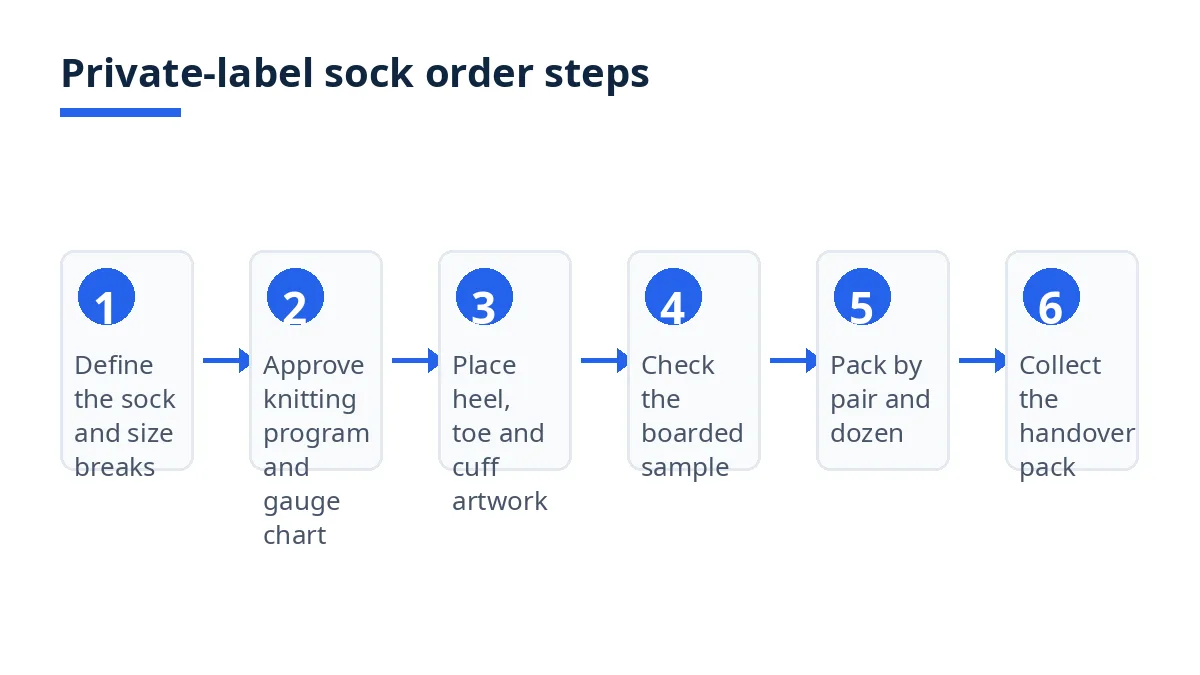
Define the sock in full. State the length (no-show, ankle, quarter, crew, or knee), the cuff type and depth, the heel type, the toe closure, the yarn blend and count, the gauge, and the intended wear: everyday, dress, or sport. Each choice changes the program and the price.
Fix the size breaks by foot length and market. Give every size as a foot-length range plus the shoe-size system for each market you sell into, and state how many sizes the range contains. A range with too few breaks fits nobody well; a range with too many breaks splits the order into small runs per size.
Approve the knitting program and the gauge chart. Ask for the program reference, the needle count, the gauge in stitches and courses, and the finished measurements per size after boarding. Record them as the standard the bulk order is measured against.
Place the artwork where it will be seen and where it will stretch. Heel and toe artwork sits on curved, stretched fabric, and cuff branding sits on rib that expands around the leg. Approve the artwork size, position, and colours on a boarded sample, not on a flat print proof.
Sample, wash, and wear-test before bulk. Order a proto sample, then a pre-production sample in the actual yarn, colours, artwork, and packing. Wash it to your care instructions, measure it after washing, and wear-test it across the size range. Approve or list corrections in writing.
Pack by pair, then by dozen, then by carton. State the pair unit, the dozen or inner-box count, the carton count, and the barcode for each size and colour combination. A barcode that covers a whole style instead of one size and colour combination will fail at a retailer's goods-in desk.
Collect the handover pack at shipment. Receive the knitting program reference, the gauge chart, the boarding specification, the approved artwork files, the label and packing artwork, and the approved sample measurements, and confirm in writing who may reuse each item on a repeat order.
Specification item | State in your enquiry | Why it locks the order |
|---|---|---|
Size breaks | Foot-length range and shoe system per market | Decides fit and the split per size |
Knitting program | Program reference, needle count, gauge | Decides stretch, thickness, and hand feel |
Boarding spec | Form size, temperature, finished measurements | Decides the size the customer receives |
Heel and toe artwork | Position, size, colours, stretch allowance | Artwork moves when the sock stretches |
Cuff branding | Rib type, depth, branding method, stretch | Branding distorts if the rib is wrong |
Pair and dozen packing | Pairs per inner box, boxes per carton | Decides barcodes and carton counts |
File handover | Program, gauge chart, artwork, label files | Decides whether a repeat matches |
Costs, timelines and documents
What are the typical costs and timelines?
There are no typical private-label sock costs or timelines a guide can state as fact, because each factory prices your yarn blend, gauge, size range, artwork placements, cuff branding, packing, and delivery term for your specification. The Incoterms 2020 rules set out 11 rules with a clear allocation of cost, risk, and obligations,3 so compare quotations only on the same rule and named place.
For timelines, ask for sampling, yarn ready, knitting, boarding, packing, and inspection dates as separate lines, not a single delivery week. Boarding and packing are the two stages most often squeezed when a schedule slips, and both change the finished sock: boarding sets the final size, and packing sets the pair count the buyer counts on arrival.
Set-up cost only matters per pair, so work it that way. As an illustration — not a quotation — put the knitting program at 180 dollars, heel-and-toe artwork at 120 dollars and cuff branding preparation at 60 dollars: 360 dollars in total. On 12,000 pairs that is 3 cents a pair; on a 3,000-pair repeat it would be 12 cents a pair. The numbers are examples only. What carries over to a real quote is the split: lines paid once should not reappear on a repeat order unless the program or the artwork has changed.
Example figures for packing: an order of 12,000 pairs packed 12 pairs to an inner box gives 1,000 inner boxes (12,000 divided by 12 = 1,000). If each carton holds 20 inner boxes, the order gives 50 cartons (1,000 divided by 20 = 50).
Which documents are needed?
The order documents are the sock specification, the size and gauge chart, the boarding specification, the artwork and label files, the itemized quotation, and the purchase order, with the split per size and colour on both. The export set is the Bill of Export, commercial invoice, packing list, EXP form certified by an authorized dealer, and certificate of origin.4 Keep pair and dozen counts identical across invoice, packing list, and carton markings.
Bangladesh-specific rules and tips
Confirm association claims at the source. If a supplier claims BKMEA membership, confirm it with the association itself. BKMEA represents the knitwear sector and its member factories,2 so membership signals an active knitwear business, not a knitting program, a gauge capability, or capacity for your size range. Ask separately which gauges and sock lengths the factory knits in-house, and which it buys in.
Settle the fibre split before you lock the label. The lines under heading 6115 divide by fibre, including cotton and synthetic fibres,1 and the label must reflect the actual yarn blend. If you sell into the European Union, Regulation (EU) No 1007/2011 states that a textile product shall be labelled or marked with the name and percentage by weight of all constituent fibres in descending order.5 Agree the blend at specification stage: a blend corrected after knitting means re-knitting, not relabelling.
Keep one legal name across every paper. Goods may not be loaded unless an export declaration, the Bill of Export or Shipping Bill, is submitted to Customs and approved, and the declaration names the exporter and the foreign buyer.4 The brand owner name on the purchase order, the invoice, the packing list, and the payment account should match that declaration name, or the file can pause at checking.
Check the boarded size, not the knitted size. A sock changes size on the boarding form. Agree the form sizes, conditions, and finished measurements per size before bulk, and measure the pre-production sample after boarding and washing.
Mistakes and red flags
What are the most common mistakes?
Specifying by shoe size alone. Shoe sizes differ by market, and a sock size that covers a wide shoe range fits the middle of that range and no one else well. State foot-length ranges per size and the shoe system for each market, and wear-test the extreme sizes, not only the middle size.
Approving artwork flat. Heel and toe artwork and cuff branding are approved on flat artwork and then found distorted on a stretched, boarded sock. Approve artwork on the boarded sample, on the foot, with the cuff stretched to leg width.
Counting pieces instead of pairs. Socks are sold, packed, barcoded, and inspected by the pair. A quotation, packing list, or inspection report that counts pieces will double the apparent quantity and hide a short shipment of one size. Insist on pairs at every stage, with the split per size and colour.
Skipping the boarding specification. Two factories can knit the same program and deliver different finished sizes if their boarding forms and conditions differ. Without a written boarding specification, there is no standard to measure bulk against.
Accepting a verbal size or artwork change. A size break moved by one step, a cuff depth changed by a centimetre, or an artwork colour swapped late in sampling changes the program, the packing, and the barcode set. Record every change on the specification and re-approve the sample it affects.
Treating a profile or a badge as a knitting capability. A profile is a starting point for enquiries. It does not test whether a factory can knit your gauge, hold your size range, or board to your measurements, and a badge is not a guarantee of capacity, quality, or delivery.6
Skipping inspection to save time. Sampling under ISO 2859-1 checks a lot against an agreed acceptance quality limit (AQL), which is the maximum average percentage of defective items considered acceptable during random sampling.7 Set a defect class for pair mismatch, wrong size marking, and barcode errors, so those faults are counted defects rather than matters of opinion.
Checklist
Before you confirm, every line should be answered in writing.
Sock defined: length, cuff type and depth, heel type, toe closure, yarn blend, gauge, intended wear.
Size breaks fixed by foot-length range and shoe system per market, with the split per size and colour.
Knitting program reference, needle count, and gauge chart recorded as the bulk standard.
Heel, toe, and cuff artwork approved on the boarded sample, at stretch.
Pre-production sample washed, measured after boarding, and wear-tested across the size range.
Boarding specification agreed: form sizes, conditions, finished measurements per size.
Packing agreed in pairs: pairs per inner box, boxes per carton, barcode per size and colour.
Set-up lines itemized apart from the unit price; paid program and artwork recorded for repeats.
Inspection plan agreed, with pair mismatch, size marking, and barcode errors as counted defects.7
Quotations compared on the same specification and Incoterm.3
Export set agreed, with matching names and identical pair counts across invoice, packing list, and cartons.4
Handover pack due at shipment: program, gauge chart, boarding spec, artwork, label and packing files.
How Exportain helps
On Exportain, browse suppliers and post a request for quotation (RFQ) on the RFQ board with your sock specification, size breaks, and boarding requirement attached, so suppliers quote against the same program and packing. Read the badges for what they record: verification is a document and photo review, not a factory inspection, and a badge is not a guarantee.6 8 See how supplier verification works on Exportain before you confirm.
FAQs
What should I know first about private label?
Know the sock before you ask for a price. Private label means the sock carries your brand on the cuff, the heel and toe artwork where you use it, the labels, the packing, and the barcodes. State the length, cuff, heel, toe, yarn blend, gauge, and size breaks in writing first, because each of those points changes the knitting program and the quotation.
What are the typical costs and timelines?
There are no typical figures a buyer can rely on, because each factory sets its price and lead time for your yarn, gauge, size range, artwork placements, cuff branding, packing, and delivery term.3 Ask for set-up lines apart from the unit price, and for sampling, yarn ready, knitting, boarding, packing, and inspection dates as separate lines.
Which documents are needed?
The order documents are the sock specification, the size and gauge chart, the boarding specification, the artwork and label files, the itemized quotation, and the purchase order. The export set is the Bill of Export, commercial invoice, packing list, EXP form certified by an authorized dealer, and certificate of origin.4
What are the most common mistakes?
The most common mistakes are specifying by shoe size alone, approving artwork flat instead of on a boarded sock at stretch, counting pieces instead of pairs, skipping the boarding specification, accepting size or artwork changes verbally, and reading a badge as a guarantee of knitting capability.6
Next steps on Exportain
Browse suppliers, then post your sock specification, size breaks, and boarding requirement on the RFQ board so suppliers state their program, gauge, and packing in pairs. Before you confirm, read how to import socks from Bangladesh and the socks quality control checklist.
Sources
- HS heading 6115: hosiery, knitted or crocheted. GOV.UK (accessed )
- BKMEA at a Glance. BKMEA (accessed )
- Incoterms® 2020. International Chamber of Commerce (ICC) (accessed )
- Customs Clearance Procedures for Export. Bangladesh Customs, National Board of Revenue (accessed )
- Regulation (EU) No 1007/2011 on textile fibre names and related labelling and marking of the fibre composition of textile products. European Union, (accessed )
- Trust & Safety Center. Exportain (accessed )
- ISO 2859-1:2026 - Sampling procedures for inspection by attributes — Part 1: Sampling schemes indexed by acceptance quality limit (AQL) for lot-by-lot inspection. ISO (accessed )
- Supplier verification: Earn trust badges buyers can see. Exportain (accessed )
About the author
Sourcing from Bangladesh?
Post a request for quotation and suppliers on Exportain can send you their quotes directly.
Post an RFQ