Private Label Puffer Jackets Manufacturing in Bangladesh: A Brand Owner's Guide
Private label puffer jackets put your brand on a factory-made jacket: who owns the design and labels, how label proofs and samples are approved, and which market rules the labels must meet.
Short answer
Private label puffer jacket manufacturing in Bangladesh means a factory makes a jacket to a brand owner's specification, labels, and packaging, while the brand owner keeps ownership of the mark, design, and label artwork. The process runs through a brand brief, written ownership and exclusivity terms, separate label and packaging approvals, production samples, inspection, and shipment, with label rules checked for each sales market.
On this page
Key takeaways
Private label means the factory makes the jacket while the brand owner owns the mark, design, label artwork, and packaging, under written ownership and exclusivity terms.
Labels and packaging need separate written approvals from the jacket sample, checked word for word against the rules of each sales market.
Brand costs sit apart from the unit price: labels, tags, packaging, set-up, samples, testing, and inspection, with repeat-order treatment stated in writing.
Fill and certification claims must match the certificate for the shipment, and a trust badge records document and photo checks only, not a factory inspection.
A private label puffer jacket carries your brand name, your labels, and your packaging, even though a factory in Bangladesh makes the jacket. The factory supplies production capacity. You supply the brand identity and the decisions that decide what a customer sees, touches, and reads on the label. That split only works when it is written down before production starts.
Private label is not adding a logo to a factory range. The jacket is made for one brand owner, with labels and packing that belong to that owner, and exclusivity and ownership are terms to agree in writing.
Why this matters for buyers and sellers
For a brand owner, a private label order is a brand decision before it is a purchasing decision. The jacket will be judged as your product. A wrong fiber statement, a fill claim you cannot support, or a carton another brand could also use will all read as your choices.
Trademark protection sits with the brand owner, not the factory. Under the Madrid System administered by the World Intellectual Property Organization (WIPO), a trademark owner can seek protection across more than 130 export markets with one application, in one language, paying one set of fees in Swiss francs, provided the owner is a national of, or has a domicile or business in, a Madrid System member and has applied for or registered a trademark through that member's intellectual property office.1 Protection is not automatic in each market: each office examines the mark under local law and can refuse it, and refusal in one market does not affect others.1 An international registration is valid for 10 years and can be renewed.1 Check that the name is clear in each sales market, record who owns the mark and the artwork, and give the factory a written license to use the mark for your order only.
For a seller, labels, hang tags, cartons, and retail packing are made for one buyer and cannot be sold to another buyer if the order changes. Factories therefore ask for firm brand files, approved proofs, and a firm color and size plan before they commit label and packing runs.
Step-by-step: how it works
The diagram below sets out the process in six stages. Each stage ends with an approval in writing.
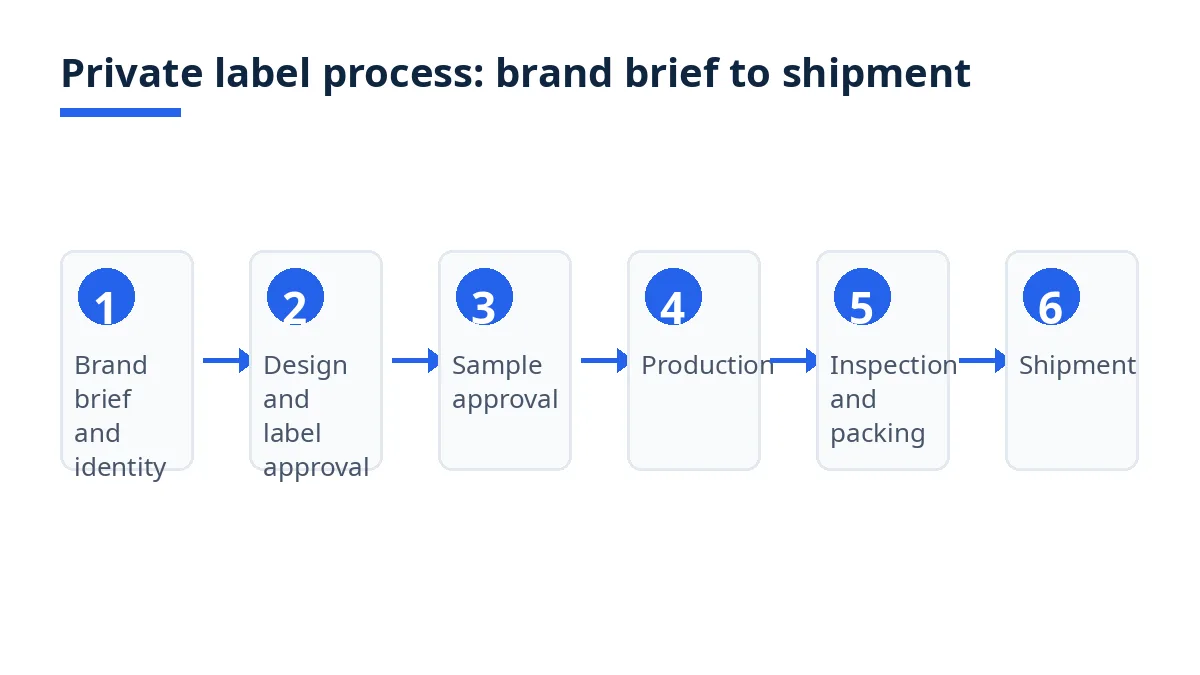
Write the brand brief. State the brand name, target customer, markets, and sales channel. Attach logo files, colors, typeface, and brand rules for labels, hang tags, and cartons. Name the one person who can approve brand decisions.
Agree ownership and exclusivity in writing. State who owns the design, patterns, artwork, labels, and packaging, and whether the factory may make the same jacket for any other buyer, in any market, during or after the agreement.
Approve labels and packaging separately. A jacket sample is not a label approval. Ask for label, hang tag, care label, carton, and polybag proofs as separate items, each approved in writing. Check every word against the market rules below, on the proof itself, not on a photograph of it.
Approve samples in production materials. Order a proto sample, then a pre-production sample in the actual shell, fill, lining, trims, labels, and packaging.
Run production against the approved record.
Inspect, pack, and ship as the brand owner.
Costs, timelines and documents
Brand costs that sit outside the unit price
Ask for each brand line to be priced apart from the unit price, or stated as included, in writing: label and tag production, packaging, artwork and set-up, samples and courier charges, testing, and inspection.
Example figures: the table below shows structure only. Every amount is an example figure, not a market price.
Brand cost line | Example figures | Question to ask |
|---|---|---|
Woven labels | 2,000 labels at an illustrative unit charge | Does the charge repeat on a repeat order |
Hang tags and care labels | One print run for the full order | Are reprints priced apart from the jacket |
Carton printing plates | One set-up charge for the carton design | Who keeps the plates after the order |
Pre-production sample | One sample charge plus courier | Is the sample charge credited against bulk |
Fill and fabric testing | One test charge per test required | Which tests are required, and by whom |
Timelines by gate, not by a single date
Ask for a date for each gate: label proofs, design approval, proto sample, pre-production sample, label and packaging production, bulk production, inspection, and shipment.
Use one Incoterm for every quotation you compare. The Incoterms 2020 rules provide a clear allocation of cost, risk, and obligations, and have been used globally in trade contracts since 1936, updated in 2020.2 The rules list 11 rules with guidance for selecting the right term.2 Compare quotations only on the same rule and named place.
Which documents are needed
The brand group is the brand brief, the trademark and license record, the approved label and packaging proofs, and the artwork files. The order group is the specification, the accepted quotation, the purchase order, the size and color plan, the delivery term, the inspection standard, and the sample approval record. The shipment group is the commercial invoice, the packing list, the transport document, and any origin or customs document required for the destination.2
For export clearance in Bangladesh, goods shall not be loaded unless an export declaration, known as the Bill of Export or Shipping Bill, is submitted to Customs in the prescribed format and approved, with the description of goods, value, exporter name, foreign buyer name, and transport operator specified.3 The enclosed documents include the export letter of credit or, where there is none, the export contract or purchase order or export guarantee approved by the negotiating bank, the commercial invoice, the packing list, the EXP form certified by authorized dealers, the certificate of origin issued by the Export Promotion Bureau or a Chamber of Commerce and Industry, the VAT registration certificate, and the taxpayer identification number.3
Bangladesh-specific rules and tips
Label rules for the European Union and the United States
In the European Union, Regulation (EU) No 1007/2011 requires that a textile product shall be labelled or marked with the name and percentage by weight of all constituent fibers in descending order.4 It also requires the phrase "Contains non-textile parts of animal origin" where such parts are present, such as real fur trim or leather parts.4
In the United States, Federal Trade Commission guidance states that most textile and wool products must have a label listing fiber content, country of origin, and the identity of the manufacturer or another business responsible for marketing or handling the item.5 Fiber names and percentages must be listed in descending order of predominance, only fibers at five percent or more may generally be named, fibers below five percent should be disclosed as "other fiber" or "other fibers," and wool or recycled wool must always be disclosed by name and percentage even below five percent.5 State whether the label carries the brand owner's name, the importer's name, or a registered identification number.
Fill claims, classification, and inspection
A fill claim must match the fill in the jacket and the evidence behind it. The Responsible Down Standard is a voluntary international standard owned and managed by Textile Exchange that addresses animal welfare in the duck and goose supply chain and the chain of custody of down and feather material from certified farms to final products.6 All sites must be certified, each shipment must be accompanied by a transaction certificate, and the standard applies to products containing at least five percent Responsible Down Standard material, as a percentage of the down or feather material.6 Hold the transaction certificate for the shipment, check its scope and dates, and use the certification name only within that scope.
For classification, the Harmonized System is a multipurpose international product nomenclature developed by the World Customs Organization, comprising more than 5,000 commodity groups, each identified by a six-digit code, and used by more than 200 countries and economies as a basis for customs tariffs and trade statistics.7 Heading 6201 covers overcoats, car-coats, capes, cloaks, anoraks including ski-jackets, wind-cheaters, wind-jackets and similar articles, men's or boys', other than those of heading 6203, not knitted or crocheted, split by fiber.8
For inspection, ISO 2859-1:2026 defines a system of acceptance sampling plans for inspection by attributes, indexed by acceptance quality limit (AQL) for lot-by-lot inspection.9 AQL is the maximum average percentage of defective items considered acceptable during random sampling, and it determines sample sizes and acceptance and rejection thresholds.9
Confirming a supplier in Bangladesh
Check association claims at the source. The Bangladesh Garment Manufacturers and Exporters Association has launched an online Membership Management System to make membership registration faster and simpler, and to help existing members manage membership information online, update information, make payment, and generate an e-certificate of membership.10 If a supplier claims membership, ask for the record and confirm it with the association itself.
Read trust badges for what they record. Exportain states that verification is a document review by its team, not a factory inspection, and not a check against a government database, and that a badge is not a guarantee of production capacity, product quality, or delivery.11 Exportain Verified means Exportain has checked identity, phone, email, and business registration, Export Verified means it has checked the Export Registration Certificate, Factory Verified means it has reviewed photos of the manufacturer's factory, and Trading Company Verified means it has reviewed photos of the trading company's office or warehouse.11 Verification is free and never purchased, and membership plans never grant a trust badge.11 See how supplier verification works on Exportain before you shortlist.
Mistakes and red flags
Approving a jacket sample and calling the brand approved. Label proofs, hang tags, care labels, carton artwork, and barcodes each need their own written approval against the market rules for the destination.4 5
Letting the factory keep brand files without terms. Agree ownership, the license for the order only, storage, return or destruction of files and plates, and the ban on use for other buyers, before you send artwork and logo files.
Using a certification name without the certificate for the shipment. Hold the certificate for the shipment and use the name only within its scope.6
Changing the brand late and expecting no cost or delay. A late change to a logo, color, label, or carton restarts label and packing runs. Expect a new proof, cost line, and packing date, and do not ship mixed label versions in one order.
Treating a badge, a catalogue, or a sample photograph as proof of brand control. A badge records document and photo checks.11
Red flags in a reply. Pause where a supplier will not name the owner of the design, will not state exclusivity in writing, will not provide separate label proofs, asks for brand files before terms are agreed, offers a certification name without a certificate, or states label text that conflicts with your destination rules.4 5 6
Checklist
Before you confirm, every line should be answered in writing, with version numbers that match the order record.
Brand brief agreed, with the person who approves brand decisions named.
Trademark checked in each sales market, with a written license for the factory to use the mark for this order only.1
Design ownership and exclusivity agreed, for stated styles, markets, and period.
Label, hang tag, care label, and packaging proofs approved separately, word for word, for each market.4 5
Fill and certification claims supported by the certificate for the shipment.6
Specification agreed: shell, fill, quilting, lining, trims, size and color plan, and packing plan.
Pre-production sample measured, washed where relevant, and approved in writing.
Brand cost lines priced apart from the unit price, with repeat-order treatment stated.
Inspection standard agreed, including AQL values, inspection level, and brand-item checks.9
Delivery term and named place stated on one Incoterm for every quotation compared.2
Export document set agreed, with names matching the purchase order, invoice, and labels.3
Supplier checks completed: association claim confirmed at the source, and badges read for what they record.10 11
Repeat-order record kept: approved proofs, artwork files, plates, screens, and the sealed sample.
For the general meaning of a minimum quantity, and how it is counted per style or per color, see the guide to MOQ meaning.
What should I know first about puffer jackets?
Know the jacket as a brand product, not only as a garment. Fill decides warmth and the evidence behind any fill claim, shell decides weather performance and shade, and quilting decides whether fill stays where it insulates. The mark decides who the customer believes made the jacket, the labels decide what the customer is told about fiber, origin, and care, and the packaging decides what the customer sees first.
What are the typical costs and timelines?
There are no typical costs or timelines for private label puffer jackets as a category that a buyer can rely on. Fill, shell, quilting, trims, labels, packaging, quantity, the size and color plan, the delivery term, and the destination each move the figure, and brand cost lines sit apart from the unit price.2 Ask for a cost breakdown by line, a date for each gate, and a validity date, and compare suppliers on the same breakdown and delivery term.
Which documents are needed?
The brand set is the brand brief, the trademark and license record, the approved label and packaging proofs, and the artwork files. The order set is the specification, the accepted quotation, the purchase order, the size and color plan, the delivery term, the inspection standard, and the sample approval record. The shipment set is the commercial invoice, the packing list, the transport document, and any origin or customs document required for the destination.2 For Bangladesh export clearance, the enclosed set includes the export letter of credit or the export contract or purchase order, the commercial invoice, the packing list, the EXP form, the certificate of origin, the VAT registration certificate, and the taxpayer identification number.3 Add fill and certification evidence where a claim will appear on a label, hang tag, or listing.6
What are the most common mistakes?
The most common mistakes are approving a jacket sample and treating the brand as approved, sending brand files without written ownership and exclusivity terms, using a certification name without the certificate for the shipment, changing a label or carton late without a new proof, and reading a badge, a catalogue, or a sample photograph as proof of brand control.1 4 5 6 11
Next steps on Exportain
Browse suppliers and shortlist factories by outerwear capability, label and packaging control, and the documents behind their claims, then send each one the same brand brief, specification, and market list. Post a free RFQ on Exportain and get quotes from Bangladeshi suppliers → https://exportain.com/rfqs
Sources
- Madrid System: Frequently Asked Questions. World Intellectual Property Organization (accessed )
- Incoterms® 2020. International Chamber of Commerce (ICC) (accessed )
- Customs Clearance Procedures for Export. Bangladesh Customs, National Board of Revenue (accessed )
- Regulation (EU) No 1007/2011 on textile fibre names and related labelling and marking of the fibre composition of textile products. European Union, (accessed )
- Threading Your Way Through the Labeling Requirements Under the Textile and Wool Acts. Federal Trade Commission (accessed )
- RDS - Responsible Down Standard. Control Union (accessed )
- What is the Harmonized System (HS)?. World Customs Organization (accessed )
- HS, 2012 - Code 6201. United Nations Statistics Division (accessed )
- ISO 2859-1:2026 - Sampling procedures for inspection by attributes — Part 1: Sampling schemes indexed by acceptance quality limit (AQL) for lot-by-lot inspection. ISO (accessed )
- BGMEA launches Membership Management System to provide faster and simpler services. BGMEA (accessed )
- Trust & Safety Center. Exportain (accessed )
About the author
Sourcing from Bangladesh?
Post a request for quotation and suppliers on Exportain can send you their quotes directly.
Post an RFQ