Private Label Organic Cotton T-Shirts Manufacturing in Bangladesh: A Brand Owner's Guide
A private-label organic cotton T-shirt order from Bangladesh turns on certification ownership: GOTS scope, transaction certificates for the full quantity, approved dye and print artwork, and a label pack that matches the fibre content. This guide sets out what to own, check and put in writing.
Short answer
A private label organic cotton T-shirt order from Bangladesh succeeds when the buyer owns the certification chain: a GOTS scope certificate for every facility, a stated grade of 95 to 100 percent organic or 70 to 94 percent made with organic materials, a certifier label release for each artwork, and transaction certificates covering the full shipped quantity. Without those documents, the organic claim on the label cannot be supported.
On this page
Key takeaways
Ownership of the organic claim rests on documents, not on fabric feel: a scope certificate for every facility, a stated GOTS grade, a label release for each artwork, and transaction certificates for the full quantity.
GOTS grades are fixed: 95 to 100 percent organic fibres is organic, while 70 to 94 percent is made with (x%) organic materials, and the label, pricing and store copy must all use the same grade.
A fabric or yarn certificate alone never proves a finished printed T-shirt is certified, and an OEKO-TEX safety certificate never replaces organic scope or transaction certificates.
Dye and print inputs, artwork files, screen reuse and the label pack each need written terms before bulk production, with label artwork released by the certifier before labels are printed.
Compare quotations only on the same tech pack, grade, colour split and delivery term, and keep one legal name across the order, invoice and export declaration.
A private-label organic cotton T-shirt order gives you two things to get right: a shirt customers want to wear, and an organic claim customers and retailers can rely on. The shirt is judged by fit, fabric weight, and print quality. The claim is judged by paper. If the documents behind the claim do not cover the yarn, the dyeing, the printing, and the finished quantity, the word organic on the label has nothing standing behind it, however soft the fabric feels.
What makes the T-shirt case specific is how plain the garment is. There is no complex construction to hide a weak link in the chain. The decisions that matter most sit upstream: which organic yarn was bought, which dye and print inputs were used on it, how the cut and weight were developed, and which certificates travel with the finished shirts. This guide follows that chain from tech pack to shipment.
Why this matters for buyers and sellers
For the buyer, the risk is a claim that cannot be defended after the shirts are in stock. A retailer who asks for the certificate file will not accept a yarn invoice or a fabric swatch in place of scope and transaction certificates. If the file falls short, the shirts may still sell as conventional T-shirts, but they cannot be sold as organic, and any store copy that already calls them organic has to be corrected.
For the seller, the risk runs the other way. A factory that buys organic yarn, dyes it, prints it, and sews it without keeping the certificate chain intact has done the expensive work and kept none of the value. Segregation during production, records of input quantities, and transaction certificates are what turn certified inputs into a certified finished shirt.
Bangladesh's knitwear sector gives a buyer plenty of factories to approach, and the sector's trade body is the Bangladesh Knitwear Manufacturers and Exporters Association (BKMEA).1 Each candidate still has to show scope coverage for the exact steps it will perform on your order, because a scope certificate for knitting says nothing about dyeing or printing done elsewhere.
The grade you state decides what the label may say. Under the Global Organic Textile Standard, a product with 95 to 100 percent organic fibers carries the organic grade, while a product with 70 to 94 percent organic fibers is labeled as made with a stated percentage of organic materials.2 The grade, the price list, and the store copy must all use the same wording.
Two certificates that look reassuring do not substitute for the organic chain. A fabric or yarn certificate on its own never proves that a finished printed T-shirt is certified, because it says nothing about the dyeing, printing, cutting, and sewing that followed. An OEKO-TEX STANDARD 100 certificate addresses product safety testing, and it never replaces organic scope or transaction certificates.3
Step-by-step: how it works
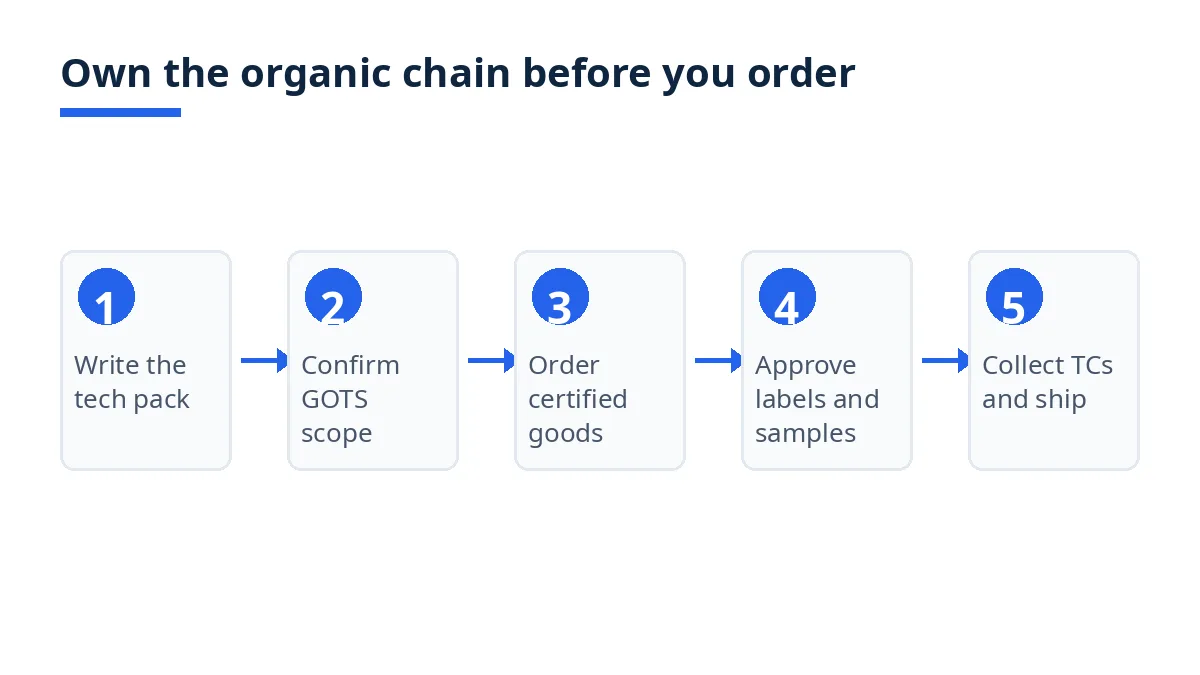
Fix the grade and fiber content. State the target grade, the organic fiber percentage, and any non-organic fibers in the blend. A blend change that drops the shirt below 95 percent organic changes the grade and the label wording.2
Collect a scope certificate for every facility. Ask each facility that will spin, knit, dye, print, cut, or sew your shirts for its current scope certificate, and check that it covers the product category and the step you need from that facility. Record each certificate number, its validity dates, and the steps it covers before you order.
Source the organic yarn against a written quantity. Order yarn with transaction certificates from the yarn supplier, and reconcile the incoming certified quantity against the quantity your order needs, including cutting waste. A shortfall cannot be topped up with conventional yarn and still sold as organic.
Develop the fabric weight and cut on the organic yarn. Organic cotton yarn can behave differently from conventional yarn in shrinkage, hand feel, and dye uptake, so develop the weight, stitch density, and pattern on that yarn. Approve the weight, washed measurements, and shrinkage allowance on a sample cut from production-intent fabric.
Develop dye and print inputs with the certifier's requirements in view. Agree in writing which dye and print inputs will be used, and ask the supplier to confirm that each input is acceptable for the certified product. Approve color, print sharpness, and wash fastness on samples in the actual colors.
Build the label pack and get the artwork released before printing. Prepare every label, hang tag, and carton marking, including the grade wording and fiber percentages, and submit the artwork to the certifier for label release. Hold label printing until the release is in writing for each artwork, since the release authorizes the claim.
Approve samples in the certified materials. Order a proto sample for fit and construction, then a pre-production sample in the actual organic yarn, dye, print, and labels. Measure it, wash it, and check the print and label pack against the released artwork. Approve it in writing, or list corrections.
Keep the certified lot separate in production. Agree in writing how certified yarn, dyed fabric, and printed panels are kept apart from non-certified material through production, and how leftover certified material is counted. Ask for production records that tie the finished quantity back to the certified inputs.
Reconcile transaction certificates against the shipment. Collect transaction certificates that cover the full shipped quantity, and check that the quantity, product description, and buyer name on each certificate match the invoice and packing list. A certificate that covers part of the shipment leaves the rest without an organic claim.
Costs, timelines and documents
What are the typical costs and timelines?
A guide cannot quote a standard price or lead time for this order, because the figure moves with the organic yarn you choose, the fabric weight, the color count, the dye and print inputs, the label work, and the delivery term. The Incoterms 2020 rules set out 11 rules with a clear allocation of cost, risk, and obligations,4 so put every quotation on an identical footing: same tech pack, same grade, same color split, and same delivery term with a named place.
For timelines, ask for sampling, yarn ready, dyeing, printing, bulk production, and inspection dates as separate lines, not a single delivery week. Scope checks precede ordering, label release precedes label printing, and transaction certificates are issued against the shipment.
Example figures: a buyer compares two quotations for 4,000 shirts in two colors. Example figures put the organic yarn line at 2.10 dollars per shirt in one quotation and 1.85 dollars per shirt in the other, with a label-release and set-up line of 300 dollars in the first and 180 dollars in the second. These are example figures only, not market prices, and valid only because both quotations use the same tech pack, grade, color split, and delivery term.
Which documents are needed?
The order documents are the tech pack with grade and fiber percentages, the itemized quotation, the purchase order, the scope certificates, the label pack with the certifier release, the written sample approvals, and the transaction certificates. The export documents must match them on buyer name, product description, and quantity.
Hold loading until Customs approves the export filing. The pack your exporter prepares is the standard commercial set — order or contract, invoice, packing list, authorised-dealer-certified EXP form, and an EPB or Chamber certificate of origin — with a Utilization Declaration added for bonded-warehouse garment shipments.5
Bangladesh-specific rules and tips
Check association claims separately from certification claims. Treat a BKMEA membership claim as evidence of an active knitwear business, not as a GOTS scope and not as approval of your label artwork. Ask for the scope certificate itself and check it separately.1
Lock the fiber wording for each market at tech-pack stage. If you sell into the European Union, Regulation (EU) No 1007/2011 requires the name and percentage by weight of all constituent fibers in descending order on the label.6 A wording agreed early costs nothing extra to print; a wording corrected after production costs a relabeling run and a second inspection pass. Keep one approved label pack per market.
Use a single legal name on the order, the invoice, and the export declaration. When the brand owner name differs across the trade licence, quotation, proforma invoice, and payment account, banks and customs both have a reason to pause the file. Align every paper on one legal name.
Agree screen and input handling for print runs in writing. Screens, print pastes, and dye baths used for other work can carry over residue or color into a certified run. State in the purchase order how screens are cleaned or dedicated for your run, which print inputs are approved for the certified product, and who confirms that approval.
Ask which steps happen in-house and which are subcontracted. A supplier may knit in-house and send dyeing or printing elsewhere. Each subcontracted step needs its own scope certificate, and the transaction-certificate chain must pass through each facility. Record the full facility list at quotation stage.
Mistakes and red flags
What are the most common mistakes?
Treating a yarn certificate as proof for the finished shirt. The yarn certificate covers the yarn. Dyeing, printing, cutting, and sewing each need scope coverage, and the finished shirt needs transaction certificates. A file that stops at the yarn stage proves an input, not a product.
Accepting a safety certificate in place of organic documents. An OEKO-TEX STANDARD 100 certificate addresses product safety testing and never replaces organic scope or transaction certificates.3 If a supplier offers it as the organic proof, the organic file is missing.
Letting the grade drift between documents. The grade on the tech pack, the label, the price list, and the store copy must match. A shirt that drops from 95 percent organic to a lower blend during sampling changes grade, and every document that still calls it organic is now wrong.2
Printing labels before the certifier releases the artwork. Label printing feels like a late, minor step. It is the step that fixes the claim in print. Hold printing until the release for each artwork is in writing.
Allowing a substitution without a new certificate check. A substitute yarn, dye, or print input that is not covered by the scope and transaction chain breaks the claim for the shirts made from it. Record any substitution on the purchase order and re-check the certificates before bulk uses it.
Collecting transaction certificates for part of the quantity. Example figures: a certificate covering 3,000 shirts does not support a shipment of 4,000 shirts. Reconcile certificate quantities against the invoice and packing list, and hold any shortfall quantity out of the organic claim until its certificate arrives.
Reading a badge as a certification verdict. A profile badge records checks the platform has done, and it is not a guarantee of capacity, quality, delivery, or GOTS scope. The scope certificate and the transaction certificates are the documents that support the organic claim, and they come from the certifier.7
Checklist
Run through this list before you sign the purchase order.
Grade fixed in writing, with organic fiber percentage and blend tolerance.
Scope certificate collected for every facility and every processing step.
Incoming transaction certificates reconciled against yarn quantity plus cutting waste.
Fabric weight, cut, and washed measurements approved on the production yarn.
Dye and print inputs confirmed in writing, with colors approved on dyed samples.
Label pack complete, with certifier release in writing for each artwork before printing.
Pre-production sample measured, washed, and approved in writing.
Segregation terms agreed for certified material through production.
Quotations compared on the same tech pack, grade, color split, and delivery term.4
Transaction certificates due for the full shipped quantity, matched to invoice and packing list.5
Export set agreed: order or contract, invoice, packing list, EXP form, and certificate of origin.5
How Exportain helps
Use the directory to shortlist suppliers for an organic cotton T-shirt order, then post a request for quotation on the RFQ board that states the grade, fiber blend, fabric weight, color split, and delivery term, and asks each quoter to list its scope-covered steps and subcontracted steps. Browse suppliers first to build that shortlist, and attach the tech pack summary and label pack requirement to the RFQ so the certificate questions arrive with the price question.
Read the badges for what they record. Exportain's trust pages explain the checks behind each badge, and the platform's own pages describe verification as a document and photo review, not a factory inspection.8 7 See how supplier verification works on Exportain before you confirm, and use the MOQ definition guide to frame the minimum-quantity question on the same tech pack and grade.
FAQs
What should I know first about organic cotton t-shirts?
Know that the organic claim rests on documents, not on fabric feel. You need a scope certificate for every facility in the chain, a stated grade, a certifier label release for each artwork, and transaction certificates covering the full shipped quantity. A yarn certificate alone never proves a finished printed T-shirt is certified, and a safety certificate never replaces the organic documents.2 3
What are the typical costs and timelines?
No standard price or lead time applies, because each factory prices your yarn, weight, color count, dye and print inputs, label work, and delivery term for your specification.4 Ask for set-up and certificate-related lines apart from the unit price, and for sampling, yarn ready, dyeing, printing, production, and inspection dates as separate lines.
Which documents are needed?
The order documents are the tech pack with grade and fiber percentages, the itemized quotation, the purchase order, the scope certificates, the label pack with the certifier release, the written sample approvals, and the transaction certificates. The export set is the order or contract, invoice, packing list, authorised-dealer-certified EXP form, and EPB or Chamber certificate of origin, with a Utilization Declaration added for bonded-warehouse garment shipments.5
What are the most common mistakes?
The most common mistakes are treating a yarn certificate as proof for the finished shirt, accepting a safety certificate in place of organic documents, letting the grade drift between documents, printing labels before the certifier releases the artwork, allowing an unchecked substitution, collecting transaction certificates for only part of the quantity, and reading a badge as a certification verdict.2 3 7
Next steps on Exportain
Browse suppliers, then post your grade, fiber blend, fabric weight, and color split on the RFQ board so quoters list their scope-covered steps against the same specification. Before you confirm, read the organic cotton T-shirts manufacturers in Bangladesh guide.
Sources
- BKMEA at a Glance. BKMEA (accessed )
- GOTS Labelling: Legal Conditions and GOTS Requirements - Dhaka Seminar. Global Organic Textile Standard, (accessed )
- OEKO-TEX Standard 100. OEKO-TEX (accessed )
- Incoterms® 2020. International Chamber of Commerce (ICC) (accessed )
- Customs Clearance Procedures for Export. Bangladesh Customs, National Board of Revenue (accessed )
- Regulation (EU) No 1007/2011 on textile fibre names and related labelling and marking of the fibre composition of textile products. European Union, (accessed )
- Supplier verification: Earn trust badges buyers can see. Exportain (accessed )
- Trust & Safety Center. Exportain (accessed )
About the author
Sourcing from Bangladesh?
Post a request for quotation and suppliers on Exportain can send you their quotes directly.
Post an RFQ