Private Label Leather Shoes Manufacturing in Bangladesh: A Brand Owner's Guide
Put your brand on a factory-made leather shoe: plan the range on shared lasts, count per combination, proof every mark, check labels against the sealed pair, and keep repeats identical.
Short answer
Private label leather shoes from Bangladesh put your brand on a shoe the factory already makes: its last, pattern, and build are settled, and you add the styles, colorways, sizes, and brand marks. Build the range on shared lasts, count the order per style-and-color combination, proof every mark at actual size, check materials and origin labels against the sealed sample pair, and keep a versioned range file so repeat orders stay identical.
On this page
Key takeaways
Private label starts from a shoe the factory already makes; a change to a pattern piece, last, or build crosses into custom work and must be priced as custom.
Count combinations, not styles: example figures of 3 styles in 2 colorways at 120 pairs per combination give 720 pairs, each with its own size curve.
Fit is the brand promise: one last, one width, and worn sample pairs in the smallest, middle, and largest sizes before bulk.
Materials and origin labels must match the sealed sample pair: EU labeling covers upper, lining and sock, and outer sole, and US rules require origin marking and honest leather wording.
Repeats stay identical only with a versioned range file holding the last, lot identity, shade standard, artwork, and sealed sample pairs.
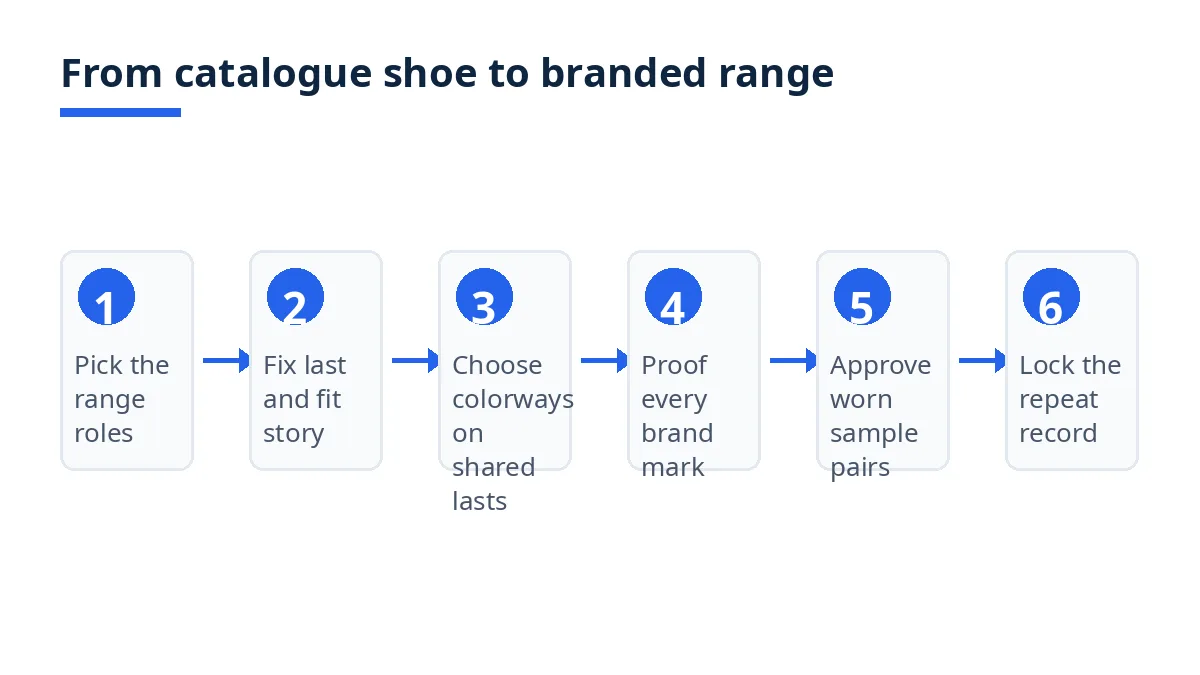
A private label leather shoes order from Bangladesh starts with a shoe that already exists. The factory has settled its last, pattern, and build, and already sews the shoe for other buyers or for its own catalogue. You put your name, fit story, and repeat range on a shoe someone else designed. This guide follows that job in order, from choosing the range to keeping the second order identical to the first. Every number below is an illustration, marked as example figures.
A shoe that already exists, sold under your name
Private label means the buyer's brand goes on a factory's existing or lightly adjusted design. Your contribution is the brand layer and the choices inside the factory's range: styles, colorways, sizes, and the marks that carry your name. A custom or OEM order is the opposite starting point: the design leaves your desk first, in a tech pack, and the factory cuts a pattern it has not cut before. The line between the two is the pattern. If your request changes a pattern piece, a last, or the way the shoe is built, you have entered custom work, with new samples, new grading, and a different calendar. Say so in writing when that line is crossed, and price the order on the new basis.
Ownership follows the same line. The factory normally keeps the last and the pattern, and you own the brand assets you supply: the name, the logo artwork, the label designs, and the box artwork. Put that split in the order file before sampling, with any exclusivity named by market, period, and styles, agreed by both sides in writing. Before artwork is printed, check the brand name in each market where the shoes will sell, including the trademark register and ordinary trade use.
Plan the range first: roles, lasts, and colorways
A range is a small set of shoes that sell together, not a list of favorites. Give each style a role before you pick it. An opener is the plain, easy-to-fit shoe that carries the first orders. A core style is the shoe the range is known for, in the colors that repeat every season. A statement style shows what the brand can do, even if it sells in smaller numbers. Three roles are enough, each with a one-line reason: who wears it, where it is worn, and what makes it yours.
Build the range on as few lasts as possible. A last is the foot-shaped form the upper is shaped over, fixing the shoe's shape, toe, and internal room. Two or three lasts can carry a whole first range if the styles share them, keeping fit consistent from one style to the next. Record the last identifier, width fitting, and size system for each style in one range sheet, and treat a change of last as a change of shoe, even when the leather and color stay the same.
Colorways multiply orders faster than styles do. Each colorway is a combination: one style, on one last, in one color, with one sole and one set of marks. Two styles in three colors are six combinations, each needing its own sample approval, shade agreement, and count. Keep the palette narrow at launch: two or three colors sharing lots are easier to match across repeats than six colors needing their own lots.
Fit carries the brand: one last, one width, one size story
For a brand owner, fit is the promise the customer tests with every step. A shoe that pinches in one style and fits in another teaches the customer that the brand has no consistent fit. Settle the fit story first: the last, the width, and the sizes the brand will always offer, in the same words on every style sheet.
Judge fit on worn pairs. Ask for sample pairs in the middle, smallest, and largest sizes, each made on the production last, and have each pair worn and walked in. Check the toe box, heel grip, instep, and width at the joint, and compare the left and right shoes. A visible difference between the two shoes can leave a pair unsellable even when each shoe looks sound on its own. Record measurements for each size against the supplier's chart for that last, and keep the worn sample pairs sealed as the fit record.
A width change is a last change for grading purposes, so narrow and wide versions of one style are two fit stories. Approve samples in each width, and never let a quotation move a style to a different width without a fresh fit check. State the size system for each destination market on the range sheet, and check that the size on the shoe, label, and box agrees with the measured pair.
The adjustment ladder: what stays private label
Factories often accept small changes to a catalogue shoe. Work up one rung at a time, and stop when the change would need a new pattern.
Rung | Change | Stays private label? |
|---|---|---|
1 | Color, finish, and thread color on the existing pattern | Yes, with a new shade agreement |
2 | Lining, insole print, and closure color on the existing build | Yes, with samples of each part |
3 | Sole color or heel finish on the existing sole unit | Yes, if the sole unit itself is unchanged |
4 | Brand marks: tongue label, insole print, heel emboss, box | Yes, with artwork proofs |
5 | Toe shape, panel layout, or last change | No, this is custom work |
Each rung needs its own sample: a shade sample for a color change, a worn-in pair for a lining change. Record which rung each style sits on, and re-approve the shoe whenever a rung changes. A style climbing the ladder in stages can reach custom work unnoticed, so name the rung in every approval note.
Marks on the shoe, the label, and the carton
A private label shoe carries more marks than a wholesale shoe: brand and size on the tongue label or insole print, an embossed mark on the heel or sole, and brand, style, color, size, and barcode on the box. Proof every mark at actual size before bulk, checking letter height, contrast, and legibility after flexing. A mark that cracks or peels when the shoe bends is a failed mark.
In the European Union, footwear labeling must give the materials of three parts: the upper, the lining and sock, and the outer sole.1 Only materials covering 80 percent or more of the upper, lining and sock, or outer sole need to be named; where none reaches 80 percent, the two main materials must be given.1 The label may be written or pictorial, must be visible, securely attached, and accessible, must appear on at least one shoe, and, for imports, the person who first places it on the EU market answers for its accuracy.1 Check the wording against the actual materials of the sealed sample pair, not the catalogue description.
In the United States, the Federal Trade Commission guides say a shoe may carry the bare word leather only when leather forms all of its substantial parts, and material that looks like leather but is not leather must be named for what it is, using terms the guides list such as vinyl, plastic, simulated leather, or imitation leather.2 Material made from ground or reconstituted leather fibers must not be sold under the plain word leather either; where bonded leather wording is used, the share of leather fibers and the share of other substances must be stated, and disclosures should appear as a stamping or on an attached tag, label, or card.2 For origin, every foreign-origin article imported into the United States must be marked conspicuously, as legibly, indelibly, and permanently as the article permits, with the English name of the country of origin.3 One proof sheet per style, signed by both sides, prevents the most common brand error: the right shoe with the wrong words on it.
Launch counts: combinations, curves, and calendar
A private label launch is counted in combinations. Example figures throughout this section. Three styles, each in two colorways, give six combinations. At 120 pairs per combination, the launch order is 720 pairs (120 x 6 = 720). The size curve splits each combination: EU sizes 40 to 45 at 10, 20, 30, 30, 20, and 10 pairs add to 120 (10 + 20 + 30 + 30 + 20 + 10 = 120).
Brand materials are counted separately, with spares. Example figures: for 720 pairs, order 800 sets of labels and boxes (720 + 80 = 800). Where a label or box is printed for one colorway only, its count follows that colorway. Ask the quotation to state each brand material, its count, and who pays for spares.
Money follows the same split. Example figures only, as an index with the launch total set at 100: shoes 62, brand materials 14, samples, freight, and inspection 16, and a launch reserve 8 (62 + 14 + 16 + 8 = 100). The reserve pays for a reprint, a second sample round, or a held carton. The delivery rule sits beside the money. Four Incoterms 2020 rules work only on sea and inland waterways: FAS, FOB, CFR, and CIF. CPT, DPU, and DDP work on any mode of transport, and under DDP the seller clears import customs and pays duty. Put the rule, named place or port, and Incoterms year on every quotation.
Count the calendar backward from the launch date, stage by stage, agreeing a date for each stage and holding the next stage until the last one is signed. For the commercial side, read how minimums are counted before comparing quotations.
Keep the second order the same shoe
The second order must be the same shoe: the same last, lot standard, build, shade, and marks. Lots change and catalogue styles are dropped, so ask before the first order ships how repeats are handled: whether the last is kept, whether the lot identity is recorded per combination, whether the shade standard survives to the next run, and how much notice the factory gives before a style or colorway is withdrawn. Record the answers in the range file, with the sealed pairs, artwork, proof sheets, and size charts, under one version number per style.
Note the producing site, the tannery that supplied the upper leather, and the firm named on the quotation and invoice, and check that names and addresses match across the trade license, the export registration certificate, and the order papers. The Leathergoods and Footwear Manufacturers and Exporters Association of Bangladesh describes its role as representing manufacturers and exporters of leather products, footwear, synthetics, and allied factories in Bangladesh.4 Membership alone proves only membership, so read any association or audit evidence for what it covers: the site, the scope, and the expiry date. On Exportain, read how Exportain checks supplier documents before shortlisting: document and photo checks are not a factory visit and do not promise capacity, quality, or delivery.
Where a shoe brand order unravels
A catalogue shoe chosen for its photo. A photo shows color and styling, not fit, last, lining, or sole build. Approve worn pairs in three sizes before bulk.
A fit story that changes between styles. One last, one width, and one chart per fit story. A style moved to a new last needs a new fit approval.
A color approved from memory. Judge shade under one agreed light, against one sealed sample pair, with the lot identity recorded.
Brand marks proofed on screen only. Proof at actual size, on the actual lining and box materials, after flexing.
Labeling copied from the catalogue. The materials label must match the sealed pair's actual upper, lining, and sole, and the origin mark must sit where the ultimate purchaser can find it.1 3
A name printed before it is checked. Check the brand name in each selling market before artwork goes to print.
A repeat assumed identical. Hold the range file, sealed pairs, and artwork under one version number, and re-approve when any of them changes.
Sign-off sheet for a first private-label shoe range
Hold bulk until every line is filled in for each combination.
Line | Record it exactly |
|---|---|
Range roles | Opener, core, and statement styles, each with a one-line reason |
Last and fit | Last identifier, width, size system, worn-pair approval in three sizes |
Colorways | Style, last, color, sole, marks, shade standard, and light per combination |
Adjustment rung | Rung 1 to 4, or custom work named as custom, per style |
Brand marks | Artwork files, positions, sizes, signed proof sheet per style |
Materials and origin labels | Wording checked against the sealed pair, origin mark position agreed |
Counts | Pairs per combination, size curve total, brand materials with spares |
Money and delivery | Unit price, delivery rule with place and year, validity, payment terms |
Repeats | Last and lot record, withdrawal notice, and range-file version number |
Evidence | Producing site, tannery, license and registration names matched to quotation |
What should a brand owner settle before picking a private-label shoe?
Settle the range, the fit story, and the ownership split first: range roles, shared lasts and widths, colorways counted as combinations, and who owns the last and pattern against who owns the artwork. Check the brand name in each selling market before printing.
How do launch counts and calendars work for a first shoe range?
Counts work per combination: styles multiplied by colorways, each with its own size curve and brand-material count. Example figures: three styles in two colorways at 120 pairs per combination give 720 pairs. Calendars run backward from the launch date, each stage signed before the next begins.
Which files and papers does a factory need for a branded shoe order?
The factory needs the artwork files, the range sheet, the signed proof sheet for every mark, the label wording, and order papers naming the same styles, combinations, counts, and delivery rule. Match the firm name and address across the license, the registration certificate, and the invoice.
What most often goes wrong on a first private-label shoe run?
Choosing from a photo, letting fit drift between lasts, approving color from memory, proofing marks on screen only, copying catalogue labeling, printing a name before checking it, and assuming a repeat is identical. Each is answered above, before bulk.
Next steps on Exportain
Start from the supplier listings with the range sheet, so each reply can be tested against the same lasts, colorways, and counts. Read how Exportain checks supplier documents, and test quotations against how minimums are counted.
Sources
- Footwear labelling. European Commission, EUR-Lex (accessed )
- PART 24—GUIDES FOR SELECT LEATHER AND IMITATION LEATHER PRODUCTS. Federal Trade Commission (accessed )
- 19 CFR § 134.11 — Country of origin marking required. Cornell Law Institute (accessed )
- President's Message - LFMEAB. Leathergoods and Footwear Manufacturers and Exporters Association of Bangladesh (LFMEAB) (accessed )
About the author
Sourcing from Bangladesh?
Post a request for quotation and suppliers on Exportain can send you their quotes directly.
Post an RFQ