Private Label Leather Gloves Manufacturing in Bangladesh: A Brand Owner's Guide
Private label leather gloves from Bangladesh, ordered on your brand: the brand pack, approval gates, labeling rules, trademark writing, and the checks before bulk.
Short answer
Private label leather gloves from Bangladesh use a factory's existing glove patterns with your brand applied. Send one versioned brand pack, confirm the pattern match, approve a physical branded sample and the label proofs, run a trial lot, and settle trademark and pattern ownership in writing before bulk. Check labeling for each destination market and verify the supplier before ordering.
On this page
Key takeaways
Private label uses the factory's existing glove patterns plus your brand; custom or OEM uses your design, specifications, and patterns. State the model in the first line of the purchase order.
Send one versioned brand pack, confirm the pattern match, approve a physical branded sample and label proofs, and run a trial lot before bulk sign-off.
Label wording follows the destination market: EN 388 and UKCA for protective gloves, United States origin marking, and leather wording checked market by market.
Settle trademark ownership, pattern ownership, exclusivity, and disposal of unused branded materials in writing before sampling; a tannery audit is not a glove certificate.
A private label leather gloves bangladesh order starts with a glove that already exists in a factory catalog, and ends with that glove carrying your brand.
What private label means on a glove order
A private label agreement is a contract under which one company manufactures products branded and sold by another under the latter's own label, often without disclosing the manufacturer.1 For gloves: you select a glove the factory already makes, add your brand identity, and the factory produces that glove with your branding.
Contract manufacturing, also called OEM in the brief for the later EXP-1392 unit, builds a product from scratch to the brand's specifications, owned by the brand.2 Private label starts from the manufacturer's existing catalog, where the manufacturer owns the formula and the brand owns the label.2 For gloves, the boundary is the pattern.
Question | Private label (this guide) | Custom or OEM (EXP-1392) |
|---|---|---|
Whose pattern is cut | The factory's existing pattern | Your pattern, built to your specification |
What you supply | Brand assets, label and packaging artwork | Design, specifications, and patterns |
What you own | Your brand name, artwork, and label and packaging design | The design and specifications you commissioned, as the agreement states |
A different finger length, thumb angle, panel layout, or lining the factory does not already sew into that glove is custom work.
Assemble the brand pack before any sample is cut
Send one brand pack, in one message, before sampling, and ask the factory to confirm receipt of every item in writing. The pack has four parts: logo artwork, label specification, packaging artwork, and written brand rules.
Logo artwork must be a vector file, not a screenshot or low-resolution image from a website. State the exact version, the minimum legible size on a glove label and hangtag, and the colors by their codes.
The label specification names every label: brand label, size label, care and material label, hangtag, and any sticker or stamp on the box or polybag. For each, state wording, languages, position, attachment method, and material.
Packaging artwork states the box or bag type, print colors, logo placement, barcode position, and wording on each face. The brand rules are a short page: who may use the trademark, where it may appear, what must never change without your written approval.
Run the glove through its brand-approval gates
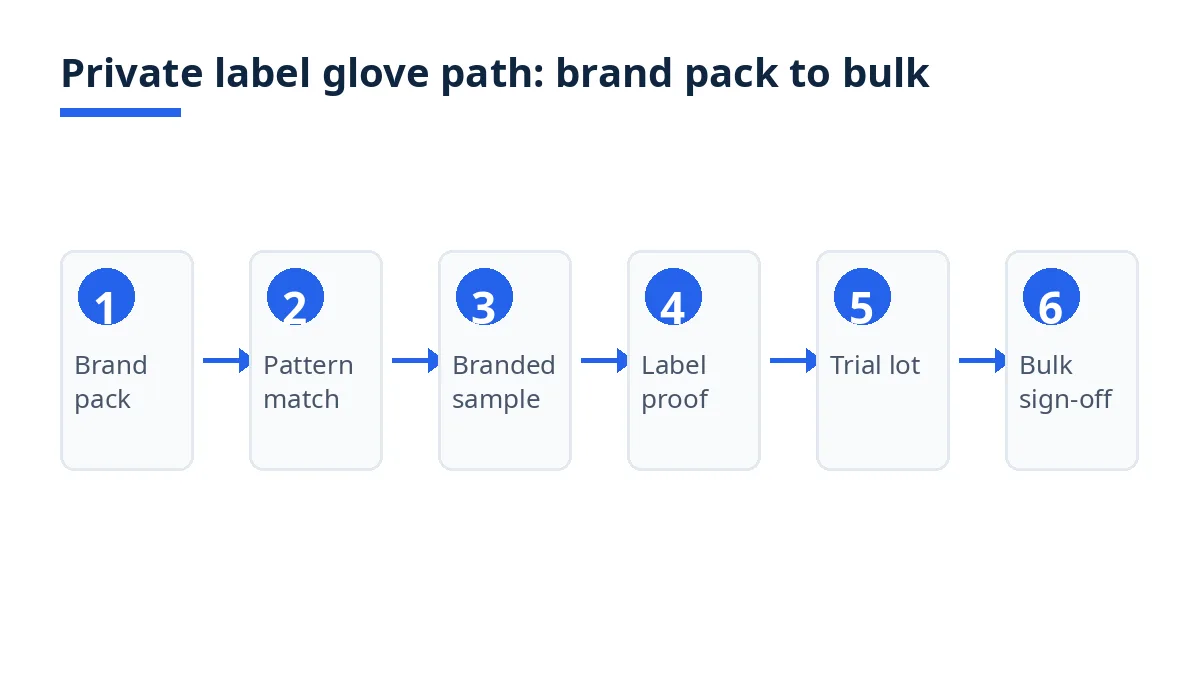
Approval has five gates. Bulk production starts only after the last is signed.
Gate one is the pattern match. The factory names the existing glove by style name or code, with leather type, lining, closure, sizes, and colors in writing.
Gate two is the branded sample: a physical branded sample pair, with labels and packaging as they will appear in bulk. Judge it as a pair, on hands. Check the logo version, size marking against the measured glove, label position, and packaging artwork.
Gate three is the label and packaging proof. Approve the printed proof for every label, hangtag, and box face, in final colors and at final size.
Gate four is the trial lot: a small lot run through the full branded process, from cutting to packing and inspection. If it shows label drift, shade variation, or packaging errors, correct the process and repeat the gate.
Gate five is the bulk sign-off. Bulk starts only when all four earlier gates are signed and the purchase order carries the same version numbers. Any change after gate five returns the order to the gate it affects.
The diagram below shows the path from brand pack to bulk sign-off.
Choose the glove underneath the brand
Three choices decide most of the fit: leather, cut and style, and lining. Each belongs in the specification, in the factory's own written words.
Sheepskin from hair sheep is described by one glove maker as very smooth and soft, with a supple grain, light weight, and extreme tensile strength, while wool sheep leather is less smooth, with poorer abrasion resistance, and is priced lower.3 Cowhide tanned for gloves is described by the same maker as combining stretch, softness, a smooth finish, and durability, with stretch less than sheep and deer.3 Goatskin is described as one of the most widely used glove leathers, chosen for value and durability, with strength fairly close to sheep and deer at a lower cost.3 The same maker gives common glove leather thickness from 0.7 to 1.0 millimeters.3
A dress, driving, work, and fashion glove differ in leather choice, lining, palm treatment, and closure.
Name the lining, attachment, and closure. The size number equals palm circumference in inches: tape the dominant hand below the knuckles, clear of the thumb, at its broadest point.4 That source's chart assigns size 11 to 10.5 to 11 inches, size 10 to 9.5 to 10, size 9 to 8.5 to 9, size 8 to 7.5 to 8, and size 7 to 6.5 to 7.4
Put the right words on the glove, the label and the box
Labeling is governed by the destination market, not by the factory.
For protective gloves sold in Europe, the standard is EN 388. EN 388:2016+A1:2018 specifies requirements, test methods, marking, and information for protective gloves against abrasion, blade cut, tear, puncture, and, where applicable, impact.5 The pictogram carries levels in a fixed order: abrasion, circular blade cut, tear, puncture, and the straight cut test as a letter, with an X where a cut test was not performed and a P where impact requirements are met.5 Levels run from Level 1 abrasion at 100 cycles to Level 4 at 8,000 cycles, tear from 10 to 75 newtons, puncture from 20 to 150 newtons, and straight blade cut from Level A at 2 to 5 newtons to Level F above 30 newtons.5 A fashion glove carries no EN 388 pictogram. The same source notes that under the PPE Regulation (EU) 2016/425, since 21 April 2019 it has been illegal to place gloves for mechanical protection on the EU market that have not been certified against the state of the art, EN 388:2016+A1:2018.5
For the United Kingdom, the marking scheme is UKCA. UKCA applies in Great Britain, meaning England, Wales, and Scotland, and does not apply to Northern Ireland, which follows the EU CE marking system.6 PPE gloves must meet the UK PPE Regulations 2018, with a UK Declaration of Conformity.6
For the United States, under 19 U.S.C. section 1304, every article of foreign origin must be marked in a conspicuous place, as legibly, indelibly, and permanently as the nature of the article or its container permits, with the English name of the country of origin.7 A Customs ruling on dress gloves cites an earlier Treasury Decision under which imported gloves must be marked by an ink stamp or a label permanently sewn or glued near the hem or cuff, in reasonable proximity to the size marking.7
For leather wording in the United States, the Federal Trade Commission Leather Guides state that it is unfair or deceptive to use the unqualified term "leather" unless the product is composed in all substantial parts of leather, and that non-leather material that appears to be leather should be disclosed, for example as "Imitation leather", "Simulated leather", "Vinyl", or "Plastic".8 Bonded leather requires the fiber and non-leather percentages.8 The scope text opened here does not name gloves in the list read.8
For the European Union and the United Kingdom, no single leather-labeling law for gloves was established by the sources opened here, and none is stated. The EU footwear labeling directive requires shoes to show the material of the upper, lining and sock, and outer sole, with leather defined as tanned hide or skin with its fibrous structure intact.9 The EU Textile Regulation requires textile products containing non-textile parts of animal origin, such as a leather trim, to state "Contains non-textile parts of animal origin".9 Italy and France reserve leather words for animal hide under national rules, and a German court in 2025 barred "apple leather" for collars containing no animal hide.9
For the UAE, no labeling rule was established by a source opened for this guide, and none is stated. Confirm UAE requirements with the buyer or broker before the label proof is approved. Protective instructions must state the covered part and limits, and travel with the glove.5
Who owns the name, the artwork and the pattern
Settle trademark ownership before the first sample, in writing, signed by both sides.
First, the trademark, logo artwork, and label and packaging designs you supply remain your property, and the factory's use of them is limited to producing your order. Sample private label agreements show the same protection through provisions on trademark license, inspection rights, branding, proprietary rights, and confidentiality.1 Second, the factory's existing pattern and manufacturing method remain the factory's property, and your order gives you no right to use that pattern elsewhere. Third, the factory will not sell gloves carrying your brand to any other buyer, will not use your artwork for any other purpose, and will return or destroy unused branded labels and packaging as you direct. Fourth, state that you own, or hold the right to use, the trademarks on the packaging and the glove, and that they do not infringe third-party rights.
What branding changes in the quotation, the calendar and the file
Price each branded element as its own quotation line: the glove as specified in the pattern match, lining and closure, brand labels and attachment, hangtags, retail packaging and printing, barcode or sticker work, and packing. Leather grade, lining, labeling and packaging complexity, and order size are the cost drivers to compare. No price is stated here, because no price source was opened for a branded glove order.
Agree each stage with its own date and owner: brand pack confirmation, pattern match, branded sample, label proof, trial lot, bulk production, inspection, and shipping. No day count is stated, because no timeline source was opened.
Keep every document carrying the same glove description, brand pack version, and size curve.
Minimum quantities deserve one cross-reference and no more. A glove minimum is counted per combination of style, color, lining, and related splits, and the counting basis must be agreed in writing; the MOQ guide explains how those counts work.10 Ask whether labels, hangtags, and packaging carry minimums of their own.
Bangladesh checks for a brand order
This guide states no factory location, capacity, or company name as a fact, because no source opened for it establishes one. Ask each factory, in writing, for the producing site and maker or trader status, and check that the name and address match across quotation, invoice, and packing list. LFMEAB calls itself Bangladesh's trade body for leather-product, footwear, synthetic, and allied factories and their exporters.11
Read the supplier verification guide and read each badge for the checks its name records, and ask for the establishment listing and export registration documents yourself. Badges record document and photo reviews, not factory inspections, and no badge guarantees capacity, quality, or delivery.12 The Leather Working Group audit protocol evaluates environmental performance in areas such as water and energy usage, waste and chemical management, air and noise emissions, and traceability, with Gold at 85 percent and above, Silver at 75 to 84 percent, and Bronze at 65 to 74 percent.13 The supplier must score the minimum in each section.14 It is not a certificate for a finished glove.
Five brand errors that reach the shop floor
Artwork supplied late, or in a format the printer cannot use.
Approving bulk production from a photograph instead of a physical branded sample: a photograph cannot show label adhesion or stamp legibility.
Ignoring the destination market's label law: approve the label proof market by market.
Leaving trademark ownership unwritten: if the agreement never states who owns the name, artwork, and pattern, the first successful order creates the dispute.
Mixing private label and custom expectations in one purchase order.
The pre-order brand file, line by line
Complete every line before the purchase order is sent.
Brand pack version confirmed received.
Pattern match confirmed: style name or code, leather, lining, closure, sizes, and colors.
Branded sample pair approved in writing from the physical pair.
Label proofs approved market by market.
Trial lot completed through the full branded process, record kept.
Ownership and exclusivity settled in writing.
Quotation lines for glove, labels, hangtags, packaging, and packing, with each branded minimum agreed.
Calendar agreed per gate; no bulk booking before sign-off.
Establishment listing and export registration checked, name and address matched.
Protective evidence, where claimed, naming glove, standard, method, and result.
How does a brand owner start a private label glove order?
Start with the brand pack and the pattern match. Send the vector logo, label specification, packaging artwork, and brand rules as one versioned pack, and ask the factory to name the existing glove it will supply, by style name or code, with leather, lining, closure, sizes, and colors in writing.1 2 Confirm the match in writing before any sample is cut.
What drives private label glove costs and approval time?
Costs are driven by leather grade and thickness, lining and closure, label and packaging complexity, and order size, with each branded element priced as its own quotation line. Approval time is driven by the gates, each with its own date, and each restart adding its own stage. No price or day count is stated as a fact here, because no source for one was opened.
Which papers carry the brand, the glove and the order?
The papers are the brand pack, the specification with the factory's size chart, the quotation with branded lines and minimums, the gate approvals, the label proofs, the trial lot and inspection records, and the invoice and packing list carrying the same glove description, brand pack version, and size curve. Keep the trademark ownership sentence in the agreement and purchase order, and the origin and leather wording for each market in that market's label proof.7 8
What goes wrong most often on a first private label glove run?
Late or unusable artwork, approval from a photograph instead of a physical branded sample, label law for the destination market ignored, trademark ownership left unwritten, and private label and custom expectations mixed in one purchase order. Fix each before sampling or before the gate it affects, in writing, with a version number.
Next steps on Exportain
Browse Bangladeshi suppliers before shortlisting. Read how supplier verification works on Exportain and the MOQ guide while writing the brand pack and specification. Then post a free RFQ with the factory pattern, brand pack version, glove job, sizes and colors, destination markets, and the label wording each market requires. Post a free RFQ on Exportain and get quotes from verified Bangladeshi suppliers → https://exportain.com/rfqs
Sources
- Private Label Agreement Clause Samples. Law Insider, (accessed )
- Contract Manufacturing vs Private Label: Full Breakdown. Selfnamed (accessed )
- Glove Company Tips: What's the Best Glove Leather?. Olympia Gloves, (accessed )
- How to measure glove size. Ansell (accessed )
- EN 388 – assessing mechanical risks. SATRA (accessed )
- PPE Pictograms Explained. Sentinel Laboratories (accessed )
- Customs Ruling HQ 562832 - Country of origin marking for imported dress gloves. U.S. Customs and Border Protection (accessed )
- 16 CFR § 24.2 - Deception as to composition. Legal Information Institute, Cornell Law School (accessed )
- Vegan Leather Labelling Rules: US, EU and UK Law Explained. Fashion Law Journal (accessed )
- MOQ Meaning (Minimum Order Quantity). Exportain (accessed )
- President's Message - LFMEAB. Leathergoods and Footwear Manufacturers and Exporters Association of Bangladesh (LFMEAB) (accessed )
- How Supplier Verification Works on Exportain. Exportain, (accessed )
- GOLD STANDARD IN LEATHER MAKING. Mossop Leather, (accessed )
- Leather from LWG certified manufacturers. Vagabond (accessed )
About the author
Sourcing from Bangladesh?
Post a request for quotation and suppliers on Exportain can send you their quotes directly.
Post an RFQ