Private Label Knitted Underwear Manufacturing in Bangladesh: A Brand Owner's Guide
Private label knitted underwear from Bangladesh, planned as two linked productions: the garment and the branding set of labels, logo waistband, hang tags and retail packaging, with the brand owner carrying destination-market labeling duties.
Short answer
Private label knitted underwear from Bangladesh means the factory makes the garment to your specification and applies your brand at every point the customer sees it: woven and care labels, a logo waistband, hang tags and retail packaging. The factory executes the artwork, but you as brand owner carry the labeling and compliance duties in the destination market, so approve every label, waistband and pack proof in writing before bulk production.
On this page
Key takeaways
Private label knitted underwear is two linked productions: the garment, and the branding set of labels, logo waistband, hang tags and retail packaging, each with its own run and minimum.
A logo waistband is either woven into the elastic or printed on it. Approve it stretched and unstretched, because a repeat that reads well relaxed can distort when worn.
The factory executes your branding, but in the EU, the United States and the United Kingdom the duty for label accuracy sits with the business placing the product on the market under its own name.
Approve every branded element as a physical sample in full retail form before bulk production, and keep one controlled artwork version for labels, waistband and packs.
Private label knitted underwear from Bangladesh is not a standard garment with a different label sewn in at the end. Your brand sits on the woven label, the waistband elastic, the hang tag and the retail pack, and each item is made in its own run, to your artwork, before or alongside the garments. Plan those runs from the start and you get a retail-ready product. Treat them as finishing details and they surface as delays, extra minimums and relabeling.
The Bangladesh Knitwear Manufacturers and Exporters Association (BKMEA), established in 1996, represents approximately 2,540 knitwear member factories.1 Knitwear exports reached $5.963 billion in July to September 2026, up 6.88 percent year on year, within ready-made garment exports of $10.578 billion, according to data released by the Export Promotion Bureau (EPB).2 This guide covers only the private label route: what your brand adds, how each element is executed, and which compliance duties stay with you. For the wider factory landscape see knitted underwear manufacturers in Bangladesh; for unbranded bulk buying see wholesale knitted underwear from Bangladesh.
What private label adds to a knitted underwear order
What should I know first about knitted underwear?
Know first that private label splits one order into two linked productions: the garment and the branding set. The branding set follows separate routes, with separate suppliers, minimums and lead times, and both must meet at the packing line in the right sizes and ratios.
In the Harmonized System, heading 6107 covers underpants, briefs and similar articles for men and boys, knitted or crocheted,3 and heading 6108 covers briefs and panties for women and girls, knitted or crocheted.4 See the HS code for knitted underwear guide for subheadings by fibre.
Woven and printed labels. The main brand label carries your name or logo and usually the size. A woven label is woven to your artwork, so the lettering is part of the label itself. A printed label is printed on tape, which sets up faster and reads smaller text cleanly. A separate care and fibre label carries the composition, care, size and origin information the destination market requires. State artwork, dimensions, fold, stitch position and language set for each label, and approve a strike-off first.
Waistband logo execution. On briefs and trunks the waistband is the most visible branding surface. In a woven, or jacquard, waistband the logo is woven into the elastic as it is made, repeating around the band. Artwork, repeat, width and colours are fixed before production, so a change after weaving means a new run. In a printed waistband a plain elastic is printed after weaving: the mark can be sharper, but it sits on the surface.
Retail packaging. Underwear is rarely sold loose, so packaging is part of the product. Formats are a single-pair card or box, a multi-pack box or bag, and a hanger pack. Each needs its own artwork: front panel, size and colour marking, fibre and care information where the market requires it, a barcode per size, and any claims wording. Barcode and pack quantity must match the contents. Approve a filled, sealed pack.
Branded element | How it is made | What you approve | Minimum set by |
|---|---|---|---|
Woven brand label | Woven to your artwork | Strike-off, size, fold, position | Weaving run per design |
Printed label | Printed on tape | Proof, text, language set | Print run per design |
Logo waistband | Woven in, or printed on elastic | Stretched and unstretched sample | Elastic run per width and repeat |
Retail pack | Printed box, card or bag | Filled pack, barcode per size | Print run per format |
Example figures: one trunk style in three colours and four sizes, packed as single pairs, needs three waistband colourways and twelve size-specific barcodes in its branding set. These example figures are illustrative only, not a typical MOQ, price or lead time,.
Why this matters for buyers and sellers
For the buyer, private label turns a sourced garment into an own-brand product a retailer can list and a customer can reorder by name.
For the seller, a private label order carries more set-up work per style than a plain order, and its branded inputs fit no other customer. Factories therefore itemise label, elastic and packaging runs apart from the garment price. The garment price build-up is in knitted underwear price in Bangladesh, and the minimums behind it in knitted underwear MOQ in Bangladesh.
The factory executes your branding, but the duty for what the label and pack say sits with the business placing the product on the market under its own name.
Step-by-step: how it works
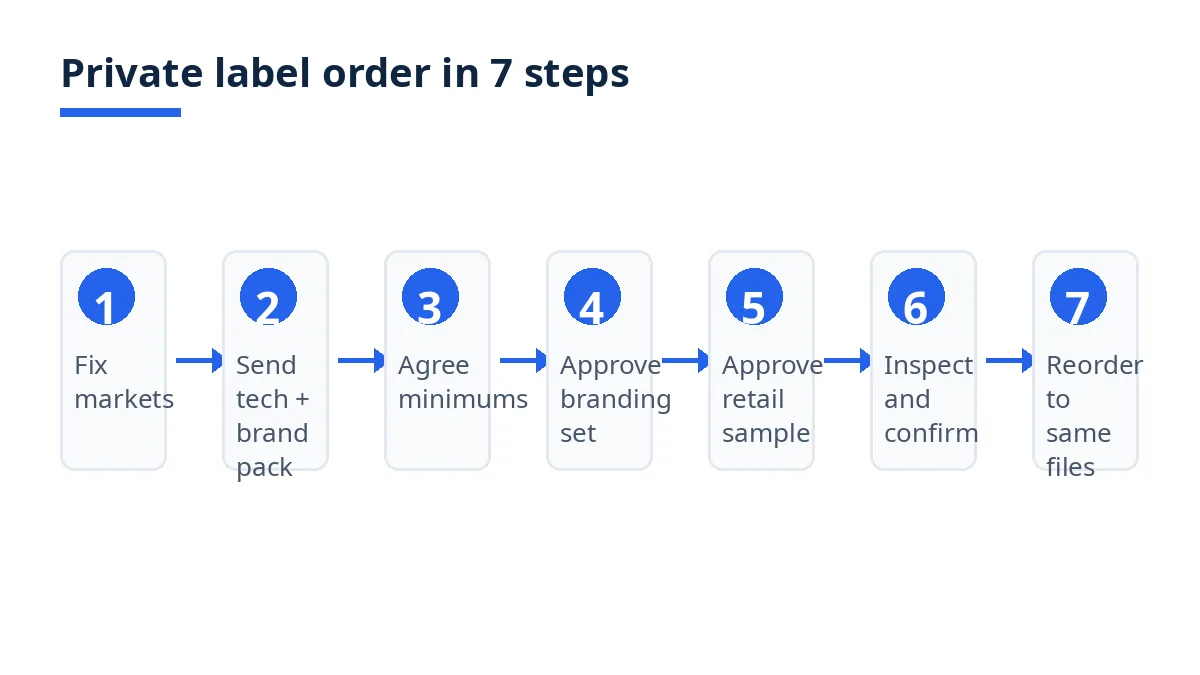
Fix the destination markets first. Fibre wording, care content, language and pack information differ by market, and one label set does not serve every market at once.
Send the tech pack and the brand pack together. The tech pack states fabric, style, sizes, size ratio, elastic width and packing. The brand pack states label and waistband artwork, tag and pack artwork, barcodes per size, and the fibre, care and origin wording per market.
Agree every minimum line by line. Ask for the garment minimum per style, colour and size ratio, and separately for the label, elastic, tag and pack minimums, and which line is binding, recorded on the quotation.
Approve the branding set as physical samples. Approve the label strike-off, the waistband stretched and unstretched, and a filled retail pack, reading every word against your label spec.
Approve the pre-production sample in full retail form. The finished garment with labels sewn in, waistband fitted and pack made up, washed and measured, approved or corrected in writing.
Agree inspection and delivery term before you confirm. State one Incoterm and named place for every quotation: the Incoterms 2020 rules set out 11 rules with a clear allocation of cost, risk and obligations.5 Write the inspection level and acceptance quality limit (AQL) values into the purchase order. ISO 2859-1 defines acceptance sampling plans for inspection by attributes, indexed by AQL for lot-by-lot inspection.6 Add label, waistband and pack checks, using the knitted underwear quality control checklist.
Confirm reorders against the same brand pack. Keep the approved artwork files as the controlled version, and state the version on every repeat order.
Costs, timelines and documents
What are the typical costs and timelines?
There are no typical private label costs or timelines, because each factory prices your garment plus your branding set. Private label adds its own lines: label weaving or printing, custom waistband elastic, hang tags, retail pack printing, barcode work. Each line is a set-up plus a run, so quantity per style, colour and pack format moves the unit cost of the branding set just as it moves the garment.
For timelines, the branding set usually sets the critical path: labels and custom elastic must exist before garments can be finished, and printed packs before garments can be packed.
Which documents are needed?
The order documents are the tech pack, brand pack with controlled artwork versions, label spec per market, itemised quotation and purchase order. Keep approved proofs and the sample sign-off with the order file.
The compliance duty sits with you. In the EU, Regulation (EU) No 1007/2011 states that a textile product shall be labelled or marked with the name and percentage by weight of all constituent fibres in descending order,7 and that labelling shall be durable, easily legible, visible and accessible and, for a label, securely attached.7 The same regulation makes the manufacturer responsible for the label and its accuracy, gives that duty to the importer where the manufacturer is not established in the Union, and treats a distributor as a manufacturer where it places a product on the market under its name or trademark.7 A brand owner selling under its own trademark is therefore answerable for fibre accuracy there.
In the United States, the rules under the Textile Fiber Products Identification Act require textile products to be labelled with the required information, and a person who directs a processor or finisher to label a product is responsible for compliance failures caused by that direction.8 The Care Labeling Rule requires manufacturers and importers of textile wearing apparel to provide regular care instructions through care labels,9 and to hold a reasonable basis for that information before sale.9 A US label spec must therefore carry fibre content, the responsible company identity and country of origin, plus a supported care instruction.
In the United Kingdom, government guidance states that the label must show the fibre content, including fur and other animal parts, that each component's content must be shown where components differ, and that manufacturers and retailers are responsible for complying.10
For export clearance from Bangladesh, goods may not be loaded unless an export declaration, the Bill of Export or Shipping Bill, is submitted to Customs and approved.11 Enclosed documents include the export contract or purchase order where there is no export letter of credit, the commercial invoice, the packing list, the EXP form certified by an authorized dealer, and a certificate of origin issued by the EPB or a Chamber of Commerce and Industry.11
Bangladesh-specific rules and tips
Confirm association claims at the source. If a supplier claims BKMEA membership, confirm it with the association itself. BKMEA represents the knitwear sector and its member factories,1 and states that it addresses environmental and labour standard issues in its member factories.1 Membership signals an active knitwear business, not in-house label or printing capability, so ask which elements are made in-house and which are bought in.
Ask where each branded element is produced. Woven labels, jacquard elastic and printed boxes are often made by specialist suppliers away from the sewing factory. Record the maker and ready date for each element.
Keep one legal name and one artwork version across every paper. The export declaration names the exporter and the foreign buyer,11 so the buyer name on the quotation, purchase order, payment account and export set should match, and artwork files should be controlled and dated.
Mistakes and red flags
What are the most common mistakes?
Approving artwork on screen only. Screens hide weave texture, print finish, label size and elastic stretch. A logo that reads cleanly as a file can blur in weaving or distort on a worn waistband.
Sending the label spec after production starts. Fibre and care wording decides label size, print layout and language set. A late spec can hold finished garments at the packing line or force a relabel.
Copying fibre wording from a different fabric. The label must state the fibre content of the fabric actually used in bulk, in the form the destination market requires.7 8 If the blend changes, all wording must change before the run is printed.
Letting the factory own your artwork files by default. State in the purchase order that your artwork is made for your orders only, keep controlled copies, and agree the return or disposal of overruns and leftovers in writing.
Printing claims you cannot support. Tag and pack claims are your statements as brand owner. Print only claims you hold evidence for.
Treating a badge as proof of private label capability. A badge records document and photo checks. It does not test label, elastic or packing capability, and it is not a guarantee of capacity, quality or delivery.12
Checklist
Every line should be answered in writing.
Destination markets listed, with one label spec per market.
Tech pack and brand pack sent together, artwork versions dated and controlled.
Label type chosen per label, with dimensions, fold and position stated.
Waistband execution chosen: logo woven in or printed, with width, repeat and colours stated.
Retail pack format, artwork and barcode per size approved as a filled pack.
Minimums confirmed per style, colour and size ratio, and separately for labels, elastic, tags and packs.
Fibre, care and origin wording checked against destination market rules.7 8 9 10
Label strike-off, stretched waistband sample and retail-form pre-production sample approved in writing.
Inspection level and AQL values in the purchase order, with label, waistband and pack checks included.6
Quotations compared on the same specification, branding set and Incoterm.5
Export set agreed: invoice, packing list, EXP form, certificate of origin, Bill of Export.11
Artwork ownership, leftover materials and reorder version stated on the purchase order.
How Exportain helps
On Exportain, browse suppliers and post a request for quotation (RFQ) on the RFQ board with your tech pack summary, size ratio, pack format and destination markets, so suppliers quote garment and branding set on the same specification. Ask each reply for its label, elastic and pack minimums apart from the garment minimum. When you accept a quotation, Exportain creates one order and issues one proforma invoice from the accepted terms.12
Read the badges for what they record. Exportain Verified means identity, phone, email and business registration have been checked, and Export Verified means the Export Registration Certificate (ERC) has been checked.12 Factory Verified means factory photos have been reviewed, and Trading Company Verified means office or warehouse photos have been reviewed.12 Verification is a document review by staff, free, and never granted by membership plans.13 It is not a factory inspection,12 13 so sample approval and label checking stay with you. See how supplier verification works on Exportain.
FAQs
What should I know first about knitted underwear?
First, private label is two linked productions: the garment and the branding set of labels, logo waistband, hang tags and retail packaging, each with its own run and minimum. Fix the destination markets before artwork: their label rules decide what the set must say.
What are the typical costs and timelines?
There are no typical figures a brand owner can rely on, because each factory prices your garment and branding set for your specification. Label, elastic, tag and pack runs add set-up and run costs on top of the garment price, and artwork and print runs sit ahead of bulk sewing.
Which documents are needed?
The order documents are the tech pack, brand pack, label spec per market, itemised quotation and purchase order. The export set is the Bill of Export, invoice, packing list, EXP form certified by an authorized dealer, and a certificate of origin from the EPB or a Chamber of Commerce and Industry.11
What are the most common mistakes?
The most common mistakes are approving artwork on screen only, sending the label spec after production starts, copying fibre wording from a different fabric, and printing claims without evidence. Reading a badge as proof of capability is another: a badge is not a guarantee of capacity, quality or delivery.12
Next steps on Exportain
Browse suppliers, then post your tech pack, brand pack summary and markets on the RFQ board so suppliers quote garment and branding set together. Before confirming, read the MOQ guide on how minimums combine.
Sources
- BKMEA at a Glance. BKMEA (accessed )
- Merchandise exports rise 6.34pc to $13.09b in Q1 FY27: EPB. The Financial Express, (accessed )
- Classification Detail — HS Code 6107. United Nations Statistics Division (accessed )
- Classification Detail — HS Code 6108. United Nations Statistics Division (accessed )
- Incoterms® 2020. International Chamber of Commerce (ICC) (accessed )
- ISO 2859-1:2026 - Sampling procedures for inspection by attributes — Part 1: Sampling schemes indexed by acceptance quality limit (AQL) for lot-by-lot inspection. ISO (accessed )
- Regulation (EU) No 1007/2011 on textile fibre names and related labelling and marking of the fibre composition of textile products. European Union, (accessed )
- 16 CFR Part 303 — Rules and Regulations Under the Textile Fiber Products Identification Act. United States Federal Trade Commission (accessed )
- 16 CFR Part 423 — Care Labeling of Textile Wearing Apparel and Certain Piece Goods. United States Federal Trade Commission (accessed )
- Textile labelling. GOV.UK (accessed )
- Customs Clearance Procedures for Export. Bangladesh Customs, National Board of Revenue (accessed )
- Trust & Safety Center. Exportain (accessed )
- Supplier verification: Earn trust badges buyers can see. Exportain (accessed )
- supplier verification
- knitwear
- buyer guide
- Bangladesh sourcing
- bangladesh garments
- Knitted underwear
- Private label apparel
About the author
Sourcing from Bangladesh?
Post a request for quotation and suppliers on Exportain can send you their quotes directly.
Post an RFQ