

Private Label Kitchen Towels Manufacturing in Bangladesh: A Brand Owner's Guide
Private label kitchen towels from Bangladesh: what brand owners must fix before sampling — label law per market, brand quality checks, artwork ownership and the contract clauses that protect the brand.
Short answer
Private label kitchen towels from Bangladesh are made to your specification under your brand. Before sampling, approve the label proof for each sales market, fix the brand colour standard and the sampling plan, and settle artwork ownership, exclusivity, change control and reject handling in writing, because the label and the contract carry the brand risk.
On this page
Key takeaways
A private-label order is two products at once: a towel and a piece of brand presentation, and the label proof, colour standard and contract need approval before bulk.
In the EU, fibre names and percentages by weight must appear in descending order; in the US, the label must state fibre content, country of origin and manufacturer or marketer identity.
Brand inspection adds label legibility, colour, barcode and pack checks to ordinary towel inspection, under the same agreed sampling plan and acceptance rule.
Artwork ownership, exclusivity, change control, reject handling and spare-label destruction belong in the order before sampling, not in a message thread.
Exportain badges record a document and photo review, not a factory inspection, so label approval, sample approval and inspection stay with the buyer.
A private-label kitchen towel order puts your brand name on a product another factory makes. The factory controls the loom, the dye bath and the stitching, but you control the artwork, the label wording, the packing and the finished standard. If the label is wrong, the shade drifts from your brand colour, or the contract never says who owns the artwork, the problem reaches your customer carrying your name.
This guide is for the brand owner, not for a buyer of unbranded stock.
What private label means for a kitchen-towel brand
Private label means the factory produces a towel to your specification and applies your brand, rather than selling you its own branded or unbranded stock. You supply the towel specification, the colour standard, the artwork and the label text. The factory supplies the fabric, the making and the packing. The order is two products at once: a towel and a piece of brand presentation, and both need approval.
What should I know first about kitchen towels?
Kitchen towels divide mainly by construction. Terry towels carry loops that absorb water, waffle towels carry a grid weave that dries fast and stays light, and flat-weave towels, including flour-sack styles, are smooth and lint-light for glass and polished surfaces. Each behaves differently after washing: terry can shed lint early, waffle can pull at the grid edges if the hem is light, and flat weave shows every print defect because no pile hides it. Fix weight, size and hem in the specification.
Classification follows the towel, not the brand. Heading 6302 covers bed linen, table linen, toilet linen and kitchen linen; subheading 630260 covers kitchen and toilet linen of terry towelling or similar terry fabrics, of cotton, while 630291 covers toilet and kitchen linen of cotton excluding terry towelling, 630293 covers toilet and kitchen linen of man-made fibres, and 630299 covers toilet and kitchen linen of other textile materials.1 Confirm the national code with your customs broker, because duty and import paperwork follow it. See the HS code for kitchen towels guide.
Your label is a legal document, not a decoration
A woven label, a printed care label and a hang tag look small, but in the destination market they carry legal duties. Get the label wrong and the shipment can be held, relabelled at your cost, or refused by a retailer, even when the towel is well made. The factory prints what you approve, so the approval is where the duty sits.
In the European Union, Regulation (EU) No 1007/2011 requires a textile product to be labelled or marked with the name and percentage by weight of all constituent fibres in descending order.2 Fibre names must be the standard names, percentages must add up, and a fibre that drops below the stated percentage after a fabric change needs a new proof. Check the language of the country of sale as well.
In the United States, the Federal Trade Commission guidance states that the label must state the country of origin and the identity, either name or Registered Identification Number, of the manufacturer or other business responsible for marketing the item, and the fibre content.3 Decide before sampling whether the label carries your company name, the factory name, or your Registered Identification Number where you hold one, and match that decision to the name on your import documents.
Market | Label must carry | Proof to approve before bulk |
|---|---|---|
European Union | Fibre names and percentages by weight, descending2 | Fibre proof against bulk fabric, in the language of sale |
United States | Fibre content, origin, and manufacturer or marketer identity3 | Identity, origin and fibre lines checked against import papers |
Every market | Brand artwork, size, care wording and barcode as the retailer requires | One signed proof per design, colour and size |
Agree the care wording in writing. A care claim the fabric cannot meet will be read as a product fault. Version the label file: when the composition changes, the label file changes, and the old file is withdrawn in writing.
Brand quality control: what you check that a wholesale buyer does not
Ordinary towel inspection checks size, stitching, stains and absorbency. Brand inspection checks all of that plus everything carrying your name. A towel can pass a generic check and still fail as your product, because the failure sits in the label, the colour or the pack.
Check the brand items on the pre-production sample and again on the first packed cartons: the woven label must read legibly after washing, print on a printed label must not bleed, and the label must sit in the same position on every towel. Check the brand colour against a physical colour standard, not a screen photo, because screens shift shade. Check the barcode scans, the set composition matches the pack promise, and the outer carton carries your brand and the correct set count.
Set the sampling plan before production. ISO 2859-1 defines a system of acceptance sampling plans for inspection by attributes, indexed by acceptance quality limit (AQL) for lot-by-lot inspection.4 AQL is the maximum average percentage of defective items considered acceptable during random sampling, and it determines sample sizes and acceptance or rejection thresholds.4 Apply the plan to brand defects too: a misspelled brand name, a wrong fibre percentage and a swapped barcode are defects with the same acceptance rule as a torn hem.
The private-label contract: clauses to settle before sampling
Most private-label disputes are not about towel quality. They are about ownership and reuse: who owns the artwork, who keeps the screens and label plates, whether the factory may sell your design to another buyer, and what happens to spare labels when the order ends. Settle each point before the first sample is cut.
Cover artwork and tooling first. State that the artwork, brand files, screens, label plates and embroidery files made for your order are your property, held only for your orders, and returned or destroyed at your written instruction when the relationship ends. Cover exclusivity next: the factory must not produce, offer or sell your design, colourway or label to any other buyer, including as unbranded stock with the label removed.
Cover change control and rejection in the same document. No change to fabric, composition, colour, label text or packing happens without your written approval, and a change made without approval is a rejectable defect. Rejected branded stock is not sold on, donated or reworked without your written release. Settle repeat terms too: whether set-up cost is paid once, how long the repeat price holds, and how spare labels are stored, counted and destroyed.
Why this matters for buyers and sellers
For the buyer, a private-label order concentrates risk in the brand. A wholesale buyer who receives a poor towel loses one order; a brand owner who ships a mislabelled or off-shade towel puts the brand on every shelf the towel reaches.
For the seller, a private-label order concentrates risk in stock that cannot be resold. Fabric dyed to your brand colour and labels printed with your name have no second buyer, so the factory prices exclusivity and set-up into the order.
Step-by-step: how it works
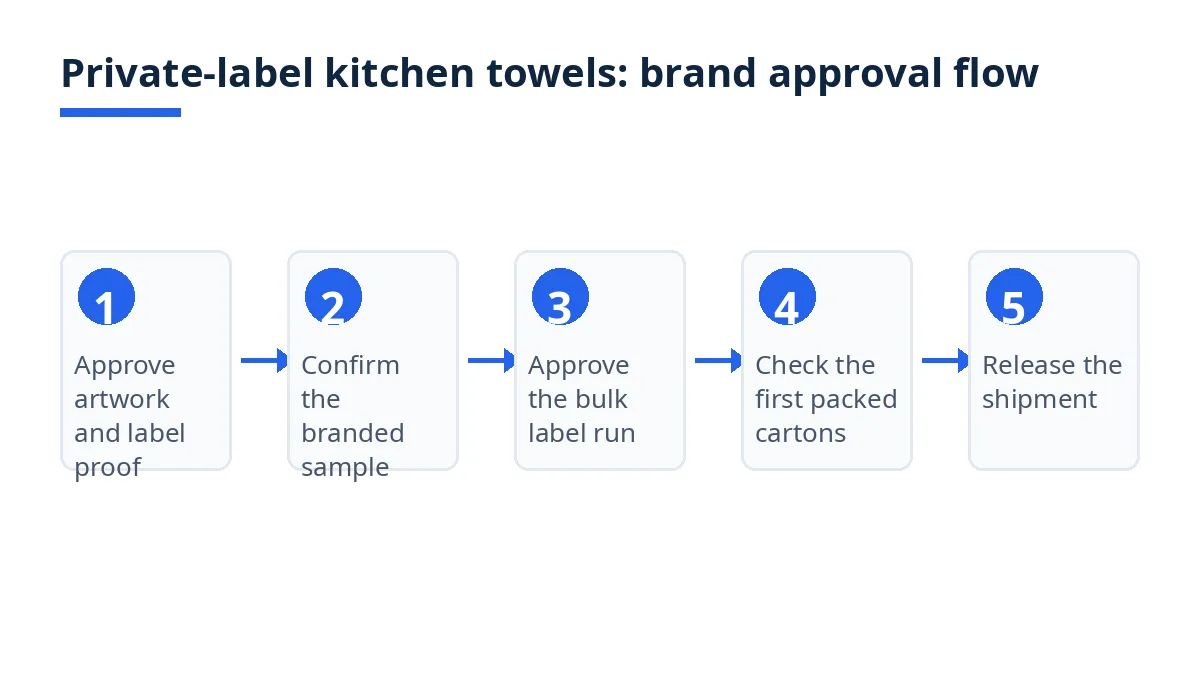
The brand-led flow below differs from a generic sourcing flow because label and artwork approvals gate each stage. Do not let bulk production start while a label proof is still open.
Fix the brand pack first. Decide construction, size, colour standard, set composition and retail pack.
Send one artwork and label file per design. Supply print-ready artwork, bulk fabric composition and label text per sales market.
Approve the label proof on its own. Check fibre lines, origin and identity lines, spelling, barcode and colour first.
Approve the branded pre-production sample. Check towel, label, colour, set and carton together.
Confirm the bulk label run. Confirm label quantity, carton marking and spare-label count in writing.
Inspect against the brand plan. Run the agreed sampling plan on towel defects and brand defects together.4
Check the first packed cartons before release. Open cartons, scan barcodes, count sets and check carton marks.
Release and file the brand record. Keep the label proof, sample approval, inspection record and spare-label count on file.
Costs, timelines and documents
What are the typical costs and timelines?
There are no typical costs or timelines a guide can state as fact, because each factory prices your construction, colour, label type, set composition and delivery term separately. Brand items add their own lines: artwork preparation, label plates or screens, label print runs, barcode registration where you hold it, and colour-matching work. Ask for those lines apart from the towel unit price.
Timelines follow the same logic. Sampling depends on fabric availability and label proof corrections, and bulk production depends on dyeing, label delivery and line capacity. Ask for sampling, label ready, production and inspection dates as separate lines, and treat an open label proof as a schedule risk.
Example figures: two label proofs, one correction round and one branded sample before bulk approval. The example shows the approval sequence only, not a typical cost, quantity or lead time.
Which documents are needed?
The order documents are the towel specification, versioned artwork and label files, itemized quotation, purchase order carrying the brand clauses, sample approvals and inspection record. For export clearance in Bangladesh, goods may not be loaded unless an export declaration, the Bill of Export or Shipping Bill, is submitted to Customs and approved.5 Enclosed documents include the export contract or purchase order where there is no export letter of credit, the commercial invoice, the packing list, the EXP form certified by an authorized dealer, and a certificate of origin issued by the EPB or a Chamber of Commerce and Industry.5
State one delivery term on every quotation. The Incoterms 2020 rules set out 11 rules with a clear allocation of cost, risk and obligations.6 Compare quotations only on the same term.
Bangladesh-specific rules and tips
Keep one legal name across every paper. The export declaration names the exporter and the foreign buyer,5 so the name on the trade licence, quotation, proforma invoice and payment account should match the identity line on your brand label. Settle any mismatch before printing.
Confirm association and factory claims at the source. If a supplier claims trade-body membership or a particular factory capability, confirm it with the body or by a visit record, not by a profile page alone.
Ask which inputs are imported for your label run. Woven label yarn, label plates and some dyes may be bought in for your specification, and an imported label input can set the earliest production date and the spare-label quantity.
Mistakes and red flags
What are the most common mistakes?
Approving the towel and forgetting the label. A buyer who approves a sample for feel and size but never reads the label proof ships a brand error at full order quantity.
Letting the fabric change without a label change. A switch from one cotton blend to another changes the fibre line, and a label carrying the old composition mislabels the towel in every market.2 3
Leaving artwork ownership unwritten. Without a written clause, the factory may treat screens, plates and label files as its own tooling and reuse your design.
Treating a profile or a badge as brand protection. A profile is a starting point for enquiries, and a badge records a document and photo review, not a factory inspection.
Releasing branded rejects into the market. Rejected towels carrying your label, sold on without your release, put your brand in front of customers on goods you refused.
Checklist
Before you confirm, every line should be answered in writing.
Towel construction, size, weight, colour standard and hem fixed.
Label type, fibre, origin and identity lines, care wording and barcode fixed per market.
Artwork and label files versioned; superseded versions withdrawn.
Label proof read line by line and signed as its own approval.
Branded pre-production sample approved: towel, label, colour, set, carton.
Artwork ownership, exclusivity, change control and reject handling in the order.
Spare-label quantity, storage and destruction agreed and recorded.
Sampling plan and acceptance rule agreed for towel and brand defects.4
Bulk label run, carton marking and first-carton check confirmed.
Quotations compared on the same specification, label run and Incoterm.6
Export set agreed: invoice, packing list, EXP form, origin certificate, Bill of Export.5
How Exportain helps
On Exportain, browse suppliers and post a request for quotation (RFQ) on the RFQ board with your towel and label specifications and delivery term, so suppliers quote against the same brand pack. Ask each reply for its label proof process, colour standard method and artwork ownership terms.
Read the badges for what they record. Exportain Verified means Exportain has checked identity, phone, email and business registration, and Export Verified means it has checked the Export Registration Certificate (ERC).7 Factory Verified means it has reviewed photos of the manufacturer factory, while Trading Company Verified means it has reviewed photos of the trading company office or warehouse.7 Verification is a document review by staff, free, and never granted by membership plans.8 It is not a factory inspection,7 8 so label approval, sample approval and inspection stay with you. When you accept a quotation, Exportain creates one order and issues one proforma invoice from the accepted terms.7 Exportain is not a party to the goods contract, so your private-label clauses still belong in your order with the supplier.
FAQs
What should I know first about kitchen towels?
Start with construction and classification: heading 6302 separates terry cotton kitchen linen under 630260 from cotton non-terry under 630291, man-made fibres under 630293 and other materials under 630299.1 Fix construction, size and colour standard before artwork.
What are the typical costs and timelines?
There are no typical figures, because each factory prices your construction, colour, label type, set composition and delivery term separately.6 Brand lines sit apart from the towel unit price.
Which documents are needed?
The order documents are the towel specification, versioned artwork and label files, quotation, purchase order with the brand clauses, sample approvals and inspection record. The export set is the Bill of Export, commercial invoice, packing list, EXP form certified by an authorized dealer, and certificate of origin issued by the EPB or a Chamber of Commerce and Industry.5
What are the most common mistakes?
The most common mistakes are approving the towel without reading the label proof, letting a fabric change pass without a label change,2 3 leaving artwork ownership unwritten, and reading a badge as brand protection.7
Next steps on Exportain
Browse suppliers, then post your towel specification and label specification on the RFQ board so suppliers quote the same brand pack. Before you confirm, read how to import kitchen towels from Bangladesh and the kitchen towels quality control checklist.
Sources
- HS 2017 - Code 6302: Bed linen, table linen, toilet linen and kitchen linen. United Nations Statistics Division (accessed )
- Regulation (EU) No 1007/2011 on textile fibre names and related labelling and marking of the fibre composition of textile products. European Union, (accessed )
- Cachet of Cashmere: Complying with the Wool Products Labeling Act. Federal Trade Commission (accessed )
- ISO 2859-1:2026 - Sampling procedures for inspection by attributes — Part 1: Sampling schemes indexed by acceptance quality limit (AQL) for lot-by-lot inspection. ISO (accessed )
- Customs Clearance Procedures for Export. Bangladesh Customs, National Board of Revenue (accessed )
- Incoterms® 2020. International Chamber of Commerce (ICC) (accessed )
- Trust & Safety Center. Exportain (accessed )
- Supplier verification: Earn trust badges buyers can see. Exportain (accessed )
About the author
Sourcing from Bangladesh?
Post a request for quotation and suppliers on Exportain can send you their quotes directly.
Post an RFQ


