

Private Label Curtains in Bangladesh: A Brand Owner's Guide
Private label curtains in Bangladesh, from the brand owner side: collection and label decisions, partner fit, sampling approvals and quality control for your own label.
Short answer
Private label curtains in Bangladesh are curtains made to your own brand, not bought as a generic range. You set the collection, labels, packaging and quality standard, and a partner in Bangladesh makes the curtains to that specification. Success depends on deciding the brand first, approving physical samples in writing, and holding the same standard on every repeat order.
On this page
Key takeaways
Private label curtains in Bangladesh are curtains made to your own brand, not bought as a generic range.
Brand decisions come first: positioning, collection, labelling and packaging.
A partner must fit your brand: label handling, repeat consistency and confidentiality.
Approve samples in writing, keep a golden sample, and define defect classes and AQL values.
Exportain is a document review, not a factory inspection, and a badge is not a guarantee.
Private label curtains in Bangladesh mean curtains made to your brand, not to a factory brand or a generic range. You decide the name on the label, the look of the collection, the packaging your customer opens, and the standard every pair must meet. The partner in Bangladesh makes the curtains to that specification. When the brand decisions are vague, the partner fills the gaps with its own defaults, and the curtains that arrive carry your name but not your standard.
A trademark is a sign capable of distinguishing the goods or services of one enterprise from those of other enterprises, and trademark protection is obtained through registration with a national or regional trademark office or through the international route described by the World Intellectual Property Organization (WIPO).1 The name, logo, colour palette and packaging are the assets you own, while the fabric, heading and stitching are the specification you hand to a maker.
What should I know first about private label?
Private label is a buying model, not a product type. You are commissioning a maker to produce a curtain range that only your brand sells, in your colours, sizes, headings and packaging. That gives you control over positioning, and responsibility for every decision the customer can see or touch.
Three questions settle whether private label fits your business. Can you describe the collection without pointing at a competitor product? Can you approve samples against a written standard, rather than by feeling? Can you hold the same specification across a repeat order months later? If any answer is no, fix that decision before you brief a partner. Your label artwork, hang tag design, packaging layout, size and care wording, and any registered mark are brand assets: put them in a controlled file, version them, and record who may use them and for what.
Decide the brand before you brief a partner
Decide who the curtain is for and what it must do in their home. A sheer panel for a rental flat, a blackout pair for a bedroom, and a lined drape for a hotel lounge are different products even when they share a fabric family. Fix the room, the light control, the heading, the drop range and the price tier before you talk about quantities. Those five choices narrow fabric, lining, heading hardware and packing in one pass.
Keep the first collection small and coherent: a limited set of designs, each in a limited set of colours, with sizes that follow one size chart. Every extra design multiplies sampling, label runs and inspection points, and every extra colour multiplies dye and trim work. Decide which designs are the core range and which are seasonal designs. Positioning also decides packaging: a value range may ship in a simple polybag with a printed insert, while a premium range may need a gift box and a care booklet. Decide the pack format, insert content and carton marking at the brand stage, and cost them as brand items.
Brand decision | What to fix in writing | Why it matters |
|---|---|---|
Customer and room | Room, light control, heading, price tier | Narrows fabric and hardware |
Collection size | Core designs, colours, size chart | Limits sampling and repeat risk |
Label identity | Name, logo, label type, placement | Protects the mark on every pair |
Packaging | Pack format, insert, carton marking | Sets cost and damage risk |
Standard | Approved sample, tolerances, defect classes | Gives inspection a pass or fail line |
Choose a private-label partner for your brand
Choose a partner by fit with your brand, not by catalogue size. A partner that makes curtains in volume may still be the wrong fit if it cannot handle your label types, your packaging, your colour range or your inspection standard. Ask how it handles brand work in practice: who holds the artwork file, who checks label placement, how a label error is caught before packing, and what happens when a repeat order must match the first order.
Ask about repeat consistency in concrete terms. Curtains are judged as pairs and as sets, so colour, length and heading must match within a pair and across a room set. Ask how the partner keeps a reference sample, how it checks a new dye lot against that reference, and how it records a change in fabric, lining or trim. Agree in writing that the partner does not sell your designs, labels or packaging to other buyers, and does not show your samples as its own range. Record the reference process in the purchase order, not only in conversation.
Build the label and packaging pack
The label and packaging pack is the brand document for the order: the woven or printed main label, the care label, the hang tag, the insert, the polybag print if any, and the carton marking. Each item needs artwork, size, placement, colour and material, and each item needs a version number. When the pack is complete, the partner can quote label and packaging work as its own lines, and you can approve each item separately.
Fibre and care wording deserves attention because it is regulated in destination markets. In the European Union, Regulation (EU) No 1007/2011 states that a textile product shall be labelled or marked with the name and percentage by weight of all constituent fibres in descending order.2 Check the destination market rules for every market you sell into, and do not copy fibre wording from a competitor label or a previous range without checking it against your own fabric and lining. Placement is a quality point too: specify the seam, distance from the edge, orientation and stitching for each label, and check placement on the sample. Packaging approval needs a physical sample, not only a print proof: ask for one packed carton, open it as a customer would, and keep one approved carton as a reference.
Sampling and approvals from the brand side
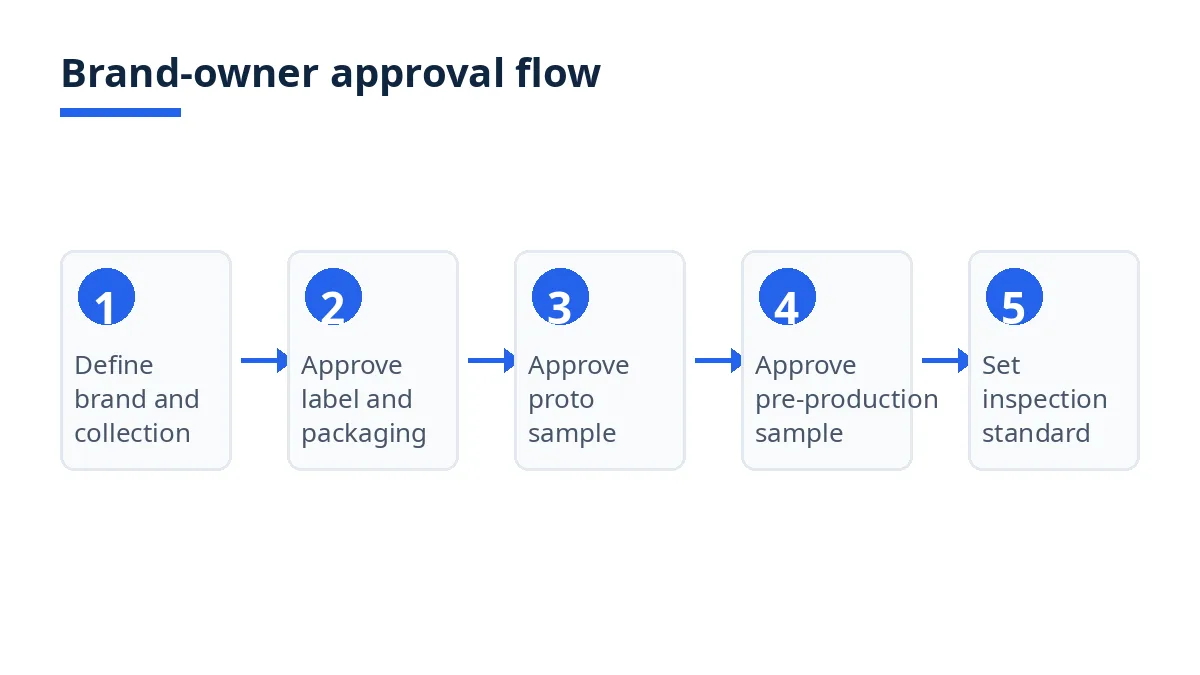
Sampling is where the brand owner earns control, because each sample is a decision point. A proto sample tests design and construction in a substitute or available fabric. A sales sample shows the design in the intended fabric and colour for range planning. A pre-production sample is made in the actual bulk fabric, colour, heading, labels and packaging, and it is the sample bulk must match. Approve each stage in writing, with corrections listed by item, or the next stage starts from an unclear base.
For each sample, record the design, colour, size, fabric, heading, lining, labels and packaging, then mark each item as approved, approved with corrections, or rejected, with a note for every correction. Photograph the sample hanging, not only flat, because length, heading drape and pair matching show only when the pair hangs. Keep the approved pre-production sample as the golden sample for bulk inspection, and agree where it is kept. Photo approval is useful for progress checks, but it does not replace a physical approval: colour, hand feel, lining weight and heading stiffness do not read reliably in a photograph.
Quality control for your own label
Quality control for your own label starts with defect classes you define. A critical defect makes the curtain unsafe or unsellable, such as a torn panel or a wrong fibre label. A major defect breaks the brand standard, such as a pair of unequal length, a heading that sags, or a colour that does not match the approved sample. A minor defect is a small flaw a customer may notice but that does not break use, such as a loose thread end. Write these classes for curtains specifically, and agree them before bulk production. An inspector without your defect classes inspects to a generic standard, and a generic standard is not your brand.
Sampling inspection gives that standard a method. ISO 2859-1 defines a system of acceptance sampling plans for inspection by attributes, indexed by acceptance quality limit (AQL) for lot-by-lot inspection.3 AQL is the maximum average percentage of defective items considered acceptable during random sampling, and it determines sample sizes and acceptance or rejection thresholds.3 Agree the inspection level and the AQL values for each defect class in the purchase order, and add hanging checks to the plan: pair length, heading drape, light control for blackout or lined pairs, and label and packaging checks on the packed carton. Decide in advance what happens on a fail: a failed lot may be sorted, repaired, re-inspected or rejected, with the re-inspection cost agreed in advance.
Costs, timelines and documents
What are the typical costs and timelines?
There are no typical costs or timelines a brand guide can state as fact, because each collection prices differently. Control the structure instead. Ask for costs split into brand lines and production lines: label and packaging tooling and print runs, sample rounds, bulk fabric and making, inspection, and freight under the agreed delivery term. Brand lines are often fixed costs, so a small first order carries a higher brand cost per pair than a repeat order that reuses the same tooling. Record which tooling you have paid for, so a repeat order is not charged for it again.
Ask for dates as separate gates, not as a single delivery week: artwork approval, label and packaging approval, proto sample, sales sample, pre-production approval, bulk production, inspection and shipment. For delivery terms, the Incoterms 2020 rules set out 11 rules with a clear allocation of cost, risk and obligations.4 State one Incoterm and named place for every quotation, so comparisons between partners compare the same delivery scope.
Example figures: a first collection of 4 designs in 3 colours, with 2 label types and 1 packaging format, carries fixed brand costs for tooling, sample rounds and packaging approval, while fabric and making vary with quantity.
Which documents are needed?
The brand documents are the collection specification, the label and packaging pack with version numbers, the sample approval forms, the golden sample record, the inspection plan with defect classes and AQL values, and the purchase order that ties them together. Keep one legal name for your business across every paper.
For export clearance in Bangladesh, goods may not be loaded unless an export declaration, the Bill of Export or Shipping Bill, is submitted to Customs and approved.5 Enclosed documents include the export contract or purchase order where there is no export letter of credit, the commercial invoice, the packing list, the EXP form certified by an authorized dealer, and a certificate of origin issued by the Export Promotion Bureau (EPB) or a Chamber of Commerce and Industry.5 In classification terms, heading 6303 covers curtains (including drapes) and interior blinds, curtain or bed valances, with subheadings that turn on construction and fibre.6 See the HS code for curtains guide for how the heading is structured.
Mistakes and red flags
What are the most common mistakes?
Briefing a product instead of a brand. A brief that lists fabric and size but not customer, room, price tier and packaging leaves the partner to guess the brand.
Approving a photograph instead of a pre-production sample. Colour, heading drape and lining weight do not read reliably on screen. A physical approval is the binding step.
Letting the label pack drift. Artwork without a version number, care wording copied from another range, or a packaging change approved by message all create a second, unofficial brand.
Treating inspection as a final hurdle. Inspection agreed at the end, with no defect classes and no fail procedure, becomes a dispute under time pressure.
Paying for tooling twice. Label tooling, print plates and packaging dies paid on the first order should be recorded and reused on repeats.
Confusing a profile or a badge with a brand guarantee. A badge is not a guarantee of capacity, quality or delivery. Sample approval and inspection stay with you.
Brand-owner checklist before the first bulk order
Before you confirm bulk production, every line should be answered in writing.
Brand position fixed: customer, room, light control, heading, price tier.
Collection fixed: core designs, colours, one size chart, seasonal designs marked.
Label and packaging pack complete, versioned, and approved as physical samples.
Fibre, care and origin wording checked for each destination market.2
Proto, sales and pre-production samples approved in writing, with corrections closed.
Golden sample kept and recorded, with hanging photographs.
Defect classes, inspection level and AQL values in the purchase order.3
Fail procedure agreed: sort, repair, re-inspect or reject, with re-inspection cost.
Paid tooling and print runs recorded for repeat orders.
Quotations compared on the same specification, label pack and Incoterm.4
Export set checked: invoice, packing list, EXP form, certificate of origin, Bill of Export.5
How Exportain helps
On Exportain, browse suppliers and post a request for quotation (RFQ) on the RFQ board with your brand brief, collection size, label and packaging pack summary, and delivery term, so partners quote against the same brand specification.
Read the badges for what they record. Exportain Verified means Exportain has checked identity, phone, email and business registration, and Export Verified means it has checked the Export Registration Certificate (ERC).7 Verification is a document review by staff, free, and never granted by membership plans.8 It is not a factory inspection,7 8 so sample approval and inspection stay with you as the brand owner. See how supplier verification works on Exportain.
FAQs
What should I know first about private label?
Private label means curtains made to your brand: your name, your collection, your packaging, your standard. A trademark distinguishes your goods from those of other enterprises.1 Decide the brand before you brief a partner, and keep brand assets under version control.
What are the typical costs and timelines?
There are no typical figures, because each collection prices differently. Control the structure: brand costs split from production costs, tooling recorded for repeats, and timelines set as approval gates. Compare quotations only on the same specification, label pack and Incoterm.4
Which documents are needed?
The brand documents are the collection specification, the versioned label and packaging pack, the sample approval forms, the golden sample record, the inspection plan and the purchase order. The export set is the Bill of Export, invoice, packing list, EXP form and certificate of origin.5
What are the most common mistakes?
The most common mistakes are briefing a product instead of a brand, approving a photograph instead of a physical sample, letting the label pack drift, leaving inspection until the end, paying for tooling twice, and reading a badge as a guarantee.7
Next steps on Exportain
Browse suppliers, then post your brand brief, collection size and label pack summary on the RFQ board so partners quote against the same brand specification. Before you confirm, read the curtains manufacturers in Bangladesh guide and the curtains quality control checklist for the partner checks and curtain inspection points behind this guide.
Sources
- Trademarks. World Intellectual Property Organization (accessed )
- Regulation (EU) No 1007/2011 on textile fibre names and related labelling and marking of the fibre composition of textile products. European Union, (accessed )
- ISO 2859-1:2026 - Sampling procedures for inspection by attributes — Part 1: Sampling schemes indexed by acceptance quality limit (AQL) for lot-by-lot inspection. ISO (accessed )
- Incoterms® 2020. International Chamber of Commerce (ICC) (accessed )
- Customs Clearance Procedures for Export. Bangladesh Customs, National Board of Revenue (accessed )
- HS, 2012 - Code 6303: Curtains (including drapes) and interior blinds; curtain or bed valances. United Nations Statistics Division (accessed )
- Trust & Safety Center. Exportain (accessed )
- Supplier verification: Earn trust badges buyers can see. Exportain (accessed )
About the author
Sourcing from Bangladesh?
Post a request for quotation and suppliers on Exportain can send you their quotes directly.
Post an RFQ


