

Organic Cotton T-Shirts Price in Bangladesh: FOB Cost Breakdown for Buyers
Organic cotton T-shirt prices in Bangladesh turn on certified fibre share, approved dyeing, shirt weight and the certificates that prove the claim. Read the FOB layers and compare quotes on the same grade and port.
Short answer
An organic cotton T-shirt price in Bangladesh has no single typical figure, because the FOB price carries a certification chain: the organic fibre share, the approved dyeing route, the shirt weight and cut, and the scope and transaction certificates that prove the claim. A product labelled organic must hold at least 95 percent certified organic fibre, while made with organic materials requires at least 70 percent. Compare only itemized FOB quotations for the same grade, weight and port.
On this page
Key takeaways
A product labelled organic must contain at least 95 percent certified organic fibre by weight, excluding accessories, while made with (x %) organic materials requires at least 70 percent.
The FOB price of an organic cotton T-shirt carries certification layers a conventional shirt does not: certified yarn, approved dyeing and finishing, and scope and transaction certificate handling.
Shirt weight and cut move the price through yarn consumption, so quotations at different weights or cuts are different offers even when the style drawing looks the same.
OEKO-TEX STANDARD 100 tests for harmful substances; it does not prove that cotton was grown organically, so keep substance testing and organic certification as separate answers.
Compare only itemized FOB quotations for the same label grade, fabric weight, cut, Incoterm and named port, with the certification lines kept visible.
A buyer comparing organic cotton T-shirt quotations from Bangladesh is not really comparing shirts. The shirts may look alike, yet the quotations can rest on different fiber shares, dye approvals, fabric weights, and certificate coverage. The unit price only makes sense once those four inputs are fixed.
Start with the label grade, since it sets the fiber the supplier must source. Under the Global Organic Textile Standard (GOTS), textiles made from at least 70 percent certified organic natural fibers fall within the standard, which sets requirements from harvesting through manufacturing up to labeling.1 Inside that range, two grades matter. A shirt described as made with a stated percentage of organic materials needs at least 70 percent certified organic fiber by weight, accessories excluded, while a shirt sold as organic needs at least 95 percent on the same basis.1 A quotation that says only organic, with no grade and no percentage, has not yet priced the fiber.
Knitted T-shirts sit under heading 6109, and cotton T-shirts under subheading 610910.2 The Bangladesh Knitwear Manufacturers and Exporters Association (BKMEA), founded in 1996, represents roughly 2,540 knitwear member factories.3 That tells a buyer where knitwear capacity sits, not whether a factory holds certificate scope for an organic shirt.
Why this matters for buyers and sellers
For a buyer, the commercial exposure sits in the label rather than in the garment. A well-sewn shirt dyed with an input the standard does not allow, or made from an untraceable fiber lot, may still be wearable while being unsellable under the organic label a retailer already printed. Fixing that after bulk production usually means relabeling, renegotiating, or losing the season slot. A lower total that drops a link in the chain is not a saving.
For a seller, the same chain limits what an enquiry can promise. A factory may sell a shirt as GOTS goods only when it is a certified entity whose scope certificate lists the relevant products and processes.1 Where dyeing or printing sits with a subcontractor, that operation must sit inside the certified chain too.
A third paper often enters the conversation and needs separating from the first two. OEKO-TEX STANDARD 100 labels textiles tested for harmful substances, with every thread, button, and accessory tested against a list of more than 1,000 harmful substances.4 That result speaks to chemical safety in the finished article, not to how the cotton was grown or whether a certified chain carried it. A quotation should show which paper supports which claim.
Step-by-step: how it works
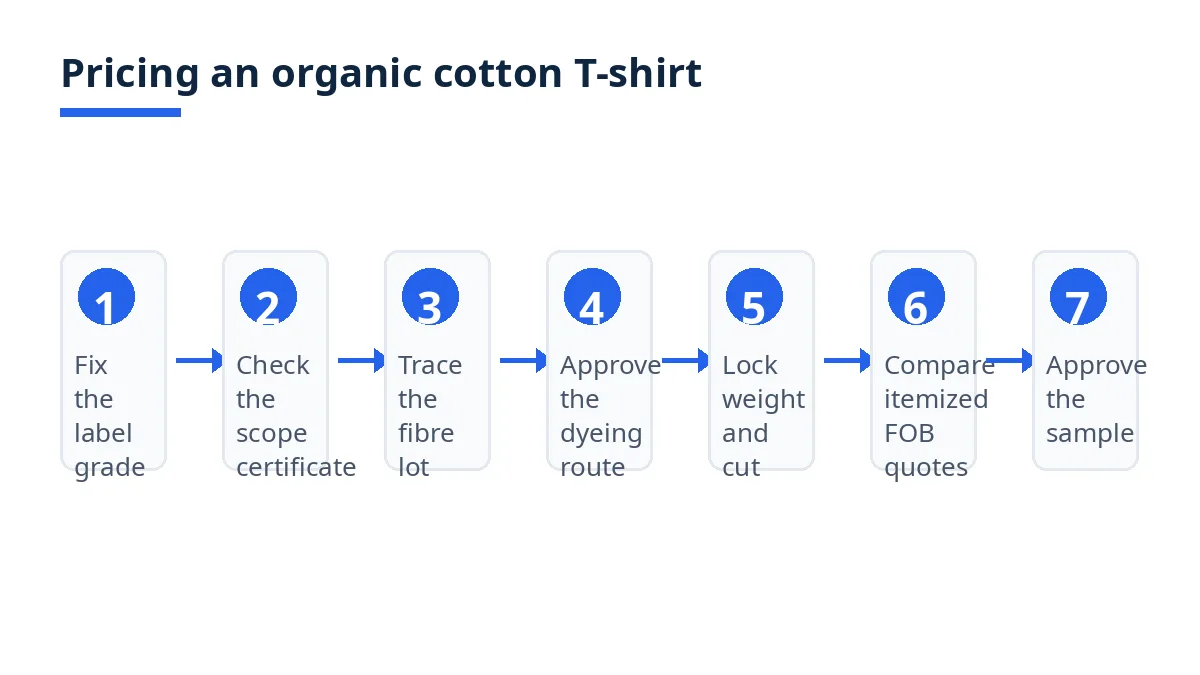
Name the grade and the standard in the first message. Write organic at 95 percent or more, or made with a stated percentage at 70 percent or more, name the standard you accept, and record fiber percentages by weight without accessories.1
Read the scope certificate before discussing price. Confirm it is current and lists T-shirts plus each process your order needs, with subcontracted dyeing or printing included where it applies.1 Coverage for yarn alone, or for garments without wet processing, leaves your order outside the claim.
Follow one fiber lot from yarn to shirt. Ask how the lot will be identified at spinning, knitting, dyeing, and packing, and which papers travel with it. GOTS labeling may be applied only by a certified entity with advance approval from its certifier.1
Settle the dyeing route before bulk. List the dyes and auxiliaries, confirm each one is approved under the standard, and agree the color standard and wash-fastness tests now. GOTS restricts chemical inputs across processing stages, so an unapproved input can disqualify a batch whose shade looks right.1
Pin down weight, construction, and cut in the tech pack. Give fabric weight in grams per square metre, knit construction, measurements by size, and the neck rib and stitching specification. Weight and cut drive yarn use per shirt, so they belong in the price enquiry.
Demand the FOB figure in separate layers. Ask for certified yarn, approved dyeing and finishing, cut and sew, certification and testing, and packing and export handling as distinct lines, on one delivery term and one named port. The Incoterms 2020 rules give a clear allocation of cost, risk, and obligations across 11 rules.5 Write the term as FOB with the named port and Incoterms 2020 on every quotation, and rank FOB figures only against FOB figures for that port.
Judge the pre-production sample on the claim as well as the shirt. Measure weight and sizes, check shade, stitching, and label wording, and confirm the transaction certificate for the bulk lot names your order. A sample cut from conventional cotton proves fit, not the organic chain.
Costs, timelines and documents
Where does the organic premium sit in an FOB quotation?
Weight and cut move the price before any premium is discussed, because they decide how much yarn and dye each shirt consumes. A 220 grams per square metre shirt takes more yarn and dye per piece than a 160 grams per square metre shirt in the same size, even where the style drawing looks unchanged. A boxy, dropped-shoulder shape consumes more fabric per shirt than a slim shape, and a broad size range wastes more fabric in the cutting marker than a narrow one. When a quotation looks low, check weight, cut, and size ratio first.
Dyeing is the second organic-specific layer, and it moves with shade depth, color count, and lot size. Deep shades take more dye, each added color creates its own dye lot, and small lots spread setup and approval work across fewer pieces. Ask which dyes and auxiliaries are approved, how many lots the order creates, and what each lot costs, so a later color change is priced as a dyeing change.
The fiber premium itself belongs on its own line, apart from dyeing and sewing. Certified organic yarn carries the farming, segregation, and lot-identity work that conventional yarn does not, and the premium rises with fiber share: a 95 percent shirt needs more certified fiber per piece than a 70 percent blend at the same weight. Where a supplier folds that premium into one fabric figure, a buyer cannot tell whether a cheaper total reflects a lower share, a lighter fabric, an unapproved dye route, or a lower yarn cost. Keep yarn, dyeing and finishing, and certification and testing as three visible lines through every revision.
Cost layer | Covers | Price lever |
|---|---|---|
Certified organic yarn | Organic fiber, spinning, lot identity | Fiber share, yarn count, lot size |
Approved dyeing and finishing | Approved dyes and auxiliaries, washing, drying | Shade depth, color count, weight, dye lot size |
Cut and sew | Cutting, sewing, neck rib, hemming | Weight, size range, stitching, print or embroidery |
Certification and testing | Certificate handling, substance testing, label release | Standard, test list, label grade, shipment count |
Packing and inland handling | Polybags, cartons, transport to port, loading | Packing, carton print, distance to port, timing |
Take an illustration, labeled as example figures throughout. For 2,400 shirts, suppose the layers come to 2.85 for certified organic yarn and knitting, 1.15 for approved dyeing and finishing, 0.95 for cut and sew, 0.55 for certification, testing, and packing, and 0.35 for inland transport and export handling, in US dollars per piece. Those example figures total 5.85 per piece (2.85 + 1.15 + 0.95 + 0.55 + 0.35 = 5.85), and 2,400 pieces give an order value of 14,040 dollars (2,400 x 5.85 = 14,040). These are example figures only, not a market price.
Apply that breakdown in reverse when a rival total lands lower. Trace the gap to a single layer: a lower fiber share, a lighter fabric, a simpler cut, fewer colors, a different dye route, or a different FOB port. Where every layer matches, ask in writing what was left out before ranking the totals.
On timing, treat sampling, yarn readiness, dyeing completion, production, and inspection as separate dates. Organic yarn availability and dye approval govern sampling, while dye lot scheduling, certificate paperwork, and line capacity govern bulk. A shipment whose transaction certificate is still pending at loading cannot ship as certified goods.
Which papers prove the claim and clear the shipment?
Put the tech pack, the layered quotation, and the purchase order on one footing, with fiber share, label grade, weight, dyeing route, FOB port, and Incoterm written into the purchase order. The certification papers sit alongside them: the scope certificate, the transaction certificate for your shipment, and the label release where your label carries the standard mark.1 Confirm the Bangladesh export declaration set with your forwarder before production, since goods may not be loaded until the export declaration is approved.6
Bangladesh-specific rules and tips
If you sell into the European Union, agree the label wording while the tech pack is still open. Regulation (EU) No 1007/2011 governs textile fiber names and the labeling and marking of fiber composition.7 The names and percentages on the label must match the composition ordered, and the organic grade must match the fiber share the standard allows.1 Agreement at tech-pack stage costs a line in a document; agreement after production costs a relabeling run.
Segregation deserves its own check, because organic and conventional cotton cannot be told apart once knitted. Ask how the factory stores organic yarn apart from conventional yarn, how dye lots are identified through wet processing, and how finished shirts are kept apart before packing. A vague answer should pause the order even where the price looks attractive.
Mistakes and red flags
Approving a dye route the standard does not allow. A shade can match while its dye or auxiliary sits outside the approved list, and the batch then fails the claim it was dyed to carry. Confirm every input against the standard before bulk.
Ordering on the word organic alone. Without a grade, a percentage, and a named standard, a shirt may hold 95 percent certified fiber, 70 percent, or none at all. State the grade and percentage in the enquiry, and check the sample label wording against that grade.1
Swapping a substance test for organic proof. A STANDARD 100 result covers harmful substances across every component of the article.4 It is not evidence of organic farming or of a certified chain.
Treating one number as enough to compare. A lone total conceals whether yarn, dyeing, or certificate handling moved. Insist the layers stay visible on the purchase order.
Ranking shirts that differ in fiber share or weight. A lower total on a 70 percent blend, a lighter fabric, or a simpler cut is a different offer from a 95 percent shirt at a heavier weight. Rank only replies built on the same tech pack, fiber share, weight, term, and port.5
Letting a badge answer a certification question. A marketplace badge never stands in for papers issued by the certifier. Only the scope and transaction certificates prove the organic claim.1
Approving bulk before the sample is signed. Weight, shade, stitching, and label wording are proven on the pre-production sample. Bulk approved without that signature leaves dye and label errors to be found after the run.
Checklist
Get a written answer to each item before you sign.
Enquiry states the label grade, percentage, and standard: organic at 95 percent or more, or made with a stated percentage at 70 percent or more.1
Scope certificate current, covering T-shirts, garment making, and subcontracted dyeing or printing where it applies, with the transaction certificate arrangement and label release recorded.1
Tech pack complete, with fiber percentages, fabric weight, knit construction, cut, measurements by size, and neck rib and stitching specification.
Dyeing route confirmed in writing, with each dye and auxiliary approved, the color standard agreed, and wash-fastness tests named.
Bulk starts only after a sample made from the actual certified lot passes measurement, wash, shade, and stitching checks and carries a written sign-off.
FOB quotation layered by certified yarn, dyeing, cut and sew, certification and testing, and packing and inland handling, with port and Incoterm named.5
No ranking happens until every reply shares the same fiber share, weight, cut, delivery term, and port.
Paperwork settled before production starts, covering the tech pack and purchase order, the scope and transaction certificates, and the export set of invoice, packing list, origin certificate, EXP form, and Bill of Export.6
Proforma invoice states how and when payment is made, in which currency, and for what total.
How Exportain helps
Browse suppliers and put your tech pack summary, fiber share, fabric weight, and FOB port on the RFQ board, asking each reply for its scope certificate, its layered FOB figure, and its transaction certificate arrangement. Treat any badge as a record of staff document checks, not as an inspection finding.8 The checks behind each badge are described on how supplier verification works on Exportain.
FAQs
What should I know first about organic cotton t-shirts?
Know the grade, the weight, and the cut before you ask for a price. A product labeled organic must contain at least 95 percent certified organic fiber by weight, accessories excluded, while a product labeled made with a stated percentage of organic materials must contain at least 70 percent.1 Cotton T-shirts fall under HS heading 6109, with subheading 610910 covering those of cotton.2 Grade, weight, and cut drive the yarn, dyeing, and certification layers.
What are the typical costs and timelines?
No single figure covers this product, because each factory prices your fiber share, weight, dyeing route, color count, certificate paperwork, and delivery term for your specification, and sets lead time around yarn availability, dye lot scheduling, and line capacity.5 Ask for the FOB layers as separate lines and the schedule as separate dates.
Which documents are needed?
The order papers are the tech pack, layered quotation, and purchase order, carrying fiber share, label grade, weight, dyeing route, and FOB port. The certification papers are the scope certificate and the transaction certificate for your shipment.1 Confirm the Bangladesh export declaration set with your forwarder before production.6
What are the most common mistakes?
The repeat errors are approving an unapproved dye route, ordering on the word organic alone, swapping a substance test for organic proof,4 ranking shirts that differ in fiber share or weight, and letting a badge answer a certification question. Only the certifier scope and transaction certificates prove the organic claim.1
Next steps on Exportain
Browse suppliers, then post your tech pack summary, fiber share, and FOB port on the RFQ board so replies state their certification layers. Before you confirm, read how to import organic cotton T-shirts from Bangladesh and the organic cotton T-shirts quality control checklist.
Sources
- Global Organic Textile Standard (GOTS) Version 6.0. Global Standard gGmbH, (accessed )
- Classification Detail — HS Code 6109. United Nations Statistics Division (accessed )
- BKMEA at a Glance. BKMEA (accessed )
- OEKO-TEX Standard 100. OEKO-TEX (accessed )
- Incoterms® 2020. International Chamber of Commerce (ICC) (accessed )
- Customs Clearance Procedures for Export. Bangladesh Customs, National Board of Revenue (accessed )
- Regulation (EU) No 1007/2011 on textile fibre names and related labelling and marking of the fibre composition of textile products. European Union, (accessed )
- Trust & Safety Center. Exportain (accessed )
About the author
Sourcing from Bangladesh?
Post a request for quotation and suppliers on Exportain can send you their quotes directly.
Post an RFQ


