Organic Cotton T-Shirts Lead Time From Bangladesh: Production and Shipping Timeline
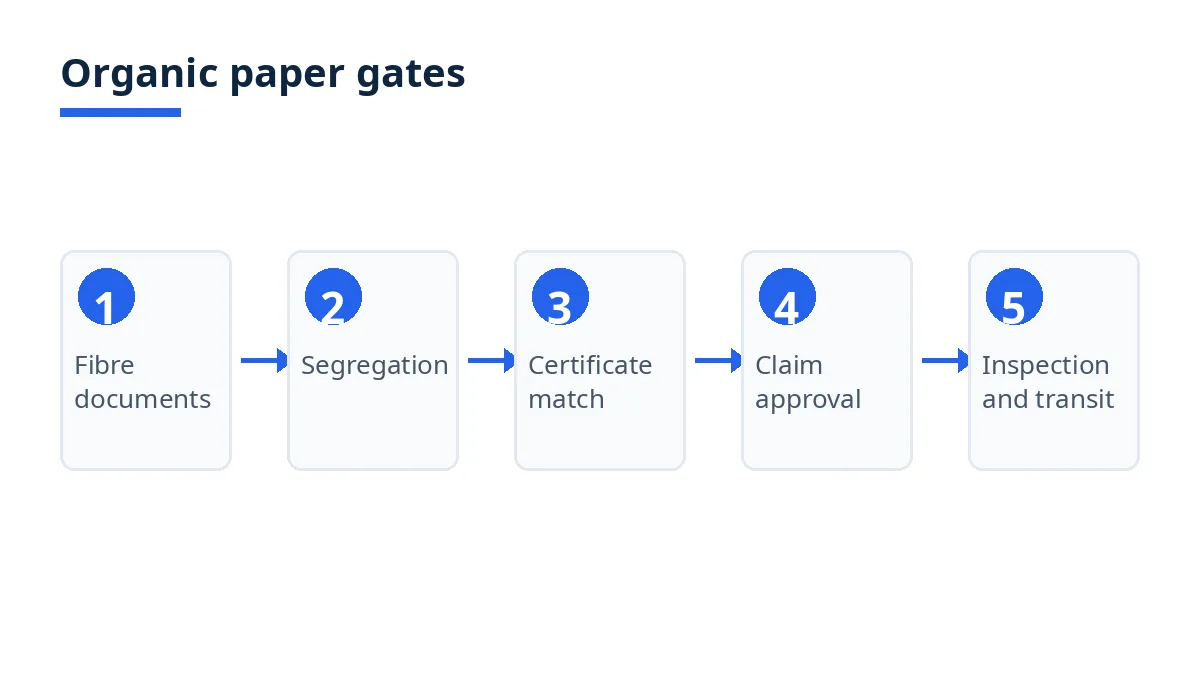
How to plan an organic cotton T-shirt lead time from Bangladesh through paper gates: fibre documents, segregation, certificate matching, and claim-wording approval before labelling, inspection, and transit.
Short answer
An organic cotton T-shirt lead time from Bangladesh is governed by paper gates as much as production: fibre-origin documentation, sampling with buyer-spec inputs, segregation through knitting and dyeing, certificate matching, and claim-wording approval, followed by inspection, export documents, and transit. No single figure fits every order. Ask for dated gates with named closing documents, a forwarder estimate, and written wording approval before printing.
On this page
Key takeaways
An organic cotton T-shirt order runs on two timelines: the shirts being made, and the papers that must support the wording printed about them, with labelling waiting until the last paper gate closes.
Gate the order in sequence: fibre-origin documentation, sampling with buyer-spec inputs, segregation through knitting and dyeing, certificate matching, and claim-wording approval before printing.
Match scope and transaction certificates on certified entity, product, quantity, and dates before any wording is approved; a scope certificate alone does not prove a specific shipment.
Keep dye and chemical inputs as buyer-spec items, with any substitution returning for approval, and keep the organic paper set separate from the export document set that gates loading.
Read every duration as a planning example only, replace it with the dated figures in the written quote and the dated forwarder estimate, and keep a buffer after wording approval and after inspection.
An organic cotton T-shirt order runs on two timelines at once: the shirts being made, and the papers that must support every word printed about them. When the second timeline lags, finished shirts can wait for a document, a corrected label, or a matched certificate, even though production itself is done. This guide treats the paper timeline as gates, each closing only with a named document or written approval, and labelling waits until the last paper gate closes.
Why this matters for buyers and sellers
For a buyer, the risk is a claim made too early. A hangtag, care label, or product page that describes the fibre before the covering documents have been matched creates a correction later, when reprinting is slower and more expensive than waiting. Sequencing wording after documents protects the launch date.
For a seller, the same gates protect the order: ask for the document set at the start, and state in writing what happens if a document does not match. A reply promising shirts on a date but saying nothing about fibre documents, segregation records, or claim-wording approval leaves the buyer guessing about the part of the order most likely to stall it.
Step-by-step: how it works
Read an organic cotton T-shirt order against seven gates, in this order. If a reply skips a gate, ask where that check sits and who closes it.
Gate 0: Fibre-origin documentation before wording is agreed
Gate 0 asks which verification scheme's documents will cover the order, and which certified entity and product they name. Under the Global Organic Textile Standard, known as GOTS, fibre entering the system must be certified organic under a production standard recognised by the IFOAM Family of Standards, and certification bodies must verify the scope and transaction certificates of all materials entering the chain.1 Traceability is reported back to the farm group, including region, state, and province of origin.1
Gate 1: Sampling with organic inputs as buyer-spec items
Sampling for an organic order asks one extra question beyond fit and hand feel: were the sample inputs the ones the buyer specified. Write the fibre, dye, and chemical inputs into the tech pack as buyer-spec items, and record which input lots the sample used, so bulk inputs can be compared with the sample. If a sample input changes before bulk, the change returns to Gate 1, with a new sample where it affects shade, hand feel, or the document set.
Gate 2: Segregation during knitting, dyeing, and cutting
Segregation is the physical side of the paper trail: organic lots kept apart from conventional cotton lots, labelled, and recorded at each step. Under the Organic Content Standard, known as OCS, storage must be segregated, lots easily identified, and procedures in place to prevent commingling or substitution.2 Ask how lots are stored and labelled at each handover, how a line is prepared between runs, and what record shows the lot entering dyeing is the lot that left knitting.
Gate 3: Dye and chemical inputs as buyer-spec items
Dye and chemical inputs are not a detail to settle after shade approval. GOTS sets environmental, chemical, traceability, and labelling requirements for applicable certified post-harvest stages.1 The input list is part of the specification, any substitution is a specification change, and a substitution after shade approval restarts shade approval and its document check. Ask for the input list in writing before bulk dyeing, and keep it with the sample record.
Gate 4: Certificate-document matching before labelling
Gate 4 is the matching check, and it is the gate most often rushed. A scope certificate shows what an operation is certified for; a transaction certificate documents a specific movement of material. Under OCS, transaction certificates are required to document each time the product changes ownership, and an organisation must hold a valid scope certificate at the time of production.2 OCS tracks the flow of raw materials from source to final product for materials from a farm certified to a recognised national organic standard.3 Under GOTS, certification bodies must conduct a plausibility check, including volume reconciliation, before issuing transaction certificates.1
Match four things before any wording is approved: the certified entity on each certificate, the product description, and the quantities and dates. If any differs, labelling waits while the mismatch is resolved. A scope certificate on its own does not close this gate.
Gate 5: Claim-wording approval before labelling
Only after Gate 4 closes does claim wording go for approval. Write the exact wording proposed for the care label, hangtag, and product page, and get it approved in writing before printing. GOTS labels may be used only in accordance with the applicable certification and labelling requirements.1 The wording must match what the matched documents support. Treat any later change as a return to Gate 5.
Gate 6: Inspection, packing, and export documents
Inspection checks the packed shipment against the approved sample and wording. The export set is prepared alongside packing. For export clearance from Bangladesh, that set commonly includes the contract or purchase order, commercial invoice, packing list, EXP form, certificate of origin, and bill of export through ASYCUDA World, with approval required before loading.4 The organic document set travels with the order file; it does not replace any export document, and no export document replaces it.
Gate 7: Transit and the delivery term
Transit starts when packed, inspected goods are handed to the carrier. Ask the forwarder for a dated estimate for the exact route and port pair, and what happens if the booked sailing is missed. The delivery term decides who arranges each leg and where risk passes. For containers handed over at a terminal in Bangladesh, FCA, CPT, or CIP often describe the handover more accurately than a sea-only term for direct on-board loading.5 Write the rule, named place, and edition in full, for example FCA Chattogram, Incoterms 2020, and name who books freight.
Costs, timelines and documents
How to read a supplier timeline
Ask for a table with five columns: gate, closing document or approval, start date, finish date, and what happens if that gate slips. Without the second column, the table never says what closes a gate. Without the fifth, it hides the cost of delay: a mismatch at Gate 4 can mean relabelling, while the same mismatch after printing can mean reprinting and repacking.
Use the table below only as a planning example. Every figure is an illustration, not a promise about any supplier, factory, or order. Replace every cell with the dated figures in the written quote and the dated forwarder estimate before planning a selling date.
Gate | Illustrative planning allowance | Confirm in writing before relying on it |
|---|---|---|
Gate 0: fibre-origin documentation | 1 to 2 weeks in the plan | Scheme, documents, entity and product named |
Gate 1: sampling with buyer-spec inputs | 2 to 3 weeks in the plan | Sample lots, comment turnaround, approval date |
Gate 2: segregation, knitting and dyeing | 3 to 5 weeks in the plan | Lot labelling, storage separation, line record |
Gate 3: dye and chemical input approval | Inside the dyeing allowance | Input list, substitution route, shade re-approval |
Gate 4: certificate-document matching | 1 week in the plan | Scope and transaction match on entity, product, quantity, dates |
Gate 5: claim-wording approval | 3 to 5 days in the plan | Exact label, hangtag, and page wording, approved in writing |
Gate 6: inspection, packing, export documents | 1 week in the plan, plus re-inspection | Inspection standard, correction window, export list |
Gate 7: transit and import clearance | Dated forwarder estimate only | Sailing, transhipment, port and clearance variables |
What moves the cost
Speed costs money, and paper rework costs money differently: relabelling after a Gate 4 mismatch, reprinting after a Gate 5 change, and repacking after a label correction.
For illustration only, a quote might show USD 400 for a re-dye lot, USD 350 for a re-inspection visit, or USD 1,200 for an air-freight upgrade. None of these figures is a market price.
Changes cost time as well as money. A fibre input change after Gate 0 restarts the document check, a dye input change after shade approval restarts Gate 3, and a wording change after printing restarts Gate 5 and can restart packing. Compare quotes on the same basis, priced to the same delivery term.
Documents that gate the timeline
Keep two sets apart. The organic paper set gates wording: the scope certificate, the transaction certificates, the input list, the segregation and lot records, and the approved claim wording. The export set gates loading and clearance: the contract or purchase order, commercial invoice, packing list, EXP form, certificate of origin, and bill of export, approved through ASYCUDA World before loading.4 Prepare both sets during production, and ask the forwarder to check the draft invoice and packing list against the inspection report before cartons are sealed.
Bangladesh-specific rules and tips
Bangladesh has a deep knitwear base, with mills, dye houses, print shops, and sewing factories in the same industrial areas. That depth helps production, but it does not shorten the paper timeline, because each handover is another point where a lot must be labelled and a document must match. Ask before sampling whether the fibre lot is already covered by the documents Gate 0 requires. It is cheaper to learn that before sampling than after dyeing.
Confirm three things in every order: the input list and segregation record route before approving the bulk sample, because a sample from one lot does not prove the bulk lot carries the same documents; who handles export clearance and which C and F agent is used, because the bill of export and EXP form must be approved before loading, and a late document is a missed sailing even when goods are ready;4 and the port and handover point in the delivery term, because containers are commonly handed to the carrier at a yard, depot, or terminal before loading.5
Mistakes and red flags
The most common mistake is printing claim wording before Gate 4 closes. A second is treating a scope certificate as proof for a shipment, when it is the matched transaction certificate that documents that shipment's movement. A third is letting lots go unlabelled between operations, so that by cutting, no record shows which lot entered which bundle. A fourth is approving a dye or chemical substitution without returning to the input list.
Red flags deserve a direct question. A timeline with no paper gates leaves the part of the order most likely to stall it unmanaged. A certificate set naming different entities, products, or quantities across its documents is a Gate 4 failure until resolved. A reply that cannot describe how lots are separated and labelled between knitting, dyeing, and cutting has no segregation record to check. A timeline giving transit as a single fixed number of days, with no route or forwarder estimate, is a guess, not a plan.
Checklist
Use this checklist before confirming an order, and keep the answers with the order documents.
Scheme and documents agreed: which scheme's certificates the buyer will check, and what each gate requires
Fibre-origin record: certified entity and product named, farm-group traceability recorded
Sample input record: fibre, dye, and chemical inputs as buyer-spec items, sample lots recorded
Segregation plan: lot labelling, storage separation, line preparation, record at each handover
Input list approved: dye and chemical inputs in writing before bulk dyeing, substitution route agreed
Certificate match checked: scope and transaction certificates matched on entity, product, quantity, dates
Claim wording approved: exact label, hangtag, and product page wording in writing before printing
Inspection agreed: packed-goods check, correction window, re-inspection route before loading
Export documents prepared during production: draft invoice and packing list checked against the inspection report, C and F agent named
Delivery term written in full: rule, named place, edition, freight responsibility named, dated forwarder estimate
Selling date protected: buffers after Gate 5 and after inspection, holidays and peak periods in the timetable
How Exportain helps
Exportain helps buyers put the paper gates into the requirement itself. A buyer can post a requirement listing the scheme documents to be checked, the buyer-spec input list, and the claim-wording approval point, and compare replies on the same gate table rather than on a single date.
FAQs
What should I know first about organic cotton t-shirts?
Start with the two timelines: the shirts being made, and the papers that must support the wording printed about them. The paper timeline runs through fibre-origin documentation, segregation records, certificate matching, and claim-wording approval, and labelling waits until the last gate closes.
What are the typical costs and timelines?
There is no single figure fitting every organic cotton T-shirt order, so treat any single number with caution and ask for the order-specific version. Costs move with inputs, decoration, inspection, freight, the delivery term, and rework at the paper gates, and the timetable moves with document arrival, lot matching, sample revisions, and the forwarder's dated route estimate. Use the example figures here only to read a quote, and replace them with the written quote's figures before planning a selling date.
Which documents are needed?
Two sets are needed. The organic paper set gates wording: the scope certificate, the transaction certificates, the input list, the segregation and lot records, and the approved claim wording. The export set gates loading and clearance from Bangladesh: the contract or purchase order, commercial invoice, packing list, EXP form, certificate of origin, and bill of export, approved through ASYCUDA World before loading.4 Keep both sets consistent with the inspection report.
What are the most common mistakes?
The most common mistakes are printing wording before certificate matching closes, treating a scope certificate alone as proof for a shipment, letting lots go unlabelled between operations, and approving a dye or chemical substitution without returning to the input list. Each removes the point where a problem could be caught cheaply: Gate 0 catches a document gap, Gate 2 catches a lot mix, Gate 4 catches a certificate mismatch, and Gate 5 catches a wording error before printing. Put a dated check at each gate, and keep a buffer after wording approval and after inspection.
Next steps on Exportain
Write the scheme documents, the buyer-spec input list, and the claim-wording approval point into one requirement, then ask each supplier for the gate table in this guide.
Post a free RFQ on Exportain at https://exportain.com/rfqs with that requirement, browse suppliers at https://exportain.com/suppliers, and confirm the delivery term in the Incoterms guide at https://exportain.com/blog/incoterms-for-shipments-from-bangladesh before signing.
Sources
- Integrity measures. Global Standards (accessed )
- Organic Content Standard Questions and Answers. Textile Exchange (accessed )
- OCS - Certifications - Textile Industry. Control Union (accessed )
- Custom Clearance in Bangladesh: Port Procedures and C and F Agent Guide. Bizmend (accessed )
- Incoterms for Shipments From Bangladesh. Exportain (accessed )
- Incoterms
- export documents
- quality control
- buyer guide
- Bangladesh sourcing
- bangladesh garments
- Organic cotton
About the author
Sourcing from Bangladesh?
Post a request for quotation and suppliers on Exportain can send you their quotes directly.
Post an RFQ